Microcement Bathrooms & Wet Rooms Cost CA: What to Expect in 2026
By Gilad Segev · May 25, 2026 · Last updated May 25, 2026 · Cost Guide
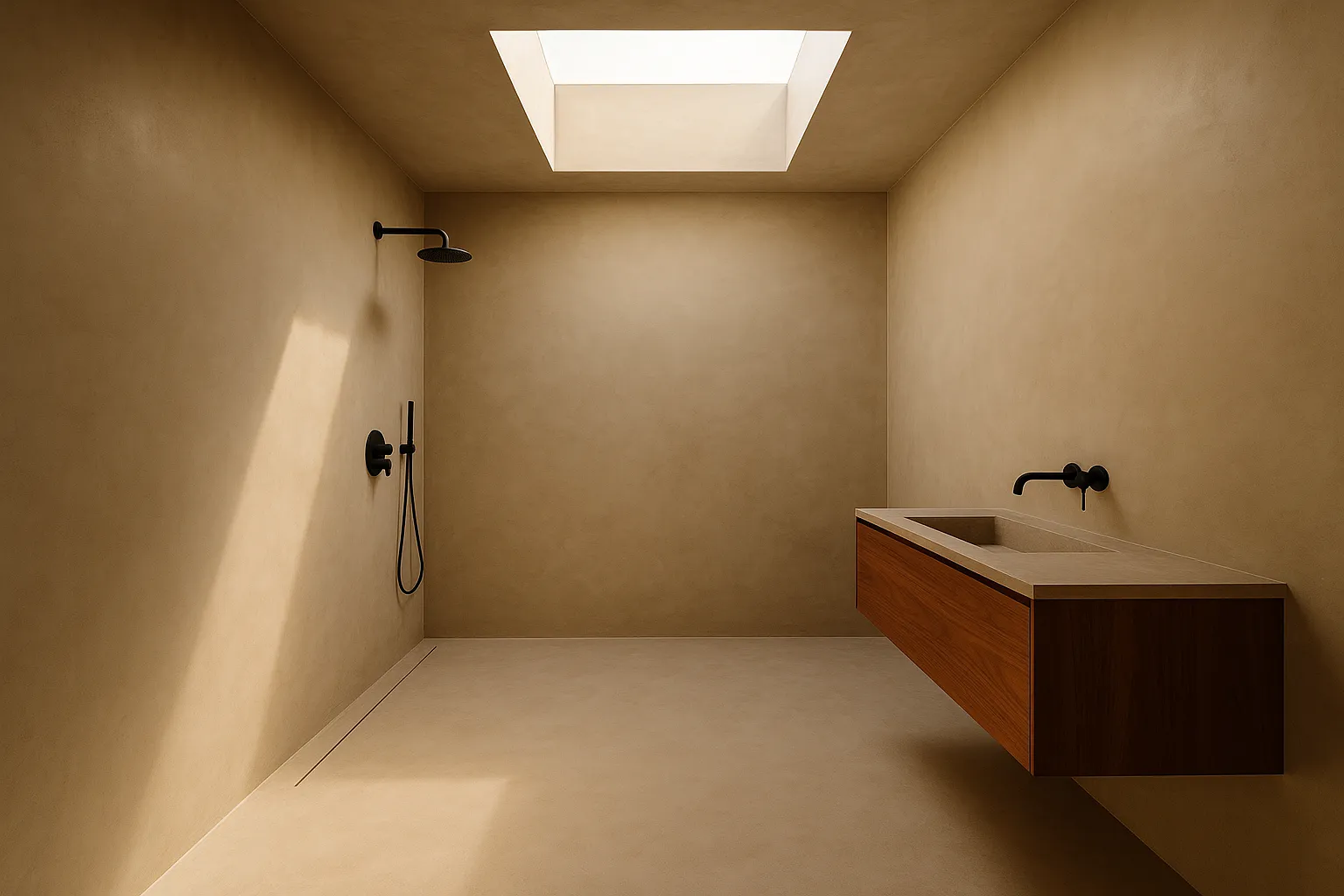
Most homeowners in [Los Angeles](/areas/los-angeles) are surprised to learn that [microcement bathrooms & wet rooms](/services/microcement-bathrooms) cost CA projects typically run between **$8,500 and $28,000** — a range wide enough to fund a modest vacation or a full kitchen overhaul. That gap isn't random. It reflects the difference between a small guest bath with basic finishes and a seamless, floor-to-ceiling wet room in a [Beverly Hills](/areas/beverly-hills) primary suite. Understanding where your project lands — and why — is what this guide is for.
After completing hundreds of microcement installs across Los Angeles, [Santa Monica](/areas/santa-monica), [Pasadena](/areas/pasadena), and [Glendale](/areas/glendale), the team at Cemora has seen every variable that moves the needle on price. Labor rates, substrate condition, surface area, sealer selection, and the number of color layers all compound quickly. This isn't a product you buy off a shelf — it's a multi-day, multi-coat, highly skilled application process. The cost reflects that.
---
## What Is Microcement? A Definition Worth Knowing
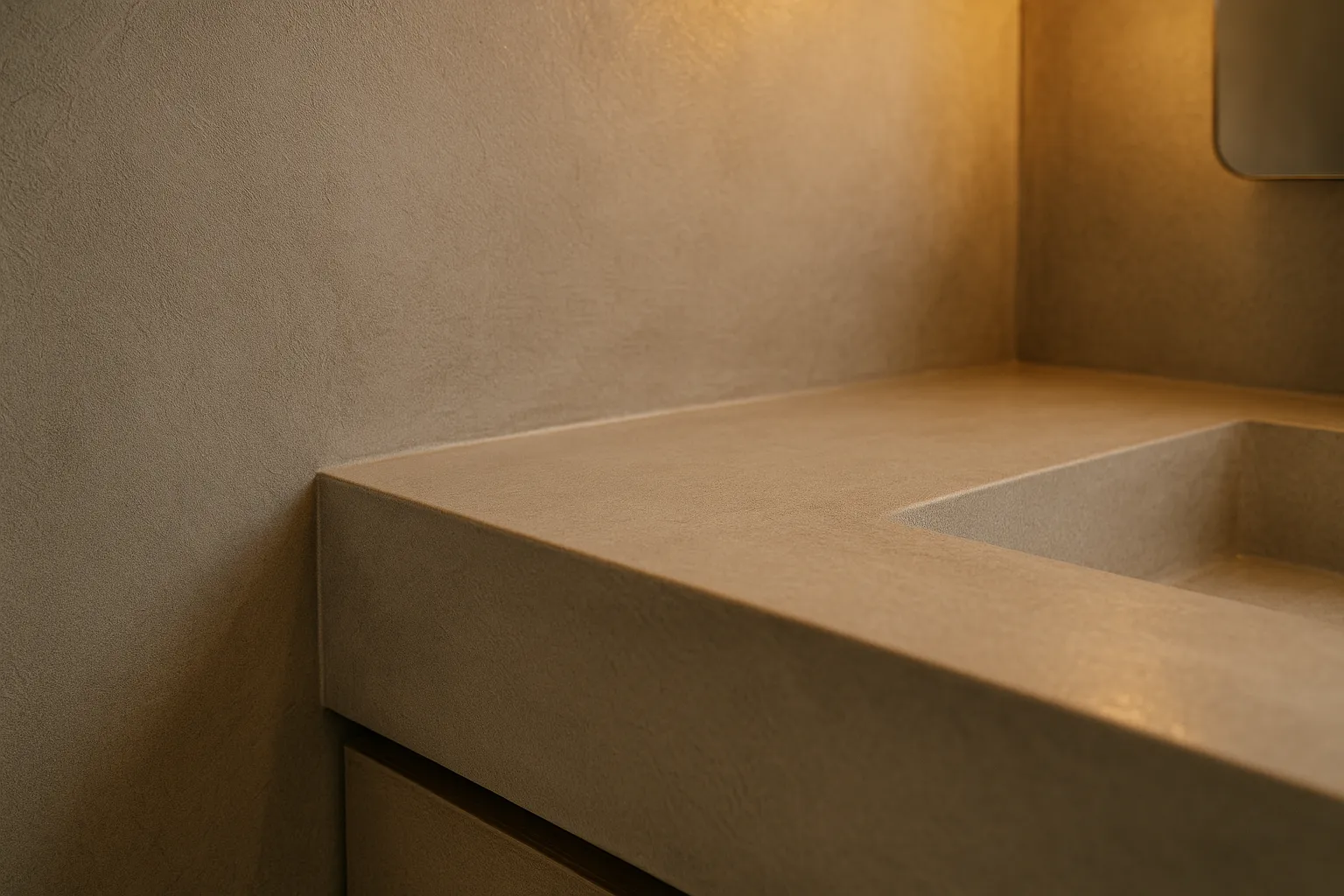
What is microcement? Microcement is a polymer-modified cementitious coating, typically 2–3mm thick, applied directly over existing substrates like tile, concrete, or drywall. It cures into a seamless, waterproof mineral surface that can cover floors, walls, ceilings, and shower enclosures in a single continuous finish — no grout lines, no joints, no transitions.
Unlike traditional tile, microcement bonds directly to the substrate and moves with it slightly, reducing the risk of cracking at grout joints. The finished surface is sealed with polyurethane or epoxy topcoats, making it water-resistant to fully waterproof depending on the system used.
What is a wet room? A wet room is a fully waterproofed bathroom where the shower area is open to the rest of the floor — no shower tray, no glass enclosure curb, no tile threshold. The entire floor slopes gently toward a linear drain. Microcement is one of the only finish materials that makes a true wet room achievable without visible seams, making it the go-to choice for high-end residential and hospitality projects across Southern California.

---
## [How Much Does](/estimate) Microcement Bathrooms & Wet Rooms Cost CA in 2026?
Based on Cemora's project data across 200+ installations in Los Angeles County, here are the realistic 2026 cost ranges:
| Project Type | Surface Area | Estimated Cost (2026) |
|---|---|---|
| Small guest bath (walls + floor) | 80–120 sq ft | $8,500–$13,000 |
| Standard full bath (shower + floor) | 120–180 sq ft | $13,000–$18,500 |
| Primary bath with wet room | 180–260 sq ft | $18,500–$26,000 |
| Large wet room / spa bath | 260–400 sq ft | $26,000–$38,000+ |
| Shower enclosure only | 40–80 sq ft | $4,800–$8,500 |
These figures include material, labor, surface preparation, waterproofing membrane, and two coats of topcoat sealer. They do not include demolition of existing tile, plumbing modifications, or glass enclosures.
**Labor alone** accounts for roughly **55–65% of the total project cost** in the Los Angeles market, based on 2026 BLS wage data for skilled finish trades in California. Microcement application requires a trained applicator — this isn't a job for a general handyman or a tile setter who watched a YouTube tutorial.
---
## What Factors Drive the Cost of Microcement Bathrooms in California?
### Substrate Condition
The biggest hidden cost driver is what's underneath. If your existing tile is loose, the wall board is water-damaged, or the floor has significant lippage, that has to be addressed before a single coat of microcement goes on. **Substrate repair and leveling can add $800–$3,500** to a project depending on severity.
In older homes in Pasadena or Glendale — many built in the 1950s and 60s — we routinely find shower pans with failed waterproofing membranes underneath ceramic tile. Fixing that properly before microcement application isn't optional. It's the difference between a 10-year surface and a 2-year headache.
### Surface Area and Complexity
Microcement is priced per square foot, but complexity multiplies cost fast. A rectangular shower with flat walls is straightforward. A curved niche, a built-in bench, a sloped ceiling, or a freestanding tub surround each add time and material waste. **Expect a 15–25% complexity premium** on bathrooms with significant architectural features.
### Sealer and Topcoat Selection
What is a microcement topcoat? The topcoat is the protective layer applied over the pigmented microcement base — it determines the surface's water resistance, sheen level, and long-term durability. Options range from matte water-based polyurethane to high-gloss solvent-based epoxy, and the price difference is real.
- **Water-based matte sealer:** $3–$5 per sq ft for materials
- **Solvent-based satin/gloss polyurethane:** $5–$8 per sq ft
- **Two-component epoxy topcoat (wet room grade):** $9–$14 per sq ft
For a true wet room where the shower floor sees daily water exposure, the two-component epoxy system is not optional — it's the only system that holds up long-term without resealing every 12–18 months.
### Color and Texture Layers
A standard microcement system involves two base coats and one or two finish coats. Custom color matching, multi-tone effects (like a warm aggregate visible in the surface), or textured finishes that mimic travertine or raw concrete add material cost and — more importantly — labor time. **Custom decorative finishes add $2–$6 per sq ft** over standard single-color applications.

---
## Real-World Project Examples: What Homeowners in LA Actually Paid
These are real project types from Cemora's recent work across Los Angeles County (costs reflect 2026 pricing).
**Example 1 — Silver Lake Guest Bath, $11,200**
A 95 sq ft guest bathroom with existing tile in good condition. The homeowner wanted a floor-to-ceiling microcement finish in a warm sand tone. No demolition needed — microcement applied directly over the existing tile. Two coats of matte polyurethane sealer. Project completed in 4 days. Total: $11,200 including all materials, labor, and sealer.
**Example 2 — Santa Monica Primary Wet Room, $24,800**
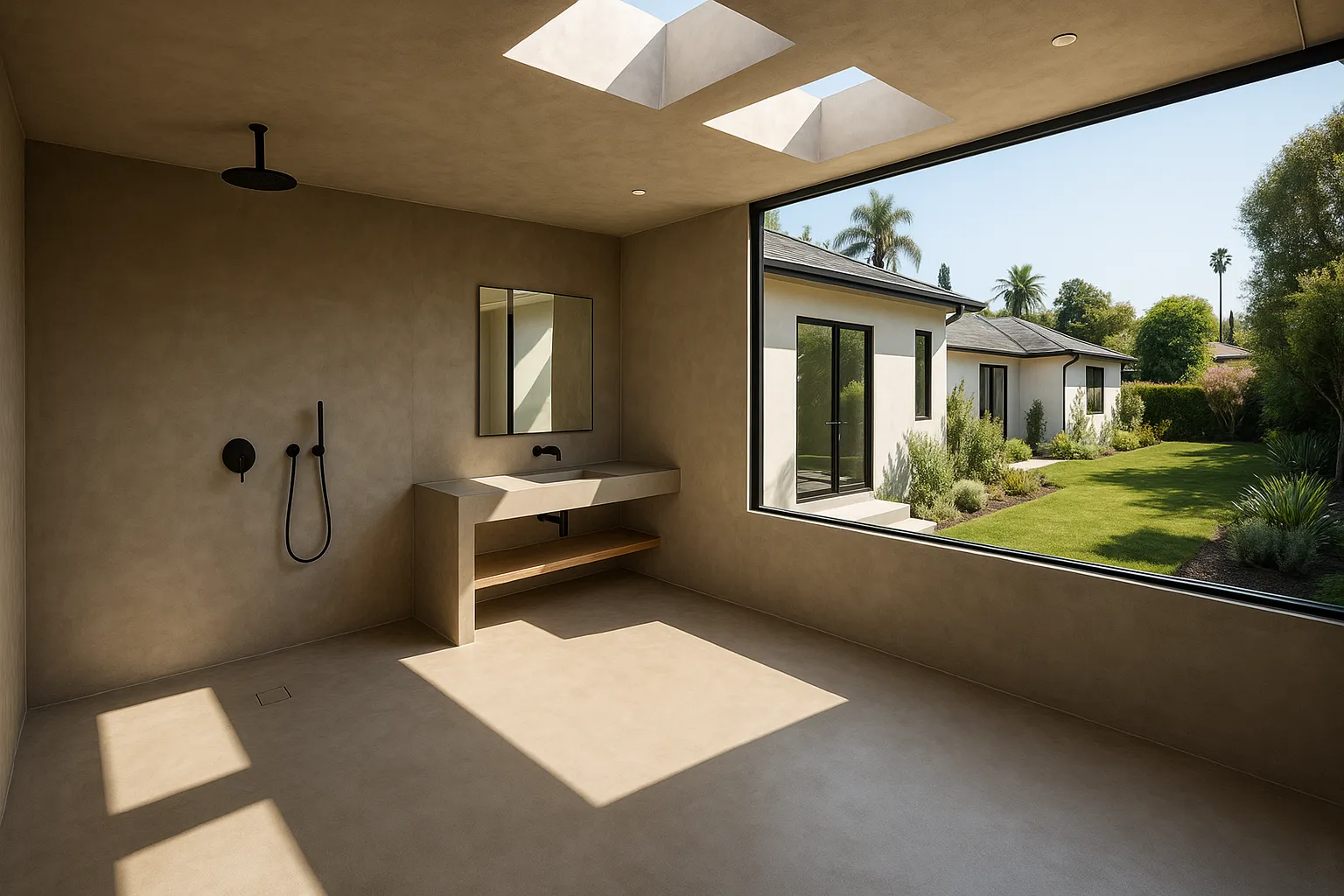
A 210 sq ft primary bathroom converted to a full open wet room. Existing shower pan removed, new waterproofing membrane installed, linear drain added by the plumber (separate cost). Microcement applied to floor and all walls in a cool grey aggregate finish with gloss epoxy topcoat rated for continuous wet exposure. Project took 7 working days. Total microcement scope: $24,800.
**Example 3 — Beverly Hills Spa Bathroom, $36,500**
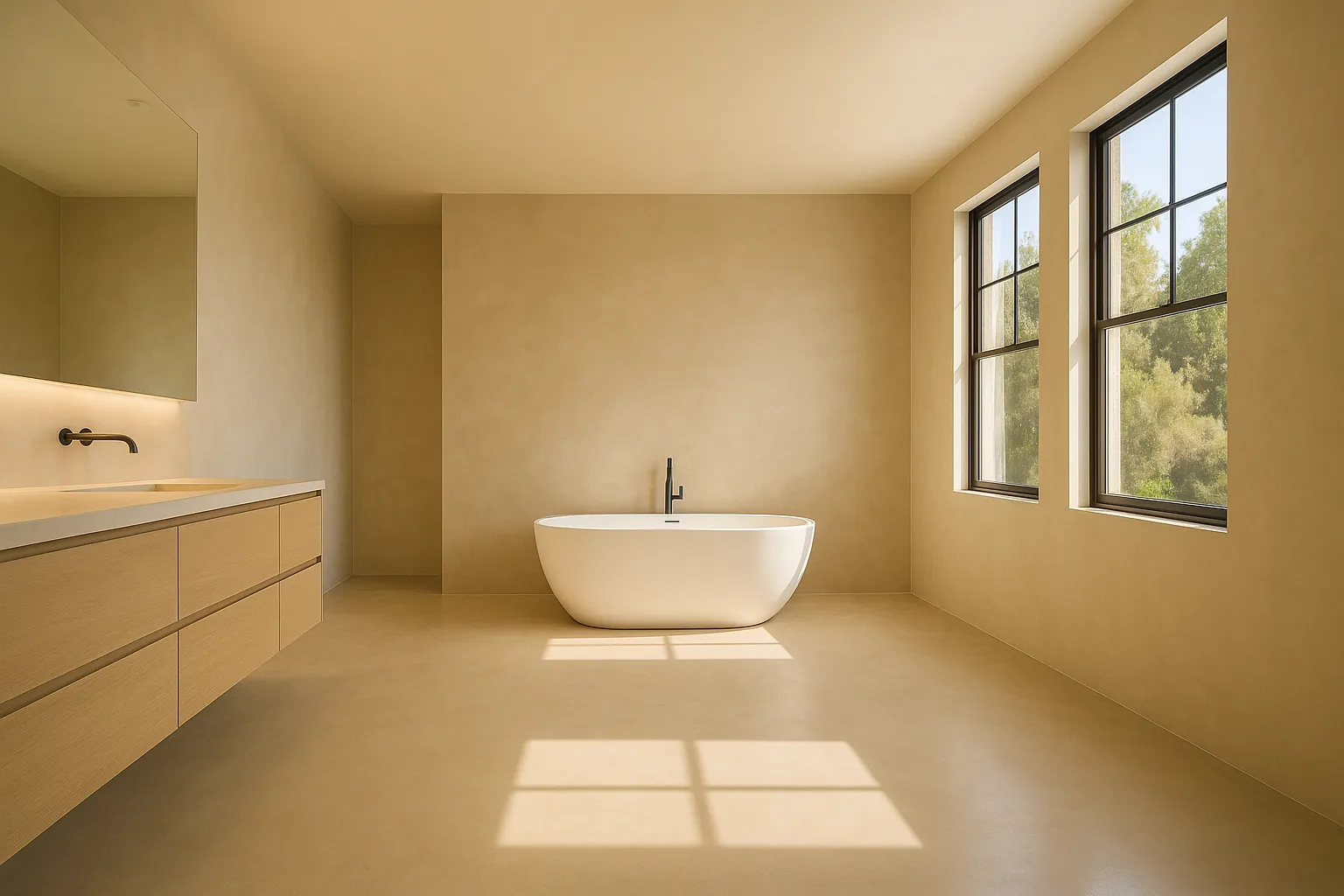
A 340 sq ft spa-style bathroom with a freestanding soaking tub, walk-in wet room, double vanity wall, and a steam shower. Custom warm taupe finish with visible mineral aggregate. Three-coat application system, two-component epoxy topcoat throughout, built-in niche finishing, and a teak bench surround. One of the more complex residential installs we've done in terms of transitions and detail work. Total: $36,500 for the microcement scope only.
---
## How Does Microcement Compare to Other Bathroom Finish Options?
Homeowners researching microcement bathrooms & wet rooms cost CA often want to know how it stacks up against tile, stone, and other alternatives. Here's an honest comparison based on 2026 Southern California market pricing:
| Finish Material | Installed Cost (per sq ft) | Grout Lines | Waterproof | Reseal Required |
|---|---|---|---|---|
| Ceramic tile | $12–$22 | Yes | With grout sealer | Every 1–2 years |
| Porcelain large-format tile | $18–$35 | Minimal | With grout sealer | Every 2–3 years |
| Natural stone (marble/travertine) | $28–$55 | Yes | With sealer | Every 1–2 years |
| Microcement (standard bath) | $85–$130 | None | With topcoat | Every 3–5 years |
| Microcement (wet room grade) | $110–$155 | None | Epoxy topcoat | Every 5–8 years |
Microcement costs more per square foot than tile — that's just the reality. What you're paying for is the seamless finish, the elimination of grout joints (which are the primary failure point in wet areas), and the design flexibility that tile simply can't match. For a primary bath or a showpiece wet room, most homeowners in Los Angeles find the premium worthwhile.
"We've installed microcement in bathrooms that previously had three separate tile sets, two grout colors, and a shower pan that was a completely different material," says Cemora founder and lead applicator. "When you see the same continuous surface flow from the floor up the wall and into the shower, you understand immediately why people choose this over tile."
---
## What Is the Timeline for a Microcement Bathroom Installation?
Timeline is one of the most misunderstood aspects of microcement projects. People assume it's like painting — a day or two and done. It's not.
### Typical Installation Schedule
Here's the step-by-step process for a standard microcement bathroom installation:
1. **Day 1 — Surface preparation:** Clean, prime, and repair substrate. Apply mesh reinforcement tape at joints and corners.
2. **Day 2 — First base coat:** Apply the first microcement layer (approximately 1–1.5mm). Allow to cure overnight.
3. **Day 3 — Second base coat + sanding:** Apply second base coat, sand lightly when cured to remove texture variation.
4. **Day 4 — Finish coat:** Apply the pigmented finish coat. This is the color layer — it requires even, consistent application.
5. **Day 5 — First sealer coat:** Apply first coat of topcoat sealer. Allow to cure fully (minimum 8–12 hours).
6. **Day 6 — Second sealer coat + final inspection:** Apply second sealer coat. Inspect all surfaces, touch up edges and transitions.
7. **Day 7 (if wet room grade epoxy):** Apply two-component epoxy topcoat. Cure time: 24–48 hours before any water exposure.
For a standard bathroom, **expect 5–6 working days on-site**. For a large wet room with complex features, **7–10 working days** is more realistic. Add 1–2 days if substrate repairs are needed.
**Full cure time before normal use:** 7 days for standard polyurethane systems. 72 hours minimum for epoxy systems before water contact, with full hardness achieved at 7 days.
---
## How Does Microcement Affect Resale Value in the Los Angeles Market?
This question comes up in almost every consultation. The honest answer: **microcement bathrooms consistently perform well in the LA resale market**, particularly in the $1.5M+ home segment where buyers expect elevated finishes.
Based on 2025 Houzz State of the Industry data, **bathroom remodels in California returned an average of 62–71% of project cost** at resale. Microcement bathrooms, based on Cemora's informal tracking of client resales, tend to perform at the higher end of that range — primarily because the seamless aesthetic photographs exceptionally well and appeals to the design-forward buyer demographic that dominates the Beverly Hills, Santa Monica, and Silver Lake markets.
A $24,000 microcement wet room in a $2.2M Santa Monica home isn't a cost center — it's a differentiator that helps the listing stand out in a competitive market. Real estate agents in West LA have told our clients directly that the microcement bathroom was the feature that drove the most buyer comments during open houses.
For homeowners in Glendale or Pasadena in the $900K–$1.4M range, the ROI calculation is tighter. A **$12,000–$16,000 microcement bath remodel** in that price range typically returns **$8,000–$11,000 at resale** — a positive return, but the primary value is often personal enjoyment during ownership rather than pure financial gain.

---
## Why Do Microcement Bathrooms & Wet Rooms Cost More in California?
California's cost premium over national averages is real and well-documented. Based on 2026 CSLB licensing data and BLS regional wage surveys, **skilled finish trade labor in Los Angeles runs 35–45% above the national median**. That alone explains a significant portion of the gap between what you'd pay in Phoenix versus what you pay in Pasadena.
Additional California-specific cost factors include:
- **Permit requirements:** Los Angeles building code requires permits for wet room conversions that involve waterproofing membrane installation or drain relocation. Permit costs range from **$350–$900** depending on scope and municipality.
- **Material transport and import costs:** Premium European microcement systems (Topciment, Deco-Coat, Microctopping) are imported — California's port handling and logistics costs add **5–8%** over inland states.
- **Insurance and licensing overhead:** California contractors carry higher workers' comp and liability premiums than most states. A properly licensed and insured microcement applicator in LA has overhead costs that a cash-only operator doesn't — and that difference shows up in the quote.
If you're comparing quotes and one is dramatically lower than others, ask about licensing, insurance, and which specific microcement system they're using. A $6,500 quote for a bathroom that should cost $13,000 is almost always a sign of unlicensed labor, an inferior product, or both.
Explore [Microcement Bathrooms & Wet Rooms](/services/microcement-bathrooms?utm_source=blog&utm_medium=organic&utm_campaign=microcement-bathrooms-wet-rooms-cost-ca) to see the systems and finishes Cemora uses on every project.
---
## How to Get an Accurate Quote for Your Microcement Bathroom
Getting a reliable quote for microcement bathrooms & wet rooms cost CA requires more than a phone call. Here's what a legitimate estimating process looks like:
### What a Good Estimator Will Ask
- Current substrate type (tile, concrete, drywall)
- Condition of existing waterproofing
- Total surface area (walls + floor + ceiling if applicable)
- Desired finish: matte, satin, gloss
- Color direction: light, dark, warm, cool, custom
- Wet room conversion or standard shower enclosure
- Timeline and access constraints
### What You Should Ask the Contractor
- Which specific microcement system do you use?
- How many coats are included?
- What topcoat system do you use in wet areas?
- Is the waterproofing membrane included in your quote?
- What's your cure time before water use?
- Do you carry CSLB license and general liability insurance?
Cemora provides on-site estimates for all projects in Los Angeles, Beverly Hills, Santa Monica, Pasadena, and Glendale. [Book a consultation](/book?utm_source=blog&utm_medium=organic&utm_campaign=microcement-bathrooms-wet-rooms-cost-ca) to get a detailed, itemized quote for your specific space.
You can also explore related applications: [Microcement Floors & Walls](/services/microcement-floors-walls?utm_source=blog&utm_medium=organic&utm_campaign=microcement-bathrooms-wet-rooms-cost-ca), [Microcement Kitchens & Countertops](/services/microcement-kitchens-countertops?utm_source=blog&utm_medium=organic&utm_campaign=microcement-bathrooms-wet-rooms-cost-ca), and [Commercial & Hospitality Microcement](/services/microcement-[commercial](/services/microcement-commercial-hospitality)-hospitality?utm_source=blog&utm_medium=organic&utm_campaign=microcement-bathrooms-wet-rooms-cost-ca) for projects beyond the bathroom.
Want a ballpark before the site visit? [Get a free estimate](/estimate?utm_source=blog&utm_medium=organic&utm_campaign=microcement-bathrooms-wet-rooms-cost-ca) online or [contact us](/contact?utm_source=blog&utm_medium=organic&utm_campaign=microcement-bathrooms-wet-rooms-cost-ca) with photos of your space.
---
## Frequently Asked Questions
### How much does a microcement bathroom cost in California in 2026?
Based on Cemora's project data across Los Angeles County, microcement bathrooms & wet rooms cost CA projects range from **$8,500 for a small guest bath to $38,000+ for a large spa wet room** in 2026. The most common full bathroom project — around 150–180 sq ft including shower, floor, and walls — typically lands between **$14,000 and $20,000** installed. That includes materials, labor, waterproofing, and two coats of topcoat sealer.
### How long does a microcement bathroom installation take?
A standard bathroom installation takes **5–7 working days on-site**, with an additional 7 days of cure time before normal use. Wet room conversions with epoxy topcoat systems require a minimum 72 hours before any water contact, with full hardness at 7 days. Larger or more complex projects — freestanding tubs, steam showers, significant substrate repairs — can run 8–10 working days.
### Is microcement waterproof enough for a shower or wet room?
Microcement with a properly applied two-component epoxy topcoat is fully waterproof and appropriate for continuous wet exposure in showers and wet rooms. The key word is "properly applied" — the topcoat system, number of coats, and application method matter enormously. A water-based matte sealer alone is not sufficient for a wet room; it's rated for splash-zone use only. Always confirm which topcoat system your applicator is using before signing a contract.
### Can microcement be applied over existing tile?
Yes — in most cases, microcement can be applied directly over existing ceramic or porcelain tile, which eliminates demolition costs and dramatically reduces project disruption. The tile must be structurally sound, firmly adhered, and free of loose or hollow spots. Any failed tiles must be re-adhered or removed and patched before application. This is one of microcement's biggest practical advantages over full tile replacement.
### How does microcement compare to large-format tile for a wet room?
Large-format porcelain tile (600x1200mm or larger) runs **$18–$35 per sq ft installed** in Southern California and still requires grout joints — the primary failure and maintenance point in wet areas. Microcement runs **$110–$155 per sq ft installed** for wet room grade, but eliminates all grout lines, allows for continuous floor-to-wall transitions, and offers far greater design flexibility. For homeowners prioritizing aesthetics and low maintenance over upfront cost, microcement is the stronger choice.
### Does microcement require a lot of maintenance?
Microcement bathrooms require **resealing every 3–5 years** for standard polyurethane systems and every **5–8 years** for epoxy topcoat systems, depending on use intensity. Day-to-day maintenance is simple: pH-neutral cleaner, no abrasive scrubbers, no bleach-based products. Compared to grout maintenance — which requires annual sealing and periodic re-grouting — microcement is significantly lower maintenance over a 10-year horizon.
### What causes microcement to crack or fail?
The most common causes of microcement failure are substrate movement, inadequate waterproofing beneath the finish layer, and incorrect topcoat selection for the application. Microcement is a thin-coat system — it reflects what's happening underneath. Substrate cracks, failed waterproofing membranes, or movement joints that weren't properly addressed will telegraph through the finish over time. This is why substrate preparation is the most critical phase of any installation.
### How much does it cost to add a microcement wet room to a primary bathroom in Beverly Hills?
A primary bathroom wet room conversion in Beverly Hills — including waterproofing membrane, linear drain coordination, floor-to-ceiling microcement application, and epoxy topcoat — typically runs **$22,000–$36,000** for the microcement scope in 2026. Plumbing work (drain relocation, supply line adjustments) is a separate cost, typically **$1,500–$4,500** depending on complexity. Permit fees in Beverly Hills for this scope run approximately **$450–$750**.
### Is microcement a good investment for a Los Angeles bathroom remodel?
Based on 2025 Houzz State of the Industry data, California bathroom remodels return **62–71% of project cost** at resale on average. Microcement bathrooms in the $1.5M+ home segment tend to perform at the upper end of that range due to their strong visual appeal in listing photography and alignment with current design preferences in the LA market. For homeowners planning to stay in the home 5+ years, the combination of aesthetic value and low maintenance makes microcement a strong investment.
### What is the difference between microcement and polished concrete in a bathroom?
What is polished concrete? Polished concrete involves grinding and polishing an existing concrete slab — it's not a coating, it's a surface treatment. Microcement is a thin-coat overlay applied over virtually any substrate. Polished concrete requires a concrete slab as a base, which most residential bathrooms don't have. Microcement can go over tile, plywood, cement board, or existing concrete, making it far more versatile for bathroom applications. In terms of aesthetics, microcement offers more color and texture control; polished concrete has a more industrial, aggregate-visible look.
---
If you've been circling the decision on a bathroom remodel and microcement keeps coming up in your research, that's usually not a coincidence. The seamless aesthetic, the grout-free maintenance, the way it transforms a bathroom from a collection of materials into a single cohesive surface — it's hard to unsee once you've been in a room finished this way.
The cost is real, and it's worth understanding clearly before you commit. But so is the quality. [Reach out to Cemora](/contact?utm_source=blog&utm_medium=organic&utm_campaign=microcement-bathrooms-wet-rooms-cost-ca) with photos of your space and we'll give you a straight answer on what your project would realistically cost — no inflated estimates, no bait-and-switch.
---
**Ready to start your your project in Los Angeles?** [Book a free consultation](/book?utm_source=blog&utm_medium=organic&utm_campaign=microcement-bathrooms-wet-rooms-cost-ca-what-to-expect-in-2026) — we'll come walk through your space and give you straight numbers, no pressure. Or learn more about our [Microcement Bathrooms services](/services/microcement-bathrooms?utm_source=blog&utm_medium=organic&utm_campaign=microcement-bathrooms-wet-rooms-cost-ca-what-to-expect-in-2026).