Microcement Cost in Los Angeles: 2026 Pricing Guide for Kitchen & Bathroom Renovations
By Gilad Segev · September 7, 2026 · Last updated September 7, 2026 · Cost Guide
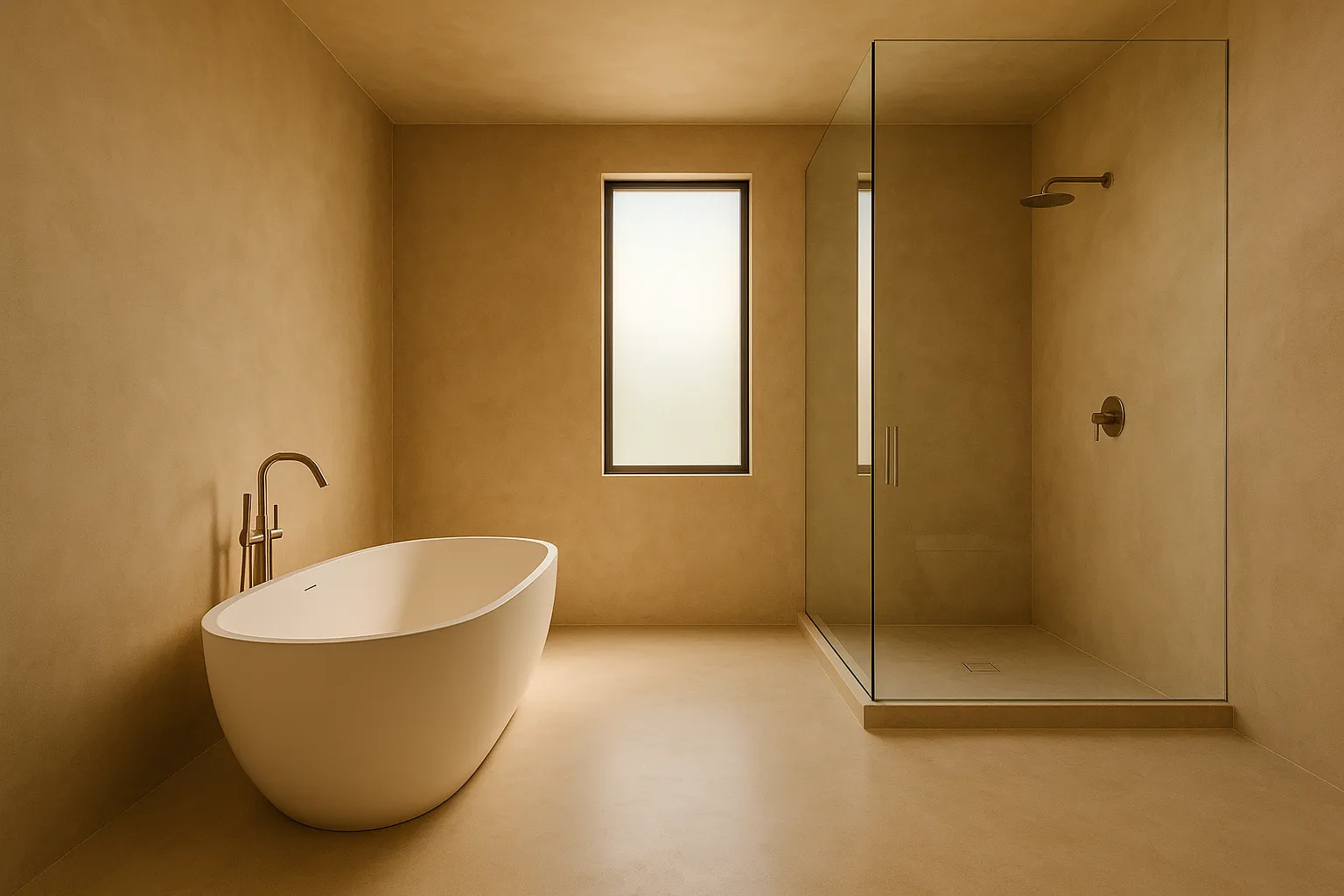
Most homeowners researching [microcement](/services/microcement-bathrooms) cost in [Los Angeles](/areas/los-angeles) get sticker shock — not because the material is overpriced, but because they're comparing it to tile or paint without understanding what they're actually buying. **In 2026, professional microcement installation in Los Angeles runs between $18 and $55 per square foot**, depending on the surface, system type, and finish complexity. That range matters, and this guide breaks down exactly where your project lands.
Microcement has become one of the most requested finishes in LA's design-forward renovation market — from [Beverly Hills](/areas/beverly-hills) bathrooms to [Pasadena](/areas/pasadena) kitchen remodels to [Santa Monica](/areas/santa-monica) [commercial](/services/microcement-commercial-hospitality) spaces. But pricing varies widely, and a lot of contractors quote low to win the job, then tack on prep costs, sealer upgrades, and color charges mid-project. We've seen it enough times to write this guide.
---
## What Is Microcement? A Quick Definition Before the Numbers
What is microcement? Microcement (also called micro-topping or mineral coating) is a polymer-modified cementitious coating applied in multiple thin layers — typically 2–3mm total — directly over existing substrates like tile, concrete, drywall, or wood. It bonds mechanically and chemically, creating a seamless, waterproof, highly durable surface without grout lines or transition strips.
Unlike traditional cement, microcement is flexible enough to resist cracking under normal structural movement. It's finished with a penetrating polyurethane or epoxy sealer that makes it food-safe, water-resistant, and easy to clean.
What makes it different from polished concrete? Polished concrete requires a poured slab — you're grinding and sealing the existing concrete itself. Microcement is applied *over* existing surfaces, which means it works in second-floor bathrooms, over existing tile, and on vertical walls. That flexibility is a big part of why it costs what it does.

---
## [How Much Does](/estimate) Microcement Cost in Los Angeles by Surface Type?
The biggest variable in microcement cost in Los Angeles isn't the material itself — it's the surface being coated and the prep work required. Based on Cemora's project data across 200+ installations in Los Angeles County, here's what you should expect to budget in 2026:
| Surface Type | Low End ($/sqft) | High End ($/sqft) | Typical Project Size | Total Estimated Cost |
|---|---|---|---|---|
| Bathroom Floors | $22 | $38 | 45–80 sqft | $990–$3,040 |
| Bathroom Walls | $20 | $35 | 80–200 sqft | $1,600–$7,000 |
| Full Wet Room (floor + walls) | $28 | $55 | 120–280 sqft | $3,360–$15,400 |
| Kitchen Countertops | $45 | $85 | 30–60 sqft | $1,350–$5,100 |
| Kitchen Floors | $18 | $32 | 120–250 sqft | $2,160–$8,000 |
| Accent Walls / Feature Walls | $20 | $40 | 60–150 sqft | $1,200–$6,000 |
| Commercial Floors | $15 | $28 | 500–5,000 sqft | $7,500–$140,000 |
| Full Home Floors | $18 | $30 | 800–3,000 sqft | $14,400–$90,000 |
**Key insight:** Countertops cost significantly more per square foot than floors. They require a harder, more abrasion-resistant system, more edge detailing, and more sealer coats. Don't be surprised when a countertop quote comes in at $55/sqft while your floor quote is $22/sqft — that's normal.
---
## What Drives Microcement Pricing in Los Angeles?
LA's labor market is among the most expensive in the country. According to 2025 Bureau of Labor Statistics data, skilled finishing trades in Los Angeles averaged **$42–$68 per hour**, compared to a national average of $31–$48. That alone adds 15–25% to project costs versus national benchmarks.
Beyond labor, here's what moves the needle on your quote:
### Surface Preparation
This is where most quotes go sideways. Microcement is unforgiving — it telegraphs every imperfection beneath it. If your existing tile has lippage, your subfloor has soft spots, or your walls have old silicone residue, all of that needs to be addressed before the first coat goes on.
- **Tile removal:** $3–$6/sqft in LA (often skippable — microcement goes over tile)
- **Subfloor leveling:** $4–$12/sqft depending on severity
- **Crack repair and surface priming:** $2–$5/sqft
- **Existing silicone removal (bathrooms):** $200–$600 flat fee
### System Type and Number of Coats
Not all microcement systems are equal. Entry-level systems use 2-coat applications over a primer. Premium systems — the ones used in high-traffic commercial spaces or fully waterproofed wet rooms — involve 5–7 layers including waterproofing membrane, base coat, finish coat, and multiple sealer applications.
**A 5-layer wet room system costs 30–45% more than a basic 2-coat floor application.** That's not a contractor upsell — it's the difference between a surface that lasts 15 years and one that fails in 3.
### Color and Finish Complexity
Solid colors in standard tones are priced into base quotes. Custom pigment matching, multi-tone effects, textured finishes, or metallic additives add **$3–$8/sqft** to material costs. A custom Venetian-inspired bathroom wall finish in a bespoke terracotta tone will cost more than a standard warm gray floor.
### Sealer Selection
The sealer is the most important part of a microcement system — and it's often where budget systems cut corners. Options include:
- **Water-based polyurethane:** Most common, $2–$4/sqft added cost, good for residential
- **Solvent-based polyurethane:** More durable, better for high-traffic floors, $3–$6/sqft
- **Epoxy topcoat:** Hardest surface, best for commercial kitchens and countertops, $5–$9/sqft
- **Matte vs. satin vs. gloss:** Finish level affects both material cost and labor time
---
## Real-World Project Examples from Los Angeles
Numbers mean more when they're attached to real projects. Here are three recent Cemora installations that illustrate how microcement cost in Los Angeles plays out in practice.
**Example 1 — Beverly Hills Primary Bathroom, 2025**
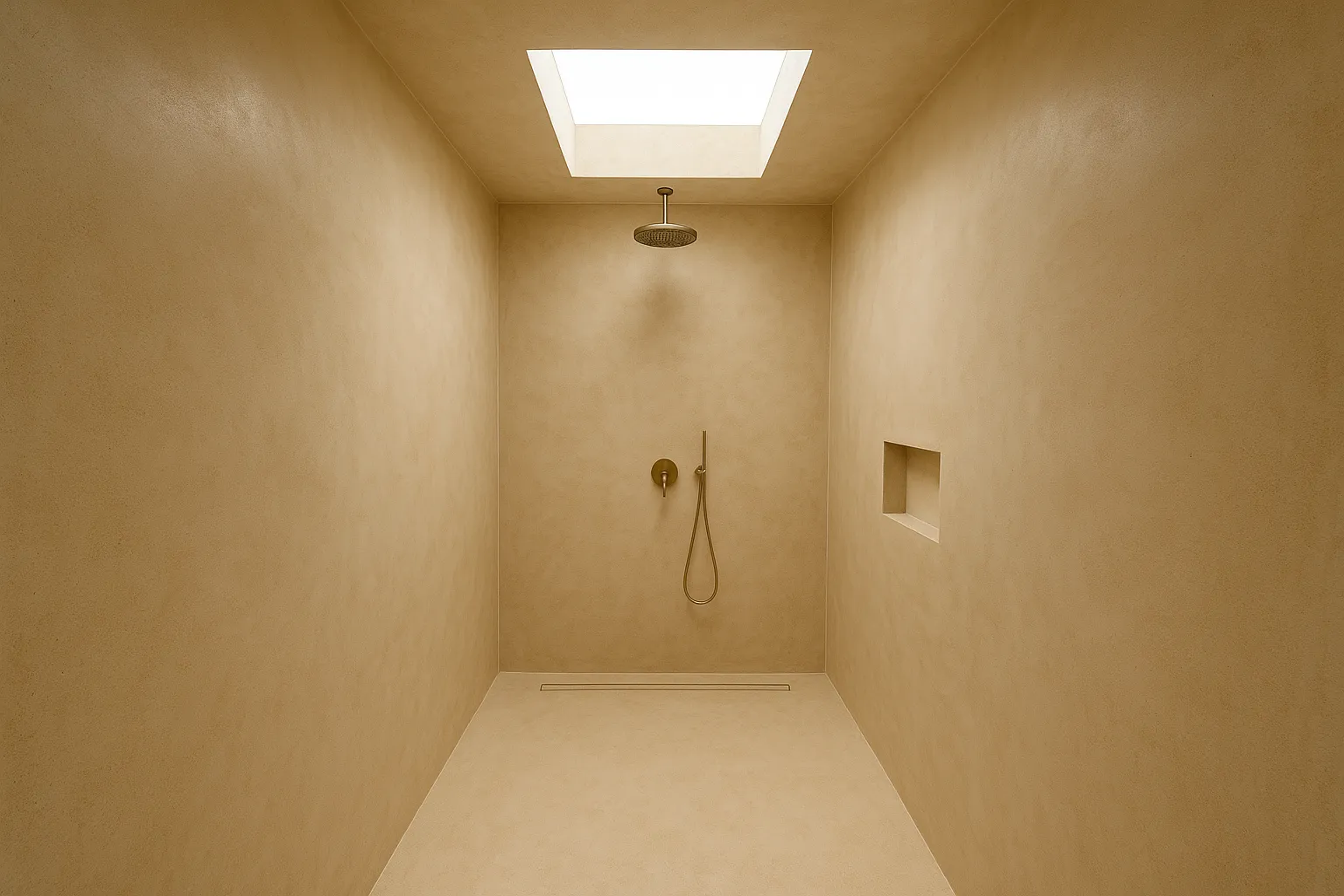
A homeowner on North Roxbury Drive had a 95-sqft bathroom with existing subway tile on floors and walls. They wanted a seamless, spa-like wet room finish in a warm sand tone. The scope included full waterproofing membrane, 5-coat microcement system on floors and walls, and a matte polyurethane sealer. **Total project cost: $8,400** — or approximately $38/sqft for the combined surface area. The homeowner saved roughly $4,200 compared to a full tile demo and regrout project that would have produced a fundamentally different aesthetic.
**Example 2 — Pasadena Kitchen Countertops + Island, 2026**
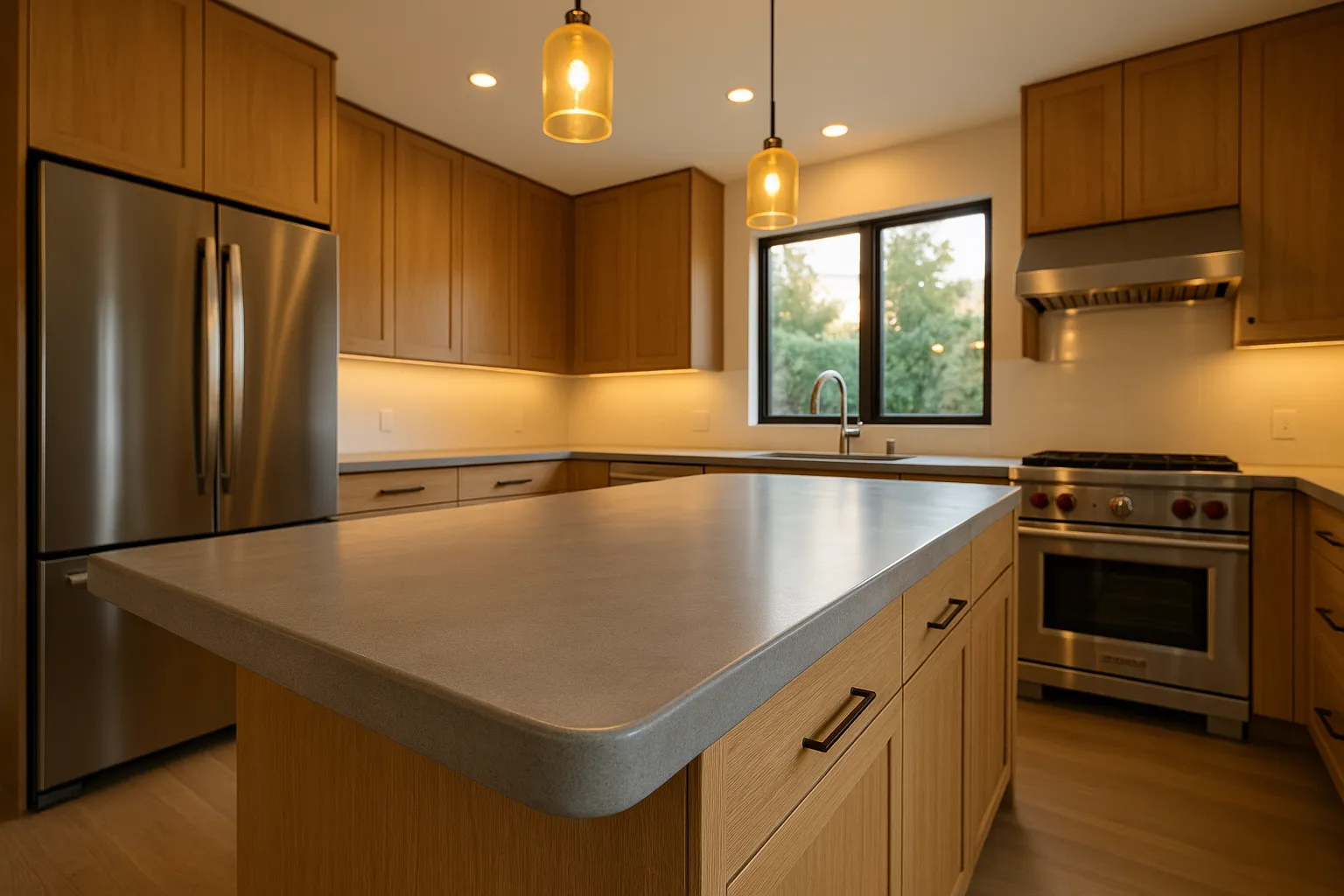
A kitchen renovation in the Bungalow Heaven neighborhood included 48 sqft of countertop surface plus a 22-sqft island top. The homeowner wanted a charcoal matte finish to complement white shaker cabinets. This required an epoxy topcoat for food-contact durability and custom edge profiling on the island. **Total project cost: $6,200** — averaging $89/sqft for countertops (slightly above typical due to the island edge complexity). The same countertops in quartz would have run $5,800–$7,400 installed, with a very different aesthetic.
**Example 3 — Santa Monica Boutique Hotel Lobby Floors, 2025**
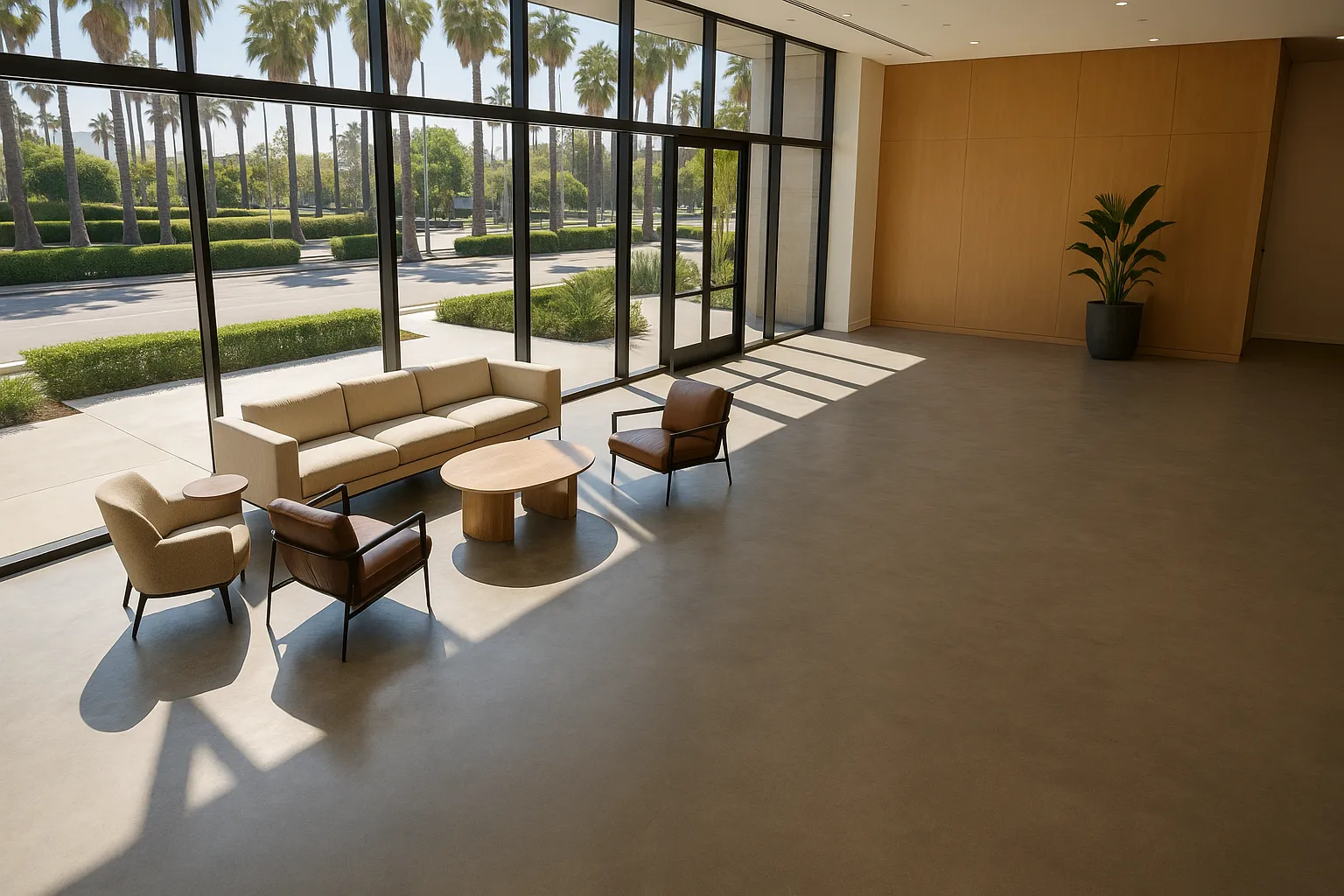
A 12-room boutique hotel on 4th Street needed 1,800 sqft of lobby and corridor flooring replaced. Existing VCT tile was in poor condition but structurally sound. Cemora applied a commercial-grade microcement system with a solvent-based polyurethane sealer rated for 10,000+ daily foot traffic. **Total project cost: $41,400** — or $23/sqft. At that scale, commercial microcement pricing becomes highly competitive with polished concrete or large-format tile, with the added benefit of zero grout lines to maintain.

---
## How Does Microcement Compare to Other Finishes on Cost?
Let's be direct: microcement is not the cheapest option. But it's often the smartest one when you account for total lifecycle cost, not just installation price.
| Finish Type | Installed Cost ($/sqft) | Lifespan | Grout Lines | Waterproof | Resale Appeal |
|---|---|---|---|---|---|
| Ceramic Tile | $8–$22 | 20–30 yrs | Yes | With grout sealing | Moderate |
| Porcelain Tile (large format) | $18–$45 | 25–40 yrs | Minimal | With grout sealing | High |
| Polished Concrete | $15–$35 | 20–30 yrs | No | No (sealer only) | High |
| **Microcement** | **$18–$55** | **10–20 yrs** | **No** | **Yes (with membrane)** | **Very High** |
| Epoxy Coating | $5–$15 | 5–10 yrs | No | Yes | Low-Moderate |
| Natural Stone (marble) | $35–$90 | 30+ yrs | Yes | With sealing | Very High |
Microcement's lifespan is shorter than stone or tile — **10–20 years with proper maintenance**, versus 30+ for quality tile. But the seamless aesthetic, the ability to apply over existing surfaces (saving $3–$6/sqft in demo costs), and the design flexibility make it the right choice for a specific kind of project.
"Microcement isn't competing with tile on price — it's competing on experience," says Cemora's lead applicator, who has completed over 300 installations across Los Angeles. "When someone wants a bathroom that feels like a single continuous piece of stone, there's no tile system that gets you there."
---
## What Is the Installation Process? A Step-by-Step Breakdown
Understanding the process helps you evaluate quotes and set realistic timeline expectations. A professional microcement installation follows this sequence:
1. **Site assessment and surface evaluation** — checking for moisture, structural integrity, existing coatings, and substrate compatibility. This takes 1–2 hours and should be done before any quote is finalized.
2. **Surface preparation** — grinding, patching, cleaning, and priming the substrate. This is the most labor-intensive phase and typically takes 1–2 days for an average bathroom.
3. **Waterproofing membrane application** (wet rooms and bathrooms only) — a flexible membrane is applied at joints, corners, and penetrations before any microcement goes down. This is non-negotiable for shower floors and wet room installations.
4. **Base coat application** — the first microcement layer is troweled on and allowed to cure for 12–24 hours.
5. **Sanding and second coat** — the surface is lightly sanded and a second, finer coat is applied. This is where color and texture are established.
6. **Finish coat** (premium systems) — a third, ultra-fine coat refines the surface texture.
7. **Sealer application** — 2–4 coats of polyurethane or epoxy sealer are applied with light sanding between coats. This phase takes 1–2 days and requires the space to remain dry and traffic-free.
8. **Cure time and handover** — light foot traffic is possible after 24 hours, but full cure (and full water exposure for wet rooms) requires **5–7 days**. Full chemical cure takes 28 days.
**Typical timeline for a full bathroom: 4–6 working days.** A kitchen countertop replacement: 2–3 days. A large commercial floor: 1–2 weeks depending on square footage.
---
## How Much Does Microcement Cost for Specific LA Renovation Scenarios?
Let's translate those per-square-foot numbers into full project budgets for the most common renovation scenarios in Los Angeles.
### Bathroom Renovations
A typical **mid-size LA bathroom (65–90 sqft total surface area)** with microcement on floors and shower walls runs **$4,500–$9,000** installed. That includes waterproofing, 5-coat system, and polyurethane sealer. A powder room or half-bath with microcement accent walls only: **$1,800–$3,500**.
For a [microcement bathroom or wet room](/services/microcement-bathrooms?utm_source=blog&utm_medium=organic&utm_campaign=microcement-cost-los-angeles), the biggest cost driver is whether you're doing a wet zone (shower, wet room) or a dry zone (vanity wall, floor only). Wet zones require waterproofing membranes that add **$4–$8/sqft** to the base price but are absolutely essential for longevity.
### Kitchen Renovations
Kitchen microcement breaks into two distinct scopes: countertops and floors. They use different systems, different sealers, and are often quoted separately.
[Microcement kitchen countertops](/services/microcement-kitchens-countertops?utm_source=blog&utm_medium=organic&utm_campaign=microcement-cost-los-angeles) in LA typically run **$45–$85/sqft installed**, with the high end applying to complex edge profiles, custom colors, and epoxy topcoats. A standard 40-sqft kitchen countertop: **$1,800–$3,400**.
Kitchen floors are priced more like residential floors — **$18–$32/sqft** — because they don't require the same sealer system as food-contact surfaces. A 200-sqft open-plan kitchen/dining floor: **$3,600–$6,400**.
### Whole-Home Floor Systems
For homeowners doing a full-home microcement floor across living areas, bedrooms, and hallways, scale works in your favor. At **1,500–3,000 sqft**, pricing often drops to **$18–$25/sqft** because mobilization costs are spread across a larger area. A full-home floor system in a 2,000-sqft [Glendale](/areas/glendale) home: **$36,000–$50,000** installed.
[Microcement floors and walls](/services/microcement-floors-walls?utm_source=blog&utm_medium=organic&utm_campaign=microcement-cost-los-angeles) at whole-home scale represent one of the most dramatic renovation investments available — and one of the highest-impact ones for resale in LA's design-conscious market.
---
## Why Is Microcement Cost in Los Angeles Higher Than National Averages?
National cost guides often cite microcement at $10–$25/sqft. In Los Angeles, the floor is closer to $18/sqft for simple residential floors, with most projects landing well above that. Here's why:
- **Labor costs:** LA's prevailing wage environment and high cost of living push skilled applicator rates to $55–$80/hour. That's 40–60% above national median.
- **Material freight:** Most premium European microcement systems (Topciment, Deco Cement, Mortex) are imported. LA port logistics and import costs add 8–15% to material pricing versus inland markets.
- **Code compliance:** LA County and City building departments have specific requirements around waterproofing in wet areas. Compliant systems cost more but protect you legally and structurally.
- **Demand premium:** According to a 2025 Houzz State of the Industry report, Southern California homeowners spent **23% more on kitchen and bath renovations** than the national average. Skilled microcement applicators in LA are in short supply — and priced accordingly.

---
## What Questions Should You Ask Before Hiring a Microcement Contractor?
Not every contractor offering microcement in Los Angeles has the training or experience to deliver a surface that lasts. Microcement is a skilled trade — application technique, environmental conditions, and system knowledge all matter enormously.
Ask these questions before signing anything:
- **What microcement system do you use, and who manufactures it?** Premium systems from established manufacturers come with technical data sheets and application protocols. Generic "microcement" from local distributors varies wildly in quality.
- **How many coats does your system include?** A 2-coat system on a wet room floor is a red flag. Proper wet room systems require 5–7 layers minimum.
- **What waterproofing membrane do you use, and is it tested to EN 14891 or ANSI 118.10?** This matters for wet areas.
- **Can I see completed projects in person?** Photos lie. Seeing a 3-year-old installation tells you more about durability than any portfolio image.
- **What's your warranty on labor and materials?** Reputable applicators offer **2–5 year workmanship warranties** on residential projects.
- **Is your quote all-in, or will prep costs be added?** Get surface prep quoted separately and explicitly — that's where surprises live.
For [commercial and hospitality microcement](/services/microcement-commercial-hospitality?utm_source=blog&utm_medium=organic&utm_campaign=microcement-cost-los-angeles) projects specifically, also ask about traffic ratings, slip resistance (especially for wet areas), and maintenance protocols for cleaning staff.
---
## How to Get an Accurate Microcement Quote in Los Angeles
Online calculators and per-square-foot ranges give you a starting point, but an accurate quote requires a site visit. Surface condition, access, existing moisture issues, and project complexity can't be assessed from photos.
Here's what a legitimate quoting process looks like:
1. **Initial consultation** — discuss scope, surfaces, aesthetic goals, timeline
2. **Site visit** — assess substrate condition, moisture levels, access, and any prep requirements
3. **System recommendation** — based on use case (wet room vs. dry floor vs. countertop)
4. **Itemized quote** — prep, materials, labor, sealer, and any contingencies broken out separately
5. **Sample review** — review color and finish samples before committing
If a contractor quotes you over the phone without a site visit, that's a risk. Either the prep costs aren't included, or they haven't accounted for what your specific substrate requires.
[Book a consultation](/book?utm_source=blog&utm_medium=organic&utm_campaign=microcement-cost-los-angeles) with Cemora to walk through your project in detail — we'll give you an honest assessment of what your surfaces need and what it will cost, before you commit to anything.
---
## Frequently Asked Questions
### How much does microcement cost per square foot in Los Angeles?
In 2026, microcement installation in Los Angeles typically costs **$18–$55 per square foot** installed, depending on the surface type, system complexity, and finish. Simple residential floors sit at the lower end ($18–$32/sqft), while wet room systems and countertops run $35–$85/sqft. These figures are based on Cemora's project data across 200+ Los Angeles County installations and reflect local labor rates, which run 40–60% above the national average.
### How long does microcement installation take?
A standard bathroom installation takes **4–6 working days** from surface prep through final sealer coat. Kitchen countertops typically take 2–3 days. Large commercial floors can take 1–2 weeks depending on square footage and system complexity. After installation, light foot traffic is possible within 24 hours, but full water exposure in wet rooms should wait **5–7 days** for the sealer to fully cure.
### Is microcement worth the cost compared to tile?
Microcement costs more upfront than ceramic tile but is often comparable to large-format porcelain installed. The value proposition is different: microcement delivers a seamless, grout-free surface that tile can't replicate, and it can be applied over existing tile (saving $3–$6/sqft in demo costs). For design-forward LA properties, the aesthetic premium translates to real resale value — particularly in primary bathrooms and open-plan living spaces.
### How long does microcement last in a bathroom?
A properly installed microcement system with a quality waterproofing membrane and polyurethane sealer lasts **10–20 years** in a residential bathroom. Longevity depends heavily on proper installation (especially waterproofing at joints and corners) and basic maintenance — annual resealing in high-traffic wet areas significantly extends the surface life. Poorly installed systems without proper waterproofing can fail in 2–3 years.
### What is the difference between microcement and polished concrete?
Polished concrete involves grinding and sealing an existing poured concrete slab — it only works where concrete already exists. Microcement is a thin coating (2–3mm) applied over virtually any existing substrate, including tile, drywall, plywood, and existing concrete. This makes microcement far more versatile for residential applications, especially in upper-floor bathrooms and kitchens where a poured slab isn't an option.
### Can microcement be applied over existing tile in Los Angeles bathrooms?
Yes — in most cases, microcement can be applied directly over existing tile, which is one of its primary advantages. The tile surface must be structurally sound, properly cleaned, and primed. Any loose, cracked, or hollow tiles must be repaired or replaced before application. Applying over tile saves $3–$6/sqft in demo and disposal costs and significantly reduces project timeline. However, if the existing tile has significant lippage or height variation, additional leveling may be required.
### How much does a microcement bathroom renovation cost in Beverly Hills or Santa Monica?
In Beverly Hills and Santa Monica, microcement bathroom renovations typically run **$5,500–$14,000** for a full wet room treatment (floors + walls + shower enclosure). The higher end of that range reflects premium finish systems, custom color matching, and the higher labor rates in these zip codes. A simpler floor-only treatment in a powder room can be done for **$1,800–$3,200** in these areas.
### What maintenance does microcement require?
Microcement requires less maintenance than tile — no grout to clean, seal, or replace. Daily cleaning with a pH-neutral cleaner is recommended. In wet rooms and bathrooms, **annual resealing** with a compatible penetrating sealer helps maintain water resistance and surface appearance. Avoid abrasive cleaners, bleach, and acidic products (including vinegar), which can degrade the sealer over time. Properly maintained microcement looks better at 10 years than most tile installations.
### What is the cost of commercial microcement flooring in Los Angeles?
Commercial microcement flooring in Los Angeles runs **$15–$28 per square foot** installed for large-scale projects (500+ sqft). At scale, pricing becomes more competitive because mobilization and setup costs are spread across more area. A 2,000-sqft restaurant floor runs approximately **$30,000–$56,000** installed with a commercial-grade sealer system. Hospitality and retail clients should also budget for a slip-resistance additive ($1–$2/sqft) required by California building code in public wet areas.
### How do I get a microcement quote for my Los Angeles home or business?
The most accurate quotes come from an in-person site assessment — surface condition, moisture levels, and access all affect pricing significantly. Cemora offers consultations across Los Angeles, Beverly Hills, Santa Monica, Pasadena, and Glendale. You can [request a free estimate](/estimate?utm_source=blog&utm_medium=organic&utm_campaign=microcement-cost-los-angeles) or [contact us directly](/contact?utm_source=blog&utm_medium=organic&utm_campaign=microcement-cost-los-angeles) to schedule a site visit. Expect a detailed, itemized quote within 48 hours of the assessment.
---
Microcement cost in Los Angeles is real money — but so is the difference between a bathroom that photographs like a design hotel and one that looks like every other tile renovation on the block. The question isn't really whether microcement is expensive. It's whether the surface you're creating is worth it for how you live in the space and what you want the property to be worth.
If you're weighing the numbers on a specific project — bathroom, kitchen, floors, or a commercial space — [reach out to Cemora](/contact?utm_source=blog&utm_medium=organic&utm_campaign=microcement-cost-los-angeles). We'll tell you honestly what your surfaces need, what it will cost, and whether microcement is the right call for your situation.
---
**Ready to start your your project in Los Angeles?** [Book a free consultation](/book?utm_source=blog&utm_medium=organic&utm_campaign=microcement-cost-in-los-angeles-2026-pricing-guide-for-kitchen-bathroom-renovations) — we'll come walk through your space and give you straight numbers, no pressure. Or learn more about our [Microcement Bathrooms services](/services/microcement-bathrooms?utm_source=blog&utm_medium=organic&utm_campaign=microcement-cost-in-los-angeles-2026-pricing-guide-for-kitchen-bathroom-renovations).