Microcement Kitchens & Countertops Cost CA: What to Expect in 2026
By Gilad Segev · May 11, 2026 · Last updated May 11, 2026 · Cost Guide
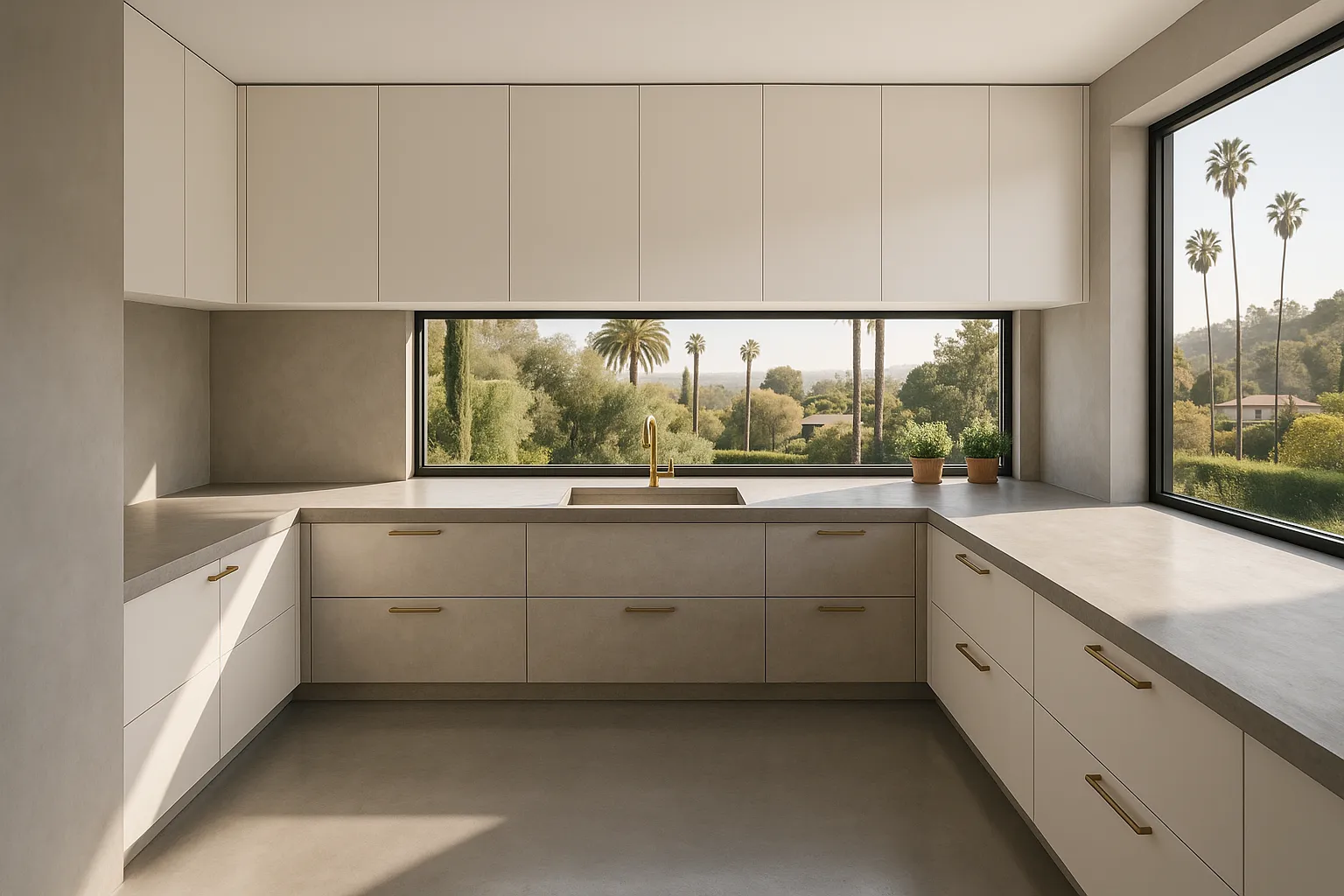
A homeowner in [Beverly Hills](/areas/beverly-hills) recently called us after getting three wildly different quotes for her kitchen — **$8,400**, **$22,000**, and **$41,000** — all for [microcement](/services/microcement-bathrooms) kitchens & countertops cost CA projects covering roughly the same square footage. She wasn't sure who to trust or what the numbers actually meant. That gap isn't unusual. Microcement pricing in California varies more than almost any other finish material, and understanding why is the first step to getting a fair deal.
This guide breaks down exactly what drives microcement kitchen and countertop costs in 2026, what you should realistically budget, and how to tell whether a quote is sharp or padded.
---
## What Is Microcement? A Definition Worth Knowing
What is microcement? Microcement is a polymer-modified cementitious coating applied in multiple thin layers — typically 2–3mm total — directly over existing surfaces including tile, concrete, wood, and drywall. It creates a seamless, monolithic finish that's fully waterproof when properly sealed, highly durable, and available in dozens of colors and textures.
Unlike traditional tile or stone, microcement has no grout lines. That's a major selling point in kitchens, where grout traps grease and bacteria. The surface is continuous, easy to wipe down, and visually striking.
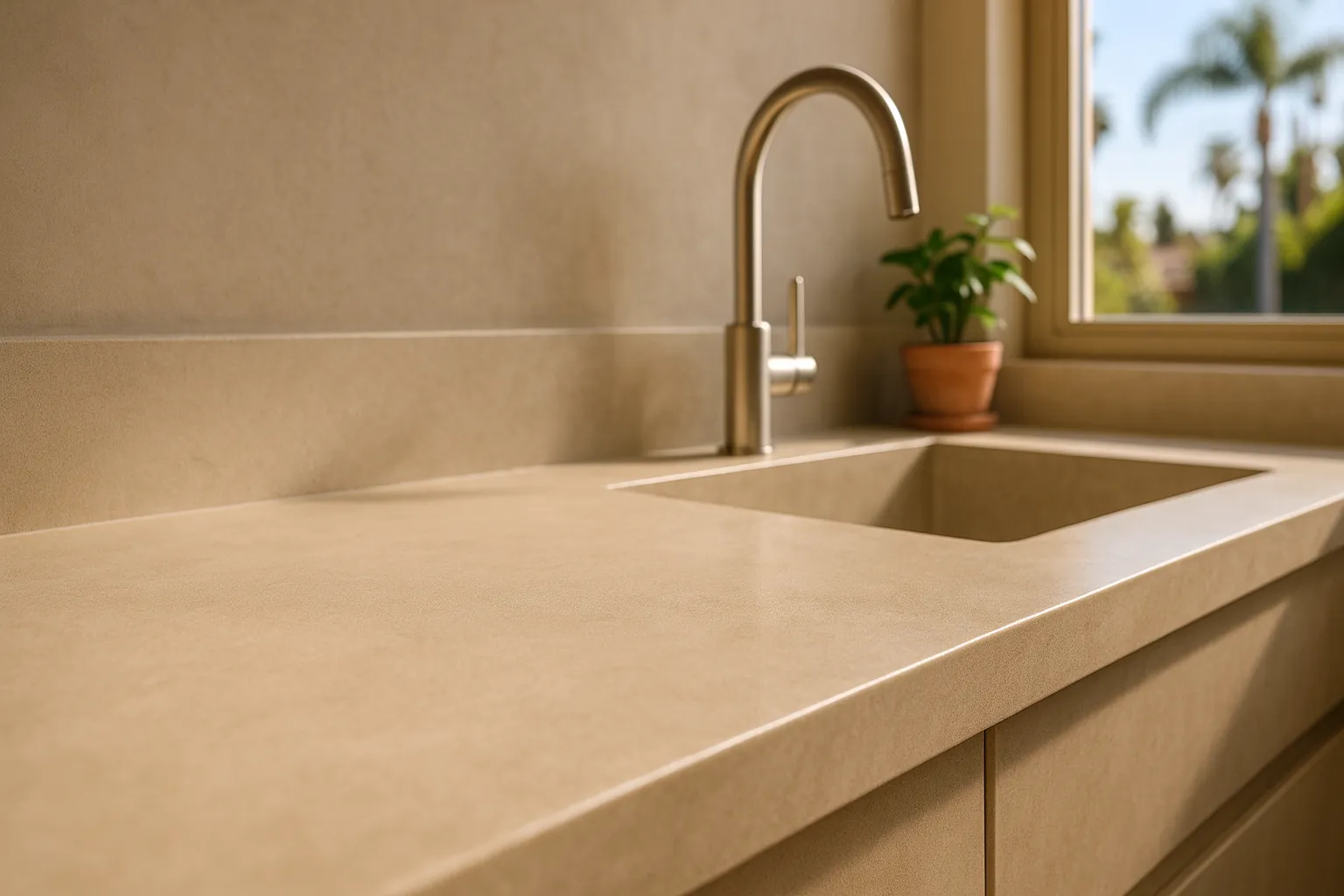
What is a microcement countertop? A microcement countertop is a countertop surface coated with microcement rather than fabricated from a slab material like quartz or granite. It's built up in layers directly on your existing substrate — typically plywood, MDF, or existing stone — and sealed with a [commercial](/services/microcement-commercial-hospitality)-grade polyurethane or epoxy topcoat for heat and stain resistance.
What is a microcement wet room? In kitchen contexts, a wet room application refers to areas around sinks and dishwashers where the microcement must be applied with additional waterproofing membranes and sealed to a higher standard. Cemora applies these protocols on every kitchen project as standard practice.
---
## [Microcement Kitchens & Countertops](/services/microcement-kitchens-countertops) Cost CA: The 2026 Numbers
Based on Cemora's project data across [Los Angeles](/areas/los-angeles), Beverly Hills, [Santa Monica](/areas/santa-monica), [Pasadena](/areas/pasadena), and [Glendale](/areas/glendale), **microcement kitchens & countertops cost CA projects in 2026 typically range from $85 to $185 per square foot installed**, depending on scope, surface condition, and finish complexity.
Here's how that breaks down by application type:
| Application | Price Range (per sq ft) | Typical Project Size | Estimated Total |
|---|---|---|---|
| Countertops only | $95–$165/sq ft | 40–80 sq ft | $3,800–$13,200 |
| Kitchen floors | $75–$120/sq ft | 150–300 sq ft | $11,250–$36,000 |
| Kitchen walls (backsplash area) | $85–$140/sq ft | 30–60 sq ft | $2,550–$8,400 |
| Full kitchen (floors + walls + counters) | $80–$185/sq ft blended | 220–440 sq ft | $17,600–$81,400 |
| Commercial kitchen surfaces | $90–$175/sq ft | 300–1,200 sq ft | $27,000–$210,000 |
*2026 projections based on Cemora project data and 2025 material/labor trends with ~4% annual market adjustment.*
Those ranges are wide — intentionally. A straightforward countertop overlay on a flat, well-prepped substrate in Glendale costs far less than a full kitchen transformation in a Beverly Hills spec home with custom color-matching, curved surfaces, and commercial-grade sealing.

---
## What Drives the Price? The Real Cost Factors
### Surface Preparation
Surface prep is where most low quotes fall apart. Microcement is only as good as what's underneath it. If your existing countertop substrate has flex, moisture, or imperfections, those will telegraph through the finish within months.
Proper prep on a kitchen project typically includes:
- Crack repair and leveling
- Priming with a bonding agent appropriate to the substrate
- Moisture barrier application in sink areas
- Sanding and cleaning to ensure adhesion
On older homes in Pasadena or Santa Monica — where kitchens may not have been touched since the 1980s — prep work alone can add **$1,200–$4,500** to a project. A contractor who quotes without walking the space hasn't priced the prep.
### Number of Layers and Finish Type
A standard microcement application involves **4–6 distinct layers**: base coat, fiberglass mesh (on countertops), two finish coats, and two to three sealer coats. Each layer requires cure time. Rushing the process causes delamination.
Matte finishes are the most forgiving and the most popular right now in Los Angeles residential kitchens. Polished or semi-gloss finishes require more labor, more sanding between coats, and premium sealers — adding **$8–$22 per square foot** over a standard matte application.
### Color and Custom Matching
Standard microcement color palettes from manufacturers like Topciment, Deco Cement, or Ideal Work run **$12–$28 per liter** for pigmented base materials. Custom color matching — especially for commercial hospitality projects where brand color consistency matters — can add **$400–$1,800** in material costs alone.
---
## Three Real Projects: What Homeowners and Businesses Actually Paid
**Project 1 — Santa Monica Kitchen Countertop Overlay**
A homeowner in Santa Monica replaced her dated laminate countertops with microcement across **52 square feet** of counter surface. The substrate was solid and well-prepped. Total project cost: **$6,240** (roughly $120/sq ft). Timeline: 4 days including cure time before use.
**Project 2 — Beverly Hills Full Kitchen Transformation**
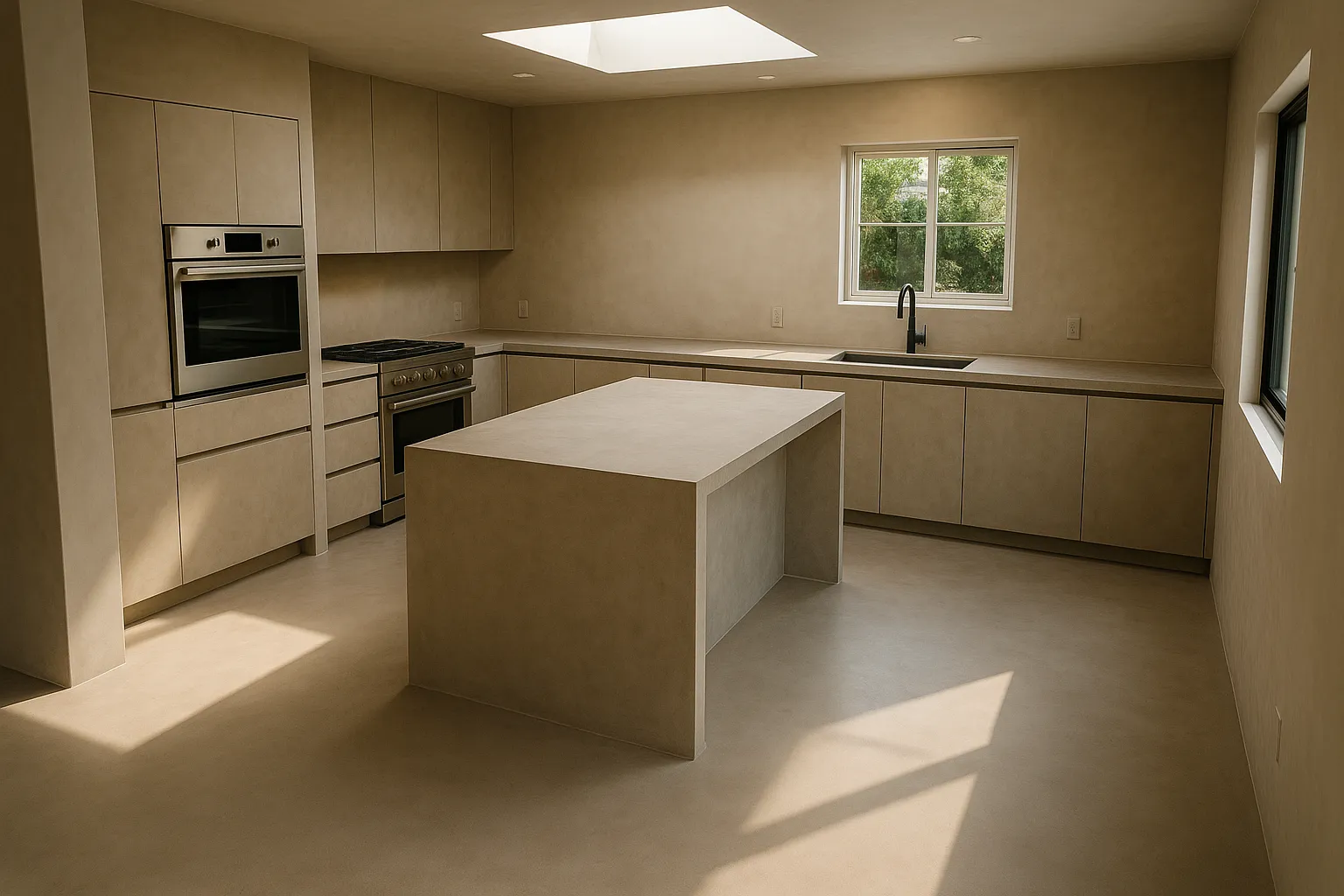
A design-led renovation in Beverly Hills covered **280 square feet** of kitchen floor, **48 square feet** of countertop, and a **36-square-foot backsplash** in a continuous warm-white microcement finish. Custom color, polished sealer, and waterproofing around the island sink. Total: **$58,800**. The homeowner's interior designer noted the microcement finish added approximately **12–15% to the kitchen's perceived resale value** compared to the tile it replaced.
**Project 3 — Glendale Restaurant Bar and Kitchen Surfaces**
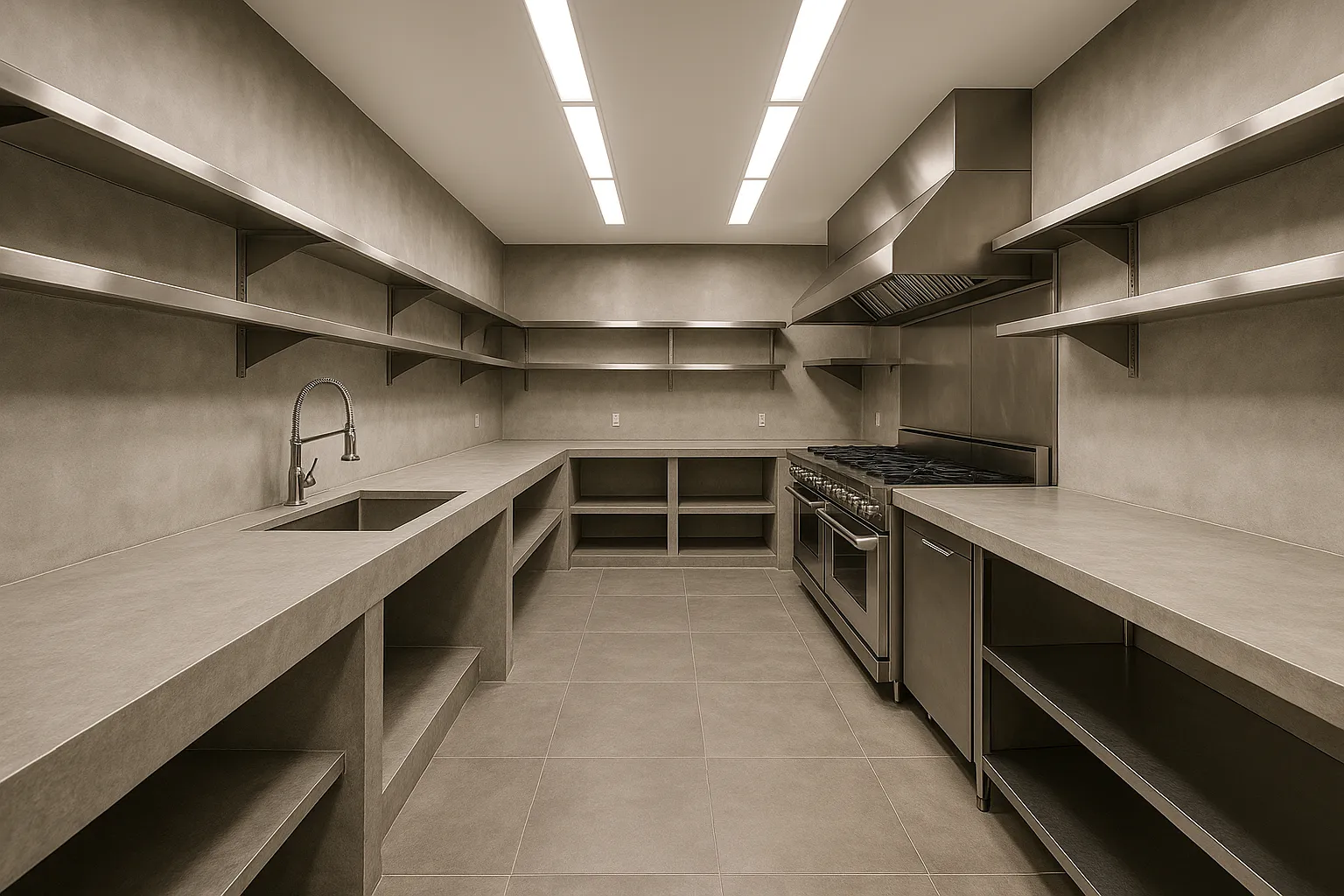
A new hospitality concept in Glendale needed **620 square feet** of microcement across bar tops, back-of-house prep surfaces, and front-of-house feature walls. Commercial-grade epoxy topcoat, NSF-compliant sealer, and a two-tone color scheme. Total project cost: **$89,400** over a **12-day installation window**. The restaurant opened on schedule. See how Cemora handles projects like this at [Commercial & Hospitality Microcement](/services/microcement-commercial-hospitality?utm_source=blog&utm_medium=organic&utm_campaign=microcement-kitchens-countertops-cost-ca).
---
## How Does Microcement Compare to Other Countertop Materials?
This is a fair question — and the honest answer is that microcement isn't always the cheapest option. But it's often the best value when you factor in longevity, aesthetics, and what it costs to maintain.
| Material | Installed Cost (CA, 2026) | Grout Lines | Seamless Sink | Reseal Frequency | Lifespan |
|---|---|---|---|---|---|
| Microcement | $95–$165/sq ft | None | Yes | Every 3–5 years | 15–25+ years |
| Quartz slab | $80–$150/sq ft | None | No (undermount) | Never | 20–30 years |
| Granite | $65–$135/sq ft | None | No (undermount) | Every 1–2 years | 25+ years |
| Ceramic tile | $25–$65/sq ft | Yes | No | Grout annually | 10–20 years |
| Concrete (poured) | $100–$200/sq ft | None | Yes | Every 1–3 years | 15–25 years |
| Epoxy resin | $70–$150/sq ft | None | Yes | Every 5–10 years | 10–20 years |
*2026 California installed cost projections. Microcement data based on Cemora project history.*
Microcement sits in a competitive range against quartz — the dominant countertop material in Los Angeles right now. The key differentiators: microcement can be applied over existing surfaces (saving demolition costs), it creates a fully integrated look from counter to wall to floor, and it's repairable in place if damaged.
Quartz requires full slab replacement if a section cracks. Microcement can be spot-patched by a skilled applicator.

---
## The Installation Process: Step by Step
Understanding the process helps you understand the timeline — and why rushing a microcement kitchen project is a bad idea.
1. **Site assessment and surface evaluation** — The applicator inspects substrate condition, moisture levels, and existing finish. Any structural or moisture issues are flagged before work begins. (Day 1, typically 2–3 hours)
2. **Surface preparation** — Grinding, patching, priming. On countertops, fiberglass mesh is embedded for crack resistance. This stage is non-negotiable and cannot be skipped to save time. (Day 1–2)
3. **Base coat application** — First microcement layer applied by hand or sprayer, depending on surface. This establishes the foundation texture. (Day 2)
4. **Intermediate coats** — One to two additional layers, sanded between applications. Color is built up gradually. (Day 3–4)
5. **Finish coat** — Final microcement layer applied with careful attention to texture consistency and color uniformity. (Day 4–5)
6. **Sealing** — Two to three coats of polyurethane or epoxy sealer, depending on the application. Each coat requires full cure time. This is what makes the surface waterproof and stain-resistant. (Day 5–7)
7. **Final inspection and cure period** — Surface is inspected under raking light for any imperfections. Light use can begin after **48–72 hours**; full cure takes **7–14 days**. Heavy countertop use (hot pots, cutting) should wait for full cure.
Total timeline for a typical residential kitchen: **5–8 working days**. Commercial projects with larger footprints typically run **10–18 days**.
---
## Why Are Some Quotes So Much Lower?
"We can do it for $45 a square foot." We hear this from clients who've shopped around. Here's what that number usually means:
- **Fewer layers** — Some contractors apply two coats instead of four to six. The surface looks fine initially but fails within 12–18 months.
- **Inferior sealers** — Budget polyurethane sealers yellow, scratch, and lose water resistance. A proper commercial-grade sealer adds **$8–$15 per square foot** to material costs alone.
- **No surface prep** — Going straight over existing tile without proper priming. Adhesion fails.
- **Unlicensed labor** — In California, any home improvement contract over **$500** requires a CSLB-licensed contractor. An unlicensed applicator has no accountability if the work fails.
The 2025 CSLB enforcement data showed that unlicensed contractor complaints in Los Angeles County increased by approximately **18%** year-over-year, with surface coating projects among the most common categories. Always verify your contractor's license at the CSLB website before signing anything.
A failed microcement installation doesn't just look bad — removing it and starting over costs **$15–$35 per square foot** in remediation before you even pay for the new application.
---
## Microcement Kitchens & Countertops Cost CA: What Affects Your Specific Quote
### Kitchen Size and Layout
Galley kitchens with straight runs are faster to coat than L-shaped or U-shaped kitchens with inside corners, curved edges, and complex transitions. Every inside corner, radius edge, and penetration (sink cutout, cooktop) adds time. **Expect 15–25% more** on complex layouts versus simple rectangular countertops.
### Existing Surface Condition
If your existing countertop or floor is structurally sound and level, prep is straightforward. If it's cracked, uneven, or has old adhesive residue, remediation adds cost. A kitchen floor with significant lippage from old tile can add **$800–$2,400** in leveling work before microcement application begins.
### Sealer Choice
For kitchens specifically, sealer selection matters enormously. Options include:
- **Water-based polyurethane** — Most common, good UV stability, **$4–$8/sq ft** in material cost
- **Solvent-based polyurethane** — Harder finish, better for high-traffic commercial kitchens, **$6–$12/sq ft**
- **Epoxy topcoat** — Maximum durability, NSF-compliant options available for food-contact surfaces, **$10–$18/sq ft**
For residential countertops in Los Angeles where aesthetics are paramount, Cemora typically recommends a matte water-based polyurethane. For commercial counters and bars, the epoxy topcoat is standard.
Explore the full range of [Microcement Kitchens & Countertops](/services/microcement-kitchens-countertops?utm_source=blog&utm_medium=organic&utm_campaign=microcement-kitchens-countertops-cost-ca) services Cemora offers across Southern California.
---
## Microcement Kitchens & Countertops Cost CA: Resale Value and ROI
The 2025 Houzz State of the Industry report found that kitchen renovations in the Western US delivered an average **return of 62–74%** of project cost in resale value. Microcement kitchens tend to perform at the higher end of that range in design-forward markets like Beverly Hills, [West Hollywood](/areas/west-hollywood), and Santa Monica — where the seamless aesthetic commands a premium with buyers.
"In 15 years of finishing surfaces across Los Angeles, we've consistently seen microcement kitchens photograph better, show better, and appraise better than tile-and-grout equivalents in the same price range," notes Cemora's lead applicator. "Buyers in this market respond to the clean, gallery-like quality of a seamless finish."
For commercial hospitality operators, the ROI calculation is different. A microcement bar top or kitchen surface that looks brand-new after three years of service versus a tile surface that's grout-stained and chipped within 18 months — the maintenance savings and brand perception value are significant. Industry benchmarks show commercial operators in California spend **$2,400–$6,800 per year** maintaining tiled kitchen and bar surfaces. A properly sealed microcement surface reduces that to essentially an annual wipe-down and occasional resealing every 3–5 years.
For [Microcement Floors & Walls](/services/microcement-floors-walls?utm_source=blog&utm_medium=organic&utm_campaign=microcement-kitchens-countertops-cost-ca) that extend the kitchen's visual language into adjacent spaces, the value compounds further — a continuous floor finish from kitchen to dining area is one of the most requested features in Los Angeles open-plan renovations right now.

---
## How to Get an Accurate Quote
A reliable microcement quote requires an in-person or detailed virtual site assessment. Be skeptical of any contractor who quotes a price per square foot over the phone without seeing the substrate.
When you [request a quote](/book), have this information ready:
- **Total square footage** of each surface (counters, floors, walls separately)
- **Current surface material** (tile, laminate, wood, concrete, etc.)
- **Age of the surface** and any known issues (cracks, moisture, unevenness)
- **Desired finish** (matte, satin, polished)
- **Timeline** — do you have a hard deadline like a renovation opening or a home listing date?
- **Color direction** — even rough inspiration images help narrow material costs
For homeowners ready to move forward, the fastest path is to [Book a Consultation](/book?utm_source=blog&utm_medium=organic&utm_campaign=microcement-kitchens-countertops-cost-ca) with Cemora directly. We assess the space, discuss the finish direction, and provide a detailed line-item quote — no vague ranges.
Alternatively, [Get a Free Estimate](/estimate?utm_source=blog&utm_medium=organic&utm_campaign=microcement-kitchens-countertops-cost-ca) online to get a ballpark figure before committing to a site visit.
For bathroom projects running alongside a kitchen renovation, our [Microcement Bathrooms & Wet Rooms](/services/microcement-bathrooms?utm_source=blog&utm_medium=organic&utm_campaign=microcement-kitchens-countertops-cost-ca) service can often be scheduled concurrently to reduce mobilization costs — a meaningful saving on larger whole-home projects.
---
## Frequently Asked Questions
### [How much does](/estimate) microcement kitchens & countertops cost CA in 2026?
Based on Cemora project data across Los Angeles, Beverly Hills, Santa Monica, Pasadena, and Glendale, microcement kitchens & countertops cost CA projects in 2026 range from **$85 to $185 per square foot installed**. Countertops alone typically run **$95–$165/sq ft**, while full kitchen transformations covering floors, walls, and counters can total **$17,600–$81,400** depending on scope and complexity. Commercial projects in hospitality settings often fall between **$90–$175/sq ft** with NSF-compliant sealers and commercial-grade finishes.
### Is microcement more expensive than quartz countertops?
Microcement and quartz are in a similar installed cost range in California — both typically **$80–$165 per square foot** depending on specification. Microcement can actually be more cost-effective when applied over existing surfaces, since it eliminates demolition and disposal costs that quartz replacement requires. The value difference is in aesthetics and flexibility: microcement creates fully seamless transitions from counter to wall to floor that quartz slab simply cannot achieve.
### How long does a microcement kitchen installation take?
A typical residential kitchen microcement project takes **5–8 working days** from surface prep through final sealer application. Larger or more complex kitchens may take up to 10 days. Commercial projects covering 300–1,200 square feet typically run **10–18 working days**. Light use of countertops can begin **48–72 hours** after the final sealer coat; full cure for heavy use (hot pots, cutting boards) requires **7–14 days**.
### Can microcement be applied over existing tile countertops?
Yes — one of microcement's biggest advantages is that it can be applied directly over existing tile, laminate, concrete, or wood substrates without demolition. The existing surface must be structurally sound, clean, and properly primed. Loose tiles, significant unevenness, or active moisture issues must be addressed first. In most Los Angeles kitchens, this overlay approach saves **$800–$3,500** in demolition and disposal costs compared to a full countertop replacement.
### How durable is microcement on kitchen countertops?
Properly installed and sealed microcement countertops are highly durable for daily kitchen use — resistant to water, stains, and moderate heat when sealed with a commercial-grade polyurethane or epoxy topcoat. They're not impervious to impact (a heavy cast iron pan dropped on an edge can chip the finish) and should not have extremely hot pots placed directly on the surface without a trivet. With proper care and resealing every **3–5 years**, a microcement countertop can last **15–25 years**.
### What maintenance does a microcement kitchen surface require?
Day-to-day maintenance is minimal: wipe with a damp cloth and a pH-neutral cleaner. Avoid abrasive scrubbers, acidic cleaners (vinegar, lemon-based products), and bleach, which can degrade the sealer over time. The sealer should be inspected annually and reapplied every **3–5 years** depending on use intensity. A professional reseal typically costs **$3–$8 per square foot** — significantly less than refinishing or replacing a conventional countertop.
### Does microcement add resale value to a Los Angeles home?
In design-forward Los Angeles markets — Beverly Hills, Santa Monica, Silver Lake, Los Feliz — microcement kitchens consistently photograph and show well, which translates to faster sales and stronger appraisals. The 2025 Houzz State of the Industry report found kitchen renovations in the Western US return **62–74%** of project cost in resale value, with premium finishes like microcement performing at the higher end of that range. The seamless aesthetic is particularly valued in open-plan layouts where the kitchen flows visually into living areas.
### Are there any California-specific considerations for microcement kitchens?
California's Title 24 energy standards don't directly affect surface finishes, but local building codes in some LA County jurisdictions may require permits for structural substrate work done as part of a kitchen renovation. More relevant is California's strict VOC (volatile organic compound) regulations, which affect which sealers can be used — some solvent-based products available in other states aren't compliant in California. Cemora uses only California Air Resources Board (CARB)-compliant materials on every project.
### How do I find a qualified microcement applicator in Los Angeles?
Look for a CSLB-licensed contractor (verify at cslb.ca.gov), a portfolio of completed microcement kitchen projects with verifiable references, and manufacturer-certified training from a recognized microcement brand. Be wary of contractors who quote without a site visit, use vague per-square-foot pricing without specifying number of layers and sealer type, or cannot provide proof of insurance. [Contact Cemora](/contact?utm_source=blog&utm_medium=organic&utm_campaign=microcement-kitchens-countertops-cost-ca) to discuss your project and verify our credentials directly.
### Can microcement be used in a commercial kitchen environment?
Yes, with the right specification. Commercial kitchens require NSF-compliant sealers for food-contact surfaces, higher-durability topcoats (typically two-part epoxy rather than polyurethane), and attention to slip resistance on floor surfaces. Cemora has completed commercial kitchen and hospitality projects in Glendale, Los Angeles, and across LA County. See our [Commercial & Hospitality Microcement](/services/microcement-commercial-hospitality?utm_source=blog&utm_medium=organic&utm_campaign=microcement-kitchens-countertops-cost-ca) service page for project examples and commercial-specific pricing guidance.
---
## The Bottom Line on Microcement Kitchen Costs in California
The microcement kitchens & countertops cost CA range in 2026 is real and wide — from under **$4,000** for a simple countertop overlay to over **$80,000** for a full-kitchen transformation in a high-specification Beverly Hills home. What sits in the middle is where most Los Angeles homeowners land: a **$15,000–$45,000** project that transforms the look and feel of a kitchen without the disruption and cost of a full gut renovation.
The key variables are surface preparation, number of application layers, sealer quality, and the complexity of the layout. Any quote that doesn't address all four of those factors in writing isn't a real quote — it's a number designed to win the job.
If you're weighing microcement against quartz, tile, or poured concrete for your next kitchen project, the decision usually comes down to two things: do you want a seamless, grout-free surface that flows continuously from counter to floor to wall? And do you want a finish that can be applied over what you already have, without demo costs? If the answer to both is yes, microcement is worth the serious look.
We work across Los Angeles, Beverly Hills, Santa Monica, Pasadena, and Glendale. If you'd like to see what your kitchen could look like — or just want an honest number — [reach out to the Cemora team](/contact?utm_source=blog&utm_medium=organic&utm_campaign=microcement-kitchens-countertops-cost-ca) or [book a consultation](/book?utm_source=blog&utm_medium=organic&utm_campaign=microcement-kitchens-countertops-cost-ca) at a time that works for you.
---
**Ready to start your your project in Los Angeles?** [Book a free consultation](/book?utm_source=blog&utm_medium=organic&utm_campaign=microcement-kitchens-countertops-cost-ca-what-to-expect-in-2026) — we'll come walk through your space and give you straight numbers, no pressure. Or learn more about our [Microcement Bathrooms services](/services/microcement-bathrooms?utm_source=blog&utm_medium=organic&utm_campaign=microcement-kitchens-countertops-cost-ca-what-to-expect-in-2026).