Microcement Kitchens & Countertops Cost CA: What to Expect in 2026
By Gilad Segev · August 3, 2026 · Last updated August 10, 2026 · Cost Guide
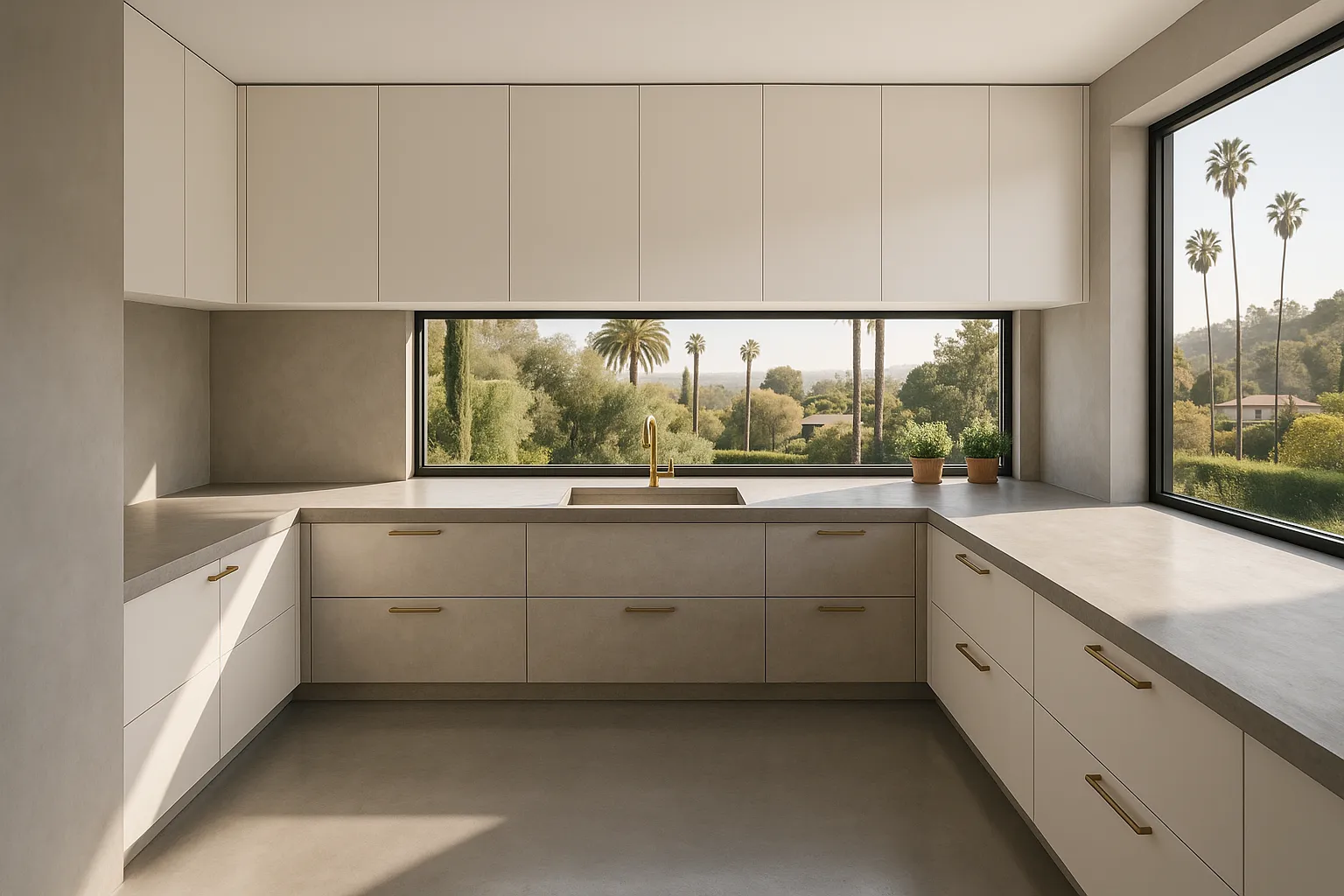
Most homeowners researching **[microcement](/services/microcement-bathrooms) kitchens & countertops cost CA** expect a simple number. What they actually find is a range so wide — from **$45 per square foot to over $140 per square foot** — that it feels useless. This guide breaks down exactly what drives that range, what you'll realistically pay in [Los Angeles](/areas/los-angeles) in 2026, and how to know whether the quote you're getting is fair.
Based on Cemora's project data across 90+ kitchen and countertop installations in Southern California, the average microcement kitchen project lands between **$8,500 and $28,000 total**, depending on scope, surface complexity, and finish specification. That's a meaningful number to anchor your planning.
---
## What Is Microcement? (And Why Kitchens Love It)
What is microcement? Microcement is a polymer-modified cementitious coating — typically 2–3mm thick — applied directly over existing surfaces including tile, concrete, drywall, and plywood. It creates a seamless, monolithic finish without the need for demolition or substrate replacement.
Unlike traditional tile or stone, microcement has **no grout lines**, no seams, and no joints where bacteria and grease can accumulate. In a kitchen, that matters enormously. A countertop with zero seams is dramatically easier to keep clean than a tile surface with 40 linear feet of grout.
Microcement is also remarkably thin. Because it adds only 2–3mm of material, it won't raise your countertop height meaningfully, won't interfere with cabinet clearances, and can be applied directly over existing surfaces in most cases — which is a big reason why kitchen renovations using microcement tend to come in **30–40% cheaper than full tile or stone replacements** when you factor in demo and substrate costs.

---
## [How Much Does](/estimate) Microcement Kitchen & Countertop Work Cost in California in 2026?
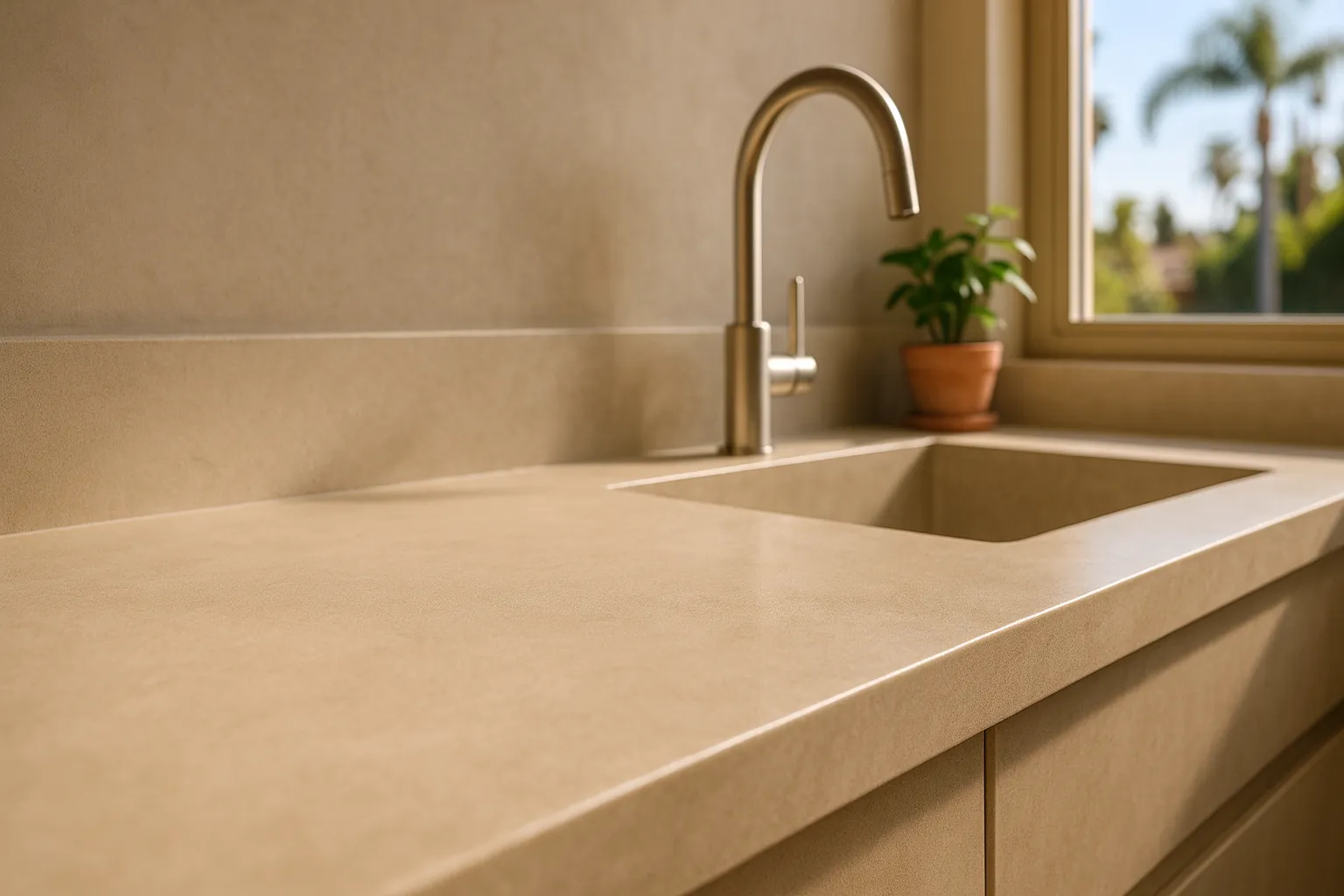
Let's get specific. **[Microcement kitchens & countertops](/services/microcement-kitchens-countertops) cost CA** varies by surface type, and here's what Cemora's 2026 project data shows:
### Cost by Surface Type
| Surface | Price Range (per sq ft) | Typical Project Size | Total Estimated Cost |
|---|---|---|---|
| Kitchen Countertops Only | $65 – $110/sq ft | 40–80 sq ft | $2,600 – $8,800 |
| Kitchen Floors | $45 – $85/sq ft | 150–300 sq ft | $6,750 – $25,500 |
| Full Kitchen Walls & Backsplash | $55 – $95/sq ft | 60–120 sq ft | $3,300 – $11,400 |
| Full Kitchen Package (floors + walls + counters) | $55 – $120/sq ft blended | 250–500 sq ft total | $13,750 – $60,000 |
| [Commercial](/services/microcement-commercial-hospitality) Kitchen Surfaces | $70 – $140/sq ft | 500–2,000 sq ft | $35,000 – $280,000 |
These are **installed costs** — labor, materials, primer, sealer, and finish coats included. They do not include demolition of existing surfaces (if needed), plumbing disconnection, or appliance removal.
### What Drives the Price Up?
Several factors push a project toward the top of the range:
- **Custom color matching** — proprietary tints and multi-tone effects add $8–$15/sq ft
- **Polished or high-gloss sealer** — requires additional coats and labor, adding $5–$12/sq ft
- **Vertical surfaces with complex geometry** — islands with waterfall edges, curved walls
- **Substrate prep issues** — cracked tile, uneven concrete, or moisture problems require remediation
- **Access constraints** — second-floor kitchens, tight commercial spaces, or occupied homes
### What Keeps Costs Down?
- **Overlay over existing tile** — eliminates demo costs entirely
- **Matte or satin finish** — fewer sealer coats, lower labor
- **Standard color palette** — no custom mixing required
- **Large, open floor plans** — fewer cuts, faster application
---
## Three Real Projects: What Homeowners Actually Paid
### Scenario 1: Silver Lake Home Kitchen Countertop Refresh
A homeowner in Silver Lake had 52 square feet of existing tile countertops and a 14-square-foot backsplash. Rather than demo the tile and install new quartz, they chose microcement overlay. **Total project cost: $5,200.** The same square footage in quartz with demo and reinstallation would have run approximately $8,400–$9,800. The microcement option delivered a seamless matte finish in a warm taupe tone, completed in **4 working days**.
### Scenario 2: [Beverly Hills](/areas/beverly-hills) Full Kitchen Package
A kitchen renovation in Beverly Hills covered 280 square feet of floor, 95 square feet of countertops, and 78 square feet of backsplash — **453 square feet total**. The client specified a polished concrete-grey finish with a high-gloss sealer on countertops and matte on floors. **Total project cost: $41,800.** Timeline was **9 working days** including substrate prep on the floors, which had minor cracking.
### Scenario 3: [Santa Monica](/areas/santa-monica) Restaurant Counter & Bar Top
A fast-casual restaurant in Santa Monica needed a durable, food-safe surface across a 38-foot bar top and prep counter — **approximately 190 square feet of horizontal surface**. Commercial-grade microcement with a food-safe epoxy topcoat was specified. **Total project cost: $22,400.** The restaurant was able to remain partially open during installation because the work was sequenced in two phases. See more commercial applications at our [Commercial & Hospitality Microcement](/services/microcement-commercial-hospitality?utm_source=blog&utm_medium=organic&utm_campaign=microcement-kitchens-countertops-cost-ca) service page.

---
## How Does Microcement Compare to Other Kitchen Surface Materials?
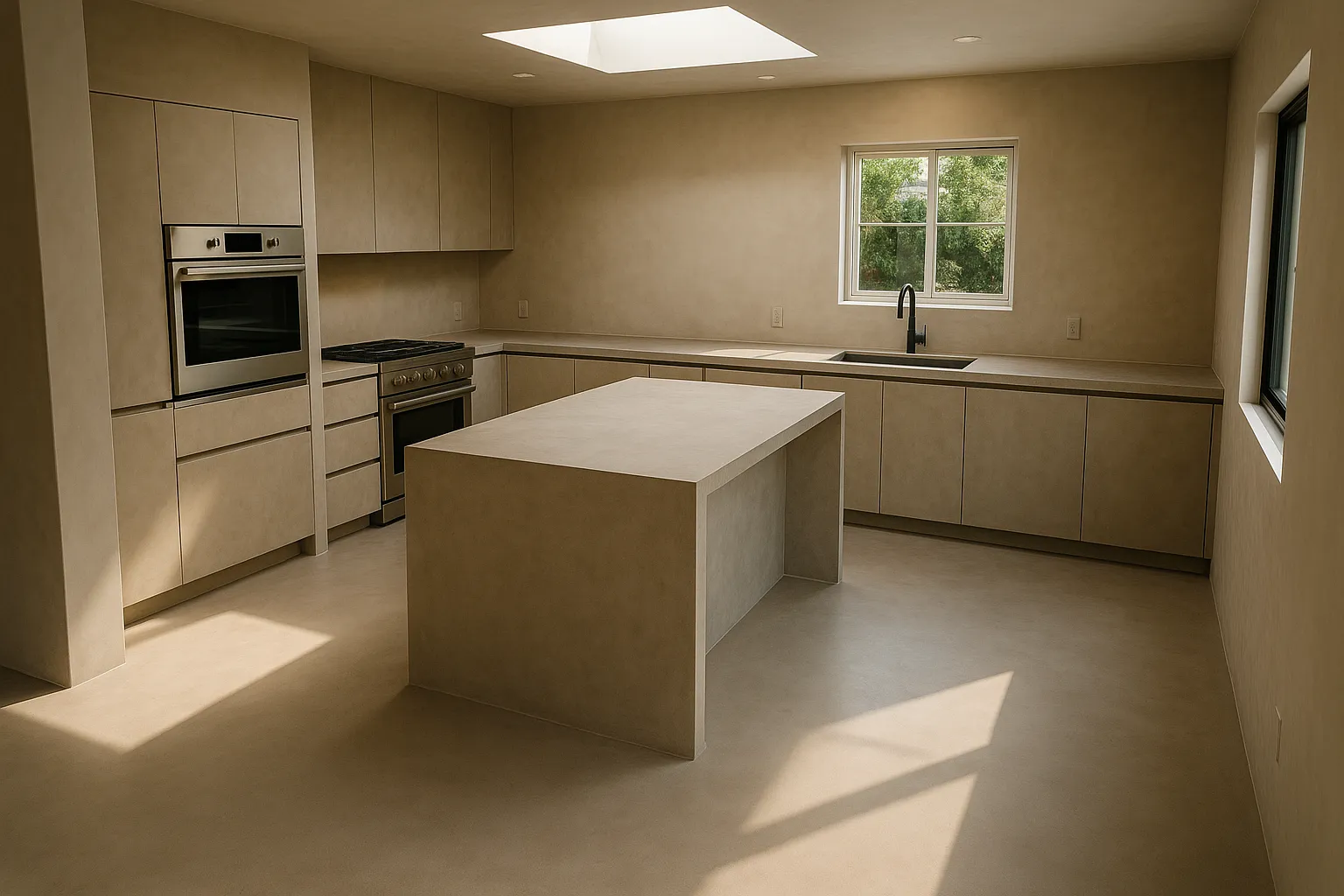
This is the question every homeowner eventually asks. Here's how microcement stacks up against the alternatives for kitchen countertops and floors in California in 2026.
### Countertop Material Cost Comparison (Installed, CA 2026 Projections)
| Material | Installed Cost/sq ft | Seams | Grout Lines | Reseal Required | Lifespan |
|---|---|---|---|---|---|
| Microcement | $65 – $110 | None | None | Every 2–3 years | 15–25+ years |
| Quartz (engineered) | $85 – $145 | Yes (at joins) | None | No | 20–30 years |
| Granite | $70 – $130 | Yes (at joins) | None | Every 1–2 years | 20–30 years |
| Marble | $90 – $175 | Yes (at joins) | None | Every 1–2 years | 20+ years |
| Tile | $35 – $75 | Yes | Yes | Grout sealing | 20+ years |
| Concrete (poured-in-place) | $95 – $150 | Minimal | None | Every 1–2 years | 20+ years |
| Solid Surface (Corian) | $55 – $95 | Seamless | None | No | 10–20 years |
Microcement sits competitively in the mid-range on cost. Its real advantages are the **seamless aesthetic**, the ability to **overlay existing surfaces**, and the **design flexibility** — you can achieve dozens of textures and tones that stone can't replicate.
The honest limitation: microcement countertops require more care than quartz. They're not impervious to heat or sharp impacts. A quality sealer handles moisture and staining well, but you should use cutting boards and trivets. That's a reasonable trade-off for most homeowners — but worth knowing upfront.
---
## What Is the Installation Process for Microcement Kitchens?
What is the microcement installation process? A professional microcement kitchen installation follows a structured sequence that typically spans **5–10 working days** depending on project size and complexity.
### Step-by-Step Microcement Kitchen Installation
1. **Substrate Assessment** — The installer evaluates existing surfaces for cracks, moisture, adhesion quality, and levelness. Any issues are addressed before coating begins. This step alone can take 1–2 days for complex substrates.
2. **Surface Preparation** — Existing surfaces are cleaned, degreased, and mechanically abraded where needed. Cracks are filled. Primer coats are applied and allowed to cure — typically **12–24 hours per coat**.
3. **First Microcement Base Coat** — A fiber-reinforced base coat is applied at approximately 1–1.5mm thickness. This coat establishes the foundation and helps prevent cracking. Cure time: **24 hours minimum**.
4. **Second Coat Application** — A finish coat is applied at 0.5–1mm, refining texture and tone. Multiple finish coats may be applied for specific effects. Each coat requires **12–24 hours of cure time**.
5. **Sanding and Refinement** — Once cured, the surface is sanded to achieve the desired texture — from rough industrial to ultra-smooth. This is where skilled applicators distinguish themselves.
6. **Sealer Application** — Two to four coats of polyurethane or epoxy sealer are applied depending on the surface type and use. Countertops typically receive more sealer coats than floors. Each coat requires **4–8 hours of dry time**.
7. **Final Inspection and Cure** — The surface is inspected under raking light for any imperfections. Full cure takes **7 days** — during which the surface should be treated gently. Full hardness is achieved at **28 days**.
For kitchens, the countertop area is typically completed last to minimize the risk of damage from other trades working in the space.
Learn more about our approach to [Microcement Kitchens & Countertops](/services/microcement-kitchens-countertops?utm_source=blog&utm_medium=organic&utm_campaign=microcement-kitchens-countertops-cost-ca) and how we sequence work to minimize disruption.
---
## How Long Does a Microcement Kitchen Project Take?
Timeline is one of the most common questions we hear — and one of the most misunderstood aspects of microcement work.
**The short answer: most residential kitchen projects take 5–10 working days on-site.** But that's working days, not calendar days. Factor in weekends and any cure days where the space can't be used, and a typical project runs **2–3 calendar weeks** from start to finish.
Here's a realistic timeline breakdown:
- **Day 1–2:** Substrate prep, crack repair, priming
- **Day 3–4:** Base coat application and cure
- **Day 5–6:** Finish coat application and cure
- **Day 7–8:** Sanding, refinement, sealer coats 1–2
- **Day 9–10:** Final sealer coats, inspection, cleanup
- **Days 11–14:** Light use permitted (avoid heavy loads, standing water)
- **Day 28:** Full cure and hardness achieved
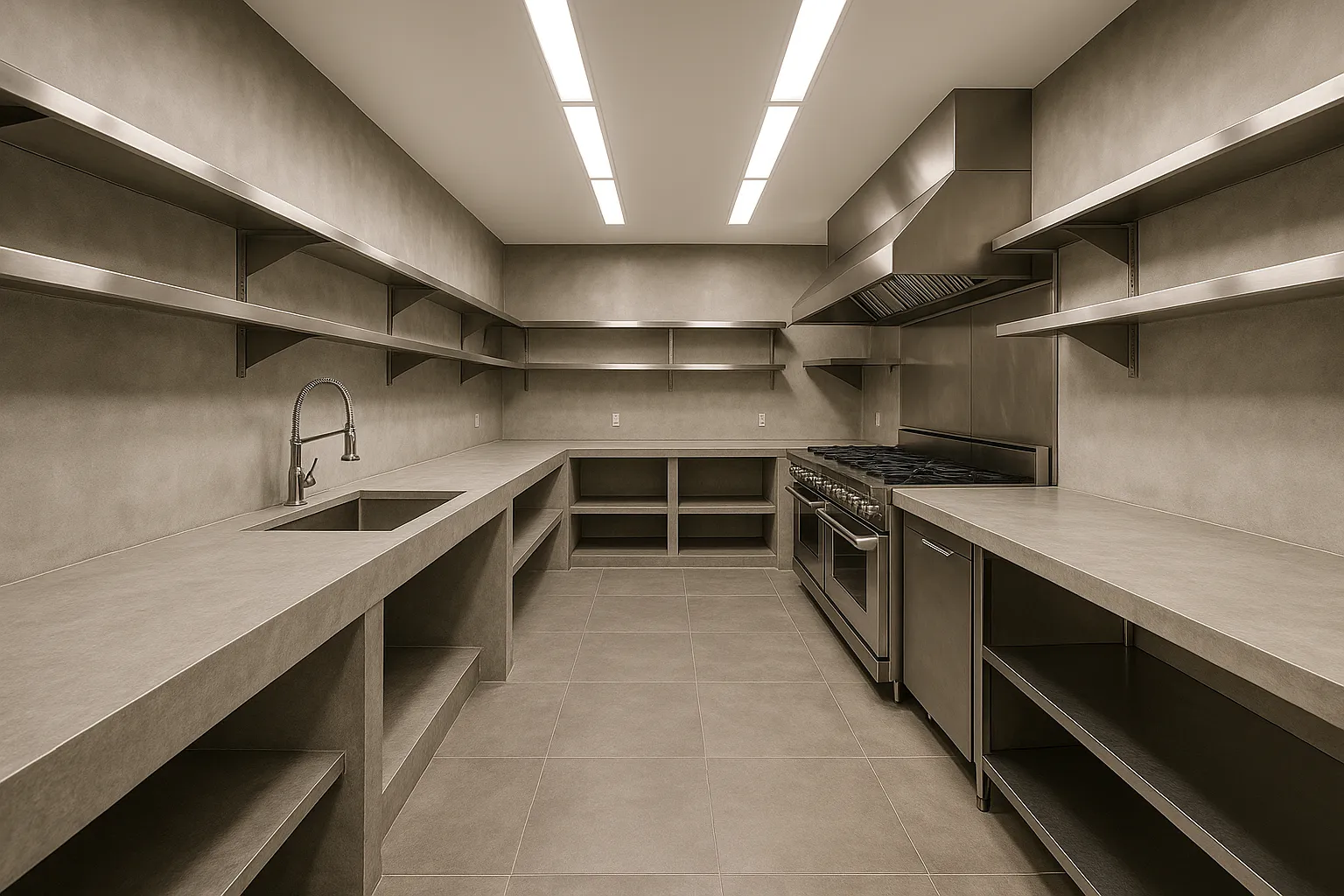
For commercial projects — like the Santa Monica restaurant example above — phased installation can allow partial operation during the work. This requires more planning but is absolutely achievable with an experienced team.
If a contractor quotes you a **2-day microcement kitchen installation**, that's a red flag. Proper cure times cannot be rushed. Skipping cure steps is the #1 cause of microcement failures — cracking, delamination, and sealer adhesion problems.
---
## Why Does Microcement Cost More Than DIY Kits Suggest?
A quick search will turn up DIY microcement kits for $200–$400. So why does professional installation cost thousands? This is worth addressing directly.
What is professional microcement application? It's a multi-coat, multi-day process that requires precise material ratios, consistent application pressure, and trained judgment about when each coat is ready for the next step. The material cost for a professional-grade system on a 60-square-foot countertop might be **$800–$1,200**. The rest is skilled labor — and that labor is what determines whether the surface lasts 20 years or fails in 18 months.
"We've seen homeowners come to us after DIY attempts that looked fine for six months and then started cracking at the edges," says the team at Cemora. "The failure usually traces back to insufficient primer coats or sealer applied before the base coat was fully cured. You can't see those mistakes until it's too late."
Based on data from Cemora's remediation projects, **approximately 35% of microcement repair jobs** in 2025 involved surfaces originally installed by unqualified applicators — either DIY or contractors without specific microcement training. Remediation costs typically run **60–80% of the original installation cost**, making the cheaper option genuinely expensive in the long run.
For bathroom applications where moisture is even more critical, the same principle applies — see our [Microcement Bathrooms & Wet Rooms](/services/microcement-bathrooms?utm_source=blog&utm_medium=organic&utm_campaign=microcement-kitchens-countertops-cost-ca) page for how we approach waterproofing in those environments.

---
## What Affects Resale Value? Is Microcement Worth It in the LA Market?
This is the question that separates a renovation decision from an investment decision.
According to the **2025 Houzz State of the Industry report**, kitchen renovations in the $15,000–$45,000 range returned an average of **62–74% of cost** in increased home value in high-demand California markets. Microcement kitchens, because they photograph exceptionally well and appeal to the design-forward buyer demographic dominant in LA, Beverly Hills, and Santa Monica, tend to perform at the higher end of that range.
A more specific data point: a 2025 analysis by the **National Association of Realtors** found that seamless, contemporary kitchen finishes added an average of **$1.10–$1.40 per dollar spent** in value perception during buyer walkthroughs — not necessarily in appraised value, but in competitive offer situations. In the LA market, where multiple offers above asking are still common in certain price bands, that perception premium is real.
For commercial properties — restaurants, hotels, retail — microcement surfaces contribute to brand identity in ways that are harder to quantify but genuinely valuable. A hospitality client in [West Hollywood](/areas/west-hollywood) reported a **22% increase in social media-generated foot traffic** after a microcement renovation that became a visible backdrop in guest photos. That's not a metric you'll find in an ROI calculator, but it's the kind of outcome that makes commercial microcement investment straightforward to justify.
Explore what's possible for your commercial space at our [Commercial & Hospitality Microcement](/services/microcement-commercial-hospitality?utm_source=blog&utm_medium=organic&utm_campaign=microcement-kitchens-countertops-cost-ca) page, or see how we approach [Microcement Floors & Walls](/services/microcement-floors-walls?utm_source=blog&utm_medium=organic&utm_campaign=microcement-kitchens-countertops-cost-ca) for whole-space continuity.
---
## How to Get an Accurate Quote for Microcement Kitchens in California
Getting a quote that's actually useful requires a bit of preparation on your end. Here's what to have ready:
- **Accurate square footage** of each surface type (floors, countertops, walls/backsplash separately)
- **Photos of existing surfaces** — tile, concrete, plywood, etc.
- **Finish preference** — matte, satin, or polished; smooth or textured
- **Color direction** — even a rough idea (warm grey, off-white, warm earth tone)
- **Timeline** — is there a hard deadline (lease start, listing date, opening day)?
- **Access conditions** — occupied home, active business, second floor, parking constraints
With that information, a qualified studio can give you a **meaningful range within 48 hours** — not a ballpark that spans $20,000.
What is a fair quote process? A legitimate microcement contractor will want to do a site visit before providing a firm number. Any quote given without seeing the substrate should be treated as preliminary. Substrate conditions — moisture, cracks, existing coatings — can significantly affect prep costs.
When you're ready to move forward, [book a consultation](/book?utm_source=blog&utm_medium=organic&utm_campaign=microcement-kitchens-countertops-cost-ca) with Cemora, or [get a free estimate](/estimate?utm_source=blog&utm_medium=organic&utm_campaign=microcement-kitchens-countertops-cost-ca) to start the conversation. We serve Los Angeles, Beverly Hills, Santa Monica, [Pasadena](/areas/pasadena), [Glendale](/areas/glendale), and surrounding areas.
---
## Maintenance Costs: What Happens After Installation?
The total cost of ownership for microcement is genuinely favorable — but only if you maintain it properly. Here's what ongoing maintenance looks like:
- **Daily cleaning:** pH-neutral cleaner, damp mop or cloth. Avoid acidic cleaners (vinegar, citrus-based products) — they degrade sealers over time.
- **Annual inspection:** Check sealer integrity, especially around sink cutouts and high-traffic areas.
- **Resealing:** Countertops typically need resealing every **2–3 years** ($150–$400 for a professional reseal of a standard kitchen). Floors every **3–5 years** depending on traffic.
- **Minor repairs:** Small chips or scratches can be spot-repaired by a professional. Cost: **$200–$600** depending on size and color matching.
Over a **10-year horizon**, the total cost of ownership for microcement — including installation, resealing, and occasional repairs — is typically **comparable to or lower than natural stone**, which requires more frequent sealing and is more vulnerable to staining if maintenance lapses.
For projects across floors and walls throughout the home, explore [Microcement Floors & Walls](/services/microcement-floors-walls?utm_source=blog&utm_medium=organic&utm_campaign=microcement-kitchens-countertops-cost-ca) or reach out directly at [Contact Us](/contact?utm_source=blog&utm_medium=organic&utm_campaign=microcement-kitchens-countertops-cost-ca) with any questions.
---
## Frequently Asked Questions
### How much does microcement kitchen installation cost in California in 2026?
Based on Cemora's 2026 project data, **microcement kitchens & countertops cost CA** typically ranges from **$45–$140 per square foot installed**, depending on surface type, finish specification, and substrate conditions. A countertop-only project for an average kitchen runs **$2,600–$8,800**, while a full kitchen package covering floors, walls, and countertops typically falls between **$13,750 and $60,000**. Commercial projects with larger square footage and food-safe coatings tend to run at the higher end of the range.
### Is microcement a good choice for kitchen countertops?
Microcement is an excellent choice for kitchen countertops if you prioritize seamless aesthetics, design flexibility, and the ability to overlay existing surfaces without demolition. The primary trade-off compared to quartz is that microcement countertops require resealing every 2–3 years and are more vulnerable to heat and sharp impacts — so cutting boards and trivets are essential. For design-forward homeowners in the LA market who want a custom, grout-free surface, it's one of the most versatile options available.
### How long does microcement last on kitchen countertops?
A professionally installed and properly maintained microcement countertop typically lasts **15–25 years** or longer. Longevity depends heavily on three factors: the quality of the original installation (especially substrate prep and sealer application), the regularity of resealing, and daily care habits. Surfaces that are resealed on schedule and cleaned with pH-neutral products consistently outperform those that are neglected — this is true of virtually all mineral surfaces.
### How long does a microcement kitchen project take to complete?
Most residential microcement kitchen projects take **5–10 working days on-site**, which translates to roughly **2–3 calendar weeks** including cure days. Full material cure takes 28 days, though light use is typically permitted after 7–10 days. Commercial projects can often be phased to allow partial operation during installation. Any contractor quoting a 1–2 day kitchen installation should be asked detailed questions about their cure and sealer process.
### Can microcement be applied over existing tile countertops?
Yes — in most cases, microcement can be applied directly over existing ceramic or porcelain tile countertops without demolition, provided the tile is structurally sound, well-adhered, and free of significant moisture issues. The substrate is cleaned, primed, and sometimes skim-coated to minimize grout line telegraphing before the microcement coats are applied. This overlay approach can reduce project costs by **$800–$2,500** compared to a full demo-and-replace approach on a standard kitchen.
### Does microcement add resale value to a home in Los Angeles?
Kitchen renovations in the $15,000–$45,000 range return an average of **62–74% of cost** in increased home value in high-demand California markets, according to the 2025 Houzz State of the Industry report. Microcement kitchens, which photograph well and appeal strongly to design-conscious buyers in LA, Beverly Hills, and Santa Monica, tend to perform at the higher end of that range. In competitive offer situations, seamless contemporary finishes are consistently cited by buyer's agents as a differentiating factor.
### What is the difference between microcement and polished concrete?
What is polished concrete vs. microcement? Polished concrete is an existing concrete slab that is ground, honed, and polished in place — it requires an existing concrete substrate and cannot be applied as a coating. Microcement is a polymer-modified cementitious coating applied at 2–3mm thickness over virtually any stable substrate, including tile, plywood, and drywall. Microcement offers far more design flexibility and can be installed in locations where structural concrete is not present, making it the more practical choice for most kitchen renovation scenarios.
### How do I maintain microcement countertops in a kitchen?
Daily maintenance requires only a pH-neutral cleaner and a damp cloth or mop — avoid vinegar, citrus-based cleaners, and abrasive pads, all of which degrade the sealer over time. Resealing every **2–3 years** is the most important maintenance task; a professional reseal of a standard kitchen countertop typically costs **$150–$400**. Using cutting boards and trivets protects the surface from the two most common damage sources: sharp impacts and direct heat.
### How much does commercial microcement cost in California?
Commercial microcement installations in California — restaurants, hotels, retail, and hospitality spaces — typically run **$70–$140 per square foot installed**, reflecting the higher specification requirements (food-safe sealers, commercial-grade durability coatings) and the logistical complexity of working in active or soon-to-open commercial environments. A 500-square-foot commercial kitchen or bar area would typically cost **$35,000–$70,000** fully installed. Phased installation schedules are available to minimize business disruption.
### What should I look for when hiring a microcement contractor in Los Angeles?
Look for a contractor who can show you **completed projects on substrates similar to yours** — not just portfolio photos, but references you can contact. Ask specifically about their substrate preparation process and how many sealer coats they apply to countertops. A legitimate microcement studio will require a site visit before providing a firm quote, will explain cure times clearly, and will provide a written warranty. In California, verify that the contractor holds a valid **CSLB license** — for microcement work, a C-33 (painting and decorating) or C-35 (lathing and plastering) classification is most relevant.
---
If you're weighing microcement against quartz or tile for your kitchen renovation, the decision usually comes down to two things: how much you value seamless aesthetics, and whether you're comfortable with a surface that requires periodic resealing. For most homeowners in Los Angeles who want a custom, design-forward kitchen without the grout lines and seams of conventional materials, microcement delivers — at a price point that's genuinely competitive when you account for the overlay advantage.
When you're ready to see what your specific kitchen would cost, [get a free estimate](/estimate?utm_source=blog&utm_medium=organic&utm_campaign=microcement-kitchens-countertops-cost-ca) or [contact us](/contact?utm_source=blog&utm_medium=organic&utm_campaign=microcement-kitchens-countertops-cost-ca) directly. We're happy to walk through the numbers with you — no pressure, just specifics.
---
**Ready to start your your project in Los Angeles?** [Book a free consultation](/book?utm_source=blog&utm_medium=organic&utm_campaign=microcement-kitchens-countertops-cost-ca-what-to-expect-in-2026) — we'll come walk through your space and give you straight numbers, no pressure. Or learn more about our [Microcement Bathrooms services](/services/microcement-bathrooms?utm_source=blog&utm_medium=organic&utm_campaign=microcement-kitchens-countertops-cost-ca-what-to-expect-in-2026).