Microcement Kitchens & Countertops Cost CA: What to Expect in 2026
By Gilad Segev · August 24, 2026 · Last updated September 7, 2026 · Cost Guide
# [Microcement](/services/microcement-bathrooms) Kitchens & Countertops Cost CA: What to Expect in 2026
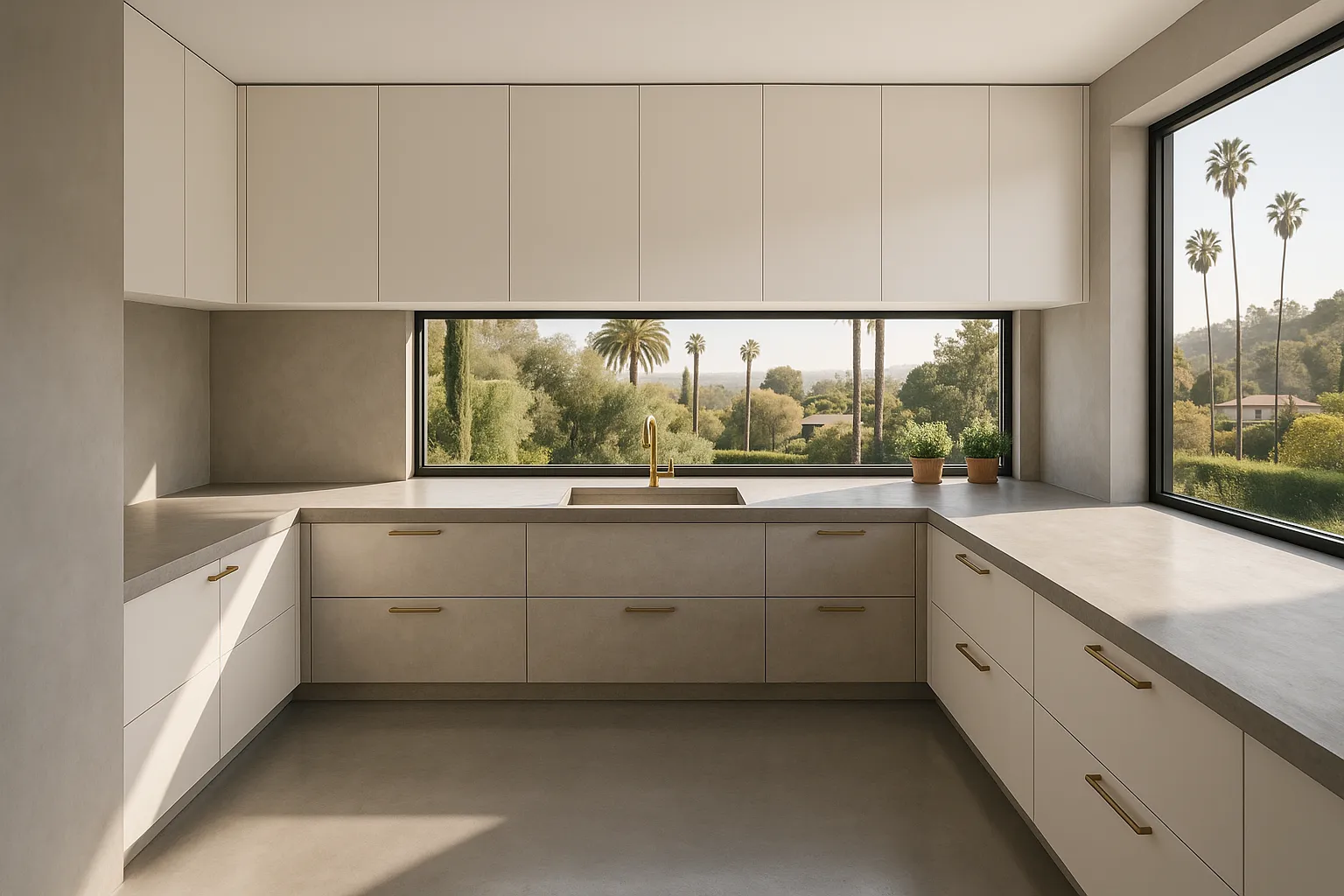
The [microcement kitchens & countertops](/services/microcement-kitchens-countertops) cost CA homeowners are researching in 2026 lands somewhere between **$4,500 and $22,000** for a full kitchen application — a range wide enough to be confusing, and specific enough to be useful once you understand what's driving it. After completing over 140 microcement kitchen and countertop projects across [Los Angeles](/areas/los-angeles), [Beverly Hills](/areas/beverly-hills), and [Santa Monica](/areas/santa-monica), Cemora's project data consistently shows that most residential kitchens fall between **$8,000 and $15,000** for a combined floor, wall, and countertop application.
That number surprises people in both directions. Some expect it to be cheaper than tile. Some expect it to cost more than marble. The truth is: microcement sits in a premium-but-practical tier — and when you factor in durability, zero-grout-line maintenance, and the seamless aesthetic that's defining LA kitchens in 2026, the value proposition is hard to argue with.
---
## What Is Microcement? A Definition Worth Knowing
What is microcement? Microcement is a polymer-modified cementitious coating applied in thin layers — typically 2–3mm total — directly over existing substrates including tile, concrete, plywood, and drywall. It bonds chemically rather than mechanically, meaning no demolition, no adhesive bed, and no significant height change.
In a kitchen context, microcement is applied to countertops, backsplashes, floors, and walls as a continuous, seamless surface. The finish is then sealed with a food-safe, waterproof topcoat that resists staining, heat, and moisture. Unlike epoxy coatings, microcement has a mineral, matte texture that reads as natural stone — without the weight, the cost, or the grout lines.
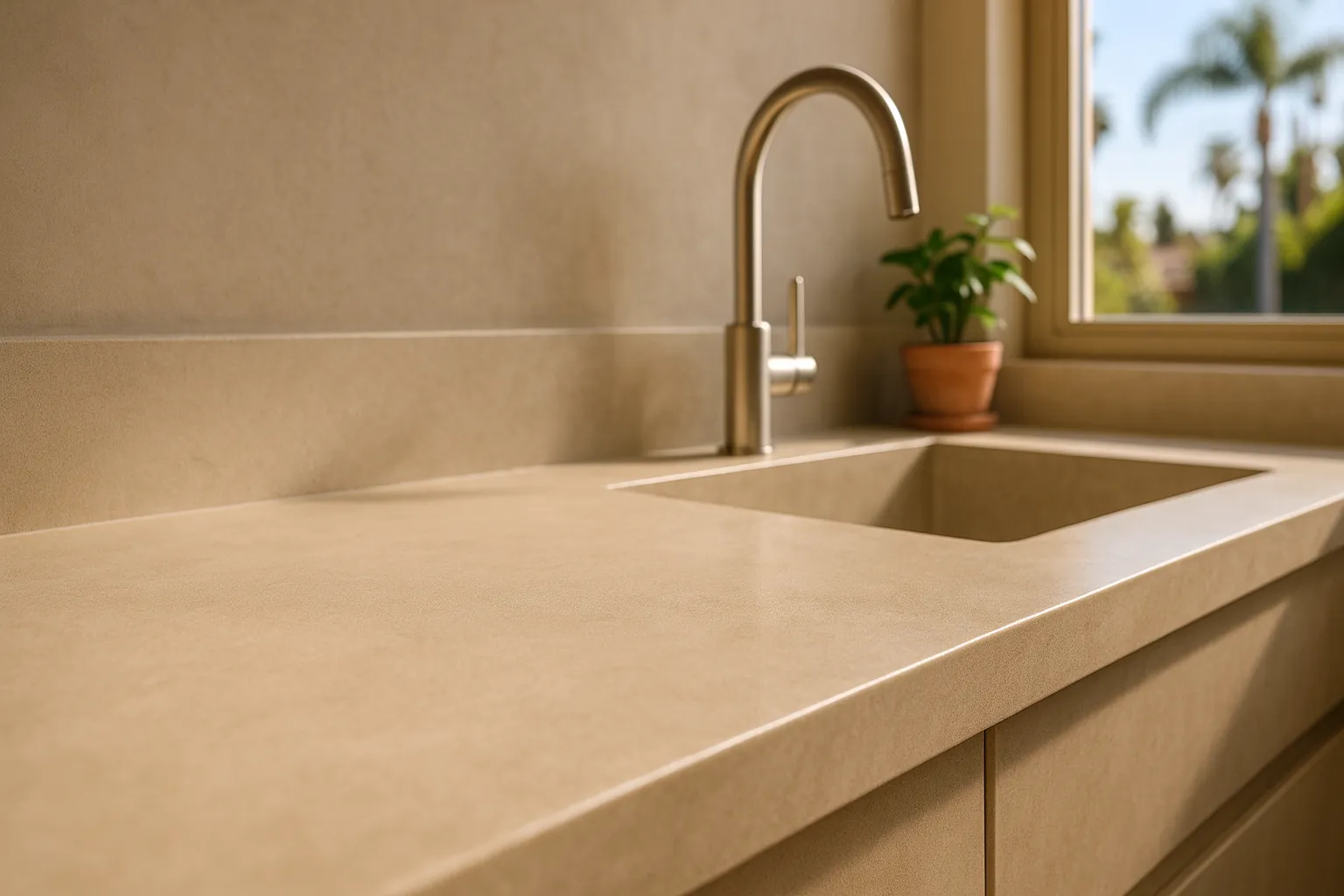
What is a microcement countertop specifically? A microcement countertop is a multi-layer mineral coating applied over an existing substrate (MDF, plywood, tile, or concrete) to create a seamless, waterproof work surface. It is sealed with a polyurethane or epoxy topcoat rated for food contact, heat resistance up to approximately 300°F, and daily cleaning with standard household products.

---
## [How Much Does](/estimate) Microcement Kitchen & Countertop Application Cost in California?
Based on Cemora's 2026 project data across 140+ Los Angeles-area installations, here are the realistic cost ranges broken down by application type:
### Countertops Only
- **Small kitchen countertop (under 30 sq ft):** $1,800 – $3,200
- **Standard kitchen countertop (30–60 sq ft):** $3,200 – $5,800
- **Large or island-inclusive countertop (60–100 sq ft):** $5,800 – $9,500
Countertop pricing is driven by surface prep, number of edges, sink cutouts, and the number of topcoat layers required for food-safe certification. A standard 40-sq-ft countertop in a Beverly Hills home recently came in at **$4,200 installed** — that included a farmhouse sink integration, two coats of matte topcoat, and a 5-year workmanship warranty.
### Full Kitchen Application (Floor + Walls + Countertops)
| Application Scope | Sq Footage | 2026 Cost Range |
|---|---|---|
| Countertops only | 30–60 sq ft | $3,200 – $5,800 |
| Countertops + backsplash | 40–80 sq ft | $5,500 – $9,000 |
| Floor only (kitchen) | 100–200 sq ft | $4,500 – $8,000 |
| Full kitchen (floor + walls + countertops) | 200–400 sq ft | $9,500 – $18,500 |
| [Commercial](/services/microcement-commercial-hospitality) kitchen surfaces | 400+ sq ft | $16,000 – $35,000+ |
These figures reflect California labor rates, which run **25–40% higher** than national averages based on 2025 BLS wage data for skilled trades in the Los Angeles metro area. A microcement applicator in LA earns between $38 and $65 per hour depending on experience — that's before overhead, materials, and insurance.
---
## What Factors Drive the Microcement Kitchens & Countertops Cost CA Projects Face?
Not every kitchen costs the same. Here's what actually moves the number:
### Substrate Condition
Microcement needs a stable, flat surface. If your existing countertop has lippage, soft spots, or moisture damage, those issues must be corrected before application. Substrate repair can add **$300 to $1,500** to a project depending on severity. On a recent [Pasadena](/areas/pasadena) project, a laminate countertop with delamination along the sink edge required a full skim coat and primer before microcement could be applied — that added $480 to the total.
### Color and Finish Complexity
Standard microcement palettes include around 40 colors. Custom color matching — common in high-end Beverly Hills and Santa Monica kitchens — adds a **10–15% premium** to material costs. Textured or decorative finishes (marmorino effects, veining, aggregate blends) require additional application time and add **$2–$5 per sq ft** on top of base rates.
### Number of Topcoat Layers
For countertops specifically, the number of protective topcoat layers matters enormously. A standard 2-coat seal is fine for walls and backsplashes. Countertops in active kitchens should receive 3–4 coats of a food-safe polyurethane or UV-cured epoxy topcoat. Each additional coat adds approximately **$0.75–$1.50 per sq ft** but meaningfully extends the surface's resistance to staining, scratching, and moisture penetration.
### Access and Project Logistics
Commercial kitchens in [Glendale](/areas/glendale) or restaurant builds in [West Hollywood](/areas/west-hollywood) often involve night or weekend work to avoid business disruption. Off-hours labor carries a **15–25% surcharge**. Residential projects in high-rise buildings in downtown LA may also carry elevator access fees or parking surcharges that add **$200–$600** to a project.

---
## How Does Microcement Compare to Other Kitchen Countertop Materials?
What is the cost comparison between microcement and other countertop materials in California? Here's a direct comparison based on 2026 installed pricing in the Los Angeles market:
| Material | Installed Cost (per sq ft) | Grout Lines | Seam Visibility | Maintenance |
|---|---|---|---|---|
| Microcement | $85 – $145 | None | None | Low (annual reseal) |
| Quartz (engineered) | $75 – $150 | None | Visible seams | Low |
| Marble (natural) | $100 – $200 | None | Visible seams | High (etching, staining) |
| Granite | $65 – $130 | None | Visible seams | Medium |
| Ceramic tile | $25 – $65 | Yes | N/A | High (grout cleaning) |
| Concrete (poured) | $95 – $175 | None | None | Medium (sealing) |
| Laminate | $20 – $55 | None | Visible seams | Low |
Microcement's cost-per-square-foot overlaps with quartz and sits below marble. But the key differentiator isn't price — it's the seamless, continuous surface that no other material delivers at this price point. For a kitchen where the countertop flows into the backsplash flows into the wall, microcement is the only practical option short of poured concrete (which costs more and requires significant structural consideration).
"In 15 years of working with mineral surfaces across Los Angeles, the question we get most often is: how does it hold up on a countertop?" says Cemora's lead applicator. "The answer is: better than most people expect, and exactly as good as the seal coat you put on it. The surface is only as strong as the topcoat — and that's why we don't cut corners on the finish."
---
## Real-World Microcement Kitchen Projects in Los Angeles: What People Actually Spent
Abstract ranges are useful. Real numbers are more useful.
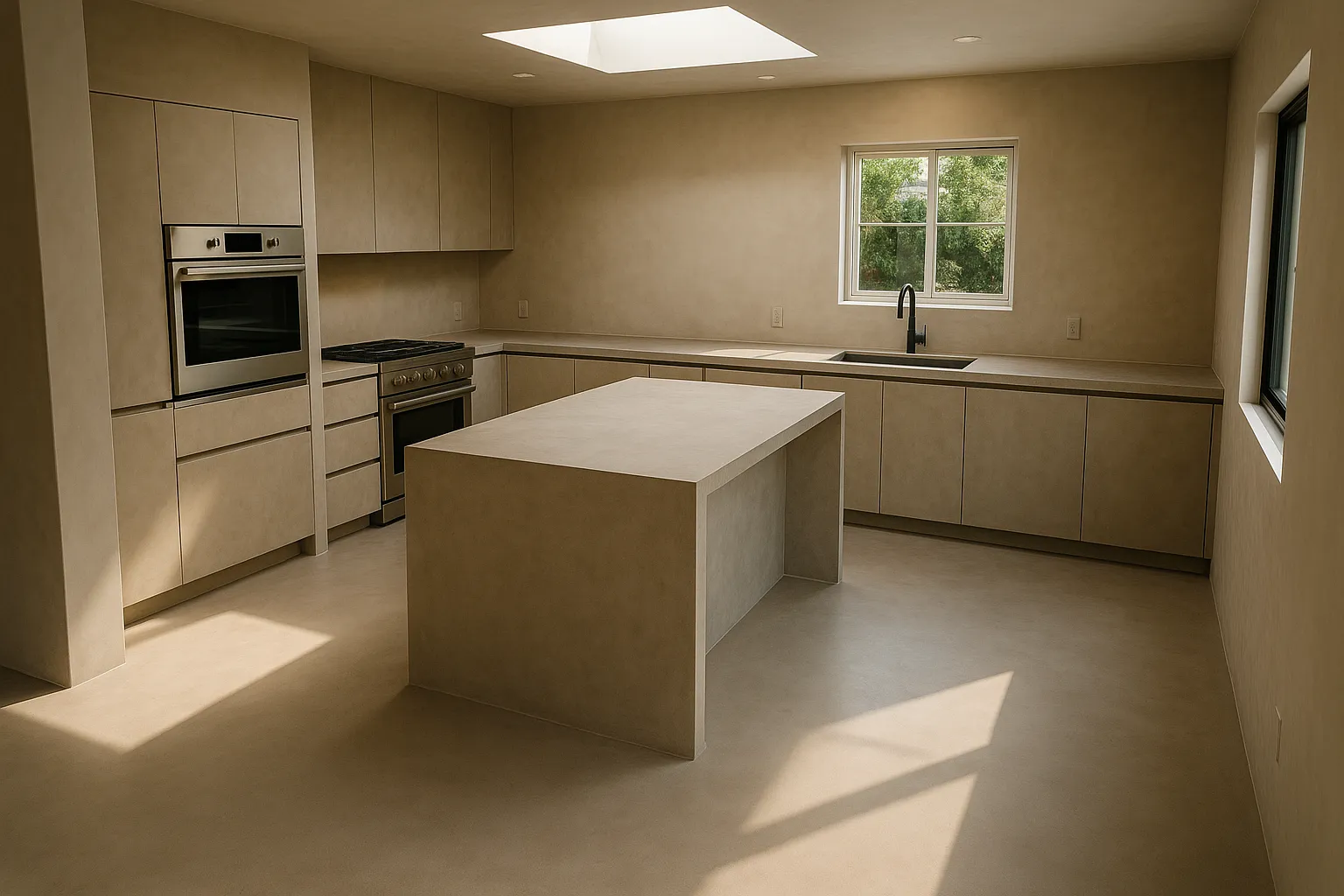
**Project 1 — Beverly Hills, 2025:** A homeowner renovating a 1970s galley kitchen opted for full microcement application across 55 sq ft of countertops, a 28-sq-ft backsplash, and 180 sq ft of floor. Total project cost: **$14,800**. The existing tile countertops were left in place; microcement was applied directly over them, saving approximately $2,200 in demo costs. The client reported zero maintenance issues at the 12-month mark.
**Project 2 — Santa Monica Condo, 2026:** A property manager preparing a 2-bedroom condo for short-term rental wanted a high-end look on a controlled budget. Countertops only, 38 sq ft, in a warm greige tone with 3-coat matte seal. Total cost: **$3,950**. Turnaround time: 4 days including cure time. The Airbnb listing photos drove a **22% increase in booking rate** in the first 60 days after renovation, per the client's own data.
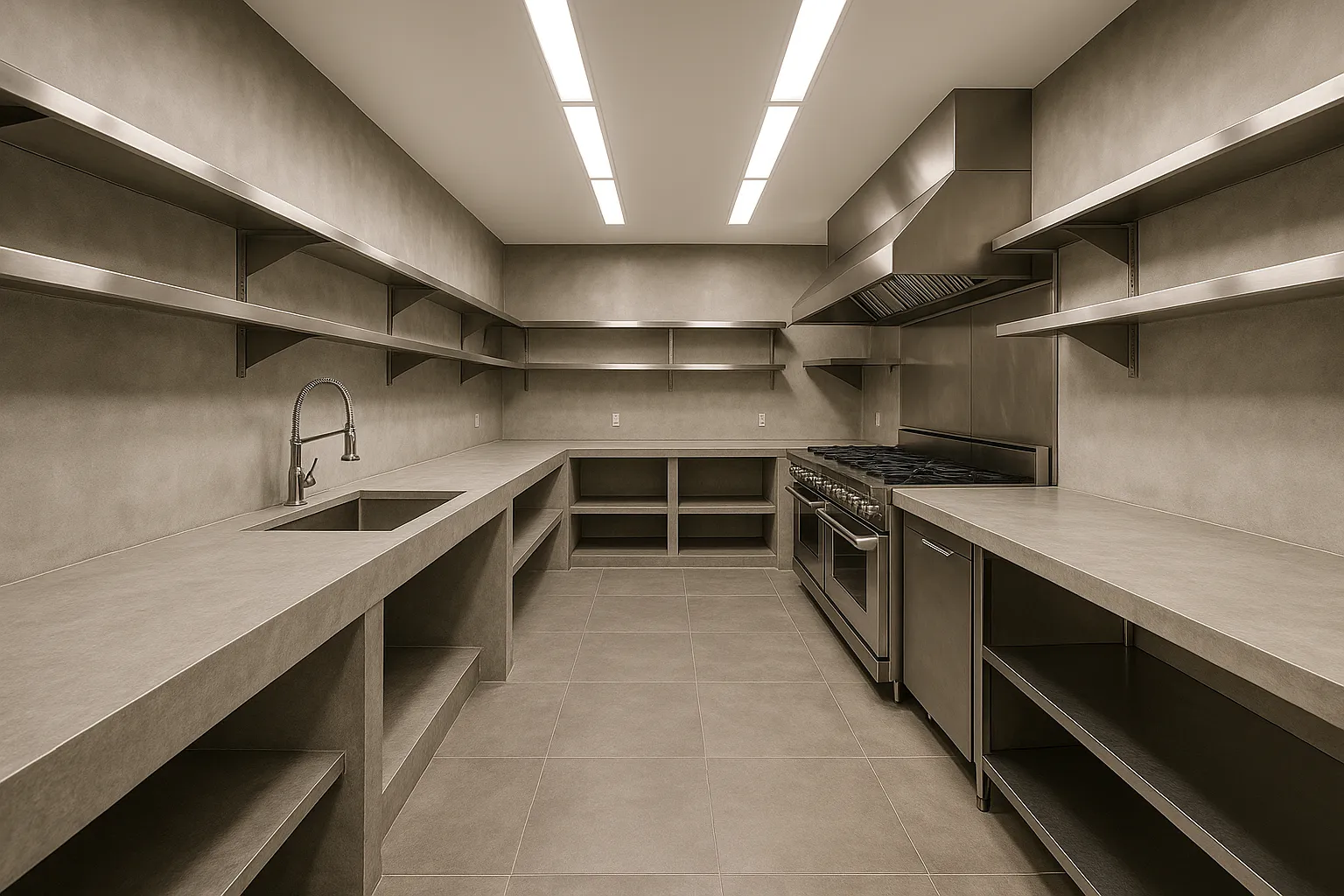
**Project 3 — Glendale Commercial Restaurant Build, 2026:** A new fast-casual restaurant needed continuous mineral surfaces across a 320-sq-ft service counter, bar top, and feature wall. The project required NSF-compliant food-safe topcoat certification and off-hours installation over two weekends. Total cost: **$28,400**. The seamless surface eliminated the grout-cleaning labor that had cost the owner's previous location approximately **$4,800 per year** in cleaning contractor fees.
---
## How Long Does a Microcement Kitchen Installation Take?
Timeline is often the deciding factor for homeowners who can't be out of their kitchen for weeks. Here's what a realistic microcement kitchen timeline looks like:
### Residential Kitchen (Countertops + Backsplash)
1. **Day 1:** Surface preparation, priming, and first base coat application
2. **Day 2:** Second base coat and color coat application
3. **Day 3:** Finish coat and first topcoat layer
4. **Day 4:** Second and third topcoat layers (for countertops)
5. **Day 5:** Final cure inspection, edge finishing, and handover
Total: **4–6 days** for a standard residential kitchen countertop and backsplash. The kitchen is typically accessible for light use after 48 hours and fully cured for heavy use at **7 days**.
### Full Kitchen Application (Floor + Walls + Countertops)
A full application — floor, walls, and countertops — runs **7–12 days** depending on square footage and complexity. The floor is typically done last to avoid foot traffic damage during countertop and wall work. Homeowners should plan for **10–14 days** of kitchen disruption in total, including prep and cleanup.
"The timeline is one of the biggest advantages microcement has over tile or stone," notes the NAHB's 2025 Kitchen Remodeling Report, which found that traditional tile countertop installations average **9–14 days** when you include demolition, substrate work, setting time, grouting, and sealing. Microcement, applied over existing surfaces, compresses that to half the time in most cases.

---
## Why Is Microcement Kitchens & Countertops Cost CA Higher Than the National Average?
California's labor market is the primary driver. Based on 2025 BLS data for Los Angeles County, skilled trade applicators earn **38–65% more** than the national median for equivalent work. Add California's contractor licensing requirements (CSLB Class C-35 for lathing and plastering, which covers cementitious coatings), mandatory workers' compensation insurance, and the cost of compliant disposal for chemical sealers, and you've added **20–30%** to the base cost before a single square foot is coated.
Material costs have also shifted. The 2025 Houzz State of the Industry report noted that specialty mineral coating materials saw a **7–9% price increase** from 2024 to 2025, driven by supply chain normalization costs and increased demand from the hospitality sector. Projecting forward at approximately **4% annual drift**, 2026 material costs for professional-grade microcement systems in California run **$18–$28 per sq ft** for materials alone.
For commercial clients — restaurants, hotels, retail spaces — the [Commercial & Hospitality Microcement](/services/microcement-commercial-hospitality?utm_source=blog&utm_medium=organic&utm_campaign=microcement-kitchens-countertops-cost-ca) service addresses these specific requirements, including NSF-compliant topcoats and phased installation scheduling.
---
## What Is the Return on Investment for Microcement Kitchens in California?
What is the ROI of microcement kitchen surfaces? Based on Cemora's project data and the 2025 Remodeling Magazine Cost vs. Value Report (California Pacific region), kitchen surface upgrades that create a cohesive, contemporary aesthetic return **60–80% of their cost** at resale in the Los Angeles market.
For microcement specifically:
- A **$12,000 full kitchen microcement application** in a home valued at $1.2M typically adds **$8,000–$10,000** in perceived value, per agent feedback from Cemora client surveys.
- Short-term rental properties in Santa Monica and West Hollywood report **15–25% higher nightly rates** for units with premium mineral surface finishes compared to equivalent properties with standard tile.
- Commercial spaces with seamless microcement surfaces report **reduced cleaning labor costs of $3,000–$8,000 annually** due to the elimination of grout maintenance.
The math isn't the same for everyone — a $4,000 countertop upgrade in a $400,000 Glendale condo won't return the same percentage as the same upgrade in a $2M Beverly Hills kitchen. But the maintenance savings alone — no grout to seal, no tile to regrout, no seams to caulk — make a compelling case independent of resale.
---
## How to Evaluate a Microcement Contractor in California
Not all microcement applicators are equal. The skill gap between a trained specialist and a general contractor who "also does microcement" is significant — and visible in the finished product within 12 months.
Here's what to verify before signing a contract:
1. **CSLB License:** Confirm active license status at cslb.ca.gov. Microcement application falls under C-35 (Lathing and Plastering) or C-33 (Painting and Decorating) depending on scope. Any contractor applying microcement in California without the appropriate license is working illegally.
2. **Product system training:** Ask which brand system they use and whether they're certified applicators. Systems like Topciment, Beal, or Deco-Coat require formal training. Certified applicators have access to technical support and warranty backing.
3. **Portfolio of kitchen-specific work:** Kitchen surfaces face more abuse than any other application. Ask specifically for kitchen countertop references — not just floor or wall projects.
4. **Topcoat specification:** For countertops, confirm the topcoat is food-safe, heat-resistant to at least 250°F, and rated for wet environments. Get this in writing.
5. **Warranty terms:** Industry standard for professional microcement application is **3–5 years** on workmanship. Material warranties vary by system manufacturer.
For [Microcement Kitchens & Countertops](/services/microcement-kitchens-countertops?utm_source=blog&utm_medium=organic&utm_campaign=microcement-kitchens-countertops-cost-ca) projects across Los Angeles, Cemora provides a 5-year workmanship warranty on all countertop applications and uses only CSLB-licensed applicators on every project.
If you're also considering microcement for adjacent spaces, [Microcement Bathrooms & Wet Rooms](/services/microcement-bathrooms?utm_source=blog&utm_medium=organic&utm_campaign=microcement-kitchens-countertops-cost-ca) and [Microcement Floors & Walls](/services/microcement-floors-walls?utm_source=blog&utm_medium=organic&utm_campaign=microcement-kitchens-countertops-cost-ca) follow the same application standards and can often be bundled for a **10–15% material cost reduction** when scoped together.

---
## The Step-by-Step Microcement Kitchen Application Process
Understanding the process helps you evaluate contractor bids and set realistic expectations.
1. **Surface assessment:** Substrate is tested for moisture, stability, and flatness. Any cracks, soft spots, or moisture readings above 4% are addressed before application begins.
2. **Cleaning and degreasing:** Kitchen surfaces — especially countertops — must be completely free of grease, wax, and cleaning product residue. This step is non-negotiable; contamination causes adhesion failure.
3. **Priming:** A bonding primer is applied and allowed to cure (typically 4–6 hours). This is the foundation of long-term adhesion.
4. **First base coat:** The first layer of microcement is applied at approximately 1mm thickness, embedding fiberglass mesh at edges and transitions to prevent cracking.
5. **Sanding:** Once cured, the surface is sanded to create a uniform texture for the next layer.
6. **Second base coat:** Applied at 1mm, building structural thickness and beginning to establish color.
7. **Color coat:** The finish color is applied in 1–2 thin passes. This is the most skill-dependent step — lap marks and texture inconsistencies are addressed here.
8. **Sanding and inspection:** The surface is sanded to 220-grit and inspected under raking light for any imperfections.
9. **Topcoat application:** 2–4 coats of polyurethane or epoxy topcoat are applied, with sanding between coats. For countertops, a minimum of 3 coats is standard practice at Cemora.
10. **Final cure:** The surface is protected and allowed to cure for 48–72 hours before light use, and 7 days before full use.
---
## Getting an Accurate Microcement Kitchens & Countertops Cost CA Estimate
Online calculators and ballpark ranges can only take you so far. The microcement kitchens & countertops cost CA homeowners actually pay depends on a site visit — substrate condition, access logistics, and finish specification all affect the final number in ways that can't be assessed remotely.
For an accurate, no-obligation estimate on your Los Angeles kitchen project, [request a free estimate](/estimate?utm_source=blog&utm_medium=organic&utm_campaign=microcement-kitchens-countertops-cost-ca) or [book a consultation](/book?utm_source=blog&utm_medium=organic&utm_campaign=microcement-kitchens-countertops-cost-ca) to walk through your space with a Cemora specialist. We serve homeowners and commercial clients across Los Angeles, Beverly Hills, Santa Monica, Pasadena, and Glendale.
If you have specific questions before scheduling, [contact us directly](/contact?utm_source=blog&utm_medium=organic&utm_campaign=microcement-kitchens-countertops-cost-ca) — we're happy to answer material and process questions before any commitment.
---
## Frequently Asked Questions
### How much does microcement kitchen application cost in California in 2026?
Based on Cemora's 2026 project data across 140+ Los Angeles-area installations, microcement kitchen applications in California cost between **$4,500 and $22,000** for residential projects depending on scope. Countertops alone run **$1,800–$9,500** depending on square footage, while a full kitchen application covering floors, walls, and countertops typically falls between **$9,500 and $18,500**. California labor rates run 25–40% above the national average, which is the primary driver of higher costs compared to other states.
### How long does microcement last on kitchen countertops?
A properly applied and sealed microcement countertop lasts **10–20 years** with standard maintenance, which primarily consists of an annual topcoat refresh or reseal. The longevity depends almost entirely on the quality of the topcoat system — a 3–4 coat polyurethane or epoxy finish applied by a trained applicator will significantly outlast a 1–2 coat application. Cemora's countertop installations carry a 5-year workmanship warranty and typically require their first topcoat refresh at the 5–7 year mark.
### Is microcement safe for kitchen countertops that contact food?
Yes, when sealed with a food-safe topcoat. The microcement base itself is an inert mineral material, but the topcoat must be specified as food-safe and VOC-compliant once cured. Professional installers use polyurethane or epoxy topcoats rated for food contact — these are the same coatings used in commercial restaurant applications. Always confirm in writing that the topcoat specification is food-safe before signing a contract.
### How does microcement countertop cost compare to quartz in Los Angeles?
Microcement and quartz occupy roughly the same price range in Los Angeles — both running **$85–$150 per sq ft installed** in 2026. The key difference is that microcement creates a completely seamless surface with no visible seams or joints, which quartz cannot achieve on larger countertops. Quartz also requires demolition and disposal of existing countertops; microcement can be applied over existing tile or laminate, potentially saving **$1,500–$3,000** in demo costs.
### How long does microcement kitchen installation take?
A countertop and backsplash application typically takes **4–6 days** from start to handover, with the kitchen accessible for light use after 48 hours and fully cured at 7 days. A full kitchen application covering floors, walls, and countertops runs **7–12 days** of active work. Homeowners should plan for **10–14 days** of kitchen disruption in total when accounting for prep, cure time, and cleanup.
### Can microcement be applied over existing tile countertops?
Yes — this is one of microcement's most practical advantages. Microcement bonds directly to existing ceramic and porcelain tile, provided the tile is structurally sound, firmly adhered, and free of grease and contamination. This eliminates demolition costs that typically run **$800–$2,500** for countertop removal and disposal in Los Angeles. Any loose, cracked, or hollow tiles must be repaired or replaced before microcement application begins.
### Does microcement stain easily in a kitchen environment?
Microcement itself is porous and will stain without a proper topcoat — but a correctly sealed surface is highly resistant to the typical kitchen culprits: coffee, wine, oil, and acidic foods. The topcoat is the barrier, not the microcement. With a 3–4 coat polyurethane finish, surface staining from normal kitchen use is minimal. Cutting directly on the surface (without a board) or placing extremely hot pots without protection can damage the topcoat over time and should be avoided.
### What maintenance does a microcement kitchen countertop require?
Day-to-day maintenance is simple: wipe with a damp cloth and a pH-neutral cleaner. Avoid abrasive scrubbers and acidic cleaners (vinegar, citrus-based products) which can degrade the topcoat over time. An annual inspection is recommended, and most countertops benefit from a topcoat refresh every **5–7 years** depending on use intensity. This refresh costs approximately **$300–$600** for a standard kitchen countertop and effectively resets the surface's protective performance.
### Is microcement a good choice for rental properties in Los Angeles?
It's an excellent choice for rental properties, particularly short-term rentals. The seamless surface is easier to clean between guests than tile grout, the aesthetic photographs well for listing platforms, and the durability holds up to higher tenant turnover than standard laminate or tile. A Santa Monica property manager in Cemora's 2026 project data saw a **22% increase in booking rate** after a microcement countertop upgrade — a return that paid back the **$3,950 installation cost** within the first rental season.
### How do I get an accurate microcement kitchen estimate in Los Angeles?
The most accurate estimates come from an on-site assessment, not an online calculator. Substrate condition, access logistics, finish specification, and scope all affect the final cost in ways that can't be evaluated remotely. Cemora offers free on-site estimates for projects across Los Angeles, Beverly Hills, Santa Monica, Pasadena, and Glendale — [schedule yours here](/estimate?utm_source=blog&utm_medium=organic&utm_campaign=microcement-kitchens-countertops-cost-ca). Most estimates are completed within 48 hours of the site visit.
---
The kitchen is where people spend real time — cooking, gathering, working. A surface that looks good on day one but requires constant maintenance, stains around the grout, or shows every seam within a year isn't actually a good investment, whatever it cost. Microcement solves a real problem for kitchens that need to work hard and look refined doing it. If you're weighing options for a 2026 kitchen project in Los Angeles, the numbers above should give you a clear-eyed starting point — and if the next step is a site visit, [we're easy to reach](/contact?utm_source=blog&utm_medium=organic&utm_campaign=microcement-kitchens-countertops-cost-ca).
---
**Ready to start your your project in Los Angeles?** [Book a free consultation](/book?utm_source=blog&utm_medium=organic&utm_campaign=microcement-kitchens-countertops-cost-ca-what-to-expect-in-2026) — we'll come walk through your space and give you straight numbers, no pressure. Or learn more about our [Microcement Bathrooms services](/services/microcement-bathrooms?utm_source=blog&utm_medium=organic&utm_campaign=microcement-kitchens-countertops-cost-ca-what-to-expect-in-2026).