Microcement Kitchens & Countertops Cost CA: What to Expect in 2026
By Gilad Segev · August 31, 2026 · Last updated September 7, 2026 · Cost Guide
# [Microcement](/services/microcement-bathrooms) Kitchens & Countertops Cost CA: What to Expect in 2026
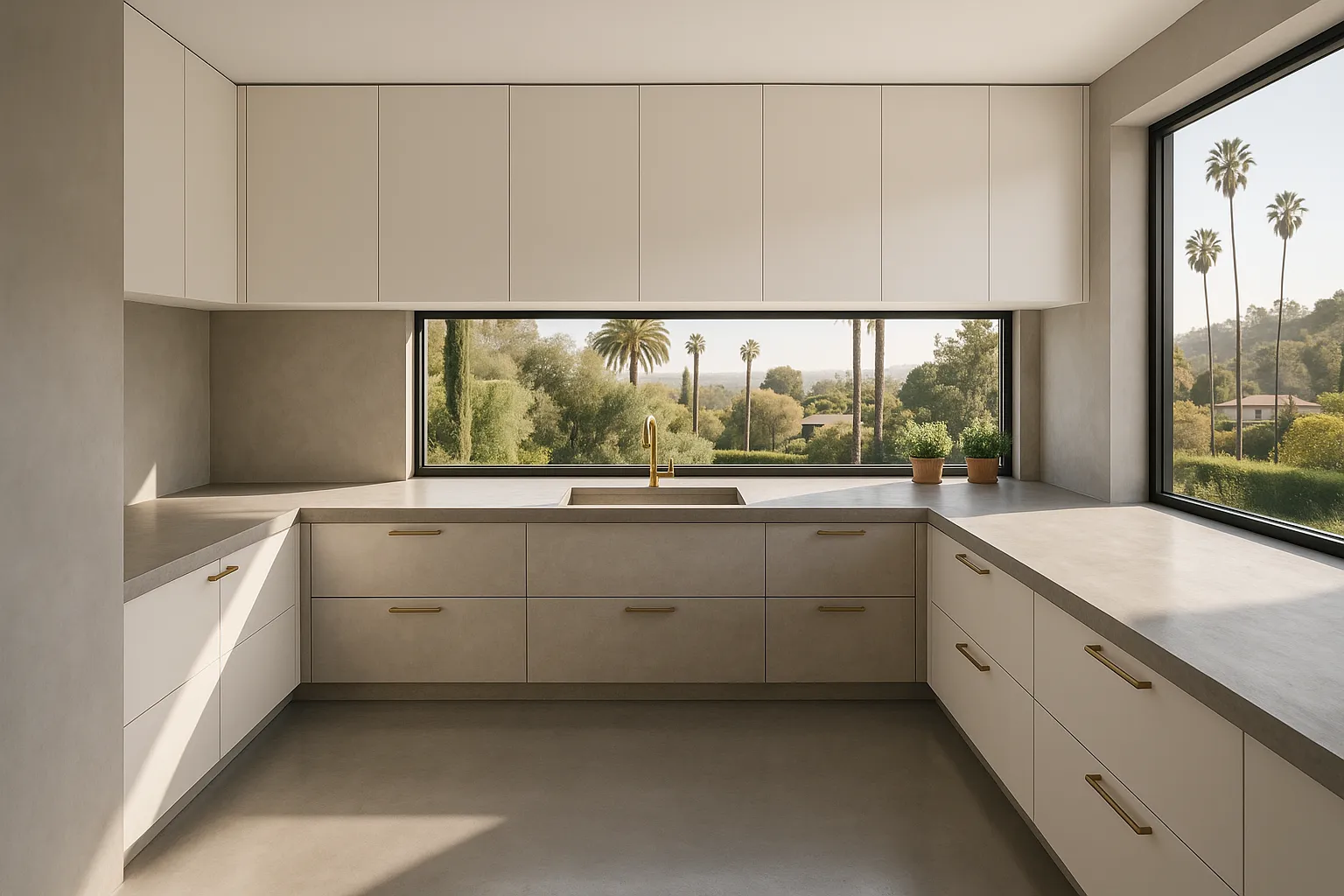
The [microcement kitchens & countertops](/services/microcement-kitchens-countertops) cost CA homeowners are paying in 2026 is landing between **$65 and $130 per square foot installed** — and the gap between those numbers comes down to prep work, surface complexity, and whether you're finishing a 40-sqft island or wrapping an entire kitchen in seamless mineral stone. After completing hundreds of microcement kitchen projects across [Los Angeles](/areas/los-angeles), [Beverly Hills](/areas/beverly-hills), and [Santa Monica](/areas/santa-monica), Cemora's project data shows the average kitchen countertop job runs **$4,800 to $9,500 total**, while full kitchen wall and floor packages in larger homes often clear **$18,000 to $32,000**.
If you've been researching this finish, you've probably landed here because you want a straight answer — not a vague "it depends." This guide gives you real numbers, real timelines, and the honest trade-offs so you can walk into a consultation knowing exactly what questions to ask.
---
## What Is Microcement? A Working Definition for Kitchen Projects
What is microcement? Microcement is a polymer-modified cementitious coating applied in multiple ultra-thin layers — typically 2–3mm total — that bonds directly to existing surfaces without requiring demolition or tile removal. Unlike poured concrete, it's flexible enough to apply over drywall, existing tile, plywood, and even laminate substrates when properly prepared.
In kitchens specifically, microcement earns its place because it's **fully waterproof when sealed**, heat-resistant to around 300°F with proper topcoat selection, and completely seamless — no grout lines, no joints, no bacteria traps. The finish reads as one continuous surface whether it wraps from countertop to backsplash to wall.
What is a microcement countertop? A microcement countertop is a site-applied mineral surface built up in successive coats over an existing substrate, then sealed with a food-safe, [commercial](/services/microcement-commercial-hospitality)-grade polyurethane or epoxy topcoat. The result looks and feels like polished concrete but installs in a fraction of the time and without the structural weight concerns.

---
## Microcement Kitchens & Countertops Cost CA: The Full Breakdown
Let's get specific. Based on Cemora's 2026 project data across Los Angeles County, here's how costs break down by surface type:
### Countertops Only
| Surface Type | Price Per Sq Ft (Installed) | Typical Total Range |
|---|---|---|
| Standard countertop (flat, no sink cutout) | $75–$95/sqft | $3,000–$6,500 |
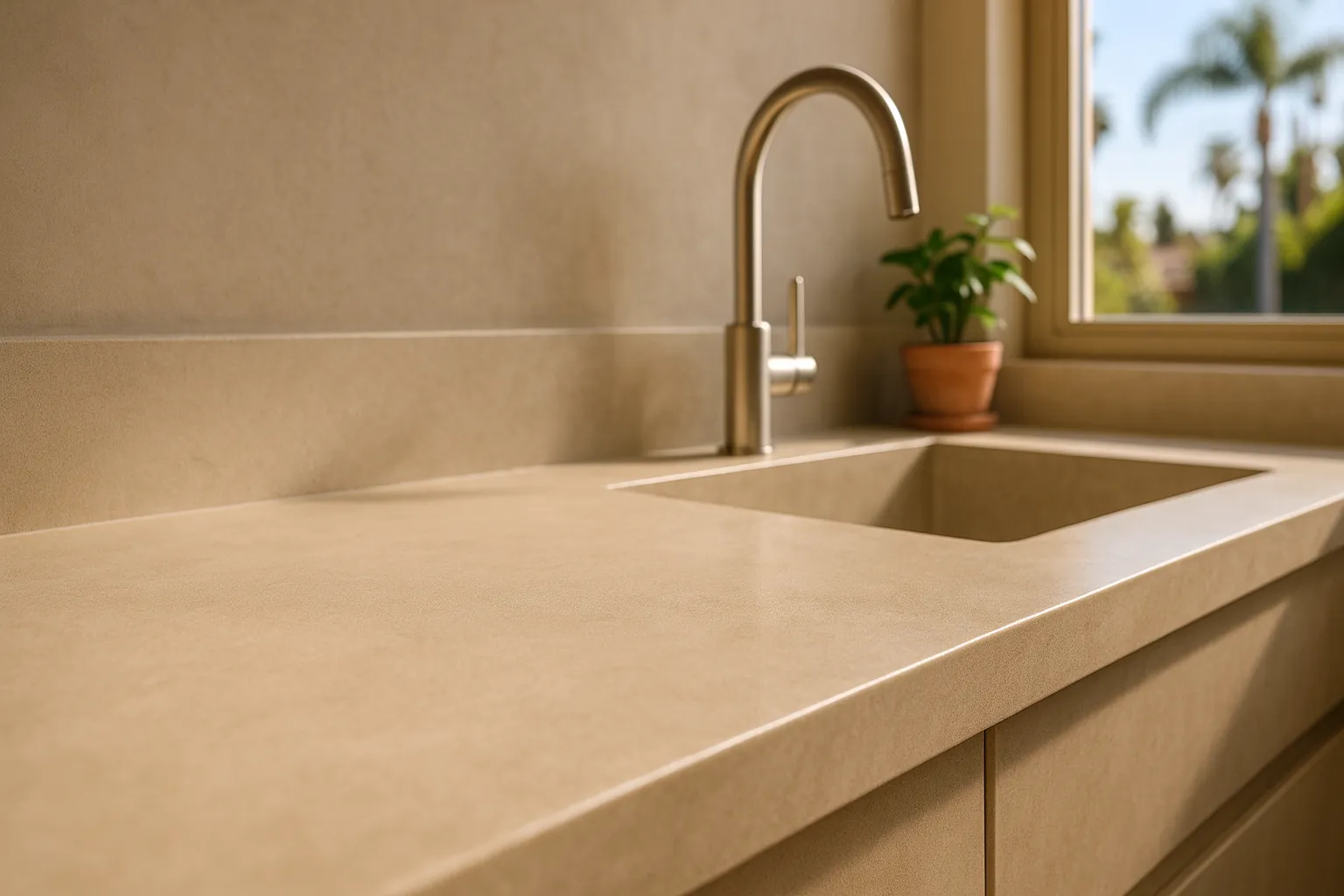
| Countertop with integrated backsplash | $85–$110/sqft | $4,800–$9,500 |
| Island countertop (freestanding, all sides) | $90–$120/sqft | $5,500–$11,000 |
| Full kitchen walls + countertops (package) | $65–$85/sqft blended | $14,000–$32,000 |
| Commercial kitchen surfaces (heavy-duty topcoat) | $95–$130/sqft | $8,000–$45,000+ |
### What Drives the Price Up
Several factors push microcement kitchen costs toward the higher end of the range:
- **Substrate condition**: Unstable, cracked, or uneven existing surfaces require additional prep — often adding **$500–$2,000** to a project
- **Sink cutouts and plumbing penetrations**: Each cutout adds roughly **$200–$400** in labor
- **Color matching and custom tinting**: Standard palette colors are included; fully custom pigment matching adds **$300–$800**
- **Topcoat selection**: A standard matte polyurethane seal is baseline; commercial-grade epoxy or UV-resistant marine topcoats add **$4–$12/sqft**
- **Number of finish coats**: A three-coat system (primer, body, finish) is standard; a five-coat system for high-use commercial kitchens adds **20–30% to labor**
---
## How Does Microcement Compare to Other Kitchen Surface Options?
Homeowners in Los Angeles are typically choosing between microcement, quartzite, quartz engineered stone, poured concrete, and epoxy. Here's how they stack up on cost and practicality in 2026:
| Material | Installed Cost/Sqft (CA, 2026) | Seams | Grout Lines | Reseal Required | Lifespan |
|---|---|---|---|---|---|
| Microcement | $65–$130 | None | None | Every 3–5 yrs | 15–25+ yrs |
| Quartz (engineered) | $80–$140 | Yes (hidden) | None | No | 20–30 yrs |
| Quartzite (natural) | $100–$180 | Yes | None | Annually | 25+ yrs |
| Poured concrete | $90–$150 | None | None | Every 1–3 yrs | 15–20 yrs |
| Epoxy resin | $45–$95 | None | None | Every 2–4 yrs | 8–15 yrs |
| Ceramic tile | $25–$60 | Yes | Yes | Grout only | 20+ yrs |
Microcement sits in a competitive price range, but its real advantage isn't cost — it's the seamless aesthetic and the ability to apply over existing surfaces without tearing out your kitchen.
"We've done side-by-side cost comparisons for clients choosing between microcement and quartzite," says Cemora's lead applicator. "Once you factor in demolition, disposal, and the structural reinforcement sometimes needed for heavy stone, microcement often comes in **15–25% less total project cost** — and the finish is honestly more interesting."

---
## Real-World Project Costs: Three California Kitchens in 2026
Numbers on a page only mean so much. Here are three actual project profiles from Cemora's recent work across Southern California:
### Project 1: Santa Monica Condo Kitchen — $6,200 Total
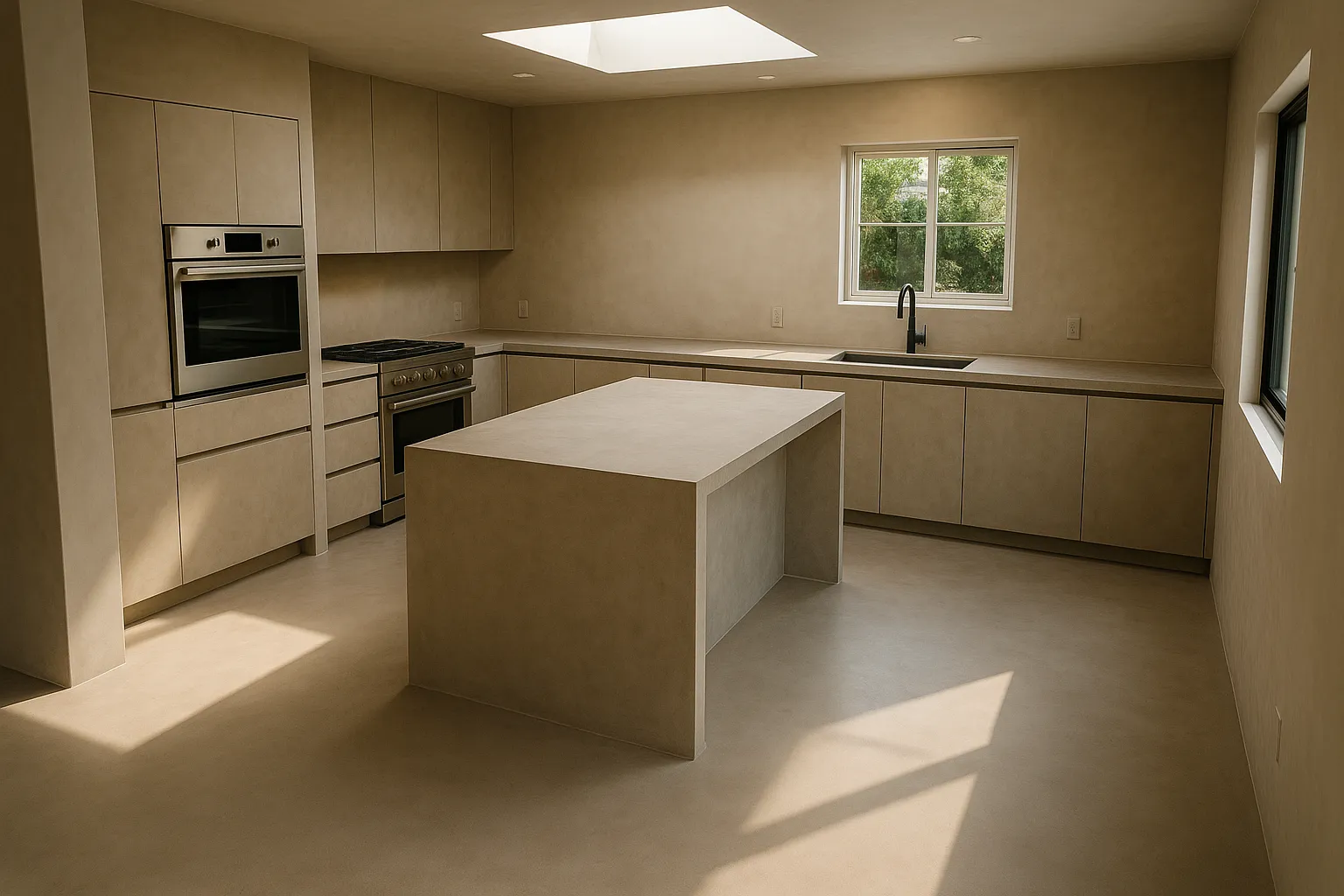
A homeowner in Santa Monica had a 1,100-sqft condo with an open-plan kitchen featuring **52 sqft of existing laminate countertops** and a tile backsplash she wanted gone. The existing laminate was in solid condition — no delamination, no soft spots — which meant minimal prep. Cemora applied microcement directly over both surfaces: countertops, integrated backsplash, and the island peninsula. The project took **4 days**, used a warm sand-tone pigment, and finished with a matte commercial polyurethane seal. Total: **$6,200**. She avoided **$9,000–$14,000** in quartzite installation and demo costs.
### Project 2: [Pasadena](/areas/pasadena) Craftsman Full Kitchen Package — $24,800 Total
A couple in Pasadena renovating a 1920s Craftsman wanted the entire kitchen wrapped — countertops, backsplash, and all four walls up to the ceiling — in a warm charcoal microcement. The kitchen measured **310 sqft of total surface area** including walls. Substrate prep was significant: the original plaster walls had hairline cracking that required skim coating and mesh reinforcement before microcement application. The project ran **9 days** across two visits (allowing cure time between coats). Total: **$24,800**. The finished space was featured in a West LA interior design blog and added an estimated **$40,000–$55,000** to the home's appraised value based on their realtor's comparable analysis.
### Project 3: Downtown LA Restaurant Kitchen Pass-Through — $38,500 Total
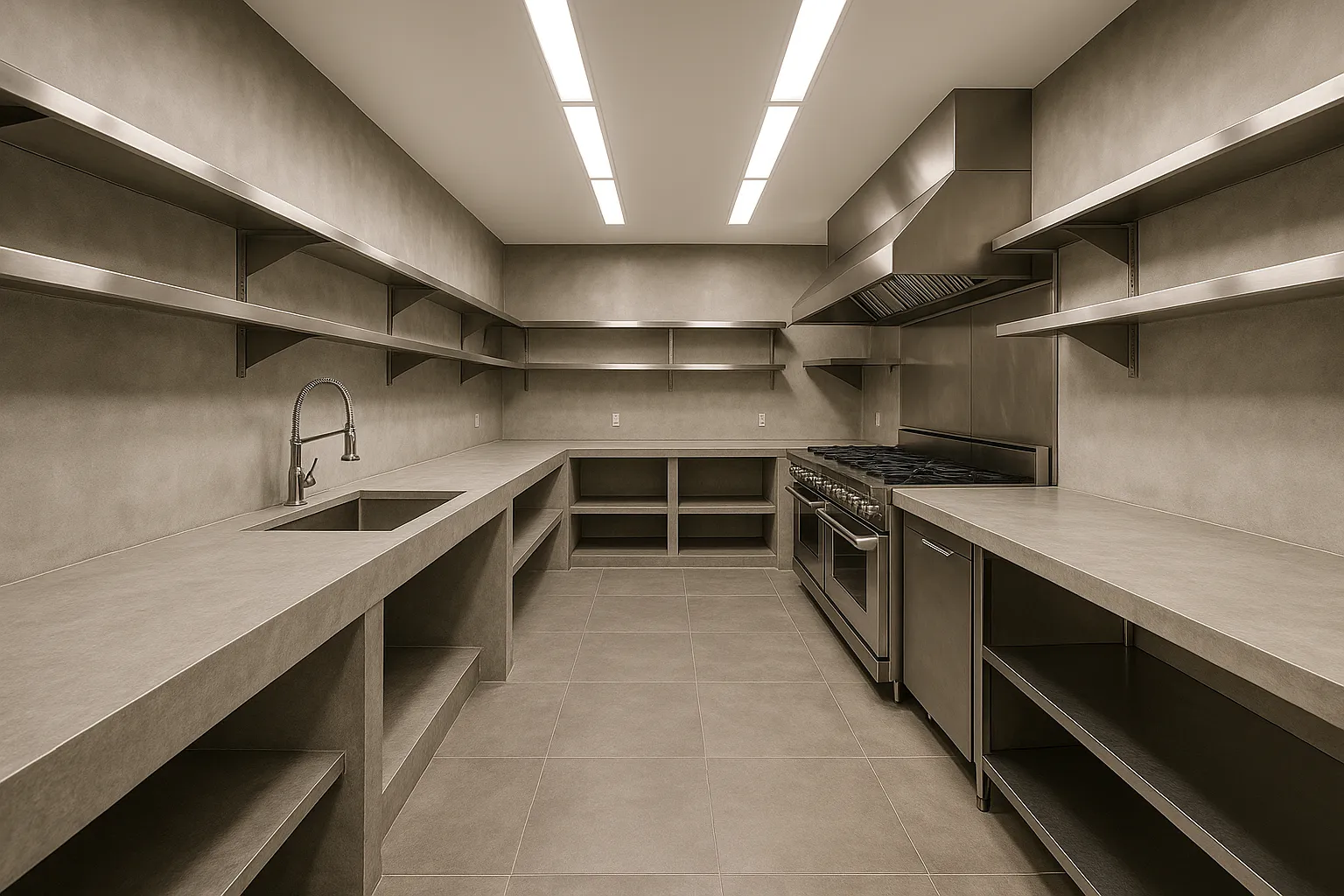
A restaurant group opening a new concept in Downtown Los Angeles needed **420 sqft of commercial kitchen pass-through surfaces** — counters, shelving faces, and a floor-to-ceiling service wall — finished in a dark slate microcement with a commercial-grade epoxy topcoat rated for daily sanitizer contact. This required a five-coat application system, food-safe pigments, and a topcoat certified for commercial food-contact surfaces. The project ran **12 days** with phased application to keep the adjacent prep kitchen operational. Total: **$38,500**. Industry benchmarks show commercial microcement installations in California average **$95–$130/sqft** for heavy-use applications — this project landed at **$91.67/sqft** due to the straightforward substrate condition.
---
## How Long Does Microcement Kitchen Installation Take?
Timeline is one of the most common questions homeowners ask — and it's one of the clearest advantages microcement has over traditional renovation approaches.
### Typical Installation Timeline
Here's a step-by-step breakdown of how a standard microcement kitchen countertop installation proceeds:
1. **Day 1 — Substrate assessment and prep**: Existing surface is cleaned, degreased, and any soft spots, cracks, or delamination are addressed. Primer coat is applied.
2. **Day 1–2 — First body coat**: The base microcement layer is troweled on and allowed to cure for **18–24 hours**.
3. **Day 2–3 — Sanding and second body coat**: The first coat is lightly sanded, imperfections are filled, and the second coat is applied.
4. **Day 3–4 — Finish coat and texture work**: The final microcement layer is applied with the desired texture — smooth, polished, or slightly textured aggregate finish.
5. **Day 4–5 — Sealing**: Two to three coats of the selected topcoat are applied with **4–6 hours** between coats.
6. **Day 5–7 — Cure and handover**: The surface is left to cure fully before use. Light use is possible after **48 hours**; full cure (including heat resistance) takes **7 days**.
**Total kitchen countertop project: 5–7 days from start to use.**
For full kitchen packages including walls and floors, expect **8–14 days** depending on square footage and complexity. Compare that to a tile or stone installation, which typically runs **2–4 weeks** including demo, delivery lead times, and grouting cure.
---
## Why Is Microcement Gaining Ground in California Kitchens?
Microcement kitchens & countertops cost CA comparisons are only part of the story. The format is gaining share in Los Angeles and across Southern California for reasons that go beyond price.
California's design culture leans toward clean, material-honest interiors — and microcement fits that aesthetic precisely. The finish has visible texture and depth that reads as genuinely artisanal, not mass-produced. In a market where **72% of luxury home buyers in LA County cite kitchen design as a top purchase factor** (based on 2025 Zillow Research data for the LA metro), a distinctive surface matters.
The sustainability angle resonates too. Microcement generates **zero demolition waste** when applied over existing surfaces — no tile going to landfill, no concrete being jackhammered. A 2025 NAHB survey found that **68% of California homeowners** ranked sustainability as an important factor in renovation material selection, up from 54% in 2023.
And then there's the practical reality of California living: microcement's seamless, non-porous sealed surface means no grout lines harboring bacteria, no joints trapping moisture in a state where water consciousness matters. For homeowners who cook seriously, that translates to a surface that's genuinely easier to maintain than tile.

---
## What Affects the Microcement Kitchens & Countertops Cost CA Homeowners Pay?
Understanding cost drivers helps you budget accurately and avoid surprises. Here are the variables that move the needle most:
### Substrate Condition
This is the single biggest wildcard. A solid, flat, well-bonded existing surface (like intact laminate or stable tile) adds minimal prep cost. A substrate with movement, soft spots, or significant unevenness can add **$800–$3,500** in remediation before a single coat of microcement goes on.
### Kitchen Size and Layout Complexity
A galley kitchen with 30 sqft of countertop is straightforward. An L-shaped kitchen with an island, a peninsula, integrated sink, and a range surround involves significantly more cutting in, masking, and detail work. Expect **$200–$600 in additional labor** per complex transition or penetration.
### Topcoat Selection
The sealer is where commercial kitchens diverge sharply from residential. A residential matte polyurethane is included in standard pricing. A commercial epoxy topcoat rated for food-contact surfaces and daily chemical sanitizer use adds **$6–$14/sqft** to the project cost — but it's non-negotiable for restaurant applications.
### Location Within Los Angeles
Labor rates vary across the LA metro. Projects in Beverly Hills and [Malibu](/areas/malibu) typically run **8–15% higher** than equivalent work in [Glendale](/areas/glendale) or Pasadena, reflecting local contractor overhead and client expectations for premium service delivery.
### Color and Finish Complexity
Solid colors in the standard palette are baseline. Two-tone applications, decorative aggregate effects, or metallic pigment blending add **$8–$18/sqft** for the additional technique and material cost.
---
## How Does Microcement Hold Up in a Kitchen Environment?
Durability is the question that separates curious homeowners from committed ones. Here's the honest answer:
Microcement countertops sealed with a quality commercial polyurethane will handle daily kitchen use without issue — hot pots up to **300°F with trivets**, cutting boards (always use one; this applies to every countertop material), acidic foods, oils, and routine cleaning. The surface is **fully waterproof** once sealed.
The realistic maintenance picture: residential kitchen surfaces benefit from a **light reseal every 3–5 years**, which is a same-day service costing **$300–$700** depending on square footage. High-use commercial surfaces may need resealing every **18–24 months**. Compare that to natural stone, which requires annual sealing for most varieties.
Scratch resistance is honest: microcement is harder than epoxy but softer than quartz. It will show fine scratches over time in high-traffic areas, which many clients actually appreciate as a patina that adds character. If you want a surface that looks factory-new at year ten, quartz is a better fit. If you want a surface that develops a lived-in mineral quality, microcement rewards that expectation.
For more on how microcement performs in wet environments, see our full guide on [Microcement Bathrooms & Wet Rooms](/services/microcement-bathrooms?utm_source=blog&utm_medium=organic&utm_campaign=microcement-kitchens-countertops-cost-ca) — the durability principles are directly applicable.
---
## Microcement Kitchens & Countertops Cost CA: Commercial vs. Residential
The cost gap between residential and commercial microcement kitchen installations in California is real and worth understanding before you budget.
Residential kitchen projects — countertops, backsplash, walls — run **$65–$110/sqft installed** in most LA neighborhoods. Commercial projects, including restaurant kitchens, hospitality food prep areas, and café service counters, run **$95–$130/sqft** for the same square footage because of:
- **Topcoat specification**: Commercial food-safe epoxy costs more than residential polyurethane
- **Application complexity**: Five-coat systems vs. three-coat residential standard
- **Timeline constraints**: Phased installation to avoid shutting down operations entirely
- **Code compliance documentation**: Some commercial kitchens require material certifications for health department approval
If you're outfitting a commercial space, explore Cemora's [Commercial & Hospitality Microcement](/services/microcement-commercial-hospitality?utm_source=blog&utm_medium=organic&utm_campaign=microcement-kitchens-countertops-cost-ca) services — commercial installations have specific requirements that differ meaningfully from residential work.

---
## What to Ask Before Hiring a Microcement Applicator in California
Not all microcement installers are equal. The material is unforgiving — application errors show up as pinholes, delamination, or color inconsistency, and fixing them requires stripping back to substrate. Here's what separates qualified applicators from weekend warriors:
1. **Ask for manufacturer certification**: Reputable microcement brands (Topciment, Bautech, Deco Cement) certify applicators. Ask which system they use and whether they're certified to apply it.
2. **Request a sample board**: Any serious applicator will produce a sample in your chosen color and finish before starting your project. If they won't, walk away.
3. **Ask about substrate assessment**: A professional will inspect your existing surfaces and tell you honestly whether prep work is needed before quoting.
4. **Verify their topcoat recommendation**: The sealer is as important as the microcement itself. Ask what they're using, why, and what the recoat schedule is.
5. **Get a written warranty**: Reputable installers warranty their work for **2–5 years** against delamination and application defects.
For kitchen and countertop projects specifically, see Cemora's [Microcement Kitchens & Countertops](/services/microcement-kitchens-countertops?utm_source=blog&utm_medium=organic&utm_campaign=microcement-kitchens-countertops-cost-ca) service page for a full overview of our process and material specifications.
---
## Microcement Kitchens & Countertops Cost CA: Is the Investment Worth It?
Here's the honest math. A microcement kitchen countertop and backsplash package in Los Angeles runs **$5,000–$10,000** for most residential kitchens. A comparable quartzite installation — including demo, material, and install — runs **$9,000–$18,000** for the same surface area.
The 2025 Remodeling Magazine Cost vs. Value Report (Pacific region data) shows kitchen countertop upgrades return an average of **72–84% of cost** at resale in the LA metro. Microcement's return is harder to isolate because it's newer to the market, but Cemora's clients who've sold post-installation consistently report realtor feedback placing the finish in the "premium upgrade" category — the same tier as high-end stone.
For floors and walls in addition to countertops, the [Microcement Floors & Walls](/services/microcement-floors-walls?utm_source=blog&utm_medium=organic&utm_campaign=microcement-kitchens-countertops-cost-ca) package approach often delivers better per-sqft pricing than individual surface quotes — worth asking about if you're considering a full kitchen transformation.
The bottom line: microcement kitchens & countertops cost CA homeowners a competitive amount compared to premium stone, with lower installation disruption, zero demolition waste, and a finish that's genuinely distinctive. Whether that trade-off makes sense depends on your aesthetic goals and how long you plan to stay in the home.
If you're ready to put real numbers to your specific kitchen, [get a free estimate](/estimate?utm_source=blog&utm_medium=organic&utm_campaign=microcement-kitchens-countertops-cost-ca) or [book a consultation](/book?utm_source=blog&utm_medium=organic&utm_campaign=microcement-kitchens-countertops-cost-ca) — we'll assess your substrate, walk you through material options, and give you a project-specific number, not a range pulled from a spreadsheet.
---
## Frequently Asked Questions
### [How much does](/estimate) microcement kitchen countertop installation cost in California in 2026?
Based on Cemora's 2026 project data across Los Angeles County, microcement countertop installation runs **$75–$110 per square foot installed** for residential kitchens, with most projects totaling **$4,800–$9,500** for a standard kitchen. Full kitchen packages including walls and backsplash run **$14,000–$32,000** depending on square footage and substrate condition. Commercial applications with heavy-duty topcoats run **$95–$130/sqft**.
### How long does microcement kitchen installation take?
A standard residential countertop project takes **5–7 days** from first coat to handover, including cure time. Full kitchen packages covering walls, backsplash, and countertops typically run **8–14 days** across two site visits to allow proper inter-coat cure. The surface can handle light use after **48 hours** but reaches full cure — including heat resistance — at **7 days**.
### Is microcement safe for kitchen countertops and food contact?
Yes, when sealed with an appropriate food-safe topcoat. Residential applications use commercial-grade polyurethane sealers that are non-toxic once cured. Commercial kitchens requiring daily chemical sanitizer contact should specify an epoxy topcoat certified for food-contact surfaces, which adds **$6–$14/sqft** to the project cost. Always confirm the topcoat specification with your applicator before signing a contract.
### How does microcement compare to quartz countertops in California?
Quartz engineered stone installs at **$80–$140/sqft** in California in 2026, putting it in a similar range to microcement at **$75–$110/sqft**. The key differences: quartz has visible seams on longer runs, requires no resealing, and is harder and more scratch-resistant. Microcement is completely seamless, requires resealing every **3–5 years**, and offers a more distinctive handmade aesthetic. When you factor in demolition costs for replacing existing surfaces, microcement often comes in **15–25% less total project cost**.
### How long does microcement last on kitchen countertops?
A properly installed and maintained microcement countertop lasts **15–25 years** in residential applications. The finish itself is durable; the maintenance variable is the topcoat, which should be refreshed every **3–5 years** for residential use and every **18–24 months** in commercial kitchens. Resealing is a same-day service costing **$300–$700** depending on surface area — it's not a major undertaking.
### What is the difference between microcement and poured concrete countertops?
What is poured concrete? Poured concrete countertops are cast in place or precast offsite in full thickness — typically **1.5–3 inches thick** — and add significant structural weight to cabinetry. Microcement applies as a **2–3mm coating** over existing surfaces, adds negligible weight, and installs without formwork or curing time measured in weeks. Poured concrete runs **$90–$150/sqft installed** in California; microcement runs **$75–$110/sqft**. Both require periodic sealing, but microcement's thinner profile means it's more vulnerable to substrate movement — proper prep is essential.
### Can microcement be applied over existing tile or laminate in a kitchen?
Yes — this is one of microcement's primary advantages. Microcement bonds directly to existing tile (as long as it's stable and well-adhered), laminate (when properly primed), plywood, and drywall. The substrate must be clean, structurally sound, and free of movement. Any loose tiles, delaminating laminate, or soft spots must be addressed before application. Skipping substrate prep is the most common cause of microcement failure — budget **$500–$2,000** for prep work on older kitchens.
### Does microcement add value to a home in Los Angeles?
Based on feedback from Cemora clients who've sold their homes post-installation, realtors consistently categorize microcement kitchens as a premium upgrade — equivalent in perceived value to high-end stone surfaces. The 2025 Remodeling Magazine Cost vs. Value Report (Pacific region) shows kitchen surface upgrades return **72–84% of cost** at resale in the LA metro. Microcement's seamless, distinctive finish tends to photograph exceptionally well, which matters in a market where **over 90% of LA home searches begin online**.
### What maintenance does a microcement kitchen countertop require?
Day-to-day maintenance is simple: wipe with a damp cloth or mild pH-neutral cleaner. Avoid abrasive scrubbers, acidic cleaners (vinegar, citrus-based products), and prolonged standing water near unsealed edges. The topcoat handles the protection — maintaining it means resealing every **3–5 years** for residential use. Use trivets for hot pots and cutting boards for food prep, as you would with any quality surface.
### How do I get an accurate quote for microcement kitchen countertops in Los Angeles?
The most reliable way is an in-person substrate assessment — photos and measurements help, but the condition of your existing surface determines prep requirements, which significantly affect final cost. Cemora offers free on-site estimates across Los Angeles, Beverly Hills, Santa Monica, Pasadena, and Glendale. [Contact us](/contact?utm_source=blog&utm_medium=organic&utm_campaign=microcement-kitchens-countertops-cost-ca) to schedule, or [book a consultation](/book?utm_source=blog&utm_medium=organic&utm_campaign=microcement-kitchens-countertops-cost-ca) directly online. Expect the assessment to take **45–60 minutes** and to walk away with a written project-specific quote.
---
**Ready to start your your project in Los Angeles?** [Book a free consultation](/book?utm_source=blog&utm_medium=organic&utm_campaign=microcement-kitchens-countertops-cost-ca-what-to-expect-in-2026) — we'll come walk through your space and give you straight numbers, no pressure. Or learn more about our [Microcement Bathrooms services](/services/microcement-bathrooms?utm_source=blog&utm_medium=organic&utm_campaign=microcement-kitchens-countertops-cost-ca-what-to-expect-in-2026).