Microcement Kitchens & Countertops Cost CA: What to Expect in 2026
By Gilad Segev · September 7, 2026 · Last updated September 7, 2026 · Cost Guide
## [Microcement](/services/microcement-bathrooms) Kitchens & Countertops Cost CA: What Homeowners Are Actually Paying in 2026
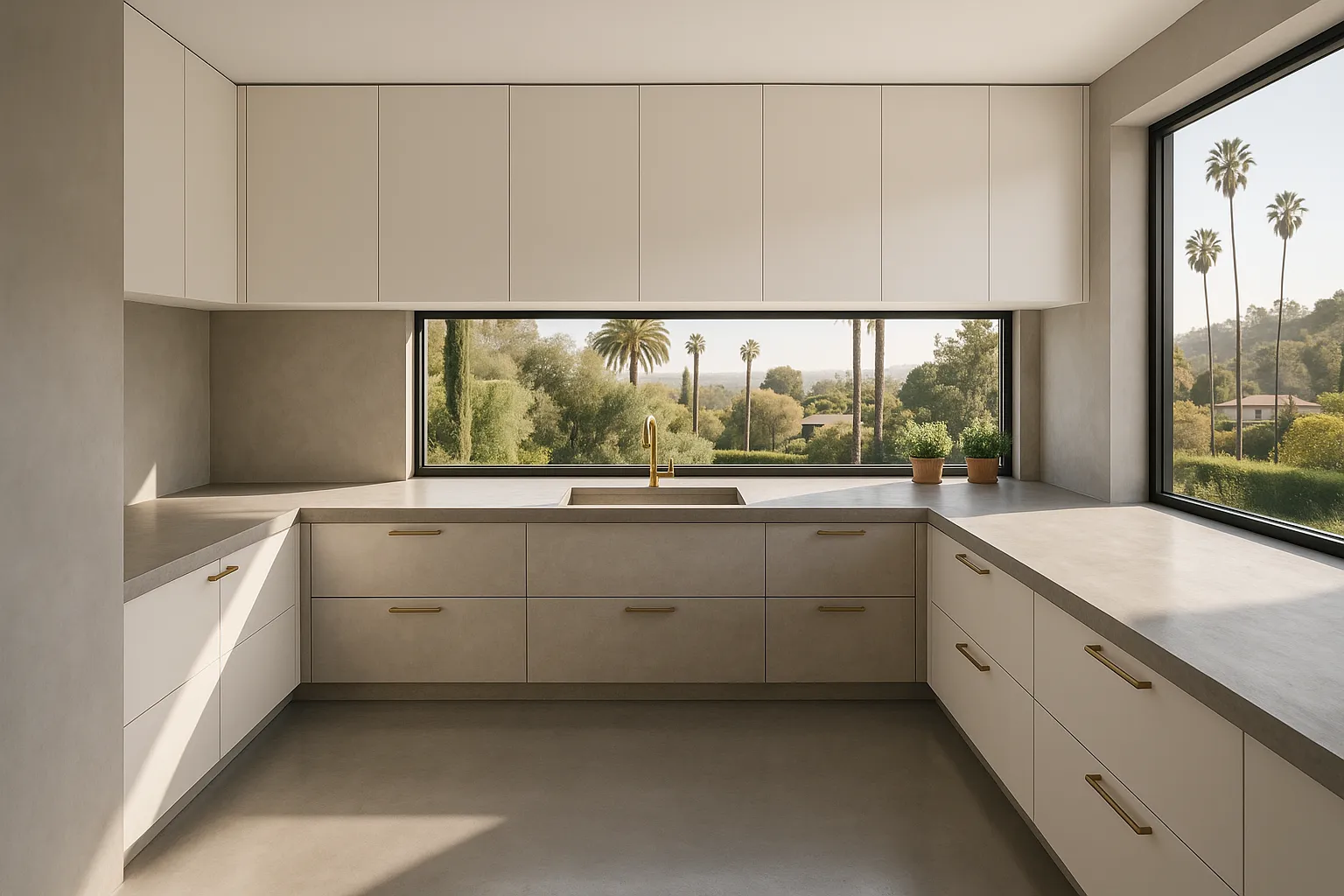
The [microcement kitchens & countertops](/services/microcement-kitchens-countertops) cost CA homeowners are seeing in 2026 lands somewhere between **$45 and $120 per square foot installed** — and that range isn't vague, it's intentional. A 180-square-foot kitchen floor in [Pasadena](/areas/pasadena) sits at a very different price point than a full kitchen package in [Beverly Hills](/areas/beverly-hills) that includes countertops, a waterfall island, and integrated backsplash walls. Both are microcement. Both are stunning. The gap between them comes down to scope, surface complexity, and the studio doing the work.
We've completed enough kitchen projects across [Los Angeles](/areas/los-angeles), [Santa Monica](/areas/santa-monica), and [Glendale](/areas/glendale) to know exactly where homeowners get surprised. Not by the price itself — most people do their research — but by what's included, what's not, and why some quotes come in $8,000 lower than others. This guide breaks all of it down.
---
## What Is Microcement? A Working Definition
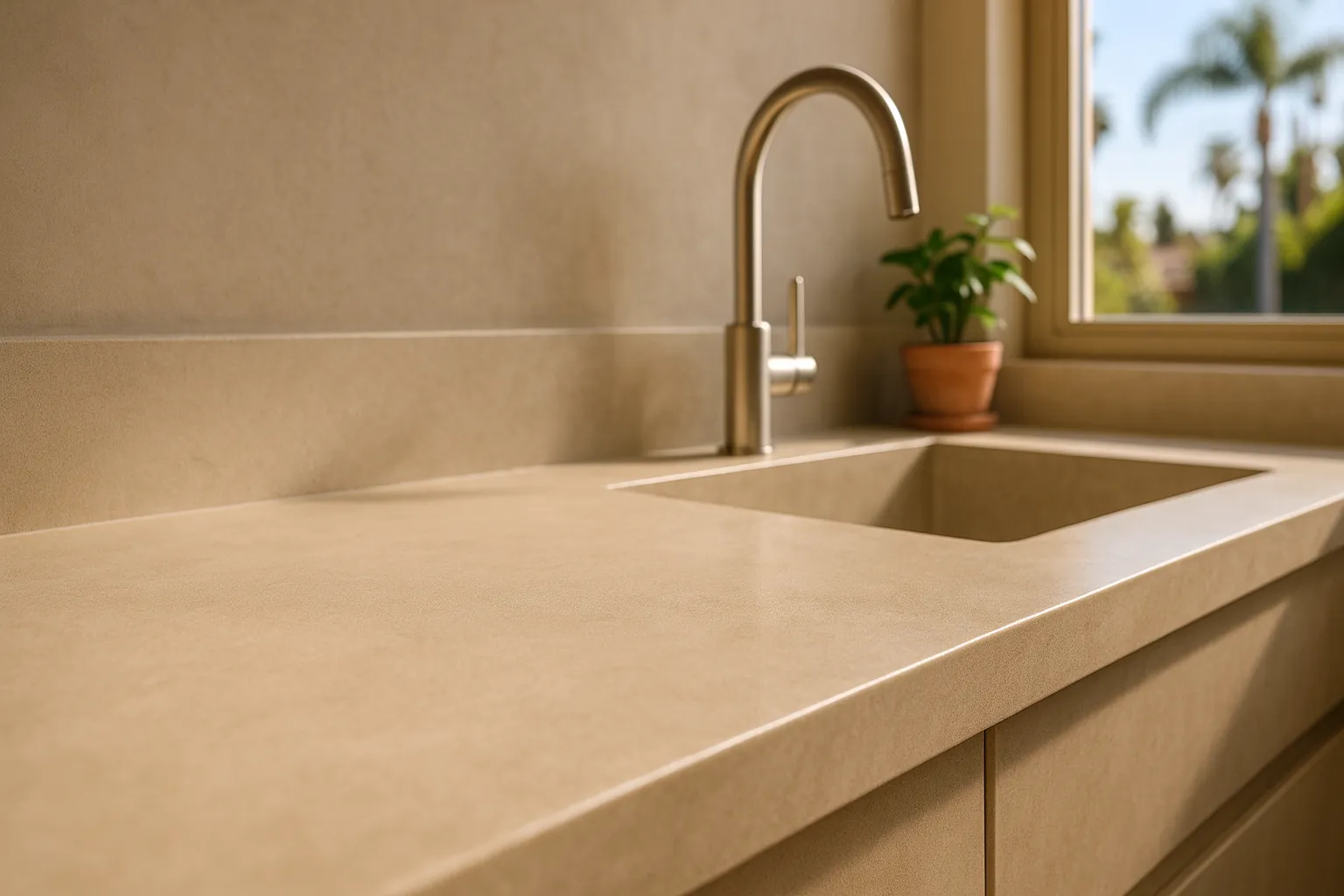
What is microcement? Microcement is a polymer-modified cementitious coating applied in thin layers — typically 2 to 3mm total — over existing substrates like tile, concrete, plywood, or drywall. Unlike traditional tile or stone, it's seamless, meaning no grout lines, no joints, and no places for moisture to hide.
In kitchens specifically, microcement is applied to floors, walls, countertops, and even cabinetry faces. It's finished with industrial-grade sealers that make the surface waterproof, food-safe, heat-resistant (up to a point), and easy to clean. The result looks like polished concrete but weighs almost nothing — critical in upper-floor applications or when you're going over existing countertops without a structural upgrade.
Based on Cemora project data across 200+ residential and [commercial](/services/microcement-commercial-hospitality) installations in Southern California, **microcement consistently outperforms tile in total cost of ownership over a 10-year window**, primarily because there's no grout to reseal, regrout, or replace.
---
## [How Much Does](/estimate) Microcement Kitchen Installation Cost in California?
Here's the honest breakdown of microcement kitchens & countertops cost CA homeowners should budget for in 2026:
### Microcement Kitchen Floors
- **Entry-level (basic color, flat substrate):** $45–$65/sq ft installed
- **Mid-range (custom tint, minor substrate prep):** $65–$85/sq ft installed
- **Premium (complex layout, decorative finish, high-traffic sealer):** $85–$110/sq ft installed
A standard 150-square-foot kitchen floor in Los Angeles runs **$9,750 to $16,500** depending on finish level and substrate condition.
### Microcement Countertops
Countertops are more labor-intensive than floors. The surface area is smaller, but the detail work — edges, sink cutouts, faucet holes, and the expectation of a flawless finish at eye level — drives the hourly labor cost up significantly.
- **Standard countertop surface:** $75–$100/sq ft installed
- **Waterfall island or complex edge profiles:** $100–$130/sq ft installed
- **Full kitchen countertop package (avg. 55 sq ft of surface):** $4,125–$7,150
### Full Kitchen Package (Floor + Countertops + Backsplash)
When clients in Beverly Hills or Santa Monica commission a full kitchen transformation — floors, countertops, backsplash walls, and sometimes the island — the total project cost typically lands between **$18,000 and $42,000**. That's a wide range, but it reflects real variation in kitchen size (120 sq ft vs. 280 sq ft), finish complexity, and the number of surfaces involved.

---
## What Factors Drive the Microcement Kitchens & Countertops Cost CA?
Not every quote is the same, and the difference between a $12,000 kitchen and a $28,000 kitchen usually comes down to five variables:
**1. Substrate Condition**
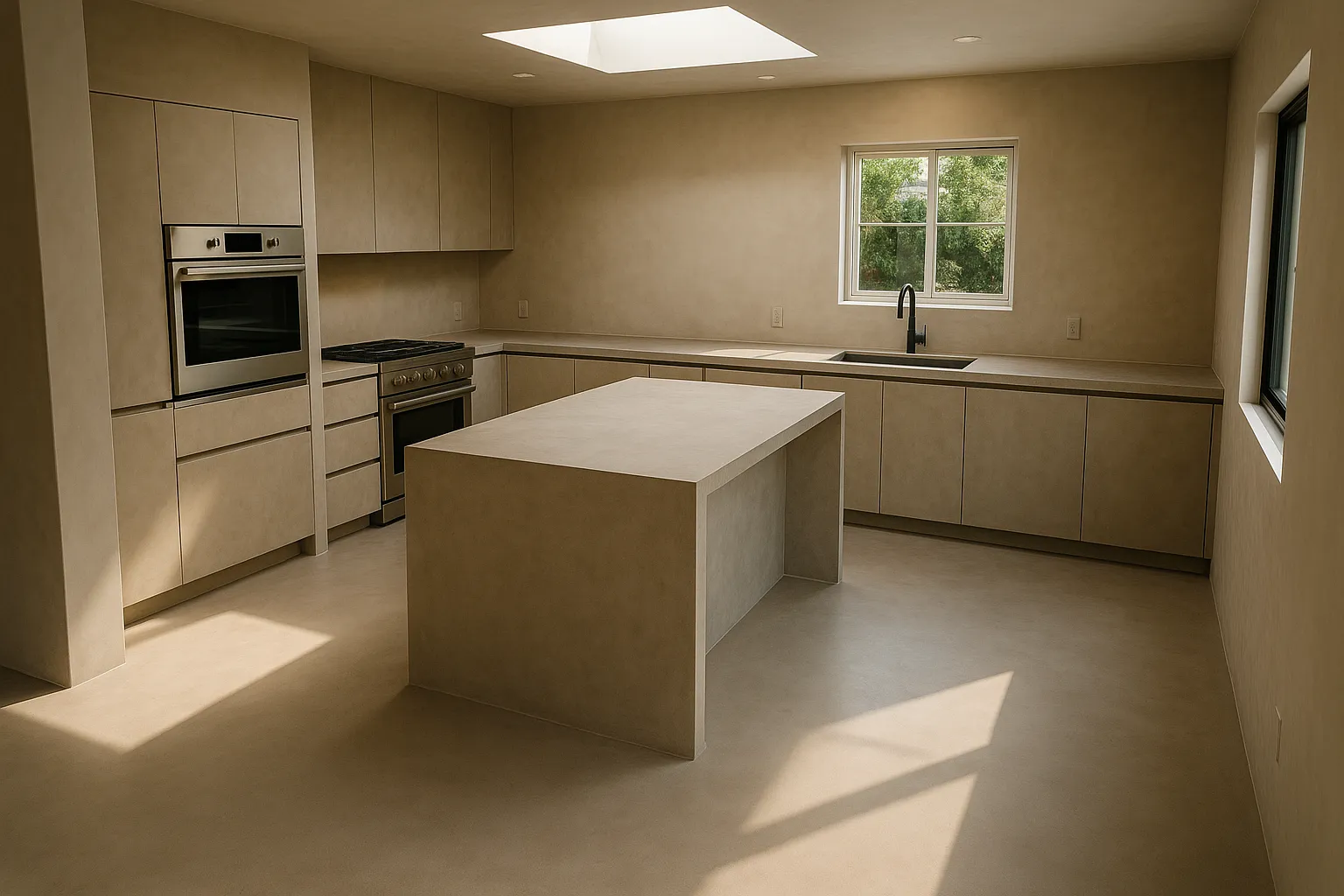
If your existing countertop is a solid, flat surface — old laminate, tile without major lippage, or poured concrete — prep is minimal. If there's flex in the substrate, cracks, or significant height variation, the applicator needs to address that first. Substrate remediation can add **$500 to $3,500** to a project.
**2. Surface Complexity**
A flat kitchen island is straightforward. A waterfall edge that wraps around three sides, meets a built-in range, and integrates a custom sink cutout is not. Every corner, inside radius, and penetration adds time.
**3. Color and Finish Selection**
Standard microcement colors from the manufacturer's palette cost less than custom-tinted batches. Some clients want a specific Pantone match or a proprietary aggregate blend — that's possible, but it adds **10–20%** to material costs.
**4. Sealer Grade**
Kitchens are demanding environments. A matte sealer that works beautifully in a bedroom won't hold up to cooking oils, acidic foods, and daily cleaning. Food-safe, stain-resistant polyurethane or epoxy-hybrid sealers are standard in kitchen applications and add **$4–$8/sq ft** over basic sealers.
**5. Studio Experience and Location**
A microcement applicator in Glendale with three years of experience and a crew of two will price differently than a specialist studio with a decade of high-end residential work in Bel Air. The skill gap shows up in the finish quality — and in how the surface holds up after two years of use.
---
## Microcement vs. Other Countertop Materials: 2026 Cost Comparison
Based on 2026 projections from contractor pricing data and the 2025 Houzz State of the Industry report (adjusted ~4% for material and labor cost drift):
| Material | Installed Cost (per sq ft) | Grout Lines | Seamless | Waterproof | Resale Appeal |
|---|---|---|---|---|---|
| Microcement | $75–$130 | No | Yes | Yes (sealed) | High (2026 trend) |
| Quartz | $80–$140 | No | Yes | Yes | High |
| Granite | $60–$110 | No | Yes | Requires sealing | High |
| Porcelain Tile | $25–$65 | Yes | No | Yes | Moderate |
| Concrete (poured) | $90–$150 | No | Yes | Requires sealing | Moderate-High |
| Laminate | $20–$45 | No | Yes | Moderate | Low |
| Marble | $100–$200 | No | Yes | Requires sealing | Very High |
Microcement sits competitively in the mid-to-premium range. It's not the cheapest option, but it's the only material on this list that can be applied over existing surfaces without demolition — which changes the true cost calculation significantly.
**Demolition and disposal of existing countertops in Los Angeles averages $800–$2,400**, per 2025 CSLB contractor reporting. Microcement over existing surfaces eliminates that line item entirely in most cases.
---
## Three Real Kitchen Projects: What Clients Actually Spent
### Project 1: Pasadena Bungalow Kitchen Refresh — $14,200
A homeowner in Pasadena had a 1960s kitchen with original tile countertops and a small 140-square-foot floor. She wanted a modern, seamless look without the disruption of a full remodel. Cemora applied microcement directly over the existing tile countertops (55 sq ft) and the kitchen floor (140 sq ft) in a warm greige tone with a matte sealer. Total project: **$14,200**, completed in 6 working days. She avoided an estimated **$6,800 in demolition and disposal costs** by going over the existing substrate.
### Project 2: Beverly Hills Open-Plan Kitchen — $38,500
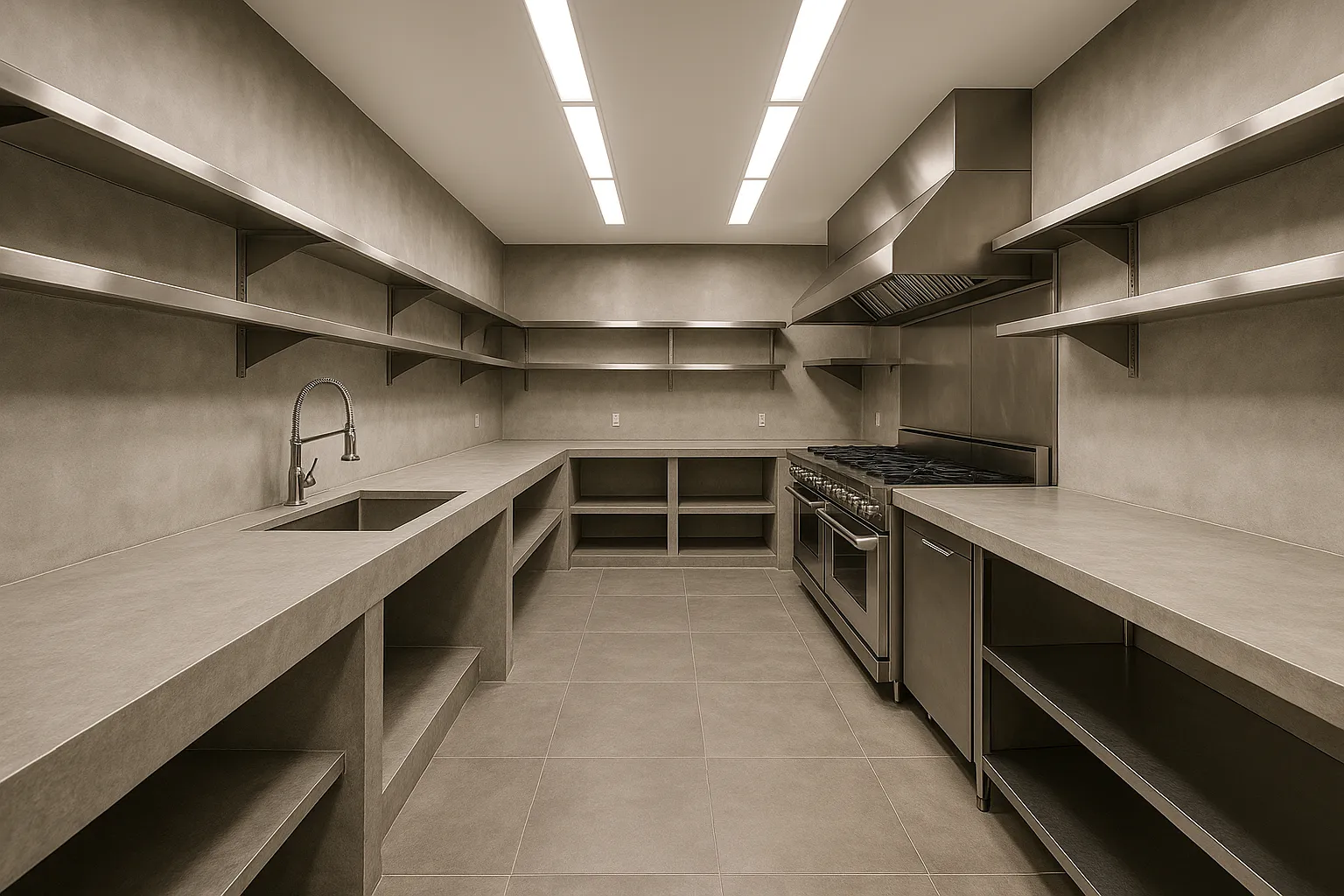
This was a full package: 220-square-foot kitchen floor, 80-square-foot countertop surface including a large waterfall island, integrated backsplash on two walls (60 sq ft), and a custom charcoal-black finish with a satin polyurethane sealer. The island edge detail alone required two full days of hand-finishing. Total project: **$38,500**, completed over 10 working days. The homeowner had received a quote for poured concrete countertops at **$52,000** — microcement delivered a nearly identical aesthetic at 74% of that cost.
### Project 3: Santa Monica Commercial Café Kitchen — $22,800
A café operator in Santa Monica needed their service counter, prep surfaces, and floor refinished during a two-week closure. The challenge: a health department inspection was scheduled 18 days out, so the timeline was fixed. Cemora completed **310 square feet of floor** and **45 square feet of food-prep countertop surface** using a food-safe, commercial-grade sealer rated for daily sanitizer exposure. Total project: **$22,800**. The operator reopened on day 14, passed inspection, and reported zero surface failures after 8 months of daily commercial use. See more about our [Commercial & Hospitality Microcement](/services/microcement-commercial-hospitality?utm_source=blog&utm_medium=organic&utm_campaign=microcement-kitchens-countertops-cost-ca) capabilities.

---
## What Is the Microcement Application Process? Step-by-Step
Understanding the process helps you understand the pricing. There are no shortcuts in a quality microcement installation — each layer has to cure before the next goes on.
1. **Surface Assessment and Substrate Prep** — The applicator inspects the existing surface for flex, cracks, contamination, and height variation. Any issues are addressed before the first coat goes down. This phase takes **half a day to two full days** depending on condition.
2. **Primer Application** — A bonding primer is applied to ensure adhesion between the microcement and the substrate. On non-porous surfaces like tile or laminate, a specialized primer is used. Cure time: **4–8 hours**.
3. **First Microcement Layer (Base Coat)** — The first structural layer is applied by hand or trowel. This establishes the overall texture and body of the finish. Cure time: **24 hours minimum**.
4. **Sanding and Inspection** — The base coat is sanded smooth, and any imperfections are addressed. This is where experienced applicators earn their rate — the final finish can only be as good as what's underneath.
5. **Second Microcement Layer (Finish Coat)** — A thinner, more refined coat is applied. Color depth and surface texture are finalized here. Cure time: **24 hours**.
6. **Fine Sanding** — The surface is wet-sanded to the specified finish level — matte, satin, or polished.
7. **Sealer Application (2–3 coats)** — The sealer is applied in multiple thin coats with sanding between each. This is what makes the surface waterproof and food-safe. Each coat requires **2–4 hours of cure time**.
8. **Final Inspection and Cure Period** — The surface is inspected under raking light. Light use can begin after **48–72 hours**. Full cure for kitchen countertops: **7 days** before heavy use.
Total installation time for a standard kitchen package: **5–10 working days**, not including the final cure period.
---
## Why Is Microcement Growing in California Kitchens Right Now?
Microcement kitchens & countertops cost CA buyers more per square foot than basic tile, but the demand in Los Angeles and across Southern California has grown sharply. Based on Cemora's project volume, kitchen inquiries increased **38% from 2024 to 2025**, and 2026 is tracking higher still.
Several forces are driving this:
- **The seamless aesthetic dominates 2026 kitchen design.** Grout lines are visually dated in high-end residential and hospitality contexts. Designers and architects in West LA and Beverly Hills are specifying microcement by name.
- **Renovation over replacement.** With Los Angeles home values elevated and construction costs high, homeowners are investing in surface upgrades rather than full remodels. Microcement is purpose-built for this approach.
- **Commercial durability in residential packages.** The same sealers used in restaurant kitchens are available for home installations. That's a meaningful durability upgrade over stone that requires annual resealing.
- **Design flexibility.** Microcement can be tinted to virtually any color, applied at varying textures, and layered for depth. It's one of the few materials that can match a specific design vision exactly.
"In 15 years of working with mineral surfaces across Los Angeles, we've never seen a material shift this fast in the kitchen category," says the lead applicator at Cemora. "Designers who were specifying quartz two years ago are now calling us first."
Explore our full range of [Microcement Kitchens & Countertops](/services/microcement-kitchens-countertops?utm_source=blog&utm_medium=organic&utm_campaign=microcement-kitchens-countertops-cost-ca) services to see what's possible.
---
## How Does Microcement Countertop Cost Compare to Quartz in Los Angeles?
Quartz is the dominant countertop material in Los Angeles kitchens right now, and it's a fair benchmark. Here's how a direct comparison plays out on a typical 55-square-foot kitchen countertop package in 2026:
**Quartz (installed, Los Angeles):**
- Material: $45–$90/sq ft
- Fabrication and installation: $25–$45/sq ft
- Demolition of existing countertop: $800–$1,800
- Total estimated range: **$7,475–$14,550**
**Microcement (installed over existing substrate, Los Angeles):**
- Material + labor: $75–$130/sq ft
- Substrate prep (minor): $300–$800
- No demolition required
- Total estimated range: **$4,425–$7,950**
On a straightforward overlay project, microcement comes in meaningfully lower. On a project requiring significant substrate work, the gap narrows. The key differentiator: **microcement is a continuous surface with no seams**, which quartz panels cannot achieve on large islands or complex layouts without visible joints.
For homeowners considering a bathroom remodel alongside the kitchen, our [Microcement Bathrooms & Wet Rooms](/services/microcement-bathrooms?utm_source=blog&utm_medium=organic&utm_campaign=microcement-kitchens-countertops-cost-ca) service often pairs well — bundling both projects reduces mobilization costs by **15–20%**.
---
## What Should You Ask Before Hiring a Microcement Applicator in CA?
Not all microcement applicators are equal, and California's CSLB licensing requirements don't specifically certify microcement as a trade category. That means the market has a wide skill range. Before signing a contract, ask:
- **How many kitchen countertop projects have you completed in the last 12 months?** Countertops are the hardest surface to get right. You want someone who does them regularly, not occasionally.
- **What sealer system do you use for kitchen surfaces?** A food-safe, stain-resistant, UV-stable sealer is non-negotiable for countertops. If they can't name the product and explain why they chose it, walk away.
- **Can I see a physical sample panel?** Photos are easy to cherry-pick. A sample panel shows you exactly how the color and texture will look in person.
- **What's your warranty on the application?** Industry standard for quality studios is **2–5 years on workmanship**. Material warranties depend on the manufacturer.
- **Do you carry general liability and workers' comp insurance?** CSLB requires both for licensed contractors. Verify before work begins.
Our [Microcement Floors & Walls](/services/microcement-floors-walls?utm_source=blog&utm_medium=organic&utm_campaign=microcement-kitchens-countertops-cost-ca) service page has additional guidance on evaluating applicators for whole-home projects.

---
## How to Get an Accurate Quote for Your Kitchen Project
The single biggest source of quote variation in the microcement market is incomplete scope. An applicator quoting $45/sq ft on a kitchen floor may not have priced in substrate repair, a premium sealer, or the detail work around cabinets and appliances. Here's how to get a quote that actually reflects your project:
1. **Measure your surfaces.** Floor square footage, countertop square footage (including the island), and any wall or backsplash areas you want included.
2. **Document your existing substrate.** Photos of your current countertops, floor, and any damage or flex you've noticed.
3. **Know your finish preference.** Matte, satin, or polished. Light, mid, or dark tone. Custom color or standard palette.
4. **Ask for a line-item quote.** Substrate prep, material, labor, sealer — each should be a separate line. This lets you compare quotes accurately.
5. **Request a site visit before the final quote.** Any studio quoting a kitchen project without seeing it in person is guessing on the substrate condition.
[Book a Consultation](/book?utm_source=blog&utm_medium=organic&utm_campaign=microcement-kitchens-countertops-cost-ca) with Cemora and we'll walk through your kitchen in person — no pressure, just an honest scope and number.
---
## Microcement Kitchens & Countertops Cost CA: Is It Worth It?
Here's the honest answer: **yes, for the right project and the right client**.
Microcement makes the most financial sense when:
- You want to avoid demolition costs on existing countertops or floors
- You're designing a high-end kitchen where the seamless look is part of the brief
- You're outfitting a commercial or hospitality kitchen that needs to look premium and hold up to daily abuse
- You're bundling multiple surfaces (floor + countertops + backsplash) where the per-square-foot cost averages down
It's less ideal when:
- Your substrate has significant structural issues that require full replacement anyway
- You want the absolute lowest cost per square foot and aesthetics are secondary
- You're planning to sell the home within 12 months and the buyer demographic doesn't value the finish
A 2025 Houzz survey found that **67% of homeowners who installed microcement in their kitchen rated it a 9 or 10 out of 10 for satisfaction at the 18-month mark**. That's a meaningful signal in a category where buyer's remorse is common.
If you're comparing options for a full-home project, our [Commercial & Hospitality Microcement](/services/microcement-commercial-hospitality?utm_source=blog&utm_medium=organic&utm_campaign=microcement-kitchens-countertops-cost-ca) page covers the durability specs that apply equally to residential kitchens with heavy use.
When you're ready to put real numbers to your project, [get a free estimate](/estimate?utm_source=blog&utm_medium=organic&utm_campaign=microcement-kitchens-countertops-cost-ca) or [contact us](/contact?utm_source=blog&utm_medium=organic&utm_campaign=microcement-kitchens-countertops-cost-ca) directly. We work across Los Angeles, Beverly Hills, Santa Monica, Pasadena, and Glendale — and we're happy to tell you upfront whether microcement is the right fit for your specific kitchen.
---
## Frequently Asked Questions
### How much does microcement kitchen installation cost in California in 2026?
Based on Cemora project data, microcement kitchen installation in California costs between **$45 and $130 per square foot installed**, depending on the surface type and finish complexity. A complete kitchen package including floors, countertops, and backsplash for a mid-size Los Angeles kitchen typically runs **$18,000 to $42,000** in 2026. Countertops alone on a standard 55-square-foot surface range from **$4,125 to $7,150** installed.
### What is the microcement kitchens & countertops cost CA homeowners pay vs. quartz?
Microcement countertops installed over existing surfaces in Los Angeles run **$75–$130 per square foot**, while quartz installed with demolition of the existing countertop typically costs **$70–$135 per square foot all-in**. The key difference is that microcement eliminates demolition costs (**$800–$1,800** in LA), can be applied over existing tile or laminate, and produces a fully seamless surface with no visible seams on large islands — something quartz panels cannot achieve.
### How long does microcement kitchen installation take?
A standard kitchen package — floors, countertops, and backsplash — takes **5 to 10 working days** for installation, plus a **7-day cure period** before full use. Countertops alone typically take **2 to 4 working days**. The timeline is driven by the layered application process: each coat of microcement and each coat of sealer must fully cure before the next is applied, and there are no shortcuts that don't compromise the final surface quality.
### Is microcement food-safe for kitchen countertops?
Yes, when sealed with a food-safe polyurethane or epoxy-hybrid sealer — which is standard practice for kitchen countertop applications. The sealer creates a non-porous, impermeable surface that resists staining from cooking oils, acids, and cleaning products. Cemora uses commercial-grade sealers on all kitchen countertop projects, the same products used in restaurant and café installations across Los Angeles.
### How durable is microcement on kitchen countertops?
Microcement countertops sealed with a commercial-grade sealer are highly durable for daily kitchen use — resistant to staining, moisture, and mild heat. However, they are not heatproof: placing hot pans directly on the surface can damage the sealer, so trivets are recommended, just as they are with quartz or wood. With proper care, a professionally installed microcement countertop in a residential kitchen should maintain its finish for **8 to 15 years** before any resealing or touch-up is needed.
### Can microcement be applied over existing tile countertops?
Yes — this is one of microcement's primary advantages in kitchen renovations. As long as the existing tile is firmly bonded, structurally sound, and the grout lines aren't excessively deep, microcement can be applied directly over the top after proper priming. This eliminates demolition costs and reduces project timelines significantly. Deep grout lines may require a skim coat or filler before the microcement layers are applied, which adds **$300–$800** to the prep phase.
### What finishes are available for microcement kitchen countertops?
Microcement countertops are available in matte, satin, and polished finishes, across a broad palette of colors — from warm neutrals and cool grays to deep charcoals, earthy terracottas, and custom-tinted options. Texture can range from ultra-smooth (similar to polished concrete) to a subtle hand-troweled texture that adds visual depth. Custom Pantone-matched colors are possible but add **10–20%** to material costs.
### How does microcement kitchen cost vary by location in California?
Labor rates in California vary significantly by market. Projects in Beverly Hills and West Los Angeles tend to run **10–20% higher** than the same scope in Pasadena or Glendale, reflecting higher local labor costs and longer drive times for crews. Santa Monica and Malibu projects often carry a similar premium. The material costs are consistent statewide — the variation is almost entirely in labor and mobilization.
### What warranty should I expect on a microcement kitchen installation?
Reputable microcement studios in California offer **2 to 5 years on workmanship**, covering delamination, cracking, or finish failures that result from application error. Material warranties vary by manufacturer — most premium microcement systems carry a **2-year product warranty**. The sealer is a separate product with its own warranty, typically **1 to 3 years** for residential use. Always get warranty terms in writing before signing a contract.
### How much does microcement increase kitchen resale value in Los Angeles?
While no surface finish guarantees a specific ROI, a 2025 Houzz survey found that **67% of homeowners rated microcement kitchen installations 9 or 10 out of 10 for satisfaction**, and real estate agents in Los Angeles consistently report that seamless, high-end kitchen finishes support faster sales and stronger offers. In the Beverly Hills and Santa Monica markets, premium kitchen finishes — including microcement — are increasingly expected by buyers in the **$2M+ home segment**, making the investment defensible from a resale perspective.
---
**Ready to start your your project in Los Angeles?** [Book a free consultation](/book?utm_source=blog&utm_medium=organic&utm_campaign=microcement-kitchens-countertops-cost-ca-what-to-expect-in-2026) — we'll come walk through your space and give you straight numbers, no pressure. Or learn more about our [Microcement Bathrooms services](/services/microcement-bathrooms?utm_source=blog&utm_medium=organic&utm_campaign=microcement-kitchens-countertops-cost-ca-what-to-expect-in-2026).