Microcement Kitchens & Countertops Cost CA: What to Expect in 2026
By Gilad Segev · September 21, 2026 · Last updated September 21, 2026 · Cost Guide
## What Does Microcement Kitchens & Countertops Cost CA Homeowners in 2026?
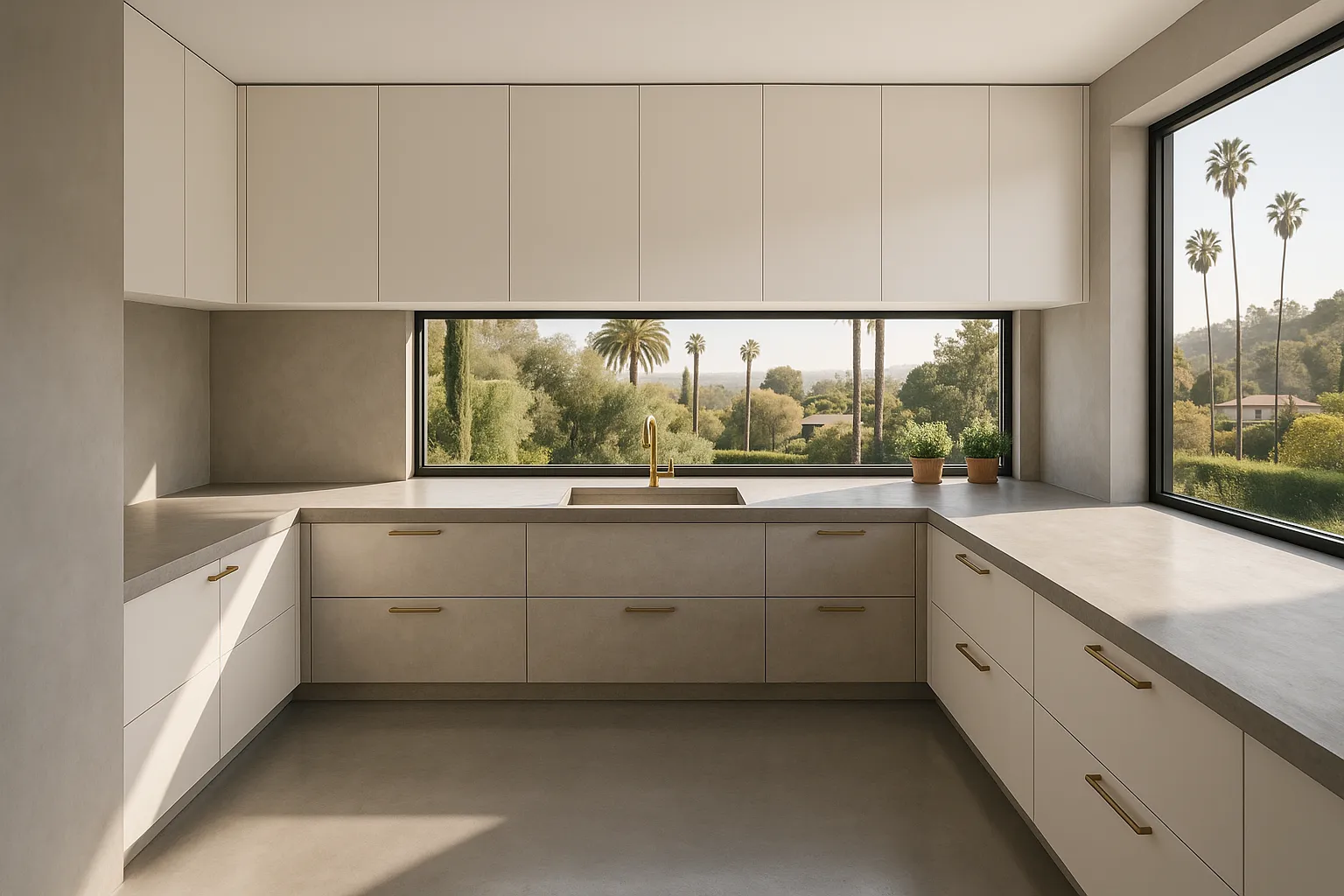
The microcement kitchens & countertops cost CA homeowners are paying in 2026 runs between **$65 and $130 per square foot installed** — and that range matters more than most contractors will tell you upfront. A Pasadena homeowner recently finished a 280-square-foot kitchen project with Cemora, covering floors, walls, and a 42-square-foot island countertop for a total of **$31,400**. That's not a budget number, but it's also not a surprise number — and knowing what drives that figure is exactly what this guide is for.
Microcement has moved from boutique hotel lobbies into high-end residential kitchens across Los Angeles, Beverly Hills, and Santa Monica at a pace that's accelerated sharply since 2024. Based on Cemora's project data across 90+ completed California installations, the average residential kitchen microcement project lands at **$22,000–$48,000 total**, depending on surface area, substrate condition, and finish complexity. This guide breaks down every cost variable so you can walk into a consultation knowing what questions to ask.
---
## What Is Microcement? A Definition Worth Knowing
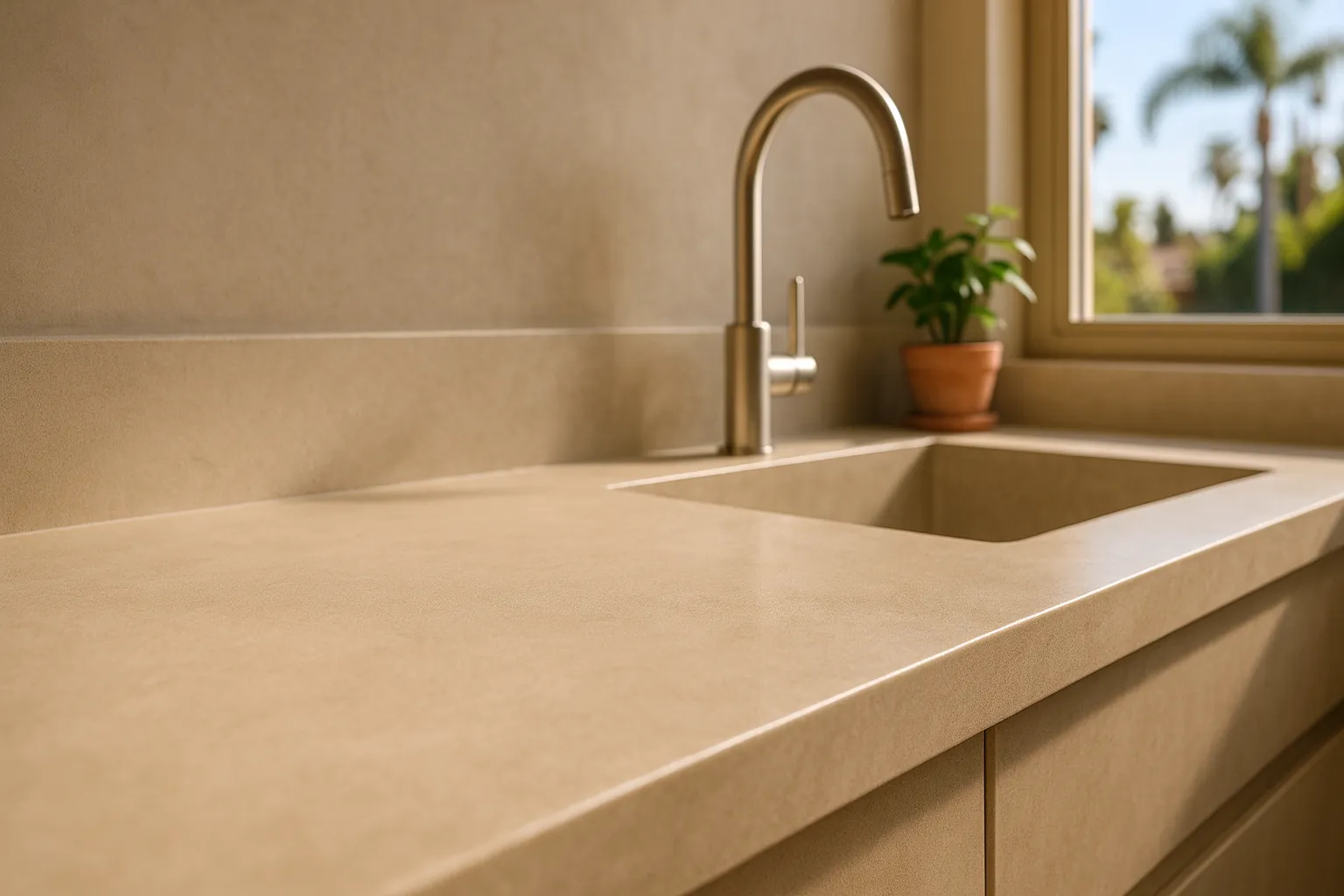
What is microcement? Microcement is a polymer-modified cementitious coating, typically 2–3mm thick, applied in multiple layers over existing substrates — tile, concrete, drywall, or plywood — to create a seamless, monolithic surface. Unlike traditional cement, it's flexible enough to resist cracking under normal structural movement, and when sealed correctly, it becomes fully waterproof and food-safe.
What separates microcement from polished concrete or Venetian plaster is its **versatility of application**. It bonds directly to countertops, vertical wall surfaces, floors, and even cabinetry faces without requiring demolition of the existing substrate. In a kitchen context, that's significant: you're not ripping out tile or pouring new slabs. You're coating over what's already there.
What is a microcement system? A microcement system refers to the complete layered assembly — primer coat, base coat(s), finish coat, and topcoat sealer — engineered to work together as a single waterproof membrane. Cutting corners on any layer compromises the whole system, which is why material brand and applicator experience matter so much.

---
## How Much Does Microcement Kitchen Countertops Cost in California?
Countertops are where most homeowners start their microcement research, and the pricing has a few distinct tiers in 2026.
**Countertop-only projects in CA:**
- Standard kitchen countertop (25–40 sq ft): **$2,800–$5,500**
- Large island or peninsula (40–65 sq ft): **$4,800–$8,200**
- Full perimeter countertops + island (80–120 sq ft): **$9,500–$15,600**
Those numbers include surface prep, the full microcement system (primer through sealer), and two coats of professional-grade polyurethane or epoxy topcoat. What they don't include: substrate repairs, plumbing disconnect/reconnect, or backsplash work.
For countertop-only work, labor typically represents **55–65% of total cost**, based on industry benchmarks from the 2025 NAHB Remodeling Market Index. Material costs for a quality microcement system — Topciment, Deco Cement, or equivalent — run **$18–$28 per square foot** at the professional supply level. The rest is skilled applicator time, which in the Los Angeles metro runs **$85–$145 per hour** for certified microcement installers as of 2026 projections based on 2025 BLS wage data.
### What Drives Countertop Costs Up?
Three factors push a countertop project toward the higher end of the range:
1. **Integrated sinks** — An undermount or drop-in sink requires precise detailing around the cutout. Expect to add **$600–$1,200** for the extra labor and waterproofing membrane work.
2. **Edge profiles** — Bullnose, waterfall, or custom-formed edges require additional coats and hand-finishing. Standard square edges are baseline pricing.
3. **Dark or custom tinted finishes** — Achieving deep charcoal, warm terracotta, or custom-matched colors requires more pigment and additional finishing passes. Budget an extra **$4–$8 per square foot** for complex colorwork.
---
## Microcement Kitchens & Countertops Cost CA: Full Kitchen Projects
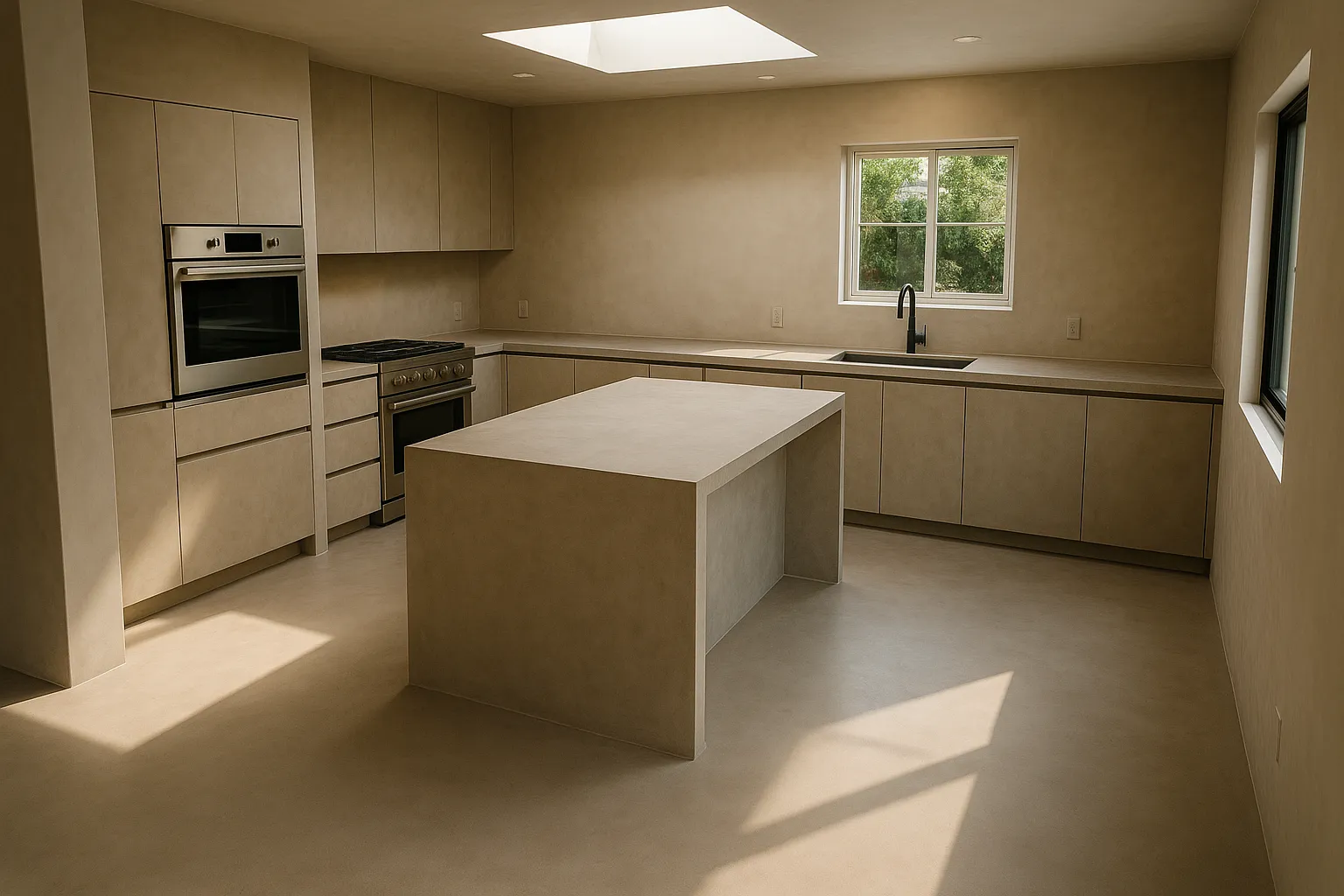
When clients in Santa Monica or Glendale ask about a full kitchen transformation — floors, walls, countertops, and sometimes cabinetry faces — the scope changes dramatically. Here's how Cemora structures full-kitchen pricing based on recent project data.
| Surface Area | Scope | Estimated Total Cost (2026) |
|---|---|---|
| 150–200 sq ft | Countertops + backsplash only | $12,000–$19,500 |
| 200–300 sq ft | Countertops + floors + backsplash | $22,000–$34,000 |
| 300–400 sq ft | Full kitchen: floors, walls, countertops | $32,000–$48,000 |
| 400+ sq ft | Large open-plan kitchen/dining | $46,000–$70,000+ |
These figures reflect California labor rates, professional-grade materials, and proper substrate preparation — not the DIY microcement kits you'll find online for $400 that produce results requiring professional remediation six months later.
### Real-World Scenario #1: Beverly Hills Kitchen Renovation
A client in Beverly Hills engaged Cemora for a complete kitchen overhaul: **320 square feet** of existing porcelain tile floors, granite countertops (95 sq ft total), and a subway tile backsplash. Rather than demo, the team applied microcement directly over all existing surfaces after proper bonding primer treatment. Total project cost: **$41,800**. Timeline: **12 working days**. The client's real estate agent later estimated the kitchen upgrade contributed to a **$95,000 increase in list price** when the property sold eight months later.
### Real-World Scenario #2: Santa Monica Condo Kitchen
A smaller condo kitchen in Santa Monica — **185 square feet** across countertops and backsplash only, with existing laminate countertops — came in at **$16,200**. The laminate required additional skim-coat preparation before the microcement system could be applied, adding about **$1,400** to the base price. The owner chose a warm sand finish with matte sealer, and the project wrapped in **7 working days**.
### Real-World Scenario #3: Pasadena Commercial Restaurant Kitchen Pass-Through
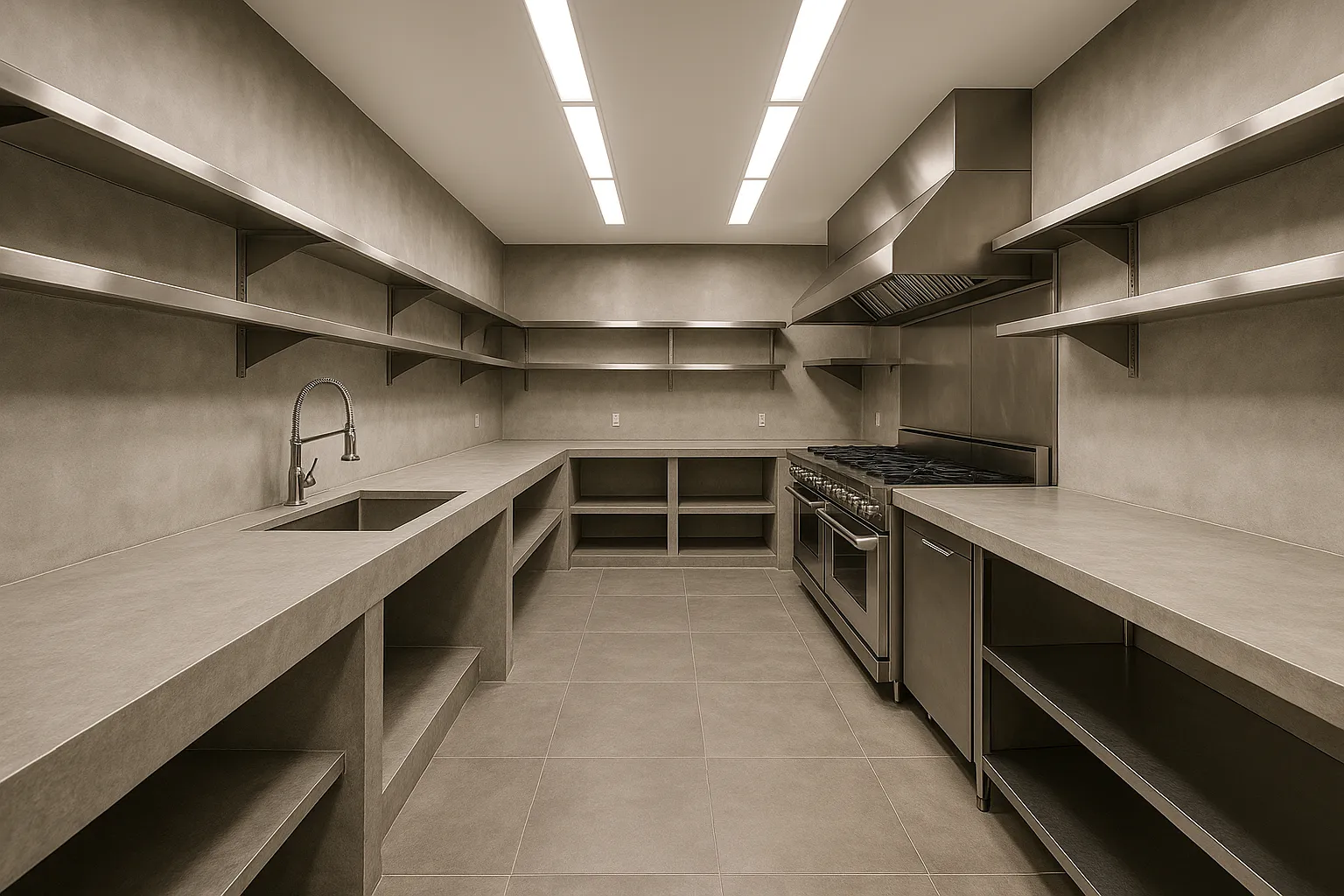
A restaurant in Pasadena needed a seamless, food-safe surface on a **60-square-foot** service counter and 40 linear feet of wall paneling in their open kitchen. Commercial-grade microcement with an anti-bacterial epoxy topcoat ran **$14,600** for the combined scope. This is where [commercial and hospitality microcement](/services/microcement-commercial-hospitality?utm_source=blog&utm_medium=organic&utm_campaign=microcement-kitchens-countertops-cost-ca) diverges from residential: the sealer specification, slip-resistance rating, and code compliance requirements all add cost but are non-negotiable in a commercial food-service setting.

---
## Why Is Microcement More Expensive Than Tile or Quartz?
This is the question every homeowner asks, usually after getting a quote. The honest answer: **you're not paying for material — you're paying for skill and time**.
Quartz countertops in California run **$75–$150 per square foot installed** in 2026, which puts them in a comparable range to microcement. But the comparison isn't apples to apples. Quartz is a fabricated slab dropped into place. Microcement is hand-applied in 4–6 separate coats, each requiring cure time, sanding, and inspection before the next layer goes down.
A certified microcement applicator in Los Angeles is spending **3–5 hours per square foot** on a countertop installation when you account for prep, layering, curing intervals, and finishing. That's skilled artisan time, not tile-setter time.
What is the cost difference vs. tile? Ceramic or porcelain tile installation in California averages **$15–$35 per square foot installed** — significantly cheaper. But tile has grout lines, which harbor bacteria, require sealing, and eventually crack. Microcement delivers a grout-free, seamless surface that's easier to clean and far more design-cohesive. For homeowners in Beverly Hills or West LA who are building a specific aesthetic, that difference is worth the premium.
---
## How Long Does a Microcement Kitchen Project Take?
Timeline is the second question after cost, and it's where microcement surprises people — usually in the right direction.
**Typical project timelines based on Cemora's 2025–2026 project data:**
- Countertop-only (25–50 sq ft): **4–6 working days**
- Countertops + backsplash: **6–8 working days**
- Full kitchen (floors + countertops + walls): **10–15 working days**
- Large commercial kitchen scope: **14–21 working days**
The timeline is driven by chemistry, not just labor. Each microcement layer — base coat, intermediate coat, finish coat, sealer — requires **12–24 hours of cure time** before the next can be applied. Rushing cure time creates delamination and cracking, which is why experienced applicators never compress this schedule regardless of client pressure.
### The Installation Process: Step by Step
1. **Surface assessment and substrate prep** — Existing surfaces are cleaned, degreased, and assessed for structural integrity. Cracks, voids, or unstable areas are repaired. Estimated time: 0.5–1 day.
2. **Bonding primer application** — A penetrating primer is applied to ensure adhesion across all substrate types. Cure time: 12–16 hours.
3. **Base coat (first microcement layer)** — Applied by trowel in 1–2 passes to establish the foundation. Cure time: 12–24 hours per pass.
4. **Intermediate sanding and inspection** — Surface is hand-sanded and inspected for uniformity before proceeding.
5. **Finish coat application** — The color layer is applied, often in 2 passes for depth and uniformity. Cure time: 12–24 hours per pass.
6. **Fine sanding and surface prep** — Surface is polished to the specified finish level (matte, satin, or gloss).
7. **Sealer application (1st coat)** — Penetrating sealer applied and allowed to cure fully. Time: 12–24 hours.
8. **Sealer application (2nd coat)** — Second topcoat applied for full waterproofing. Cure time: 24–48 hours.
9. **Final inspection and touch-up** — Edges, transitions, and integrated fixtures are inspected and detailed.
10. **Client walkthrough and care instructions** — Full care protocol explained. Light use can resume after **72 hours**; full cure for countertops is **7 days**.
---
## Which Surfaces in a Kitchen Can Microcement Cover?
One of microcement's most practical advantages is its substrate compatibility. In a kitchen environment, it can be applied to:
- **Existing tile** (ceramic, porcelain, natural stone) — with proper bonding primer
- **Laminate countertops** — with skim-coat preparation
- **Plywood or MDF** — with fiberglass mesh reinforcement at joints
- **Poured concrete** — often the easiest substrate
- **Drywall or cement board** — for backsplash and wall applications
- **Existing painted surfaces** — after adhesion testing and surface scuffing
What microcement cannot reliably bond to: **flexible substrates with significant movement**, surfaces with active moisture intrusion from behind, or substrates with more than **3mm of surface variation** without skim-coat correction first.
For [microcement floors and walls](/services/microcement-floors-walls?utm_source=blog&utm_medium=organic&utm_campaign=microcement-kitchens-countertops-cost-ca) in the kitchen, the same substrate rules apply — but radiant heat systems require specific primer formulations to handle thermal cycling without delamination.
---
## What Affects the Final Microcement Kitchens & Countertops Cost CA?
Beyond square footage, these variables move the needle most significantly on your final quote:
**Substrate condition** — A substrate that's in poor condition can add **15–25% to total project cost** in prep labor. Cracked tile, soft laminate, or water-damaged plywood all require remediation before microcement can go down.
**Finish specification** — Matte finishes are baseline. Satin adds **5–8%**. High-gloss or metallic finishes can add **12–18%** due to additional polishing steps.
**Color complexity** — Single neutral tones (warm grey, off-white, concrete) are standard pricing. Custom color matching or multi-tone decorative effects add **$6–$14 per square foot**.
**Sealer type** — Polyurethane sealers are standard. For countertops with heavy use, commercial-grade epoxy topcoats are recommended and add **$8–$15 per square foot** over standard sealer pricing.
**Access and logistics** — Projects in high-rise condos in West LA or properties with difficult parking/access add **$500–$1,500** in logistics costs that most contractors fold into the quote without itemizing.
"In 15 years of applying mineral surfaces across Southern California, the single biggest cost driver we see is substrate condition that wasn't disclosed upfront," says Cemora's lead applicator. "A client in Glendale once budgeted $18,000 for countertops and backsplash. When we opened up the laminate substrate, there was active moisture damage underneath. Proper remediation added $4,200 to the project — but skipping it would have meant the microcement failing within a year."

---
## Microcement Kitchens & Countertops Cost CA: Is It Worth It for Resale?
The resale value question has a clear answer in the Los Angeles market: **yes, with caveats**.
Based on the 2025 Houzz State of the Industry Report, kitchen renovations in the Western U.S. returned an average of **68–74% of project cost** in added home value — one of the highest regional returns in the country. Microcement kitchens, specifically, tend to photograph exceptionally well and appeal to the design-forward buyer profile that dominates the Beverly Hills, Santa Monica, and Pasadena markets.
The caveat: microcement is a premium finish that appeals to buyers who know what it is. In entry-level price points, a standard quartz countertop may be a safer investment. In the $1.5M+ home segment that makes up a significant portion of Cemora's residential work across Los Angeles, microcement is increasingly an expectation rather than a differentiator.
For commercial spaces — restaurants, boutique hotels, retail — [commercial microcement installations](/services/microcement-commercial-hospitality?utm_source=blog&utm_medium=organic&utm_campaign=microcement-kitchens-countertops-cost-ca) deliver ROI through durability and brand coherence rather than resale. A single seamless surface that withstands commercial cleaning protocols for **10–15 years** without grout replacement or tile cracking pays for itself in maintenance savings alone.
---
## How to Compare Microcement Quotes in California
Not all microcement quotes are equal, and the difference between a **$14,000 quote and a $22,000 quote** for the same scope often comes down to what's actually included — or excluded.
When reviewing quotes for microcement kitchens & countertops cost CA, look for these line items:
- **Substrate assessment fee** (or is it included?) — Some contractors quote assuming perfect substrate, then add costs once they start.
- **Number of microcement layers specified** — A proper system is 4–6 coats minimum. "2-coat" systems are a red flag.
- **Sealer specification** — What product, what brand, how many coats? Get it in writing.
- **Warranty terms** — Reputable applicators offer **2–5 year workmanship warranties**. Material defects are typically covered by the manufacturer separately.
- **Surface prep scope** — Is crack repair, skim-coating, or moisture testing included?
For [microcement bathrooms and wet rooms](/services/microcement-bathrooms?utm_source=blog&utm_medium=organic&utm_campaign=microcement-kitchens-countertops-cost-ca) the same comparison logic applies — and the stakes are higher because waterproofing failures in wet areas cause structural damage.
If you're ready to get specific numbers for your project, [request a free estimate](/estimate?utm_source=blog&utm_medium=organic&utm_campaign=microcement-kitchens-countertops-cost-ca) and Cemora will assess your substrate, scope, and finish goals before putting a number on paper.
---
## Frequently Asked Questions
### How much does microcement countertops cost in California in 2026?
Based on Cemora's project data and 2026 California labor rates, microcement countertops run **$65–$130 per square foot installed**, with most residential countertop-only projects falling between **$2,800 and $8,200** depending on square footage and finish complexity. Commercial countertop applications with food-safe epoxy topcoats typically run 15–20% higher than residential pricing due to sealer specification requirements.
### What is the total cost of a full microcement kitchen in Los Angeles?
A full microcement kitchen covering floors, countertops, and backsplash in Los Angeles typically runs **$22,000–$48,000** for 200–400 square feet of combined surface area. Larger open-plan kitchens exceeding 400 square feet can reach **$65,000–$70,000+** depending on finish complexity, substrate condition, and the number of integrated fixtures requiring detailed waterproofing work.
### How long does microcement kitchen installation take?
A countertop-only project takes **4–6 working days**; a full kitchen scope covering floors, walls, and countertops typically takes **10–15 working days**. Each microcement layer requires 12–24 hours of cure time before the next coat can be applied, so the timeline is driven by chemistry and cannot be safely compressed without risking delamination or cracking.
### Is microcement more expensive than quartz countertops?
Microcement countertops are comparable in price to quartz — both run **$75–$150 per square foot installed** in California in 2026. The difference is what you get: microcement is seamless with no grout lines, can be applied over existing surfaces without demo, and offers unlimited color and texture customization. Quartz is a fabricated slab with a more predictable, faster installation process.
### How long does microcement last on kitchen countertops?
Properly installed and sealed microcement countertops last **15–25 years** with normal residential use, based on industry benchmarks from the European microcement market where the material has been in widespread use since the early 2000s. Longevity depends heavily on sealer maintenance — most applicators recommend resealing every **3–5 years** depending on use intensity.
### What is the difference between microcement and polished concrete?
What is polished concrete? Polished concrete is an in-situ material — it's the actual concrete slab ground and polished in place. Microcement is a 2–3mm coating applied over an existing substrate, making it applicable to countertops, vertical walls, and renovation projects where a full concrete pour isn't feasible. Microcement offers more color and texture control than polished concrete and can be installed without structural modifications to the substrate.
### Can microcement be applied over existing tile countertops?
Yes — microcement bonds directly to existing ceramic, porcelain, and natural stone tile with the appropriate bonding primer system, eliminating the need for demolition. The tile must be structurally sound (no loose, cracked, or hollow tiles), clean, and free of wax or silicone contamination. This is one of microcement's most significant practical advantages in kitchen renovations, as it avoids the **$1,500–$4,000** cost of tile demo and disposal.
### Does microcement require special maintenance in a kitchen?
Microcement kitchens require minimal maintenance compared to tile: no grout sealing, no grout cleaning, and no tile replacement. The primary maintenance requirement is **periodic resealing every 3–5 years** using a compatible topcoat product, and avoiding prolonged exposure to highly acidic substances (lemon juice, vinegar) directly on the surface without wiping up promptly. Daily cleaning requires only pH-neutral cleaners — no abrasive pads or harsh chemicals.
### How do I get an accurate microcement kitchen quote in California?
An accurate quote requires an in-person or detailed photo assessment of your existing substrate, a measurement of all surfaces to be covered, and a clear finish specification (color, texture, sealer type). Generic online calculators for microcement kitchens & countertops cost CA are unreliable because substrate condition and finish complexity vary too much. [Book a consultation with Cemora](/book?utm_source=blog&utm_medium=organic&utm_campaign=microcement-kitchens-countertops-cost-ca) to get a line-item quote based on your actual project scope.
### Is microcement food-safe for kitchen countertops?
Yes — when sealed with a food-safe polyurethane or epoxy topcoat, microcement countertops are fully food-safe and meet California Department of Public Health requirements for residential kitchen surfaces. Commercial food-service applications require an **NSF-certified or equivalent anti-bacterial epoxy topcoat**, which Cemora specifies for all restaurant and hospitality projects. The sealer — not the microcement itself — is what determines food safety compliance, so sealer specification matters significantly.
---
If there's one thing that separates a microcement kitchen that looks stunning five years later from one that's cracking and peeling after eighteen months, it's the quality of the system and the skill of the applicator — not the brand name on the bag. The microcement kitchens & countertops cost CA homeowners pay is real money, and it deserves real scrutiny before you sign a contract.
Take a look at [Cemora's kitchen and countertop portfolio](/services/microcement-kitchens-countertops?utm_source=blog&utm_medium=organic&utm_campaign=microcement-kitchens-countertops-cost-ca), or [contact us](/contact?utm_source=blog&utm_medium=organic&utm_campaign=microcement-kitchens-countertops-cost-ca) to talk through your specific project. We're happy to walk you through what your substrate will and won't support before any money changes hands.
---
**Ready to start your your project in Los Angeles?** [Book a free consultation](/book?utm_source=blog&utm_medium=organic&utm_campaign=microcement-kitchens-countertops-cost-ca-what-to-expect-in-2026) — we'll come walk through your space and give you straight numbers, no pressure. Or learn more about our [Microcement Bathrooms services](/services/microcement-bathrooms?utm_source=blog&utm_medium=organic&utm_campaign=microcement-kitchens-countertops-cost-ca-what-to-expect-in-2026).