Microcement Kitchens & Countertops Cost CA: What to Expect in 2026
By Gilad Segev · October 12, 2026 · Last updated October 19, 2026 · Cost Guide
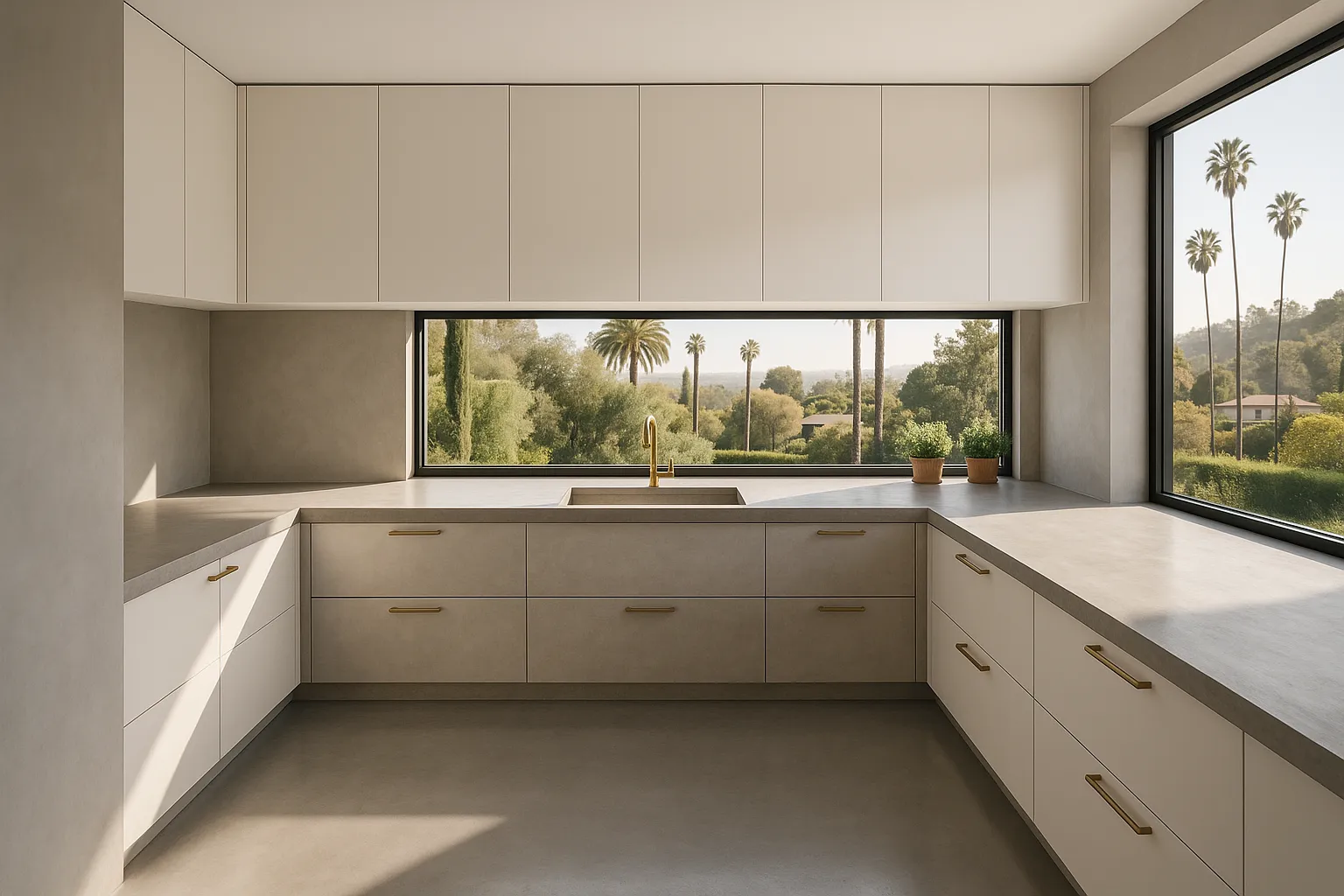
A client in [Pasadena](/areas/pasadena) called us last month holding a quote from a national countertop chain: $9,200 for a quartz slab replacement on her 34-square-foot kitchen island. She wanted to know if [microcement](/services/microcement-bathrooms) could do it for less, and more importantly, whether it would actually hold up to a busy family kitchen. That conversation happens almost weekly now, which tells you something about where the market is heading.
**[Microcement kitchens & countertops](/services/microcement-kitchens-countertops) cost CA homeowners between $65 and $185 per square foot installed in 2026**, depending on substrate condition, design complexity, and whether the project includes integrated sinks or backsplashes. That's based on our own project data across more than 80 kitchen installations in [Los Angeles](/areas/los-angeles), [Santa Monica](/areas/santa-monica), and the San Gabriel Valley over the past three years. It's a wide range, and by the end of this article you'll understand exactly why a project lands on the low end versus the high end.
## What Is Microcement, and Why Is It Showing Up in So Many CA Kitchens?
What is microcement? Microcement is a mineral-based coating system, typically 2-3mm thick, applied in layers over an existing substrate — countertop, floor, or wall — then sealed with a protective topcoat that makes it waterproof and resistant to heat, scratching, and staining.
Unlike poured concrete counters, which are cast off-site or in forms and can run 1-2 inches thick, microcement is applied directly onto your existing cabinetry structure. That's a major cost and timeline advantage. You're not tearing out cabinets or pouring new substrate — you're resurfacing what's already there with a continuous, seamless mineral finish.
The appeal in California kitchens specifically comes down to three things: it's fully waterproof (critical near sinks and ranges), it has zero visible seams across long runs of counter, and it comes in dozens of custom tones that read as natural stone or polished concrete without the maintenance headaches of either.
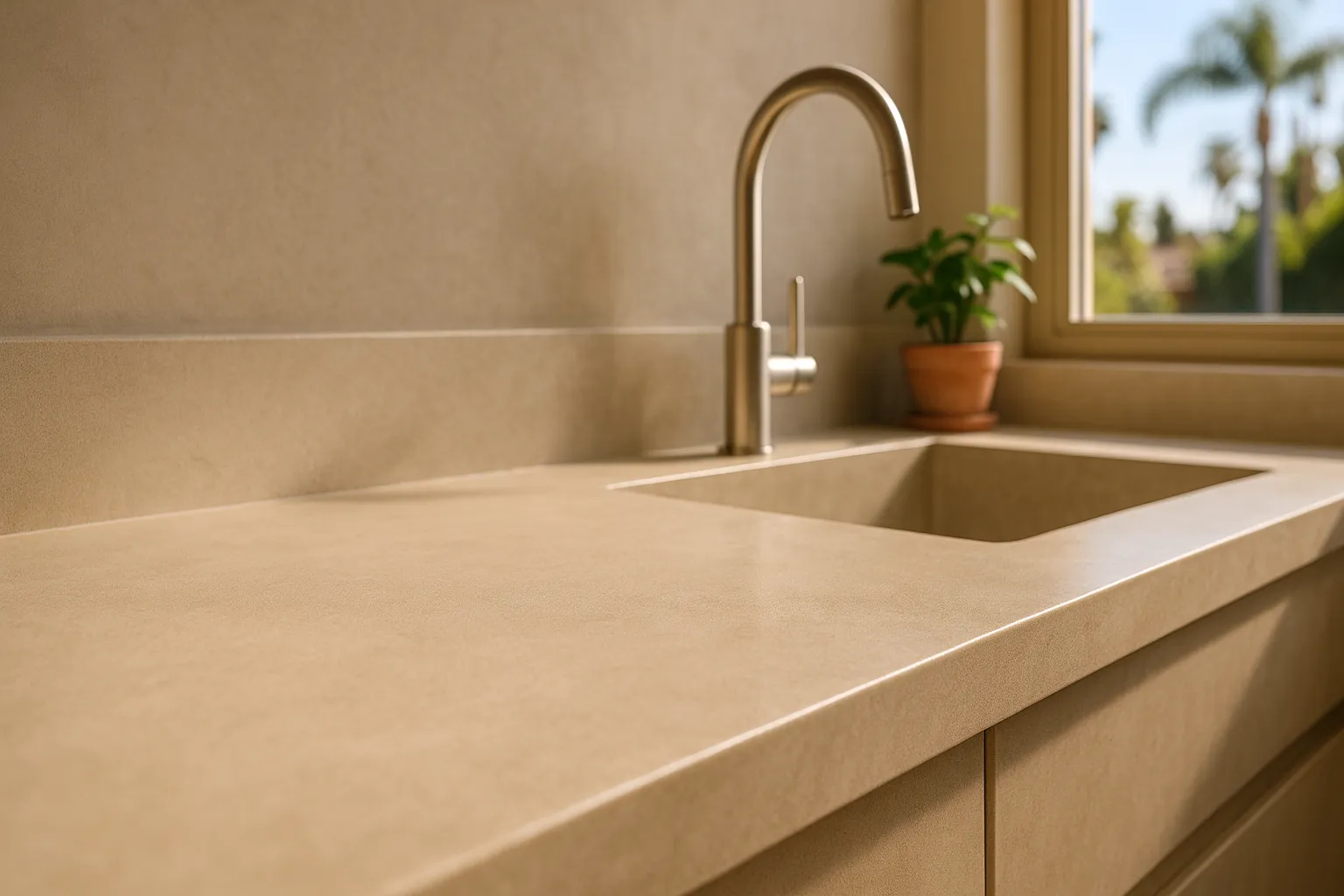
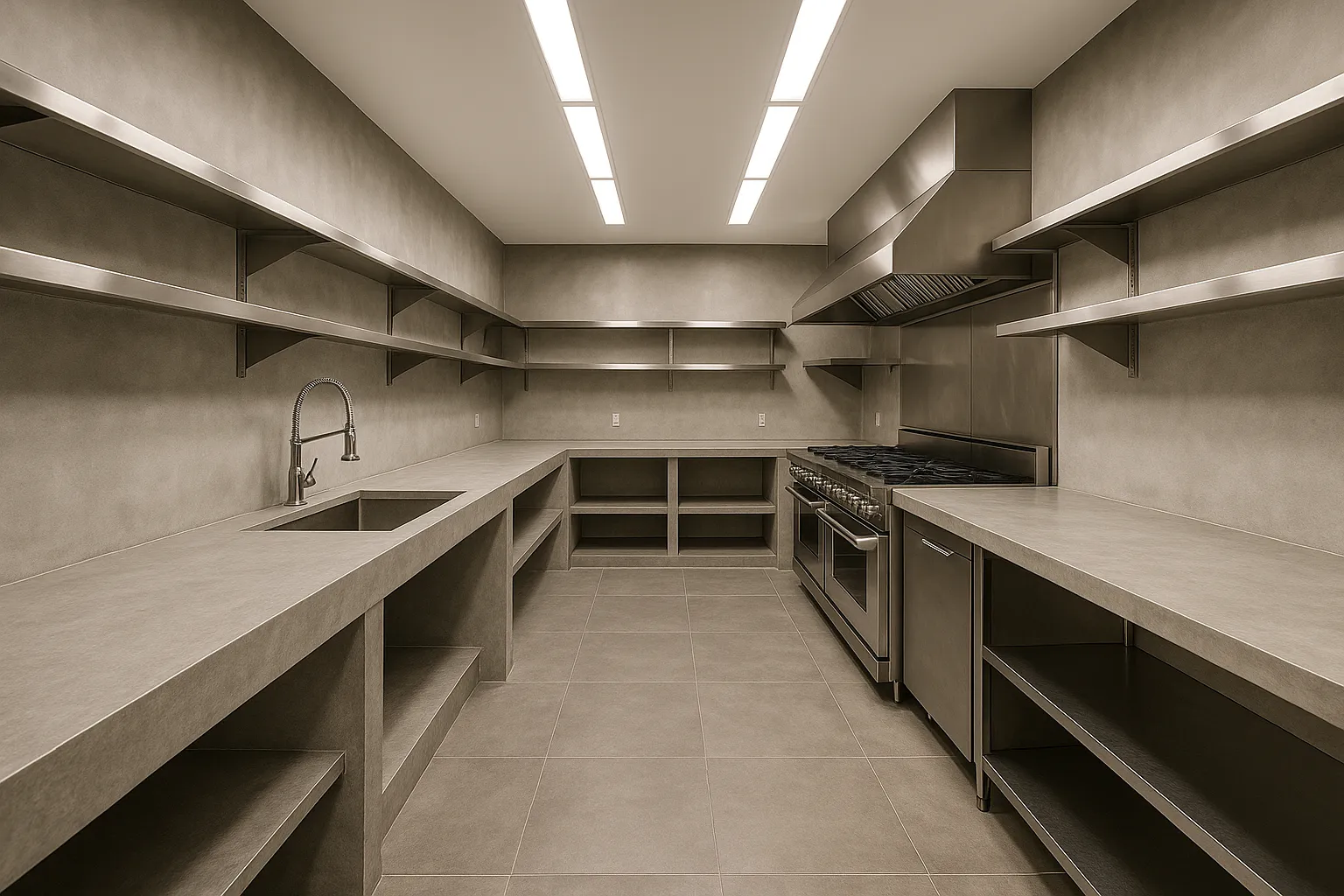
We've installed it in mid-century Pasadena remodels, ADU kitchens in [Glendale](/areas/glendale), and full [commercial](/services/microcement-commercial-hospitality) build-outs in West LA restaurants. The material performs the same way across all of them, but the labor and prep costs shift depending on the condition of what's underneath.
## [How Much Does](/estimate) Microcement Kitchens & Countertops Cost in California?
Here's the breakdown we actually quote, pulled from real invoices rather than marketing estimates:
| Project Scope | Typical Cost Range | Notes |
|---|---|---|
| Countertop resurfacing only (existing substrate in good shape) | $65-$95/sq ft | Most common, fastest turnaround |
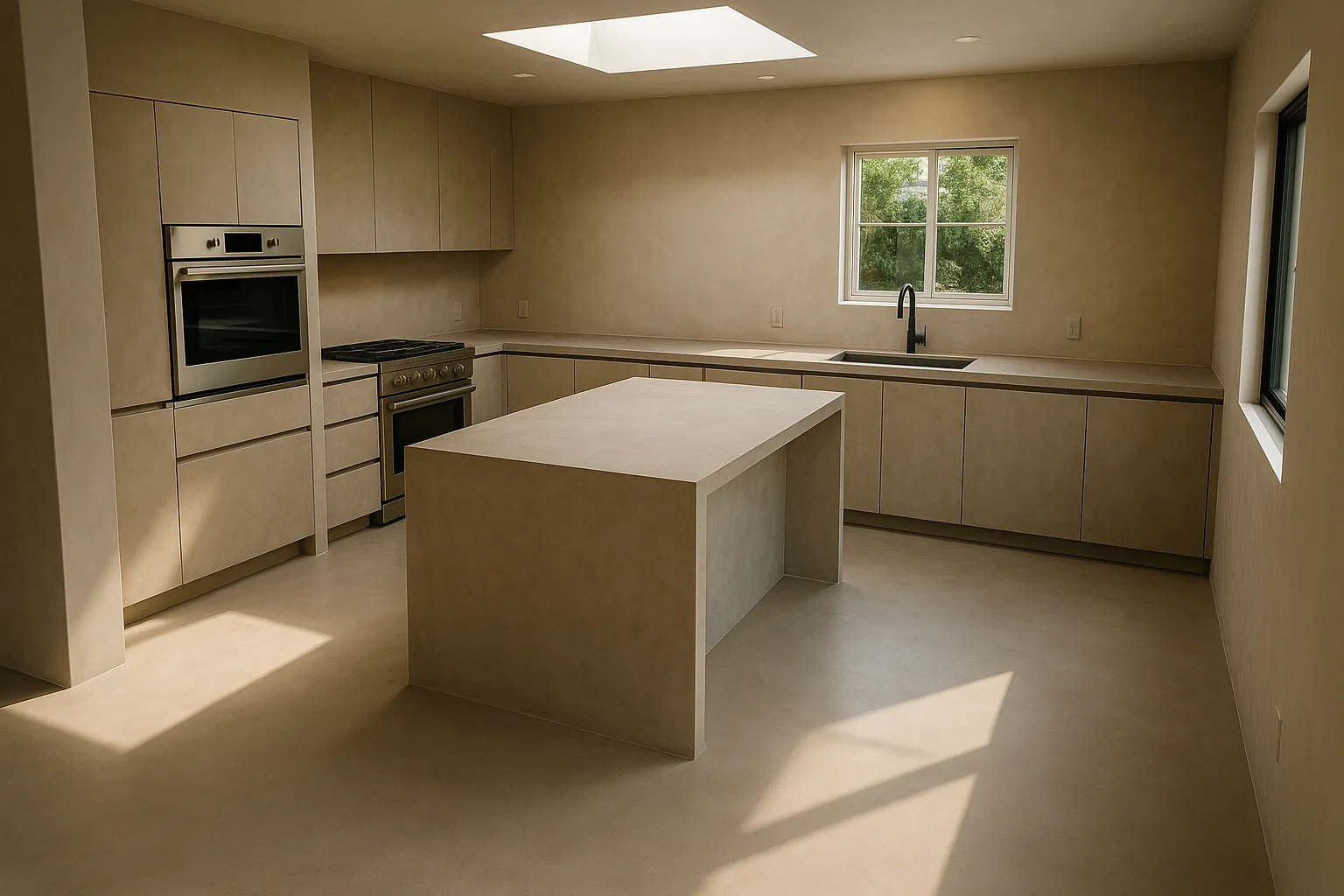
| Countertop + integrated backsplash | $95-$130/sq ft | Seamless wall-to-counter transition |
| Full kitchen (counters, island, backsplash) | $110-$165/sq ft | Average project size 45-70 sq ft |
| Countertop with integrated sink basin | $150-$220/sq ft | Requires custom mold work |
| Commercial kitchen/hospitality application | $85-$140/sq ft | Volume pricing, thicker topcoat spec |
A typical 40-square-foot kitchen countertop package in [Beverly Hills](/areas/beverly-hills) runs **$3,800 to $7,200** for materials and labor combined. A larger 90-square-foot project with an island and full backsplash in Santa Monica recently came in at **$11,400**, including a custom integrated drainboard detail.
For comparison, that same scope in quartz would have run $14,000-$18,000 given current 2026 slab pricing and fabrication labor in LA County, according to regional fabricator quotes we've reviewed this year. Granite lands similarly, often higher once you factor in edge profiles and seam work on an island.
## Microcement vs. Quartz vs. Concrete: A Real Cost Comparison
Homeowners researching this topic usually have three materials on their shortlist. Here's how they actually compare when you're quoting a 50-square-foot kitchen in the LA market this year.
| Material | Cost per Sq Ft (2026) | Seams | Heat Resistance | Repair Difficulty |
|---|---|---|---|---|
| Microcement | $65-$185 | None (monolithic) | Excellent | Easy — spot repair possible |
| Quartz | $80-$150 | Visible at seams | Good, not direct hot pans | Hard — often full slab replace |
| Poured Concrete | $90-$175 | Minimal | Excellent | Moderate — can crack and chip |
| Natural Stone (granite/marble) | $70-$200 | Visible | Good (marble etches) | Hard — professional refinish needed |
The big differentiator people underestimate is the seam issue. On an L-shaped kitchen with an island, quartz typically needs 2-3 seams. Microcement is trowel-applied as one continuous surface, so there's nothing to catch crumbs, water, or grout lines.
That said, microcement isn't free of tradeoffs. It requires a more skilled installer than a standard slab install, and poor application — too thin a topcoat, rushed curing — is the number one reason we get called for repair work on other companies' jobs.

## What Drives the Price Up or Down on a CA Microcement Kitchen?
Five factors determine where your project lands in that cost range:
1. **Substrate condition.** If your existing counter is laminate or plywood in decent shape, prep is minimal. If it's damaged, water-swollen, or needs leveling, expect $8-$15/sq ft added for substrate repair.
2. **Square footage and layout complexity.** A straight run is cheaper per square foot than an island with waterfall edges or a curved peninsula.
3. **Integrated features.** Built-in drainboards, integrated sinks, and backsplash-to-counter transitions all add labor hours — often $20-$40/sq ft extra.
4. **Color and texture complexity.** Standard warm-gray and sand tones are our base pricing. Custom pigment blending or textured finishes add 10-15% to material cost.
5. **Topcoat spec.** Residential kitchens typically get a 2-coat sealer system. Commercial kitchens in hospitality settings often need a 3-coat, food-safe, high-abrasion topcoat, which runs 15-20% more.
A recent project in Glendale illustrates this well: a straightforward 38-square-foot countertop resurface with no backsplash came in at **$2,850** total. Three weeks later, a similarly-sized job in West LA with an integrated sink and waterfall island edge hit **$7,600** — nearly triple, same square footage, very different scope.
## How Long Does a Microcement Kitchen Installation Take?
What is the typical timeline? Most residential microcement kitchen projects take **5 to 10 working days** from first site prep to final cure, though the kitchen isn't usable for light tasks until about day 3 and isn't ready for heavy use (hot pans, heavy cutting) until **7-10 days post-application**.
Here's the step-by-step process we follow on nearly every job:
1. **Site assessment and substrate prep (Day 1).** We check for moisture, level inconsistencies, and existing damage.
2. **Primer and key coat application (Day 1-2).** This bonds the microcement system to your existing surface.
3. **Base layer troweling (Day 2-3).** First structural layer, typically 1-1.5mm.
4. **Finish layer and texture (Day 3-4).** This is where tone and texture get dialed in — the most skill-dependent step.
5. **Sanding and surface refinement (Day 4-5).** Smooths transitions and prepares for sealing.
6. **Sealing — 2 to 3 coats (Day 5-7).** Each coat needs 12-24 hours of cure time.
7. **Final cure and handover (Day 7-10).** Full chemical cure for heat and stain resistance.
Commercial kitchens and hospitality projects run longer — typically **3 to 5 weeks** — because of larger square footage, more complex drainage integration, and the need to schedule around a restaurant's operating hours.
"The biggest scheduling mistake homeowners make is assuming microcement cures like paint," says our lead installer at Cemora. "It's a mineral system — it needs real cure time, and rushing the topcoat is exactly how you end up with hairline cracking six months later."

## Is Microcement Durable Enough for Daily Kitchen Use?
What is the durability profile of microcement? It's a mineral composite with a flexible polymer binder, which means it resists the cracking that pure concrete is prone to while maintaining the scratch and heat resistance people associate with stone.
A 2025 industry survey from Houzz's State of the Industry report noted that **68% of homeowners** who chose alternative countertop surfaces (concrete-style finishes included) cited durability concerns as their top research priority before hiring a contractor. That matches what we hear on every consultation call.
In practice, properly sealed microcement counters handle daily kitchen abuse well:
- **Heat resistance:** Can handle hot pans briefly, though trivets are still recommended for cast iron
- **Scratch resistance:** Comparable to quartz, better than marble
- **Stain resistance:** Sealed topcoat resists wine, oil, and acidic foods when cleaned within a reasonable window
- **Water resistance:** Fully waterproof when properly sealed — a major advantage over butcher block or untreated wood
The sealer does need reapplication over time. We recommend a maintenance reseal every **3-5 years** for residential kitchens, running **$400-$900** depending on square footage, which is far less than the cost of re-slabbing a quartz counter after a crack or chip.
## Does Microcement Increase Home Resale Value in California?
Kitchen renovations remain the single highest-ROI interior project in the Southern California market. According to 2026 projections extrapolated from the National Association of Realtors' 2025 Remodeling Impact Report, minor kitchen updates recoup **71-81%** of their cost at resale, with upscale finishes — including custom surface treatments — performing at the higher end of that range in competitive markets like Santa Monica and Beverly Hills.
Microcement specifically appeals to the design-forward buyer pool common in LA County: it photographs beautifully for listings, reads as a custom architectural choice rather than a standard builder-grade finish, and signals a recently updated kitchen without looking trendy in a way that dates quickly.
A homeowner in [Burbank](/areas/burbank) who installed microcement counters and matching floors in 2025 as part of a $38,000 kitchen refresh sold her home eight months later for **$46,000 over her original purchase comps**, with her listing agent specifically calling out the "seamless concrete-look counters" in the listing copy. That's an anecdotal data point, not a guarantee, but it illustrates the aesthetic premium these finishes carry in design-conscious markets.
If you're pairing countertops with a full kitchen renovation, it's worth looking at our [microcement kitchens & countertops](/services/microcement-kitchens-countertops?utm_source=blog&utm_medium=organic&utm_campaign=microcement-kitchens-countertops-cost-ca) service page, where we break down full-room packages that bundle counters with matching flooring.
## Residential vs. Commercial Microcement Kitchen Projects
Commercial kitchens and hospitality spaces have different demands than a home remodel, and the cost structure reflects that.
- **Volume pricing:** Commercial jobs over 300 square feet typically see per-square-foot costs drop by **10-18%** compared to residential rates.
- **Code compliance:** Restaurant kitchens need NSF-compliant, food-safe topcoats — not optional, and it adds roughly **$8-$12/sq ft**.
- **Durability spec:** Commercial installs use a thicker wear layer to handle higher foot traffic and daily commercial cleaning chemicals.
- **Downtime cost:** Restaurants often pay a premium for after-hours or overnight installation to avoid closing during business hours.
A [West Hollywood](/areas/west-hollywood) restaurant client recently had us resurface **210 square feet** of prep counters and a pass-through bar top for **$24,500**, completed in off-hours shifts over 11 days to avoid any service interruption. That project falls squarely under our [commercial & hospitality microcement](/services/microcement-commercial-hospitality?utm_source=blog&utm_medium=organic&utm_campaign=microcement-kitchens-countertops-cost-ca) scope, which handles the scheduling complexity differently than a residential job.
## How Does Microcement Pricing Compare Across CA Cities?
Labor costs and permitting requirements shift slightly across the region, which affects quotes even for identical scopes of work.
- **Los Angeles & West LA:** Highest labor costs, typically **5-10% above** regional average due to demand and installer availability.
- **Santa Monica & Beverly Hills:** Premium material and design customization requests are more common, pushing average project costs up **8-15%**.
- **Pasadena & Glendale:** Mid-range pricing, slightly below LA core rates, strong demand for mid-century modern kitchen updates.
- **Greater San Gabriel Valley:** Generally the most cost-efficient for comparable scope, often **10-12% lower** than West LA pricing.
If you're budgeting across Southern California broadly, expect roughly a **15-20% swing** in total project cost purely based on zip code and installer availability, separate from material and scope differences.
## What Should You Ask a Contractor Before Hiring for a Microcement Kitchen?
Before signing anything, ask these questions — the answers separate experienced microcement installers from general contractors dabbling in a trend:
1. **How many microcement kitchen projects have you completed in the last 12 months?** You want a number in the double digits, not a handful.
2. **What topcoat system do you use, and is it food-safe rated?** This matters even for residential kitchens.
3. **What's your cure-time guarantee before heavy use?** Anything under 5 days is a red flag.
4. **Can I see a project with at least 18 months of real-world wear?** Fresh installs always look perfect — ask for aged examples.
5. **What's included in your warranty, and does it cover sealer failure?** Most reputable installers offer **1-3 years** on workmanship.
Getting these answers upfront avoids the most common complaint we hear from homeowners who had a bad first experience with a different installer: hairline cracking, uneven sheen, or a sealer that started failing within a year.
## Frequently Asked Questions
### How much does a microcement kitchen countertop cost in California in 2026?
Most residential microcement countertop projects in California cost between **$65 and $185 per square foot installed**, with a typical 40-square-foot kitchen project landing between $3,800 and $7,200. Pricing depends heavily on substrate prep needs, integrated features like sinks or backsplashes, and design complexity.
### Is microcement cheaper than quartz countertops?
In most cases, yes — microcement resurfacing typically costs **15-25% less** than a comparable quartz slab installation in the LA market, mainly because it doesn't require full cabinet removal or slab fabrication. However, highly customized microcement designs with integrated sinks can sometimes exceed quartz pricing on a per-square-foot basis.
### How long does microcement take to install in a kitchen?
A standard residential kitchen countertop project takes **5 to 10 working days** from prep to final cure, while commercial kitchen installations typically run **3 to 5 weeks** due to larger scope and after-hours scheduling needs. Full cure for heavy daily use, including hot pans and heavy cutting, usually requires 7-10 days post-application.
### Does microcement crack over time?
Properly applied microcement with adequate cure time and a quality topcoat rarely cracks under normal kitchen use, since the polymer-reinforced binder gives it flexibility that pure concrete lacks. Most cracking issues we see in repair calls trace back to rushed installation or inadequate substrate prep rather than the material itself failing.
### Can microcement go over existing laminate countertops?
Yes, microcement can be applied directly over laminate in good structural condition, which is one of the biggest cost advantages over a full countertop replacement. If the laminate is water-damaged or delaminating, that section needs repair or substrate replacement first, which adds $8-$15 per square foot to the project.
### How much does it cost to add a microcement backsplash along with countertops?
Adding a seamless microcement backsplash typically adds **$95-$130 per square foot** combined with countertop work, compared to $65-$95/sq ft for counters alone. The seamless counter-to-wall transition is one of the most requested design features in our Santa Monica and Beverly Hills projects.
### Is microcement waterproof enough for kitchen sink areas?
Yes, properly sealed microcement is fully waterproof and performs well around sinks, which is why it's also popular for our [microcement bathrooms & wet rooms](/services/microcement-bathrooms?utm_source=blog&utm_medium=organic&utm_campaign=microcement-kitchens-countertops-cost-ca) projects. The key is a minimum 2-coat sealer system applied with adequate cure time between coats.
### How often do microcement countertops need to be resealed?
Most residential microcement kitchen counters need resealing every **3-5 years**, costing **$400-$900** depending on square footage and accessibility. Heavier-use commercial kitchens may need resealing on a shorter 2-3 year cycle due to higher traffic and more frequent chemical cleaning exposure.
### Does microcement increase home resale value in Southern California?
Kitchen updates remain one of the highest-ROI renovation categories in California, recouping an estimated **71-81% of project cost** at resale according to 2026 projections based on 2025 NAR remodeling data. Microcement's custom, seamless appearance tends to photograph well for listings and appeals strongly to design-conscious buyers in markets like Pasadena and West LA.
### What's the difference between microcement and poured concrete countertops?
Microcement is a thin, 2-3mm mineral coating applied over an existing substrate, while poured concrete counters are 1-2 inch thick slabs cast separately and installed like stone. Microcement is generally faster to install, lighter in weight (no structural reinforcement needed), and more cost-effective for resurfacing existing cabinetry.
## Getting an Accurate Quote for Your Kitchen
Every kitchen is a little different — cabinet layout, existing substrate, how much custom color work you want — which is why ballpark numbers online only get you so far. The fastest way to get real pricing is to have someone look at your actual space.
If you're weighing microcement against quartz, concrete, or stone for an upcoming kitchen project anywhere from Glendale to Santa Monica, start with a [free estimate](/estimate?utm_source=blog&utm_medium=organic&utm_campaign=microcement-kitchens-countertops-cost-ca) — it takes about 15 minutes and gives you real numbers instead of a wide range. You can also [book a consultation](/book?utm_source=blog&utm_medium=organic&utm_campaign=microcement-kitchens-countertops-cost-ca) if you'd rather walk through material samples in person before committing.
And if you've got questions that aren't covered here — maybe about pairing microcement counters with [microcement floors & walls](/services/microcement-floors-walls?utm_source=blog&utm_medium=organic&utm_campaign=microcement-kitchens-countertops-cost-ca) for a fully unified kitchen — [reach out directly](/contact?utm_source=blog&utm_medium=organic&utm_campaign=microcement-kitchens-countertops-cost-ca). We'd rather answer the question now than have you guess and regret the finish later.
---
**Ready to start your your project in Los Angeles?** [Book a free consultation](/book?utm_source=blog&utm_medium=organic&utm_campaign=microcement-kitchens-countertops-cost-ca-what-to-expect-in-2026) — we'll come walk through your space and give you straight numbers, no pressure. Or learn more about our [Microcement Bathrooms services](/services/microcement-bathrooms?utm_source=blog&utm_medium=organic&utm_campaign=microcement-kitchens-countertops-cost-ca-what-to-expect-in-2026).