Microcement Kitchens & Countertops Cost CA: What to Expect in 2026
By Gilad Segev · June 1, 2026 · Last updated June 5, 2026 · Cost Guide
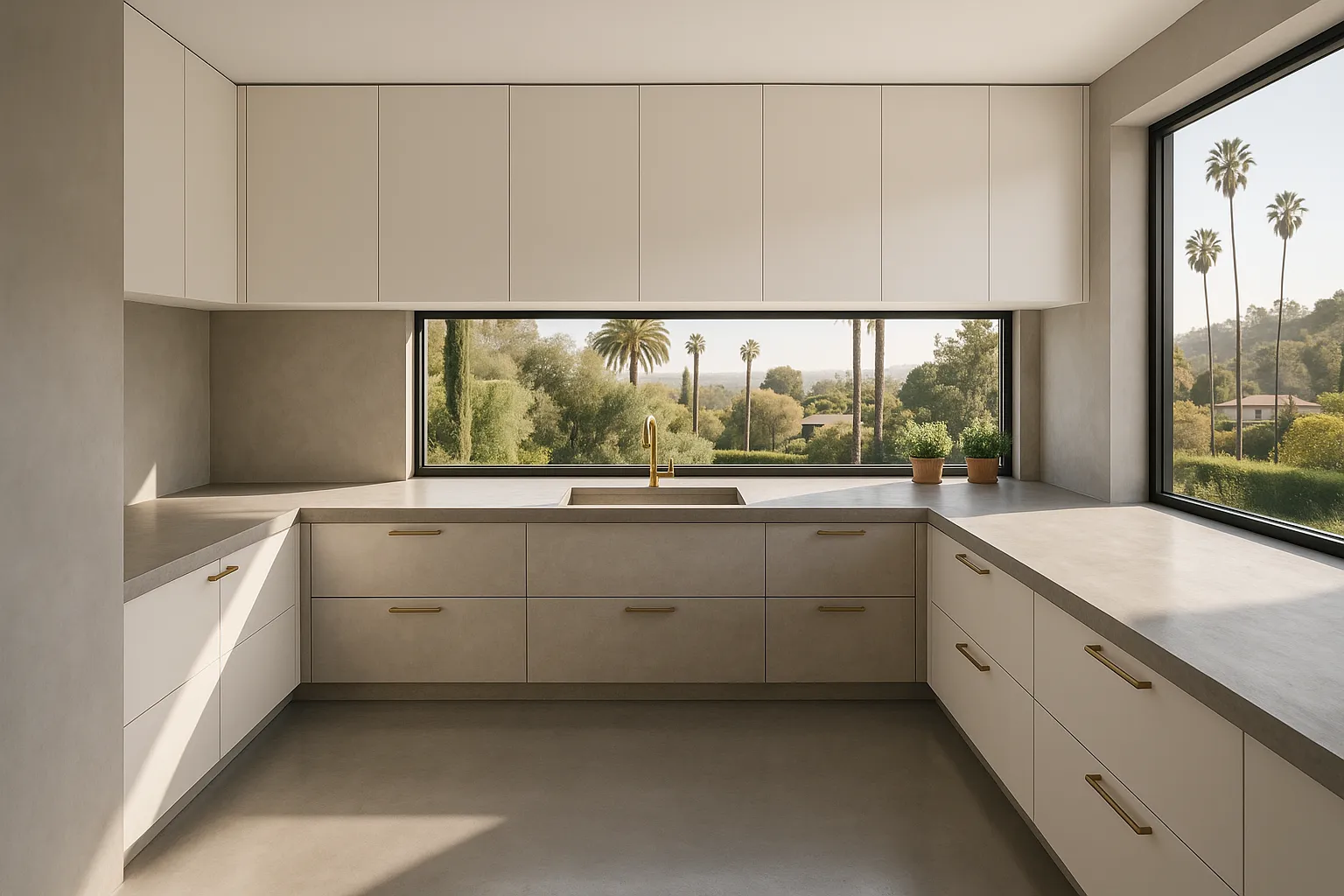
Most homeowners in [Los Angeles](/areas/los-angeles) are shocked to learn that **[microcement](/services/microcement-bathrooms) kitchens & countertops cost CA** projects typically run between **$4,500 and $18,000** — far less than a full tile or stone renovation, and with results that look like they belong in an Architectural Digest spread. If you're researching this finish for your kitchen and wondering whether the price is justified, the short answer is yes — but only if you understand what drives costs up or down before you sign anything.
Microcement is having a serious moment in 2026. Across [Beverly Hills](/areas/beverly-hills), [Santa Monica](/areas/santa-monica), and [Pasadena](/areas/pasadena), designers are specifying it for everything from countertop overlays to full kitchen wall systems. It's not a trend born of novelty — it's a response to homeowners wanting fewer grout lines, fewer maintenance headaches, and a mineral aesthetic that ages beautifully.
This guide breaks down exactly what you'll pay, why, and how to avoid the most common budget mistakes.
---
## What Is Microcement? A Definition Worth Knowing
What is microcement? Microcement is a thin-layer cementitious coating — typically **2–3mm thick** — composed of cement, water-based resins, mineral pigments, and fine aggregates. Unlike traditional concrete overlays, it bonds directly to existing substrates including tile, wood, plywood, drywall, and existing countertops without requiring demolition.
Because it's polymer-modified, it achieves flexibility that standard concrete lacks. That matters in kitchens, where thermal expansion, moisture, and daily impact are constant. When properly sealed with a two-component polyurethane or epoxy topcoat, microcement becomes **waterproof, food-safe, and stain-resistant** — all critical for kitchen environments.
What is a microcement countertop? A microcement countertop is a seamless mineral surface applied directly over an existing substrate — MDF, plywood, tile, or laminate — creating a monolithic, grout-free surface that can be tinted to virtually any color and textured to any finish level from matte to high-gloss.
What is a microcement kitchen? A microcement kitchen refers to a space where microcement has been applied to one or more surfaces — countertops, backsplashes, walls, floors, or islands — creating a cohesive, seamless aesthetic. Full microcement kitchen systems, where every surface is treated, are increasingly common in high-end residential projects across Los Angeles County.

---
## [How Much Does](/estimate) [Microcement Kitchens & Countertops](/services/microcement-kitchens-countertops) Cost CA in 2026?
Based on Cemora's project data across 80+ completed kitchen installations in Los Angeles, Santa Monica, Pasadena, and [Glendale](/areas/glendale), here's what homeowners are actually paying in 2026:
### Countertop-Only Projects
- **Small kitchen countertop (under 30 sqft):** $1,800 – $3,500
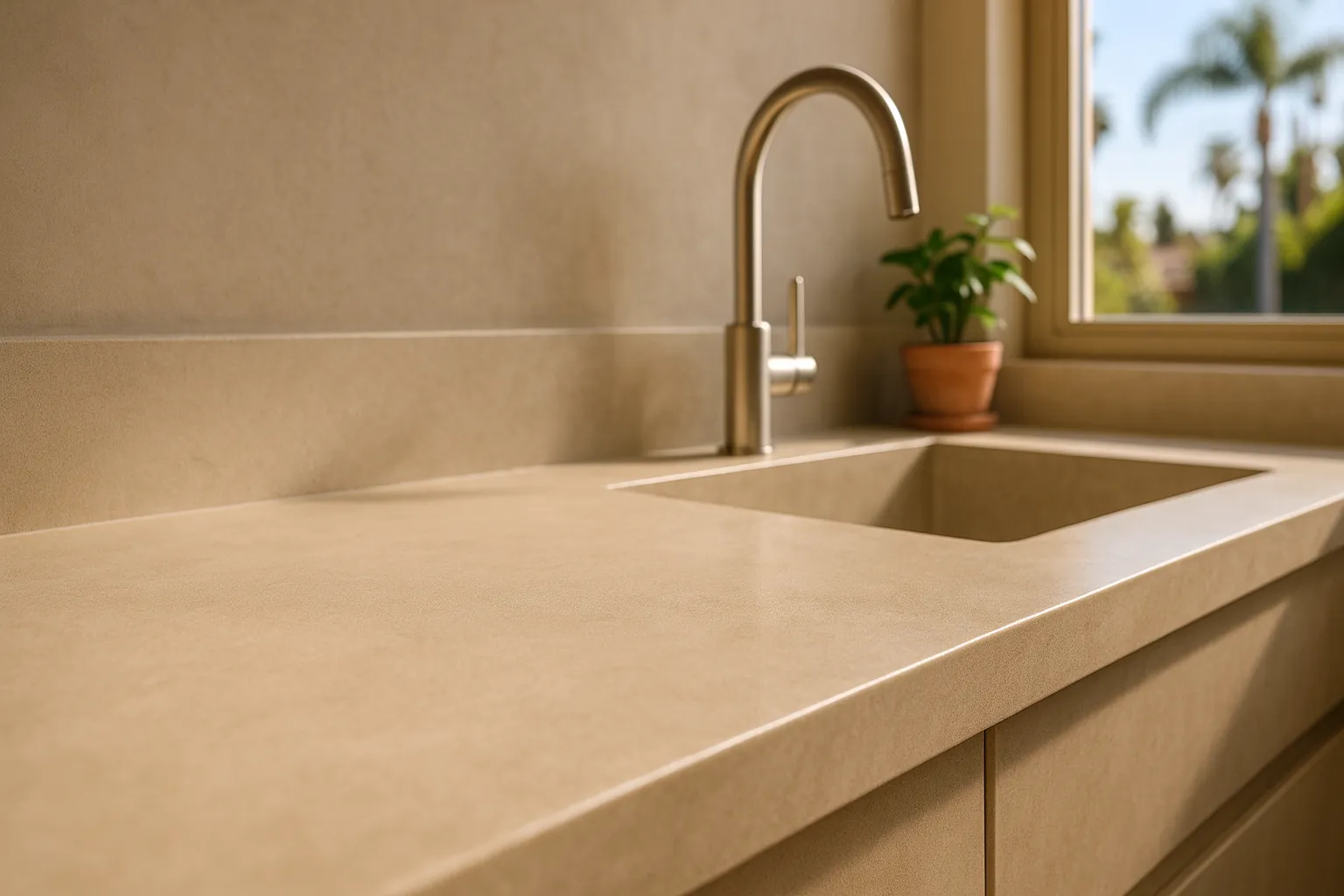
- **Mid-size countertop (30–60 sqft):** $3,500 – $6,500
- **Large countertop with island (60–100 sqft):** $6,500 – $11,000
- **Luxury custom countertop with integrated backsplash:** $9,000 – $16,000
### Full Kitchen Surface Systems
- **Countertops + backsplash only:** $5,500 – $10,000
- **Countertops + backsplash + walls:** $9,000 – $16,000
- **Full kitchen system (all surfaces including floor):** $14,000 – $28,000+
These ranges reflect **2026 projections based on 2025 Cemora project data**, adjusted for approximately **4% material and labor cost drift** observed in the Southern California market. Material costs for premium European microcement systems increased roughly **6–8% between 2024 and 2025**, driven by import logistics and resin pricing.
"The most common budget mistake we see," says Cemora's lead applicator, "is homeowners pricing countertops alone and forgetting the backsplash. When you're doing microcement, the backsplash is 20–30% of the visual impact — leaving it in tile next to a seamless counter looks unfinished."
---
## What Factors Drive Microcement Kitchen Cost in California?
The **microcement kitchens & countertops cost CA** isn't a fixed number — it moves based on several variables that are worth understanding before you get quotes.
### 1. Surface Area and Complexity
Square footage is the primary cost driver, but complexity multiplies it. A straightforward rectangular countertop at **$55–$85 per sqft** becomes **$90–$130 per sqft** when it involves integrated sinks, curved edges, waterfall sides, or tight inside corners. Each of these requires additional prep, hand-finishing time, and sealer coats.
### 2. Substrate Condition
Microcement bonds to almost anything — but what's underneath has to be structurally sound and properly prepared. Existing countertops with significant deflection, soft spots, or delamination need remediation before coating. In older homes in Pasadena and Glendale, we commonly find laminate countertops that need reinforcement — adding **$300–$900** to prep costs.
### 3. Color and Finish Selection
Standard pigment colors (greys, whites, warm beiges) cost the same as custom tints. However, achieving very dark colors — charcoal, deep forest green, navy — requires additional coats and more precise sealer chemistry to prevent blotching. Expect a **10–15% premium** on very dark or highly saturated colors.
### 4. Sealer System
The sealer is not where you cut costs. A two-component polyurethane system rated for kitchen use runs **$8–$14 per sqft** in material cost alone. Some applicators use single-component sealers to save money — they look identical on day one but show wear within 18–24 months in a working kitchen. Always ask what sealer system is being specified.
### 5. Location Within LA County
Labor rates vary across the region. Projects in Beverly Hills and Bel Air typically carry a **10–18% premium** over projects in the San Fernando Valley or East Los Angeles, reflecting both travel time and the market's tolerance for premium pricing.

---
## Microcement vs. Other Kitchen Countertop Materials: A Cost Comparison
Understanding how **microcement kitchens & countertops cost CA** stacks up against alternatives helps homeowners make an informed decision — not just on upfront cost, but on total ownership value.
| Material | Installed Cost (per sqft) | Lifespan | Grout Lines | Resealable | Customizable Color |
|---|---|---|---|---|---|
| Microcement | $55 – $130 | 15–25 years (with maintenance) | None | Yes | Unlimited |
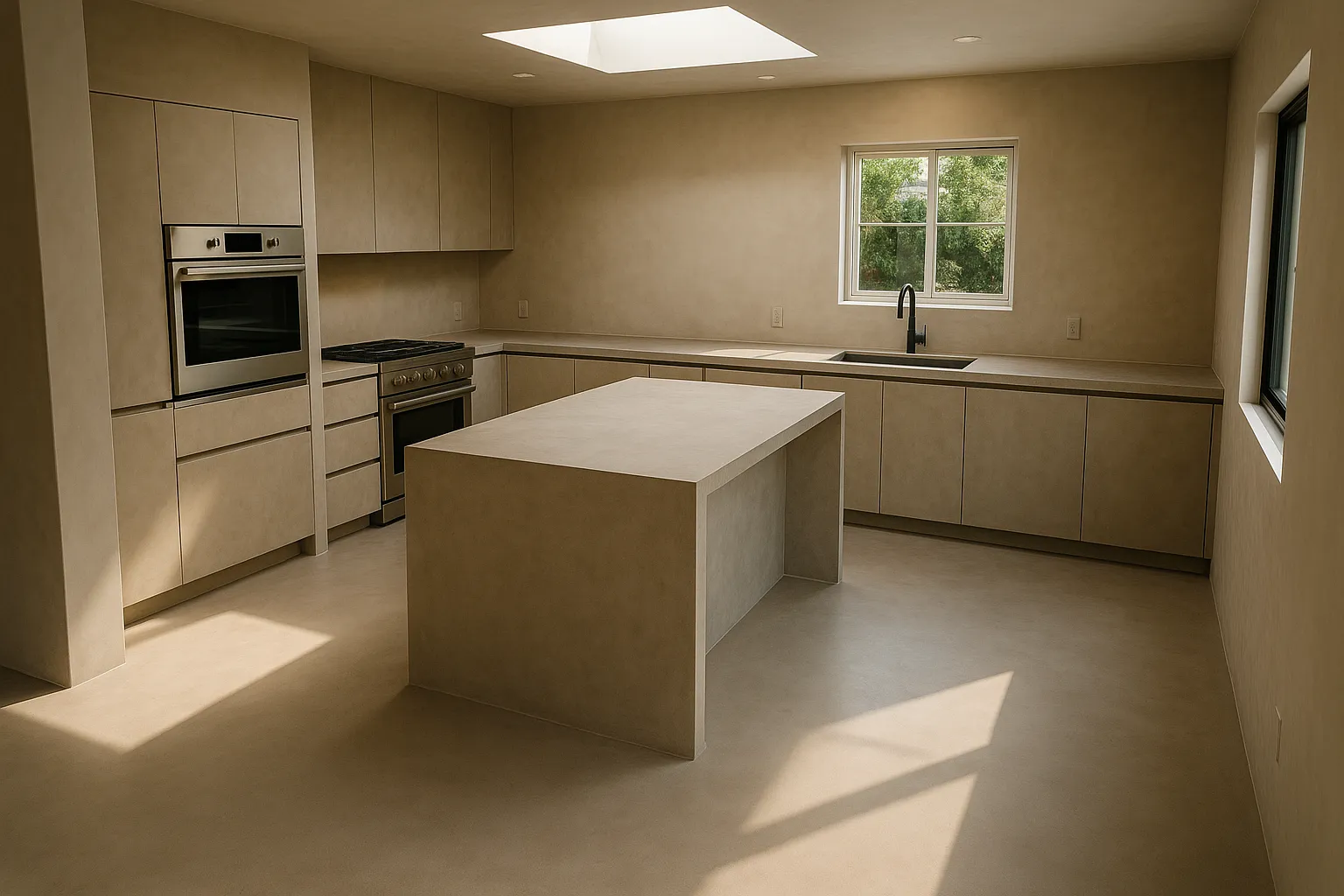
| Quartz (engineered) | $75 – $150 | 20–30 years | None | No | Limited |
| Granite | $60 – $140 | 20–30 years | None | Yes | Limited |
| Marble | $80 – $200 | 20–30 years | None | Yes | Limited |
| Tile | $25 – $75 | 15–25 years | Yes | No | Moderate |
| Laminate | $15 – $40 | 10–15 years | None | No | Moderate |
| Concrete (cast) | $90 – $150 | 15–20 years | None | Yes | High |
Microcement's competitive advantage isn't always price — it's the **combination of seamlessness, repairability, and design flexibility** that no other material matches at this price point. Quartz can't be tinted to match a specific paint color. Marble can't be applied over existing surfaces without demolition. Microcement can.
According to the **2025 Houzz State of the Industry report**, homeowners who chose mineral and cement-based surfaces for kitchen renovations reported **23% higher satisfaction scores** at the 2-year mark compared to tile installations, primarily citing ease of cleaning and aesthetic cohesion.
---
## How Long Does a Microcement Kitchen Project Take?
Timeline is one of the most underestimated aspects of planning a microcement kitchen. Here's a realistic breakdown:
### Typical Project Timeline
1. **Consultation and color selection:** 1–2 weeks (includes sample review and substrate assessment)
2. **Scheduling and material lead time:** 1–3 weeks (European microcement systems have 10–21 day import lead times)
3. **Substrate preparation:** 1–2 days (cleaning, priming, any structural repairs)
4. **Microcement application — Layer 1 (base coat):** 1 day, then **24-hour cure**
5. **Microcement application — Layer 2 (finish coat):** 1 day, then **24-hour cure**
6. **Sanding and surface refinement:** Half day
7. **Sealer application — Coat 1:** Half day, then **4–6 hour cure**
8. **Sealer application — Coat 2:** Half day, then **12-hour cure**
9. **Full cure before heavy use:** **7 days** from final sealer coat
**Total on-site time: 4–6 days.** Total project duration from first consultation to finished surface: **3–6 weeks**, depending on scheduling and material availability.
For [commercial](/services/microcement-commercial-hospitality) kitchen projects in Los Angeles — restaurants, hotel kitchens, hospitality spaces — Cemora's [Commercial & Hospitality Microcement](/services/microcement-commercial-hospitality?utm_source=blog&utm_medium=organic&utm_campaign=microcement-kitchens-countertops-cost-ca) team schedules around operational hours to minimize business disruption.
---
## Three Real-World Microcement Kitchen Projects in Los Angeles
### Project 1: Santa Monica Condo Kitchen Countertop Overlay
A homeowner in Santa Monica had a 42 sqft laminate countertop in a rental unit that needed updating without a full renovation. Tearing out the laminate and installing quartz would have required new substrate work and cost approximately **$8,400 installed**. Instead, Cemora applied a warm greige microcement system directly over the existing laminate with a two-component polyurethane sealer. **Total project cost: $4,200.** The tenant couldn't tell it wasn't a high-end stone surface — and the landlord saved over $4,000.
### Project 2: Beverly Hills Full Kitchen Surface System
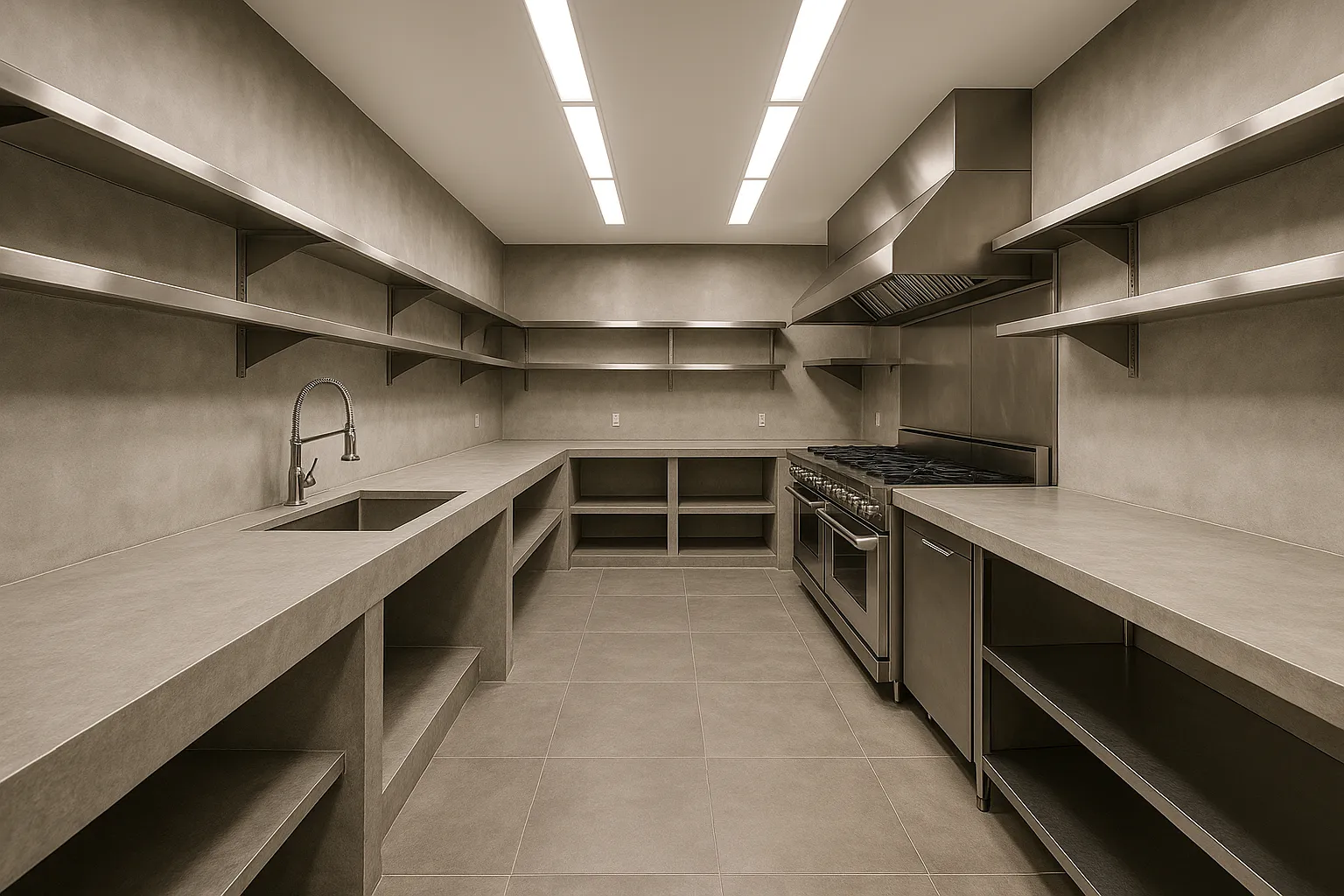
A designer-led kitchen renovation in Beverly Hills specified microcement across countertops, backsplash, and a floor-to-ceiling feature wall adjacent to the range. Total treated surface area: **187 sqft** across three surface types. The substrate varied — existing tile on the backsplash, plywood on the countertops, and drywall on the feature wall — requiring different primer systems for each. **Total project cost: $21,400.** The same aesthetic in natural stone would have required **$38,000–$55,000** in material and fabrication costs alone.
### Project 3: Pasadena Restaurant Kitchen Pass-Through Counter
A new restaurant in Pasadena needed a pass-through counter and service bar surface that could handle commercial-grade daily use — hot pans, acidic spills, constant wiping. Cemora specified a commercial-grade epoxy-hybrid sealer system over a charcoal microcement base. **Total surface area: 68 sqft. Project cost: $8,900.** The owner reported zero visible wear at the **12-month inspection** — a surface that a standard tile installation would have shown grout discoloration on by month six.
---
## Is Microcement Worth It for Kitchen Countertops in California?
The ROI question matters — especially in the LA real estate market, where kitchen finishes directly influence buyer perception and appraisal value.
Based on industry benchmarks from the **2025 NAHB Remodeling Impact Report**, kitchen renovations in the Western US region return an average of **62–71 cents on the dollar** at resale. Microcement kitchens tend to outperform that benchmark in design-conscious markets like Beverly Hills, [West Hollywood](/areas/west-hollywood), and Silver Lake, where buyers specifically seek out non-standard finishes.
For investment properties and short-term rentals in Los Angeles, the calculus is even clearer. A microcement countertop overlay that costs **$4,000–$6,500** can increase nightly rental rates by **$15–$35 per night** on Airbnb-style platforms — paying back the investment within **6–18 months** depending on occupancy rates.
Microcement is also the only countertop material that can be refinished in place. If a surface gets damaged — a deep gouge, a burn mark — a skilled applicator can patch and re-seal the affected area for **$300–$800**, versus replacing an entire stone slab for **$3,000–$8,000**.
For homeowners considering [Microcement Bathrooms & Wet Rooms](/services/microcement-bathrooms?utm_source=blog&utm_medium=organic&utm_campaign=microcement-kitchens-countertops-cost-ca) or [Microcement Floors & Walls](/services/microcement-floors-walls?utm_source=blog&utm_medium=organic&utm_campaign=microcement-kitchens-countertops-cost-ca) alongside their kitchen project, bundling surfaces into a single project scope typically reduces per-sqft cost by **12–18%** — the mobilization and prep costs are shared across more surface area.

---
## How to Choose the Right Microcement Applicator in California
Not all microcement is created equal — and more importantly, not all applicators are. The finish quality of a microcement surface is almost entirely determined by the skill of the hands applying it. This is a material that rewards expertise and punishes shortcuts.
### What to Ask Before Hiring
- **What brand of microcement system do you use?** Premium European systems (Topciment, Deco-Coat, Diasen) perform differently than budget domestic alternatives. Ask specifically.
- **Can I see a kitchen countertop project you've completed?** Not a floor. Not a bathroom wall. A countertop — which requires the highest precision and the most durable sealer chemistry.
- **What sealer system do you specify for kitchen countertops?** The correct answer involves a two-component polyurethane or epoxy-hybrid system. Single-component acrylic sealers are not appropriate for kitchen use.
- **Do you offer a warranty?** Reputable applicators offer **1–2 year workmanship warranties** on kitchen surfaces. Material defects are typically covered by the manufacturer.
- **Are you licensed and insured in California?** CSLB (California Contractors State License Board) requires a valid C-35 (Lathing and Plastering) or C-54 (Tile) license for most microcement applications. Verify the license number at CSLB.ca.gov before signing.
"We've re-done more than a dozen microcement countertops in the last two years that were applied by unlicensed installers," says Cemora's project manager. "The pattern is always the same — wrong primer for the substrate, single-component sealer, and a surface that's peeling or staining within 12 months. The homeowner ends up paying twice."
For a [Free Estimate](/estimate?utm_source=blog&utm_medium=organic&utm_campaign=microcement-kitchens-countertops-cost-ca) on your kitchen project, Cemora provides a substrate assessment and written scope before any commitment.
---
## Understanding the Microcement Kitchen Installation Process
Knowing the step-by-step process helps you evaluate quotes and ask the right questions. Here's how a professional microcement countertop installation should proceed:
1. **Substrate assessment:** The applicator evaluates existing surface for deflection, moisture, adhesion potential, and structural integrity.
2. **Surface preparation:** Cleaning, degreasing, sanding, and any structural repairs. This step cannot be rushed — it determines whether the coating bonds permanently or fails within months.
3. **Primer application:** Substrate-specific primer is applied and allowed to cure fully (typically 4–8 hours). Skipping or rushing primer is the #1 cause of delamination failures.
4. **Mesh embedding (if required):** On countertops with seams, joints, or flexible substrates, a fiberglass mesh is embedded in the first coat to prevent cracking.
5. **Base coat application:** First layer of microcement — approximately 1–1.5mm — is troweled on. This establishes the primary color and builds the surface body.
6. **Intermediate sanding:** Light sanding to remove trowel marks and surface irregularities.
7. **Finish coat application:** Second layer — 0.5–1mm — is applied with finer aggregate for the final texture and color depth.
8. **Fine sanding:** Wet or dry sanding to achieve the specified surface texture (matte, satin, or polished).
9. **Sealer coat 1:** First sealer coat penetrates the surface and begins building the protective film.
10. **Sealer coat 2:** Second coat builds the full protective layer. Some kitchen specifications require a third coat for maximum chemical resistance.
11. **Cure period:** Surface is protected and kept dry for **7 days** before full use.
For [Microcement Kitchens & Countertops](/services/microcement-kitchens-countertops?utm_source=blog&utm_medium=organic&utm_campaign=microcement-kitchens-countertops-cost-ca) projects, Cemora follows this process on every installation — no shortcuts, no condensed timelines that compromise cure quality.
---
## 2026 Design Trends: What LA Homeowners Are Choosing
The **microcement kitchens & countertops cost CA** conversation in 2026 is increasingly happening alongside specific design decisions. Here's what's moving in Los Angeles right now:
- **Warm mineral tones:** Travertine-inspired beiges, warm taupes, and terracotta-adjacent tints are replacing the cool greys that dominated 2022–2024.
- **Matte and ultra-matte finishes:** High-gloss is fading. Matte microcement with a slight texture — sometimes called "linen" or "concrete linen" finish — is the dominant specification in Beverly Hills and Bel Air residential projects.
- **Monolithic kitchens:** Matching countertop, backsplash, and island in a single color and finish for a seamless, uninterrupted visual field.
- **Dark drama:** Charcoal, deep sage, and near-black microcement countertops in contrast against light cabinetry — a specification that's particularly strong in West Hollywood and Silver Lake.
- **Integrated sinks:** Microcement applied over a formed substrate to create a seamless sink-to-counter transition — no caulk lines, no edges to collect grime.
These trends directly affect **microcement kitchens & countertops cost CA** because some finishes (integrated sinks, ultra-dark colors, polished surfaces) require more labor and more precise sealer chemistry than a standard matte grey countertop.
For commercial and hospitality clients — restaurants, hotels, retail food service — Cemora's [Commercial & Hospitality Microcement](/services/microcement-commercial-hospitality?utm_source=blog&utm_medium=organic&utm_campaign=microcement-kitchens-countertops-cost-ca) service includes NSF-compliant sealer options for food-contact surfaces.
---
## Maintaining Your Microcement Kitchen Countertop
The long-term value of microcement depends entirely on proper maintenance. This is a mineral surface, not a plastic laminate — it responds to how you treat it.
**Daily care:** Wipe with a damp microfiber cloth. Mild pH-neutral dish soap is fine. Avoid abrasive scrubbers.
**Avoid:** Bleach, ammonia-based cleaners, acidic cleaners (vinegar, lemon juice). These degrade the sealer film over time.
**Annual maintenance:** A light reapplication of a compatible surface wax or maintenance sealer — typically a **$150–$350 service call** — extends the life of the sealer system significantly and keeps the surface looking new.
**Re-sealing:** Every **3–5 years** in a working kitchen, the sealer should be refreshed. This is a half-day service, not a full reinstallation, and costs **$400–$900** depending on surface area.
Proper maintenance extends a microcement countertop's functional lifespan from **10 years to 20+ years** — making the upfront cost significantly more competitive with stone alternatives over a full ownership period.
[Contact Us](/contact?utm_source=blog&utm_medium=organic&utm_campaign=microcement-kitchens-countertops-cost-ca) if you have an existing microcement surface that needs assessment or maintenance — Cemora services installed surfaces across Los Angeles, Glendale, Pasadena, and Santa Monica.

---
## Frequently Asked Questions
### How much does a microcement kitchen countertop cost in California in 2026?
Based on Cemora's 2026 project data across Los Angeles, Santa Monica, Pasadena, and Glendale, microcement countertop installations typically cost **$55–$130 per square foot installed**, depending on surface complexity, substrate condition, and sealer system. A small kitchen countertop under 30 sqft runs **$1,800–$3,500**, while a large island countertop system can reach **$11,000–$16,000**. These figures reflect the full scope: prep, application, and a two-component polyurethane sealer rated for kitchen use.
### What is the total cost of a full microcement kitchen in Los Angeles?
A full microcement kitchen system — countertops, backsplash, walls, and floor — in Los Angeles ranges from **$14,000 to $28,000+** depending on total surface area and finish complexity. Countertop-and-backsplash-only projects are more commonly priced between **$5,500 and $10,000**. Bundling multiple surfaces in a single project scope typically reduces per-sqft cost by **12–18%** compared to doing surfaces separately.
### How long does microcement countertop installation take?
On-site installation for a standard kitchen countertop takes **4–6 working days**, including substrate preparation, two microcement coats, sanding, and two sealer coats — each requiring cure time between applications. The full project from initial consultation to finished surface typically spans **3–6 weeks**, accounting for scheduling, material lead times (European microcement systems have 10–21 day import windows), and cure periods. The surface should not be subjected to heavy use for **7 days** after the final sealer coat.
### Is microcement cheaper than quartz countertops in California?
Microcement and quartz are competitively priced in the California market — quartz installs at **$75–$150 per sqft** versus microcement at **$55–$130 per sqft**. The meaningful cost difference emerges when microcement is applied as an overlay over existing surfaces, eliminating demolition and disposal costs that typically add **$800–$2,500** to a quartz replacement project. For surfaces requiring custom shapes, integrated sinks, or backsplash continuity, microcement is almost always the more cost-effective solution.
### How long does a microcement countertop last in a kitchen?
A properly installed and sealed microcement countertop in a residential kitchen lasts **15–25 years** with appropriate maintenance, including annual surface waxing and re-sealing every **3–5 years**. The sealer system is the critical variable — two-component polyurethane systems significantly outperform single-component acrylics in kitchen environments. Microcement is also the only countertop material that can be spot-repaired and refinished in place, which effectively extends its functional lifespan indefinitely.
### Can microcement be applied over existing tile or laminate countertops?
Yes — one of microcement's primary advantages is its ability to bond directly to existing substrates including ceramic tile, laminate, plywood, and MDF, without requiring demolition. The substrate must be structurally sound, properly cleaned, and primed with a substrate-specific bonding primer. Tiles with significant lippage (variation in surface level) or laminate with delamination or soft spots require remediation before coating. A substrate assessment is included in Cemora's [Free Estimate](/estimate?utm_source=blog&utm_medium=organic&utm_campaign=microcement-kitchens-countertops-cost-ca) process.
### What is the best sealer for microcement kitchen countertops?
For kitchen countertops in California, the industry benchmark is a **two-component polyurethane or epoxy-hybrid sealer system** applied in two to three coats. These systems provide chemical resistance to common kitchen acids (citrus, wine, vinegar), thermal resistance to moderate heat, and a film hardness that withstands daily abrasion. Single-component acrylic sealers are not recommended for kitchen countertops — they lack the chemical resistance needed for food-preparation surfaces and typically show wear within **18–24 months**.
### Does microcement add value to a home in Los Angeles?
Yes — in design-forward Los Angeles markets including Beverly Hills, Silver Lake, and West Hollywood, microcement kitchen finishes consistently attract buyer attention and support premium pricing. Based on **2025 NAHB Remodeling Impact Report** data for the Western US, kitchen renovations return **62–71 cents on the dollar** at resale, with mineral and seamless surface finishes outperforming tile in buyer satisfaction surveys by **23%**. For investment properties, microcement countertop overlays costing **$4,000–$6,500** can increase short-term rental rates by **$15–$35 per night**, achieving payback in **6–18 months**.
### What colors and finishes are available for microcement countertops?
Microcement can be tinted to virtually any color using mineral pigments — from warm travertine beiges and cool concrete greys to deep charcoals, sage greens, and near-black tones. Finish textures range from ultra-matte linen effects to polished, semi-reflective surfaces. In 2026, the dominant specifications in Los Angeles are **warm mineral tones in matte and ultra-matte finishes**, with monolithic systems (matching counter, backsplash, and island) gaining significant traction. Very dark colors and polished finishes carry a **10–15% cost premium** due to additional coats and more precise sealer application.
### How do I find a licensed microcement applicator in California?
In California, microcement installation falls under CSLB licensing requirements — typically a **C-35 (Lathing and Plastering)** or **C-54 (Tile)** contractor license. Verify any applicator's license number at CSLB.ca.gov before signing a contract. Beyond licensing, ask specifically for completed kitchen countertop references (not just floor or wall projects), confirm the sealer system being specified, and request a written warranty covering workmanship for a minimum of **12 months**. [Book a Consultation](/book?utm_source=blog&utm_medium=organic&utm_campaign=microcement-kitchens-countertops-cost-ca) with Cemora to see completed project samples and get a substrate-specific recommendation for your kitchen.
---
If you've made it this far, you're clearly serious about getting this right — and that's exactly the kind of homeowner microcement works best for. It's not a material that forgives careless installation or budget-corner-cutting. But when it's done properly, by an experienced applicator with the right system and sealer, a microcement kitchen countertop is one of the most satisfying surfaces you can put in a home.
The questions worth sitting with: Is your kitchen the kind of space where seamlessness matters? Do you want a surface that can be refinished rather than replaced? Are you building something meant to last 20 years, not 10?
If the answer to any of those is yes, [Book a Consultation](/book?utm_source=blog&utm_medium=organic&utm_campaign=microcement-kitchens-countertops-cost-ca) with Cemora — we'll assess your substrate, walk you through color and finish options, and give you a written estimate with no pressure and no surprises.
---
**Ready to start your your project in Los Angeles?** [Book a free consultation](/book?utm_source=blog&utm_medium=organic&utm_campaign=microcement-kitchens-countertops-cost-ca-what-to-expect-in-2026) — we'll come walk through your space and give you straight numbers, no pressure. Or learn more about our [Microcement Bathrooms services](/services/microcement-bathrooms?utm_source=blog&utm_medium=organic&utm_campaign=microcement-kitchens-countertops-cost-ca-what-to-expect-in-2026).