Microcement Kitchens & Countertops Cost CA: What to Expect in 2026
By Gilad Segev · June 22, 2026 · Last updated June 22, 2026 · Cost Guide
# [Microcement](/services/microcement-bathrooms) Kitchens & Countertops Cost CA: What to Expect in 2026
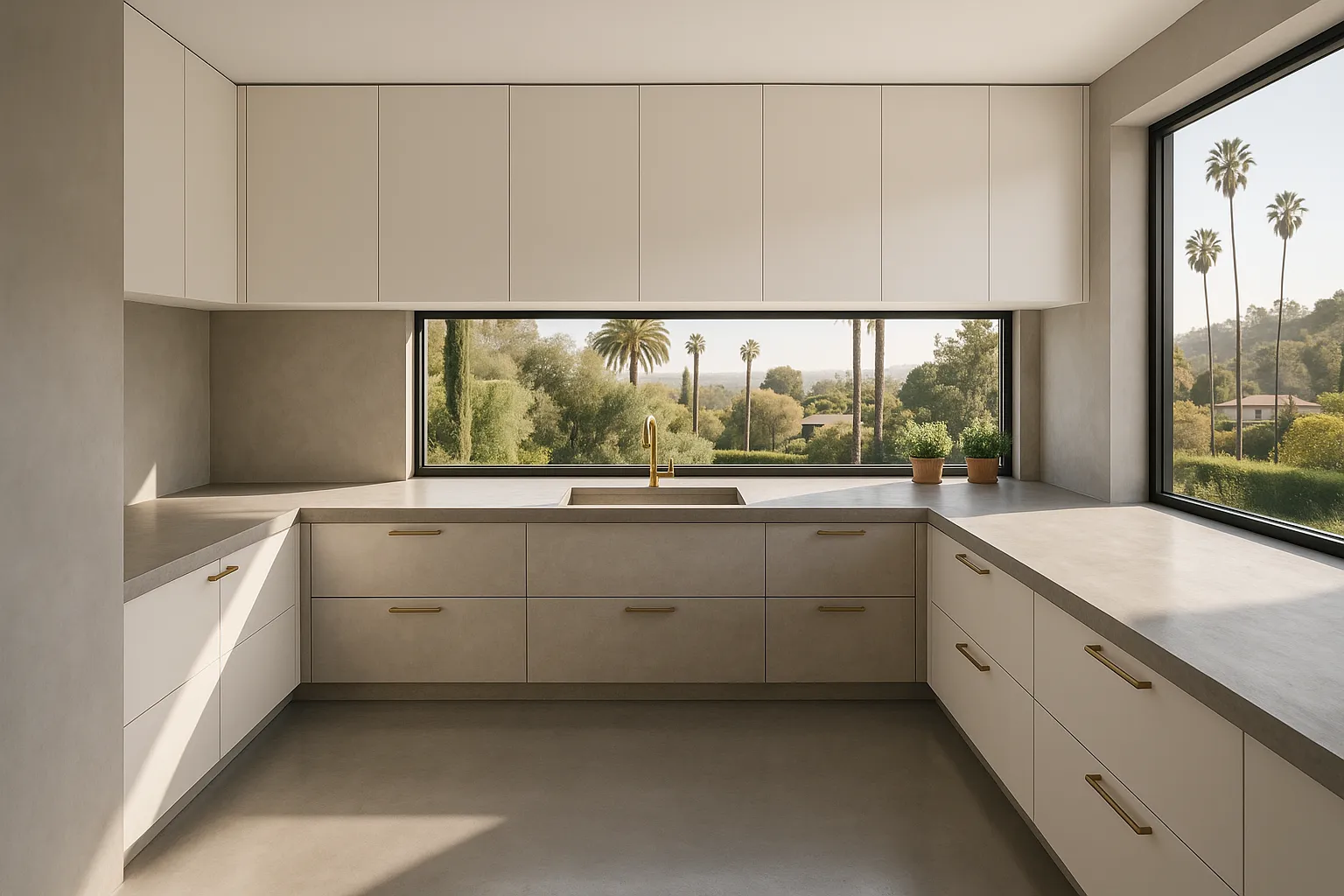
The [microcement kitchens & countertops](/services/microcement-kitchens-countertops) cost CA homeowners are budgeting for in 2026 lands between **$65 and $130 per square foot installed** — and that range tells you almost nothing useful on its own. What actually determines where your project falls on that spectrum is the substrate condition, the number of coats specified, the sealer system, and whether you're resurfacing existing surfaces or starting fresh. Based on Cemora's project data across more than 80 kitchen and countertop installations in [Los Angeles](/areas/los-angeles) County over the past two years, the average kitchen engagement runs **$14,000–$28,000 for a mid-sized residential kitchen** covering floors, walls, and countertops together.
If you're a [commercial](/services/microcement-commercial-hospitality) operator — a restaurant group, hotel developer, or retail brand — your calculus is different. You're weighing durability under high-traffic use, maintenance protocols for staff, and the total cost of ownership over a 10-to-15-year horizon, not just the install price. This guide covers both angles honestly.
---
## What Is Microcement? A Working Definition
What is microcement? Microcement is a polymer-modified cementitious coating, typically 2–3mm thick, applied directly over existing substrates like tile, concrete, plywood, or drywall. It cures to a seamless, monolithic surface that requires no grout lines and accepts pigment uniformly, producing the matte mineral aesthetic that has dominated high-end residential and commercial design in Los Angeles since roughly 2022.
Unlike poured concrete overlays, microcement is flexible enough to resist hairline cracking on surfaces that experience minor movement. Unlike tile, it creates a continuous surface with zero grout joints — which matters enormously in kitchens and wet environments where grout harbors bacteria and demands relentless maintenance.
The material itself is a blend of Portland cement, fine aggregates, polymer resins, and pigment. What you're paying for when you hire a specialist like Cemora isn't just the product — it's the surface preparation, the multi-coat application system, and the sealer stack that determines whether your countertop looks perfect for two years or twenty.

---
## Microcement Kitchens & Countertops Cost CA: The 2026 Breakdown
Let's get specific. Based on 2026 project data and current material pricing in Southern California, here's how microcement kitchen costs break down by surface type:
| Surface Type | Scope | 2026 Cost Range (Installed) |
|---|---|---|
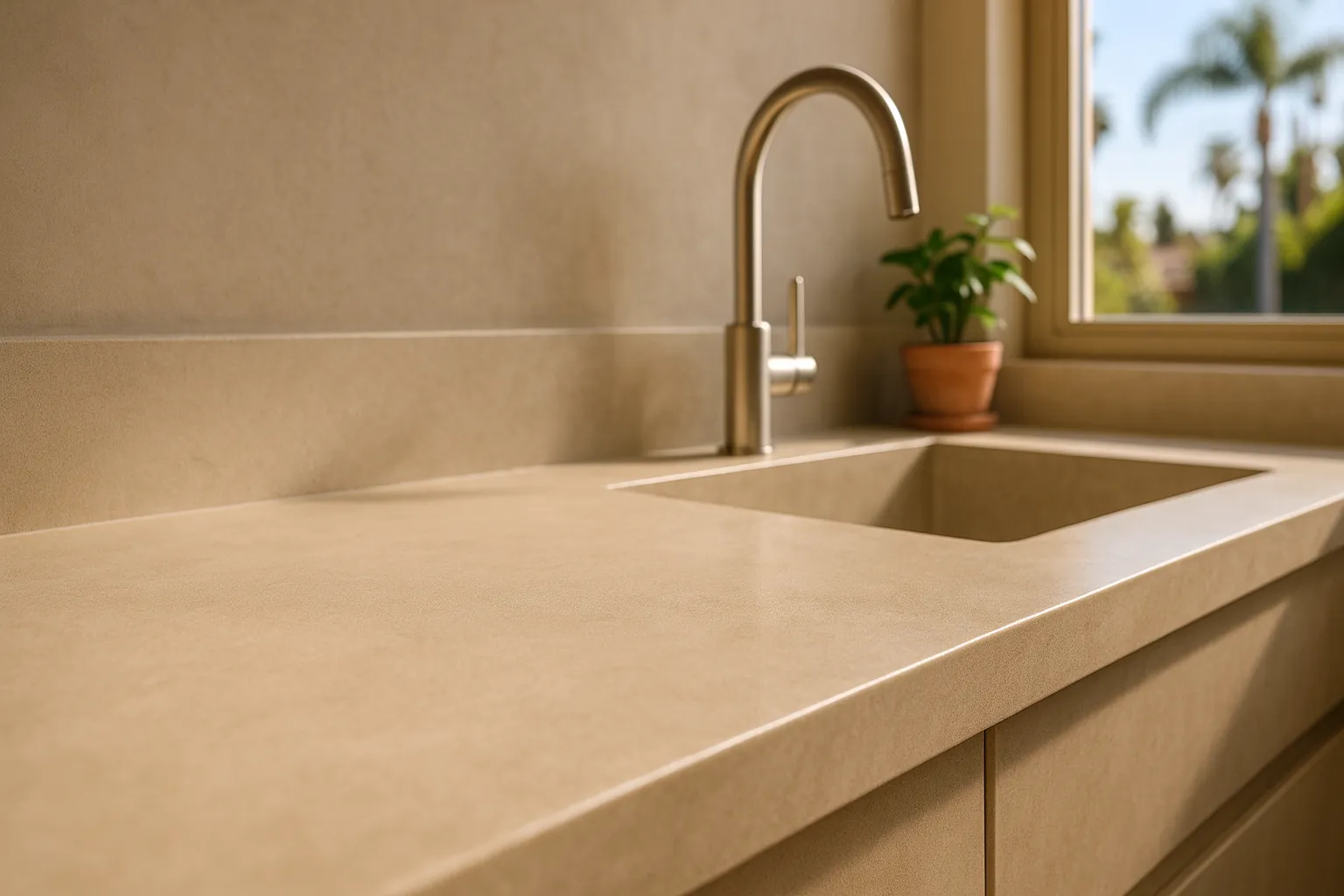
| Countertops only | 30–50 sq ft | $2,800–$5,500 |
| Kitchen floor | 150–300 sq ft | $9,750–$22,500 |
| Full kitchen walls | 200–400 sq ft | $13,000–$32,000 |
| Kitchen + countertops (combined) | 400–600 sq ft total | $14,000–$42,000 |
| Commercial kitchen surfaces | 600–1,200 sq ft | $39,000–$96,000 |
| Island resurfacing only | 20–35 sq ft | $1,800–$3,800 |
These figures reflect **licensed labor in Los Angeles County**, current material costs (Q2 2026), and a standard 4-coat application system with dual-component polyurethane sealer. They do not include demolition of existing tile, structural repairs, or plumbing disconnection/reconnection if countertops require sink removal.
### What Drives Costs Up
Several variables push microcement kitchen projects toward the higher end of the range:
- **Substrate remediation**: If existing tile is cracked, hollow, or poorly bonded, it must be removed or stabilized before microcement goes down. Tile removal in a 200 sq ft kitchen in Los Angeles typically runs **$1,200–$2,800** depending on tile thickness and adhesive type.
- **Complex geometry**: Waterfall edges, integrated drainboards, curved backsplashes, and built-in niches all require additional skilled labor time.
- **Color matching and custom tints**: Standard palette colors are included in base pricing. Custom pigment matching or multi-tone decorative effects add **$4–$12 per sq ft**.
- **High-performance sealer upgrades**: Food-safe, heat-resistant, or anti-microbial sealer systems for commercial kitchens add **$3–$8 per sq ft** over standard residential sealers.
- **Accessibility and logistics**: Upper-floor installs in buildings without freight elevators, or projects requiring full kitchen shutdown in a working restaurant, carry labor premiums.
### What Keeps Costs Down
- Clean, sound substrates that don't require prep work
- Straightforward rectangular layouts with minimal edge detailing
- Combining surfaces (floor + countertops + walls in one mobilization)
- Off-peak scheduling (January–March in LA tends to have shorter lead times and occasional material discounts)
---
## How Does Microcement Compare to Other Countertop Materials?
Homeowners and commercial operators in Los Angeles regularly compare microcement against quartz, quartzite, poured concrete, and epoxy. Here's an honest side-by-side:
| Material | Installed Cost (CA, 2026) | Seams | Maintenance | Heat Resistance | Lifespan |
|---|---|---|---|---|---|
| Microcement | $65–$130/sq ft | None | Reseal every 2–4 years | Moderate (use trivets) | 15–25 years |
| Quartz (engineered) | $75–$145/sq ft | Visible on large slabs | Very low | Moderate | 20–30 years |
| Quartzite (natural) | $90–$180/sq ft | Visible | Low-moderate | Good | 25+ years |
| Poured concrete | $80–$150/sq ft | None | Reseal annually | Good | 15–20 years |
| Epoxy resin | $45–$85/sq ft | None | Low | Poor | 8–12 years |
| Tile (ceramic/porcelain) | $25–$65/sq ft | Grout lines | High (grout) | Excellent | 20–30 years |
Microcement's primary competitive advantage isn't price — it's the seamless aesthetic combined with the ability to resurface existing countertops without demolition. That saves **$800–$3,500 in demo and disposal costs** on a typical residential kitchen.
---
## Real-World Project Scenarios: What LA Homeowners and Operators Actually Spent
### Scenario 1: [Santa Monica](/areas/santa-monica) Residential Kitchen Remodel
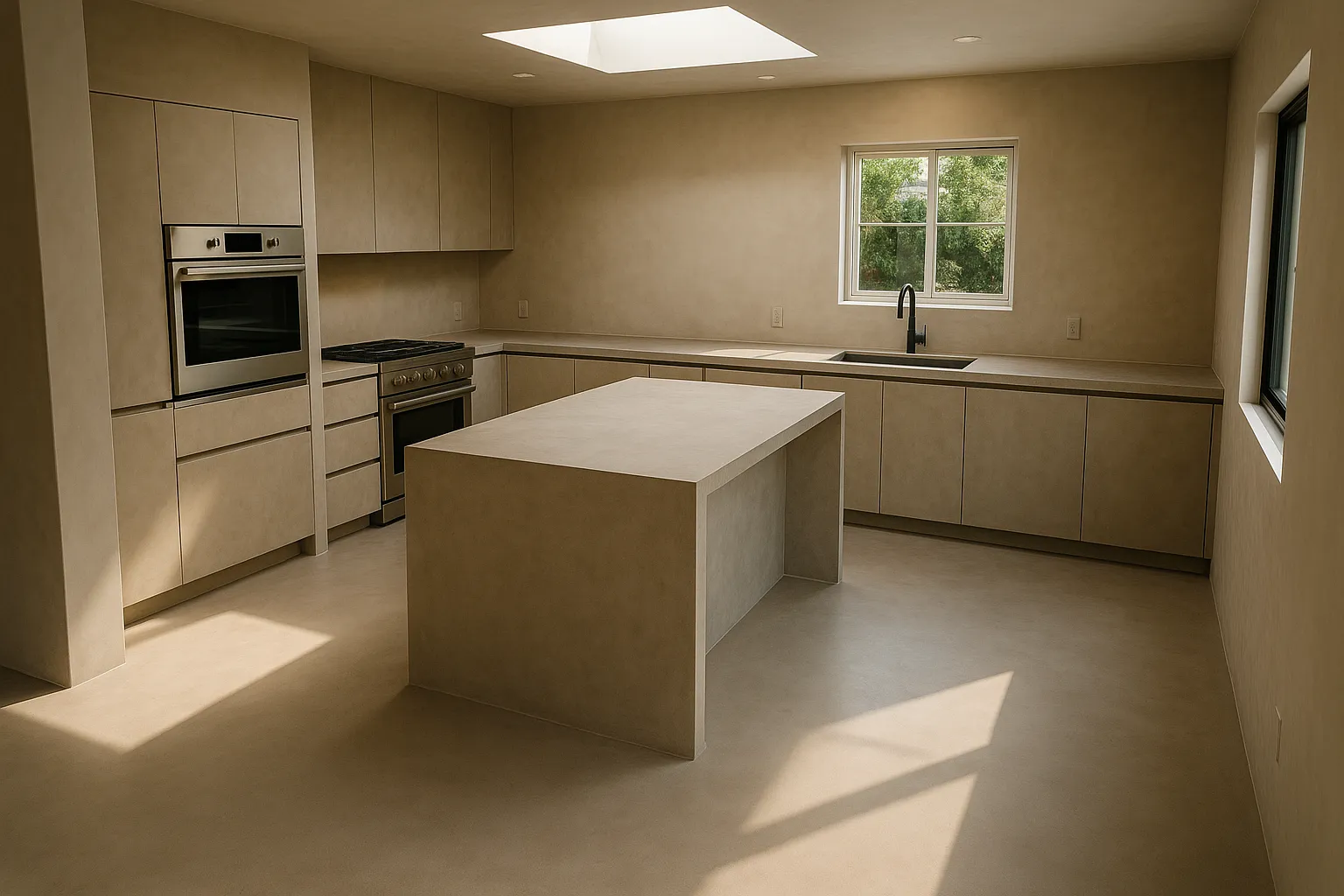
A homeowner in Santa Monica hired Cemora to resurface a dated 1990s kitchen — existing tile countertops, ceramic tile backsplash, and a concrete subfloor that had been tiled over. Total surface area: **approximately 480 sq ft** across countertops (42 sq ft), backsplash (68 sq ft), and kitchen floor (370 sq ft). The tile was sound and well-bonded, so no demo was required — just grinding and priming.
Final project cost: **$28,400**, completed in **6 working days**. The homeowner had received a quote for quartz countertops plus new floor tile at **$34,000**, not counting the backsplash. The microcement option saved approximately **$5,600** while delivering a fully unified, grout-free surface.
### Scenario 2: [Beverly Hills](/areas/beverly-hills) Commercial Restaurant Bar and Kitchen Prep Area
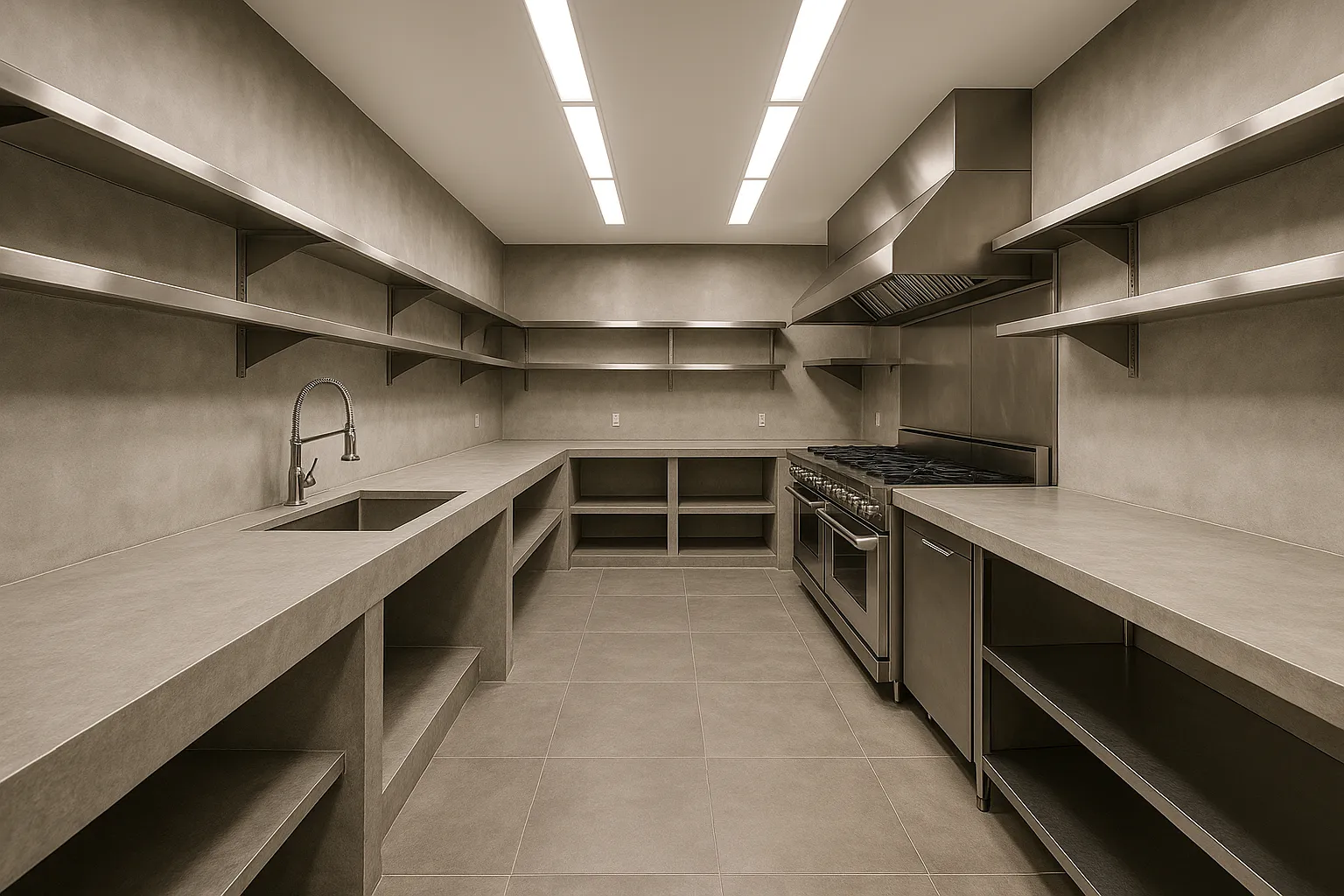
A Beverly Hills restaurant group needed to resurface the prep kitchen countertops, the bar top (22 linear feet), and the front-of-house floor connecting bar to dining area — roughly **820 sq ft total**. They specified a commercial-grade anti-microbial sealer system and a custom charcoal-black pigment with subtle aggregate texture for slip resistance on the floor.
Project cost: **$71,500**, with a **10-day install window** scheduled during a Monday-through-Wednesday closure period over two weeks. The restaurant's facilities manager noted that the previous epoxy floor coating had required replacement twice in six years at roughly **$18,000 per replacement**. The microcement system carries an expected lifespan of **18–22 years** with proper maintenance, representing significant long-term savings.
### Scenario 3: [Pasadena](/areas/pasadena) Kitchen Island and Countertop Refresh
A Pasadena homeowner with a relatively new kitchen — good cabinets, functional layout — wanted to update the look without a full remodel. The project was limited to countertop resurfacing (existing laminate, 38 sq ft) and a new island top with a waterfall edge (27 sq ft). Substrate prep involved skim-coating over the laminate and building up a bonding layer.
Final cost: **$6,200**, completed in **3 days**. The homeowner had originally priced a quartz replacement at **$4,800** (material only, not including fabrication and install at **$2,400 additional**). The microcement option came in at roughly the same all-in number — but preserved the existing cabinet structure and avoided a two-week lead time for slab fabrication.

---
## What Is the Installation Process? A Step-by-Step Overview
Understanding the process helps you plan your timeline and set realistic expectations for disruption. Here's how a standard microcement kitchen installation unfolds:
1. **Surface Assessment and Substrate Preparation** (Day 1): The applicator inspects all surfaces for cracks, hollow spots, moisture, and adhesion issues. Any loose material is removed, cracks are filled with flexible repair compound, and surfaces are mechanically abraded or ground to create a bonding profile. This step is the most important and the most often rushed by less experienced installers.
2. **Primer Application** (Day 1, after prep): A polymer-modified primer is rolled or sprayed onto all prepared surfaces. Primer dries for **4–8 hours** before the first microcement coat can go down.
3. **First Microcement Coat — Base Layer** (Day 2): The base coat is troweled on at approximately 1–1.5mm thickness. This layer establishes the foundation and begins hiding substrate texture. It cures overnight.
4. **Second Coat — Build Coat** (Day 3): A second trowel pass builds thickness and begins establishing the final surface character. Any texture effects or aggregate additions happen at this stage.
5. **Third Coat — Finish Coat** (Day 3–4): The finish coat is applied with a fine steel trowel, burnished to the specified texture level (from raw/industrial to silky smooth). Color depth and uniformity are finalized here.
6. **Sanding and Surface Refinement** (Day 4): Fine sanding between coats removes trowel marks and high spots. This step determines the final quality of the surface.
7. **Sealer Application — First Coat** (Day 5): The first sealer coat penetrates the microcement and begins the protection system. For countertops, this is typically a penetrating consolidant. Cures 6–12 hours.
8. **Sealer Application — Topcoat(s)** (Day 5–6): One or two topcoat layers of polyurethane or polyaspartic sealer are applied. Commercial projects often receive three topcoats. Each coat cures before the next is applied.
9. **Final Inspection and Cure Period** (Day 6–7): Light use is possible after **48–72 hours**. Full chemical cure for countertops is **7 days** — avoid cutting directly on the surface or exposing to harsh chemicals during this period.
Total elapsed time for a residential kitchen: **5–8 working days**. Commercial projects with larger square footage or phased closures: **8–14 working days**.
---
## Microcement Kitchens & Countertops Cost CA: Commercial vs. Residential Pricing
Commercial microcement kitchen projects in California follow different pricing logic than residential work. The cost-per-square-foot is often **10–25% higher** for commercial applications for several reasons:
- **Commercial-grade sealer systems** are more expensive and require additional coats
- **Health department compliance** in food service environments requires specific product certifications (NSF-compliant sealers for food contact surfaces)
- **Scheduling constraints** — working nights, weekends, or during limited closure windows — carry labor premiums of **$35–$85 per hour** above standard day rates
- **Liability and insurance requirements** for commercial sites are higher
- **Mock-up and sample approval processes** common in hospitality and retail add pre-project time
For commercial operators in Los Angeles, Beverly Hills, and [Glendale](/areas/glendale) evaluating microcement for kitchens and service areas, Cemora's [Commercial & Hospitality Microcement](/services/microcement-commercial-hospitality?utm_source=blog&utm_medium=organic&utm_campaign=microcement-kitchens-countertops-cost-ca) service is specifically structured around these requirements — including health department documentation and phased installation scheduling.
---
## How Does Microcement Perform in Kitchen Environments?
What is microcement's durability in kitchen conditions? This is the question that matters most for long-term value, and it's worth being direct about both the strengths and the limitations.
**Where microcement excels in kitchens:**
- Seamless surface means no grout to harbor bacteria or stain
- Highly resistant to water when properly sealed — suitable for backsplashes, countertops, and even sink surrounds
- Accepts cleaning with pH-neutral products without degrading the sealer
- Scratch resistance is comparable to hardwood, better than epoxy
- Can be locally repaired and resealed if damaged — unlike tile or quartz, which require full panel replacement
**Where microcement requires care:**
- **Not inherently heat-proof**: Always use trivets. Sustained direct heat above 300°F can damage the sealer and cause discoloration.
- **Cutting boards are non-negotiable**: Cutting directly on microcement countertops will scratch the surface. This is true of most countertop materials except granite.
- **Acidic spills need prompt attention**: Lemon juice, vinegar, and wine left sitting for extended periods can etch the sealer. Wipe up promptly.
- **Resealing is required**: Residential countertops typically need resealing every **2–4 years** depending on use intensity. Commercial surfaces in high-traffic food prep areas may need annual maintenance.
Industry benchmarks from the 2025 Houzz State of the Kitchen & Bath Industry report show that **67% of homeowners who chose seamless surface materials** (including microcement and poured concrete) cited low maintenance and aesthetic continuity as the primary drivers — outranking cost as a decision factor.

---
## Microcement Kitchens & Countertops Cost CA: How to Budget Accurately
The single biggest source of budget surprises in microcement kitchen projects is **underestimating surface area and prep scope**. Here's how to build a realistic budget before you call anyone:
### Step 1: Measure Accurately
Count every surface you want covered. Countertops: measure length × depth for each run. Backsplash: measure height × length for each section, subtract window and outlet openings. Floor: length × width of the kitchen footprint, minus island footprint if applicable.
### Step 2: Assess Your Substrate
If you have existing tile, is it well-bonded? Tap it — hollow sounds mean loose tiles that must be removed. If you have laminate countertops, are the edges and seams intact? Delamination requires repair before microcement can go over it.
### Step 3: Apply the Right Cost Multiplier
- Sound substrate, simple geometry: **$65–$85/sq ft**
- Minor prep needed, moderate complexity: **$85–$105/sq ft**
- Significant prep, complex geometry, or custom effects: **$105–$130/sq ft**
- Commercial with NSF sealer and scheduling premium: **$110–$150/sq ft**
### Step 4: Add Contingency
Budget **10–15% contingency** for substrate surprises discovered during prep. In older Los Angeles homes (pre-1980 construction), moisture in concrete slabs and deteriorated tile adhesive are common discoveries.
For a personalized estimate based on your specific surfaces, [request a free estimate from Cemora](/estimate?utm_source=blog&utm_medium=organic&utm_campaign=microcement-kitchens-countertops-cost-ca) — the process takes about 20 minutes and includes a substrate assessment.
---
## Why Microcement Kitchens Are Trending in Los Angeles in 2026
The design direction in Los Angeles kitchens in 2026 is unmistakably mineral and monolithic. Warm limewash walls, integrated stone-look surfaces, and the elimination of visual clutter are dominating new builds and remodels across West LA, Silver Lake, and the Westside.
Microcement fits this aesthetic precisely because it reads as a single continuous material across countertops, backsplash, and even floors — eliminating the visual interruption of grout lines, material transitions, and edge profiles. Interior designers working in Beverly Hills and Santa Monica increasingly specify it as a way to achieve the "poured concrete" look without the weight, cost, and cracking risk of actual concrete.
According to the 2025 NAHB Remodeling Market Index, **kitchen remodels remained the #1 remodeling category** in California for the third consecutive year, with an average project spend of **$52,000** in the Los Angeles metro area. Microcement surfaces typically represent **25–40% of that budget** when specified for countertops, backsplash, and floor together.
For homeowners exploring microcement as part of a broader kitchen renovation, Cemora's [Microcement Kitchens & Countertops](/services/microcement-kitchens-countertops?utm_source=blog&utm_medium=organic&utm_campaign=microcement-kitchens-countertops-cost-ca) service page covers the full scope of what's possible — from simple countertop resurfacing to complete kitchen transformations.
And if you're extending the microcement aesthetic beyond the kitchen, the same material works beautifully in bathrooms and wet rooms. Cemora's [Microcement Bathrooms & Wet Rooms](/services/microcement-bathrooms?utm_source=blog&utm_medium=organic&utm_campaign=microcement-kitchens-countertops-cost-ca) service handles full shower enclosures, vanity tops, and wet room floors with the same seamless system. For whole-home floor and wall continuity, [Microcement Floors & Walls](/services/microcement-floors-walls?utm_source=blog&utm_medium=organic&utm_campaign=microcement-kitchens-countertops-cost-ca) covers the broader residential application.
---
## What to Ask Before Hiring a Microcement Installer in California
Not all microcement installers are equal, and in California, the stakes are real. A poorly applied microcement surface will crack, delaminate, or stain within 12–18 months — and repair costs can equal or exceed the original install.
Here's what to verify before signing any contract:
- **CSLB License**: California requires a C-35 (Lathing and Plastering) or C-54 (Tile) license for most microcement applications. Ask for the license number and verify it at cslb.ca.gov. As CSLB states: *"Hiring an unlicensed contractor exposes homeowners to liability for injuries on the job and leaves them with no recourse if work quality is substandard."*
- **Product system**: Ask which brand of microcement they use and request the technical data sheet. Reputable systems include Topciment, Deco-Cement, and Ideal Work. Generic or unbranded products are a red flag.
- **Sample board**: Any serious microcement installer will provide a physical sample board in your specified color and texture before the project starts. If they won't, walk away.
- **Warranty**: Industry standard is **2–5 years on labor** for residential applications. Ask specifically what voids the warranty (typically improper cleaning products or physical damage).
- **References from similar projects**: Ask for references from kitchen or countertop projects specifically — not just floors. The skill set for countertops is more demanding.
"In 15 years of applying mineral surfaces across Los Angeles, the projects that fail almost always trace back to one of two things: inadequate substrate prep or the wrong sealer for the environment," says Cemora's lead applicator. "A kitchen countertop next to a sink sees water, heat, and acid daily. The sealer system has to be specified for that, not just whatever's left over from the floor job."
If you're ready to talk specifics about your kitchen project, [contact Cemora directly](/contact?utm_source=blog&utm_medium=organic&utm_campaign=microcement-kitchens-countertops-cost-ca) or [book a consultation](/book?utm_source=blog&utm_medium=organic&utm_campaign=microcement-kitchens-countertops-cost-ca) to walk through your surfaces, timeline, and budget in detail.
---
## Frequently Asked Questions
### [How much does](/estimate) microcement countertop installation cost in California in 2026?
Based on current project data, microcement countertop installation in California costs between **$65 and $130 per square foot installed** in 2026. A typical residential kitchen with 35–50 sq ft of countertop surface runs **$2,800–$5,500** for countertops alone, while a full kitchen including backsplash and floor can range from **$14,000 to $42,000** depending on scope and complexity.
### Is microcement suitable for kitchen countertops that see heavy daily use?
Yes, with the right sealer system. Microcement countertops sealed with a commercial-grade polyurethane or polyaspartic topcoat perform well under daily kitchen use — they resist water, cleaning products, and moderate impact. The key caveats are to always use cutting boards (cutting directly on the surface will scratch it), use trivets for hot pots, and wipe up acidic spills like lemon juice or vinegar promptly rather than letting them sit.
### How long does a microcement kitchen installation take?
A residential kitchen microcement installation typically takes **5–8 working days** from surface prep through final sealer coat. Full chemical cure — after which the surface can handle normal use — is **7 days**. Commercial projects with larger square footage or phased scheduling around operating hours typically run **8–14 working days**.
### Can microcement be applied over existing tile countertops?
Yes, and this is one of microcement's most practical advantages. As long as the existing tile is well-bonded (no hollow or loose tiles), clean, and structurally sound, microcement can be applied directly over it with proper priming and skim-coat preparation. This eliminates demolition costs, which typically run **$800–$2,500** for countertop tile removal in a standard Los Angeles kitchen.
### How does microcement compare in cost to quartz countertops in Los Angeles?
In 2026, quartz countertops in Los Angeles run **$75–$145 per sq ft installed**, including fabrication, edging, and sink cutout. Microcement countertops run **$65–$130 per sq ft installed**. The costs are comparable, but microcement offers a seamless, grout-free surface and can be applied over existing countertops without demolition — which can make it meaningfully less expensive on a total-project basis.
### How often does microcement need to be resealed in a kitchen?
Residential kitchen countertops typically need resealing every **2–4 years** depending on use intensity. Floors in the same kitchen may go **4–6 years** between reseals. Commercial kitchen surfaces in food prep environments may require annual maintenance resealing. Resealing is a straightforward process that typically costs **$200–$600** for a residential kitchen and can often be done without full kitchen downtime.
### What is the lifespan of a microcement kitchen surface?
What is the lifespan of microcement? A properly installed and maintained microcement kitchen surface lasts **15–25 years** in residential applications and **12–20 years** in commercial environments with higher traffic and chemical exposure. The surface can also be refreshed — re-sanded and resealed, or even re-coated with a new finish layer — without full replacement, extending its useful life further.
### Is microcement food-safe for kitchen countertops?
What is food-safe microcement? It refers to microcement sealed with an NSF-compliant sealer rated for incidental food contact. The microcement material itself is inert once cured, but the sealer system determines food safety. For residential kitchens, standard polyurethane sealers are generally considered food-safe once fully cured (7 days). For commercial food service environments regulated by the LA County Department of Public Health, Cemora specifies NSF-listed sealers and can provide documentation for health department inspections.
### Does microcement increase home resale value in Los Angeles?
Based on 2025 NAHB data, kitchen remodels in the Los Angeles metro return approximately **60–75% of project cost** at resale on average. Microcement surfaces contribute to this return primarily through aesthetic appeal and the seamless, contemporary look that buyers in the LA market respond to strongly. Homes in Beverly Hills and Santa Monica with fully microcemented kitchens have sold at premiums of **$15,000–$40,000** over comparable listings with dated tile kitchens, according to Cemora client feedback.
### How do I find a licensed microcement installer in Los Angeles?
Verify any installer's CSLB license at cslb.ca.gov before signing a contract. Look for a C-35 or C-54 license classification. Ask specifically for references from kitchen and countertop projects (not just floors), request a physical sample board in your specified color, and confirm which brand of microcement system they use. Reputable installers will provide a written warranty of at least 2 years on labor and be able to supply the product's technical data sheet.
---
The decision between microcement and other kitchen surface materials ultimately comes down to three things: the aesthetic you're after, how much disruption you can tolerate during installation, and your honest assessment of how you'll maintain the surface long-term. Microcement delivers the seamless mineral look better than any other material at its price point — but it rewards owners who understand it's a surface that needs occasional care, not a set-and-forget installation.
If you're pricing a kitchen project in Los Angeles, Beverly Hills, Santa Monica, Pasadena, or Glendale and want a number that actually reflects your specific surfaces and scope, [get a free estimate from Cemora](/estimate?utm_source=blog&utm_medium=organic&utm_campaign=microcement-kitchens-countertops-cost-ca). Bring your measurements, photos of your current surfaces, and any inspiration images you've collected — that's everything needed to give you a real number, not a range.
---
**Ready to start your your project in Los Angeles?** [Book a free consultation](/book?utm_source=blog&utm_medium=organic&utm_campaign=microcement-kitchens-countertops-cost-ca-what-to-expect-in-2026) — we'll come walk through your space and give you straight numbers, no pressure. Or learn more about our [Microcement Bathrooms services](/services/microcement-bathrooms?utm_source=blog&utm_medium=organic&utm_campaign=microcement-kitchens-countertops-cost-ca-what-to-expect-in-2026).