Microcement Kitchens & Countertops Cost CA: What to Expect in 2026
By Gilad Segev · July 6, 2026 · Last updated July 20, 2026 · Cost Guide
## [Microcement](/services/microcement-bathrooms) Kitchens & Countertops Cost CA: What Homeowners Are Actually Paying in 2026
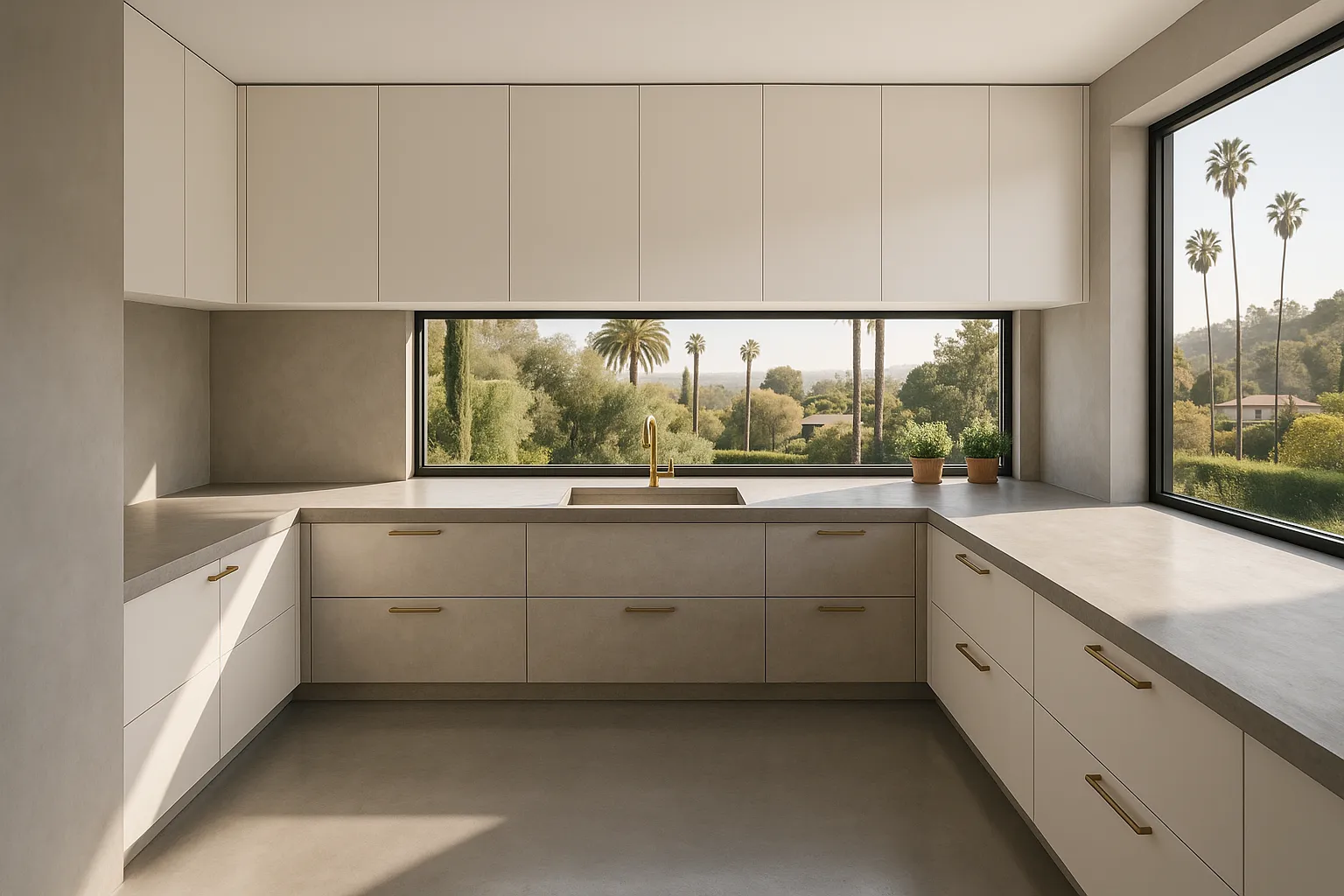
The [microcement kitchens & countertops](/services/microcement-kitchens-countertops) cost CA homeowners are quoting right now runs anywhere from **$4,500 for a single countertop application to $28,000+ for a full kitchen transformation** — and understanding why that range is so wide is the difference between a smart investment and a budget disaster. Based on Cemora's project data across [Los Angeles](/areas/los-angeles), [Beverly Hills](/areas/beverly-hills), [Santa Monica](/areas/santa-monica), and [Pasadena](/areas/pasadena), the average full kitchen microcement installation in Southern California lands around **$14,000–$22,000** in 2026, depending on surface area, substrate condition, and finish complexity.
If you've been comparing microcement to quartz slabs or polished concrete, you already know the appeal: seamless surfaces, zero grout lines, waterproof performance, and that unmistakable mineral texture that reads as both modern and timeless. What you might not know yet is exactly what drives the cost up — or how to avoid the most common mistakes that turn a $12,000 kitchen project into a $19,000 one.
---
## What Is Microcement? A Working Definition
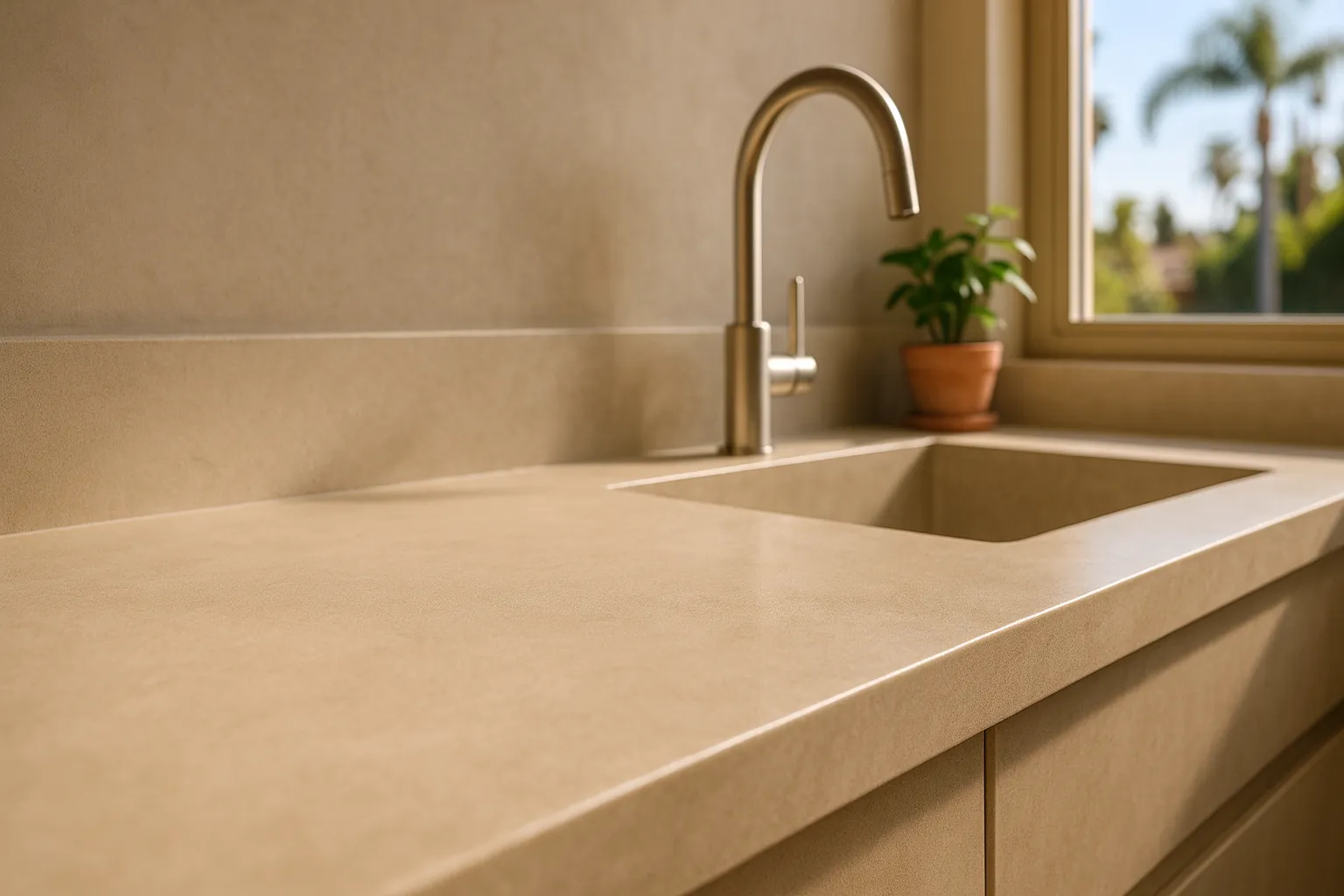
What is microcement? Microcement is a polymer-modified cementitious coating, typically 2–3mm thick, applied in multiple layers over existing substrates — tile, concrete, drywall, wood, or plywood. Unlike poured concrete, it doesn't require demolition or structural reinforcement. Unlike tile, it creates a continuous, grout-free surface that's fully waterproof when properly sealed.
The material itself is a blend of white cement, fine aggregates, water-based resins, and mineral pigments. The result is a surface that looks and feels like raw concrete but bonds directly to almost any stable substrate without adding significant weight or height.
For kitchens specifically, microcement is applied to countertops, backsplashes, kitchen islands, and sometimes full floor-to-ceiling wall treatments. Each application zone has its own prep requirements, wear demands, and cost implications — which is why a per-square-foot number alone rarely tells the whole story.

---
## [How Much Does](/estimate) Microcement Kitchen Installation Cost in California?
Based on Cemora's 2026 project data across Los Angeles County and surrounding areas, here's what homeowners are realistically paying:
### Countertops Only
- **Small kitchen countertop (under 30 sqft):** $4,500–$7,500
- **Mid-size countertop (30–60 sqft):** $7,500–$12,000
- **Large island + perimeter counters (60–100 sqft):** $12,000–$18,000
### Full Kitchen Microcement (Counters + Backsplash + Walls)
- **Small kitchen under 150 sqft total surface:** $9,000–$14,000
- **Mid-size kitchen 150–300 sqft total surface:** $14,000–$22,000
- **Large open-plan kitchen 300–500 sqft total surface:** $22,000–$35,000
### What's Driving the Per-Square-Foot Rate?
Labor in Los Angeles runs **$85–$140 per hour** for skilled microcement applicators in 2026, based on BLS wage data for California specialty coating trades (2025 base, adjusted ~4% for 2026). Material costs for professional-grade microcement systems — Topciment, Deco-Coat, or similar — run **$18–$32 per sqft** for materials alone when you factor in primers, base coats, finish coats, and sealers.
All-in installed rates typically land between **$55–$95 per sqft** for countertops and **$45–$75 per sqft** for walls and backsplashes. Floors are a separate category, handled under [Microcement Floors & Walls](/services/microcement-floors-walls?utm_source=blog&utm_medium=organic&utm_campaign=microcement-kitchens-countertops-cost-ca).
---
## Microcement Kitchens & Countertops Cost CA: The Real Cost Drivers
The square footage is just the starting point. Here's what actually moves the needle on your final invoice:
### 1. Substrate Condition
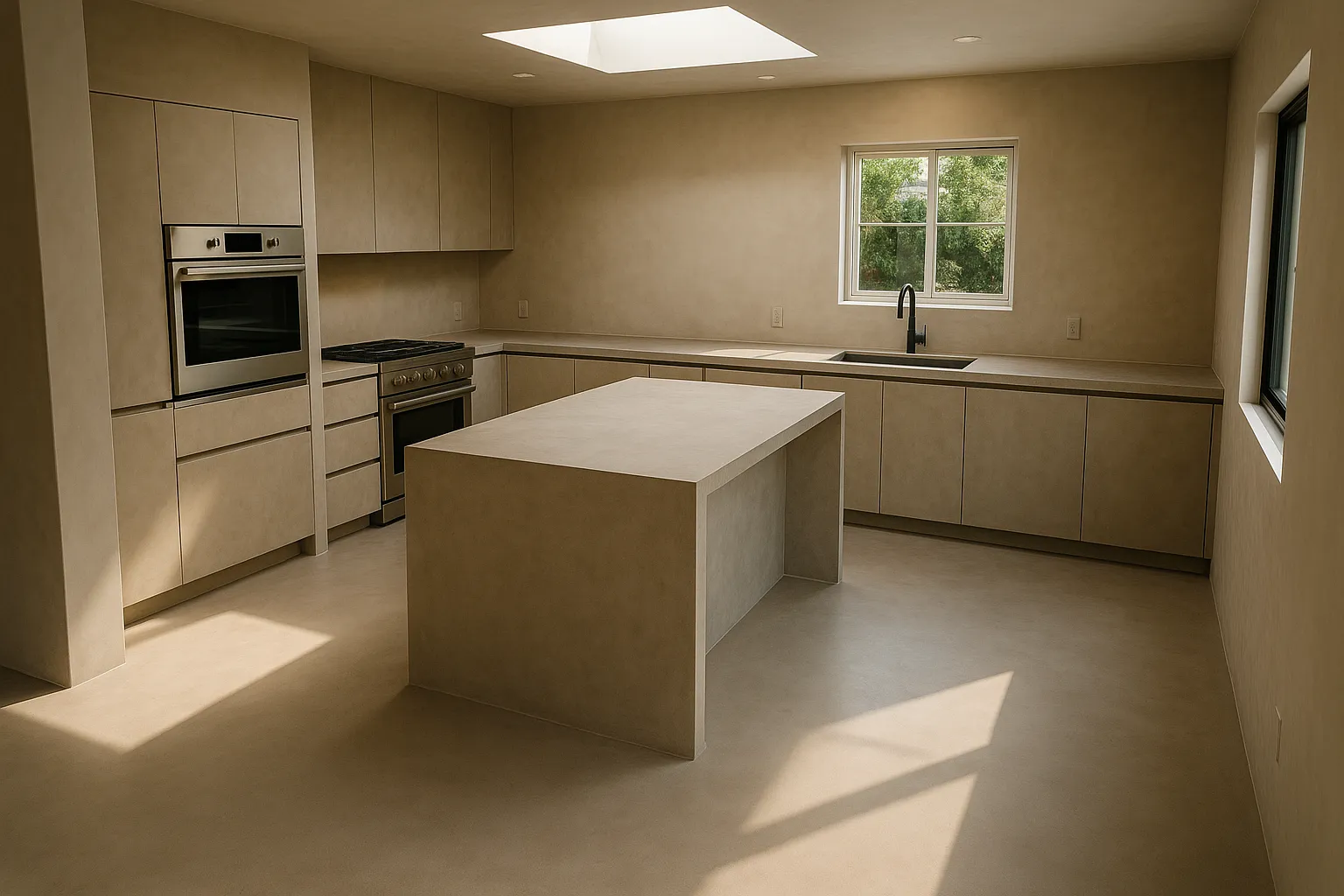
Microcement bonds to stable, flat, structurally sound surfaces. If your existing countertops are laminate with delaminating edges, or your tile has hollow spots, the prep work adds **$800–$3,500** before the first coat of microcement touches the surface. In older Los Angeles homes — particularly in Pasadena and [Glendale](/areas/glendale) where 1950s kitchens are common — substrate remediation is the most frequent budget surprise.
### 2. Number of Coats and Finish Type
A standard microcement application involves 5–7 layers: primer, base coat (x2), color coat (x2), and sealer (x2). A matte finish sealer costs less and shows less wear. A high-gloss or satin polyurethane topcoat adds **$3–$8 per sqft** to the material cost but dramatically improves stain resistance — critical for kitchen countertops that see daily cooking.
### 3. Edge Profiles and Integrated Sinks
A standard eased edge on a microcement countertop is included in the base price. Waterfall edges, ogee profiles, or custom radius work adds **$200–$600 per linear foot** of edge treatment. Integrated microcement sinks — a popular choice in Beverly Hills and Santa Monica kitchen renovations — add **$1,800–$4,500** depending on basin size and complexity.
### 4. Color Matching and Custom Tinting
Off-the-shelf microcement colors (greys, whites, warm beiges) are standard. Custom color matching to a specific Pantone or RAL reference adds a small premium — typically **$400–$900** for the tinting service — but the visual payoff for high-end kitchens is significant.
### 5. Access and Logistics in LA
High-rise condos in West LA or downtown Los Angeles add logistics costs that single-family homes don't. Elevator scheduling, parking permits, and material staging in tight urban environments can add **$500–$1,500** to a project. This is a real line item that many out-of-area contractors forget to quote.
---
## Microcement vs. Other Countertop Materials: 2026 Cost Comparison
How does microcement stack up against the alternatives? Here's a direct comparison based on 2026 California market pricing (2025 data adjusted ~4%):
| Material | Installed Cost (per sqft) | Lifespan | Grout Lines | Waterproof | Resale Appeal |
|---|---|---|---|---|---|
| Microcement | $55–$95 | 15–25 years (w/ maintenance) | None | Yes (sealed) | High |
| Quartz (engineered) | $75–$145 | 25+ years | None | Yes | Very High |
| Porcelain Tile | $35–$85 | 20+ years | Yes | Yes | Moderate |
| Polished Concrete | $65–$110 | 15–20 years | None | Partial | High |
| Granite | $60–$130 | 25+ years | None | Partial | High |
| Butcher Block | $30–$65 | 10–15 years | None | No | Moderate |
| Laminate | $15–$40 | 5–10 years | None | Partial | Low |
Microcement sits in the mid-to-upper tier on cost, but it's the **only option that can be applied seamlessly over existing surfaces** — which eliminates demo costs entirely in most cases. That's often a **$2,000–$6,000 savings** right there.

---
## What Is the Microcement Application Process? Step-by-Step
Understanding the process helps you understand the timeline — and why rushing it costs money.
**Step 1: Site Assessment and Substrate Evaluation (Day 1)**
The applicator inspects existing surfaces for stability, moisture, and levelness. Any hollow tile, soft spots, or movement is documented. This determines whether substrate repair is needed before work begins.
**Step 2: Surface Preparation (Days 1–2)**
Existing surfaces are cleaned, degreased, and mechanically abraded or primed depending on the substrate type. For countertops going over laminate, a fiberglass mesh layer is often embedded in the first coat to prevent cracking at seams.
**Step 3: Primer Application (Day 2)**
A penetrating primer bonds the microcement system to the substrate. Drying time: 4–8 hours depending on humidity. Los Angeles's dry climate generally accelerates this, though marine layer conditions in Santa Monica can slow cure times.
**Step 4: Base Coat Application — First Pass (Day 3)**
The first structural coat of microcement is troweled on, building thickness and filling minor imperfections. This coat is critical for crack resistance.
**Step 5: Base Coat Application — Second Pass (Day 4)**
A second base coat refines the surface texture and begins establishing the final color tone. Any texture variations are corrected at this stage.
**Step 6: Color Coat — First Pass (Day 5)**
The pigmented finish coat is applied with a steel trowel, creating the characteristic mineral texture. Technique here is where the artistry comes in — trowel pressure, angle, and speed all affect the final look.
**Step 7: Color Coat — Second Pass (Day 6)**
A final color coat tightens the texture and ensures full, even coverage. The surface is then lightly sanded between coats.
**Step 8: Sealer Application — Two Coats (Days 7–8)**
Water-based or polyurethane sealers are applied in two coats with a light sand between applications. For kitchen countertops, a food-safe, stain-resistant polyurethane topcoat is standard.
**Step 9: Final Cure and Handover (Days 9–10)**
The surface reaches working hardness within 24–48 hours of final sealer application. Full cure — where the surface reaches maximum hardness and chemical resistance — takes **21–28 days**. Light use is fine after 48 hours; avoid harsh chemicals for 30 days.
**Total Timeline: 8–12 days on-site** for a typical kitchen project. Add 2–3 days buffer for substrate repairs or multi-zone projects.
---
## Three Real-World California Kitchen Projects: What They Cost
### Project 1: Santa Monica Condo Kitchen — $11,400
A homeowner in Santa Monica had a 1980s galley kitchen with original laminate countertops and a ceramic tile backsplash. Total surface area: approximately **52 sqft of countertop and 28 sqft of backsplash**. Cemora applied microcement directly over the existing laminate (after priming and mesh reinforcement) and over the tile backsplash with a skim-coat prep layer. **No demolition required.** The final invoice was **$11,400**, compared to a quartz replacement quote of $14,800 that would have required full demo and reinstallation. The homeowner saved roughly **$3,400** and had a seamless, contemporary finish that the quartz option couldn't match.
### Project 2: Beverly Hills Kitchen Renovation — $26,800
A full kitchen transformation in Beverly Hills covering **a large island (42 sqft), perimeter counters (58 sqft), full-height backsplash to ceiling (95 sqft), and integrated microcement sink**. Custom warm grey tinting, waterfall island edges, and a high-gloss polyurethane sealer. The substrate was new plywood over freshly framed cabinets — ideal conditions. Total project cost: **$26,800**, completed in 11 working days. The homeowner's real estate agent estimated the renovation contributed to a **$65,000 increase in listing price** when the home sold 8 months later.
### Project 3: Pasadena Restaurant Kitchen Pass-Through — $8,900
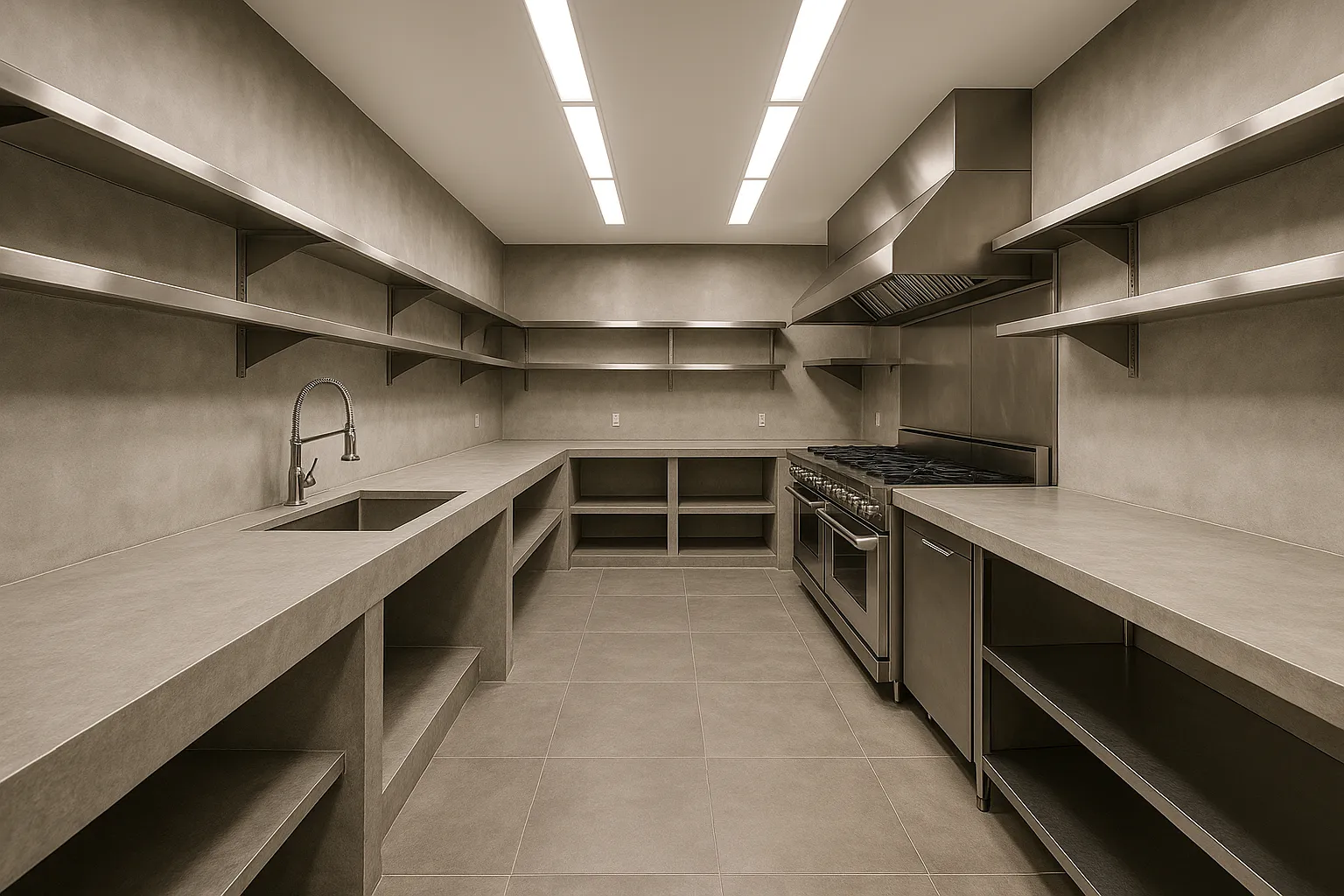
A Pasadena restaurant needed a durable, food-safe surface for a 40-linear-foot kitchen pass-through counter and service wall — approximately **75 sqft total**. Standard poured concrete had been quoted at $14,500 with a 3-week installation window that would have closed the restaurant. Microcement was completed in **6 working days** with the restaurant operating normally during off-hours. Final cost: **$8,900**, with a [commercial](/services/microcement-commercial-hospitality)-grade polyurethane sealer rated for food-contact surfaces. For commercial microcement projects like this, see Cemora's [Commercial & Hospitality Microcement](/services/microcement-commercial-hospitality?utm_source=blog&utm_medium=organic&utm_campaign=microcement-kitchens-countertops-cost-ca) services.
---
## What Is the Lifespan of Microcement Countertops?
What is the lifespan of microcement countertops? When properly installed and maintained, microcement countertops last **15–25 years** in residential kitchens. The sealer is the critical variable — not the microcement itself.
The sealer on a kitchen countertop typically needs refreshing every **3–5 years** with normal use. This is a simple process: light sanding and one or two new coats of sealer, which costs **$400–$900** for a typical kitchen countertop in Los Angeles. It's not unlike refinishing a hardwood floor — the substrate lasts indefinitely; the protective layer needs periodic renewal.
A 2025 Houzz State of the Industry report noted that **68% of homeowners** who chose mineral surface finishes cited low long-term maintenance as a primary factor — and microcement's resealing cycle is significantly less disruptive than regrouting tile or replacing laminate.
---
## How Does Microcement Affect Kitchen Resale Value in California?
This is the question every LA homeowner asks before signing a contract. Based on Cemora's project follow-up data and conversations with Los Angeles real estate agents in 2026, microcement kitchen finishes consistently generate **positive buyer perception** — particularly in the $1.2M–$3.5M home segment that dominates Beverly Hills, Santa Monica, and Pasadena markets.
The NAHB's 2025 Remodeling Impact Report found that kitchen renovations recover an average of **67–72% of costs** at resale nationally. In high-demand California coastal markets, that recovery rate climbs to **75–85%** based on local agent feedback, because design-forward finishes command premium pricing from buyers who would otherwise renovate immediately after purchase.
"In the Beverly Hills and [West Hollywood](/areas/west-hollywood) market, a seamlessly finished kitchen is no longer a luxury — it's an expectation at the $2M+ price point," notes a Los Angeles-based real estate agent with 18 years of experience in the area. "Microcement specifically reads as current and high-end without looking trendy — buyers perceive it as a long-term choice."
For homeowners considering a full bathroom transformation alongside the kitchen, Cemora's [Microcement Bathrooms & Wet Rooms](/services/microcement-bathrooms?utm_source=blog&utm_medium=organic&utm_campaign=microcement-kitchens-countertops-cost-ca) service creates a cohesive whole-home mineral aesthetic that agents consistently report as a strong selling point.

---
## What Is the Difference Between Microcement and Polished Concrete for Countertops?
What is the difference between microcement and polished concrete for countertops? This is one of the most common questions Cemora fields from Los Angeles homeowners who love the concrete aesthetic but have heard mixed things about both materials.
Polished concrete countertops are **poured and cured in place** (or cast offsite and installed as slabs). They're typically **3–4 inches thick**, require significant structural support, and involve a much more disruptive installation process. They're also prone to hairline cracking as the concrete cures and shrinks — even with fiber reinforcement.
Microcement is **2–3mm thick**, applied over existing substrates, and uses polymer modification to dramatically reduce shrinkage cracking. It achieves a nearly identical visual result at **30–40% lower installed cost** in most California applications, with a faster timeline and zero demolition. The tradeoff: polished concrete is slightly harder and more scratch-resistant at the surface level, though both require periodic resealing.
---
## Microcement Kitchens & Countertops Cost CA: What's Included in a Professional Quote
When you get a quote from a qualified microcement studio in California, here's what should be itemized:
- **Site visit and substrate assessment** (typically free from reputable studios)
- **Surface preparation** — cleaning, grinding, priming, mesh if needed
- **Material costs** — primer, base coats, color coats, sealers
- **Labor** — number of days, number of applicators
- **Edge work** — standard eased edge vs. custom profiles
- **Sealer specification** — matte, satin, gloss, or commercial-grade
- **Post-installation care kit** — pH-neutral cleaner, touch-up sealer
- **Warranty terms** — workmanship warranty (typically 1–2 years from reputable studios)
Anything missing from that list is worth asking about before you sign. Substrate repairs, custom colors, and integrated sinks are the three most common items that appear as change orders on poorly scoped jobs.
To get a properly scoped quote for your kitchen project, [request a free estimate](/estimate?utm_source=blog&utm_medium=organic&utm_campaign=microcement-kitchens-countertops-cost-ca) or [book a consultation](/book?utm_source=blog&utm_medium=organic&utm_campaign=microcement-kitchens-countertops-cost-ca) with Cemora's team.
---
## How to Maintain Microcement Countertops Long-Term
Maintenance is straightforward, but a few specific habits make a meaningful difference in longevity:
- **Daily cleaning:** pH-neutral cleaner only. Avoid acidic cleaners (vinegar, citrus-based products) that degrade polyurethane sealers over time.
- **Heat protection:** Use trivets for hot pans. Microcement itself is heat-tolerant, but the sealer can discolor under sustained direct heat above 300°F.
- **Cutting boards:** Always. Microcement is scratch-resistant, not scratch-proof.
- **Spill response:** Wipe up oil, wine, and acidic liquids promptly. The sealer handles incidental contact well; prolonged exposure to red wine or lemon juice can stain if the sealer is worn.
- **Resealing schedule:** Plan for a light reseal every **3–5 years** in a busy kitchen. A professional reseal in Los Angeles costs **$400–$900** for a standard kitchen countertop area.
For floors and walls in the same space, the same maintenance principles apply — more detail on that in Cemora's [Microcement Floors & Walls](/services/microcement-floors-walls?utm_source=blog&utm_medium=organic&utm_campaign=microcement-kitchens-countertops-cost-ca) guide.
---
## Which Sealer Is Right for Microcement Kitchen Countertops?
What is the right sealer for microcement kitchen countertops? Sealer selection is one of the most consequential decisions in a microcement kitchen project — and it's often made by the applicator without much client input. Here's what you should know:
**Water-based polyurethane:** The most common choice for residential kitchens. Good stain resistance, food-safe when cured, available in matte to gloss sheens. Cost: **$8–$14 per sqft** for two coats applied professionally.
**Solvent-based polyurethane:** Harder, more chemical-resistant, slightly more amber tint. Better for high-traffic commercial kitchens. Requires more ventilation during application. Cost: **$10–$18 per sqft** applied.
**Epoxy topcoat:** Maximum hardness and chemical resistance. Used in commercial environments. Adds a glassier look that some homeowners find too plastic. Cost: **$14–$22 per sqft** applied.
**Penetrating sealer (impregnator):** Soaks into the surface rather than forming a film. Lower maintenance, more natural matte look, but less stain resistance. Better for walls and low-use areas than countertops.
For most Los Angeles residential kitchens, **water-based polyurethane in satin or matte finish** is the right call — durable, food-safe, easy to maintain, and visually natural.
---
## Frequently Asked Questions
### How much does microcement kitchen installation cost in California in 2026?
Based on Cemora's 2026 project data across Los Angeles, Beverly Hills, and Santa Monica, microcement kitchen installations run **$55–$95 per sqft for countertops** and **$45–$75 per sqft for walls and backsplashes** installed. A full kitchen transformation covering counters, backsplash, and walls typically totals **$14,000–$22,000** for a mid-size kitchen, with smaller countertop-only projects starting around **$4,500–$7,500**.
### How long does microcement kitchen installation take?
A typical residential kitchen microcement project takes **8–12 working days on-site**, including substrate prep, multiple application coats, and sealer layers. Countertops are ready for light use within **48 hours** of final sealer application, but full chemical resistance and maximum hardness require **21–28 days** of cure time. Commercial projects with compressed schedules can sometimes be completed in **5–7 days** with additional crew members.
### Is microcement a good choice for kitchen countertops?
Microcement is an excellent choice for kitchen countertops when properly installed and sealed with a food-safe polyurethane topcoat. It creates a seamless, waterproof, low-maintenance surface with no grout lines — a significant hygiene advantage over tile. The main consideration is that it requires periodic resealing every **3–5 years**, which is a minor maintenance commitment compared to grout cleaning or laminate replacement.
### How does microcement compare to quartz countertops on cost?
In California in 2026, quartz countertops run **$75–$145 per sqft installed**, while microcement runs **$55–$95 per sqft installed**. However, quartz requires full demolition of existing countertops, adding **$1,500–$4,000** in demo and disposal costs. Microcement can often be applied directly over existing surfaces, making the total project cost competitive with or lower than quartz — particularly in kitchens where the existing substrate is stable.
### How long does microcement last on kitchen countertops?
Properly installed and maintained microcement countertops last **15–25 years** in residential kitchens. The microcement substrate itself is extremely durable; the sealer layer is what requires periodic renewal. A professional reseal in Los Angeles costs **$400–$900** for a standard kitchen and takes one day, effectively resetting the surface's stain and water resistance.
### Can microcement be applied over existing tile countertops?
Yes — this is one of microcement's most practical advantages. Microcement can be applied directly over existing ceramic or porcelain tile countertops that are structurally sound, with no hollow spots or movement. The tile surface is cleaned, primed, and a skim-coat preparation layer is applied before the microcement system begins. This eliminates demolition costs entirely, saving homeowners **$2,000–$5,000** on a typical kitchen project.
### What is the maintenance routine for microcement kitchen countertops?
Daily maintenance requires only a pH-neutral cleaner — standard dish soap diluted in water works well. Avoid acidic cleaners like vinegar or citrus-based products, which degrade the polyurethane sealer over time. Use trivets for hot pans and cutting boards for food prep. Plan for a professional reseal every **3–5 years** depending on use intensity, which costs **$400–$900** in the Los Angeles area.
### Does microcement increase home resale value in California?
Yes, based on agent feedback and Cemora's project follow-up data in the Los Angeles market. Kitchen renovations nationally recover **67–72% of costs** at resale per the NAHB's 2025 Remodeling Impact Report, with California coastal markets performing at **75–85%** recovery rates. Microcement specifically appeals to design-forward buyers in the $1.2M–$3.5M home segment that dominates Beverly Hills, Santa Monica, and Pasadena, often contributing to faster sales and stronger offers.
### Is microcement food-safe for kitchen countertops?
Microcement itself is an inert mineral material and is not a food safety concern. The critical factor is the sealer — a food-safe, water-based polyurethane topcoat must be fully cured (minimum **21–28 days**) before the surface is used for direct food contact. All professional microcement kitchen installations should specify a food-safe sealer product; Cemora uses only certified food-contact-safe polyurethane systems on all kitchen countertop projects.
### How do I find a qualified microcement installer in Los Angeles?
Look for a studio with documented project experience specifically in microcement (not just general decorative concrete), references from completed kitchen projects, and clear material specifications in their quote. Ask which microcement system they use (brand, product line), what sealer they specify, and what their substrate assessment process looks like. A reputable studio will offer a site visit before quoting — if someone quotes you over the phone without seeing the substrate, that's a red flag. [Contact Cemora](/contact?utm_source=blog&utm_medium=organic&utm_campaign=microcement-kitchens-countertops-cost-ca) for a site assessment across Los Angeles, Beverly Hills, Santa Monica, Pasadena, and Glendale.
---
## The Bottom Line on Microcement Kitchen Costs in California
The microcement kitchens & countertops cost CA homeowners are navigating in 2026 reflects a material that sits in a genuinely interesting position: it's not the cheapest option, but it's often the most cost-efficient when you factor in what you don't have to demo, the design flexibility you gain, and the long-term maintenance math.
For a $14,000–$22,000 full kitchen transformation in Los Angeles, you're getting a surface that would cost $18,000–$28,000 in quartz with demo, takes half the time to install, and creates a visual continuity — counters flowing into backsplash flowing into walls — that no tile or slab material can replicate.
If you're planning a kitchen project in Los Angeles, Beverly Hills, Santa Monica, Pasadena, or Glendale and want to understand exactly what your specific space would cost, Cemora offers a no-obligation site assessment. See the [full range of Microcement Kitchens & Countertops](/services/microcement-kitchens-countertops?utm_source=blog&utm_medium=organic&utm_campaign=microcement-kitchens-countertops-cost-ca) work, or [get a free estimate](/estimate?utm_source=blog&utm_medium=organic&utm_campaign=microcement-kitchens-countertops-cost-ca) to start the conversation. The best way to understand what a microcement kitchen costs is to have someone who's done hundreds of them walk through yours.
---
**Ready to start your your project in Los Angeles?** [Book a free consultation](/book?utm_source=blog&utm_medium=organic&utm_campaign=microcement-kitchens-countertops-cost-ca-what-to-expect-in-2026) — we'll come walk through your space and give you straight numbers, no pressure. Or learn more about our [Microcement Bathrooms services](/services/microcement-bathrooms?utm_source=blog&utm_medium=organic&utm_campaign=microcement-kitchens-countertops-cost-ca-what-to-expect-in-2026).