Microcement Kitchens & Countertops Cost CA: What to Expect in 2026
By Gilad Segev · July 13, 2026 · Last updated July 13, 2026 · Cost Guide
# [Microcement](/services/microcement-bathrooms) Kitchens & Countertops Cost CA: What to Expect in 2026
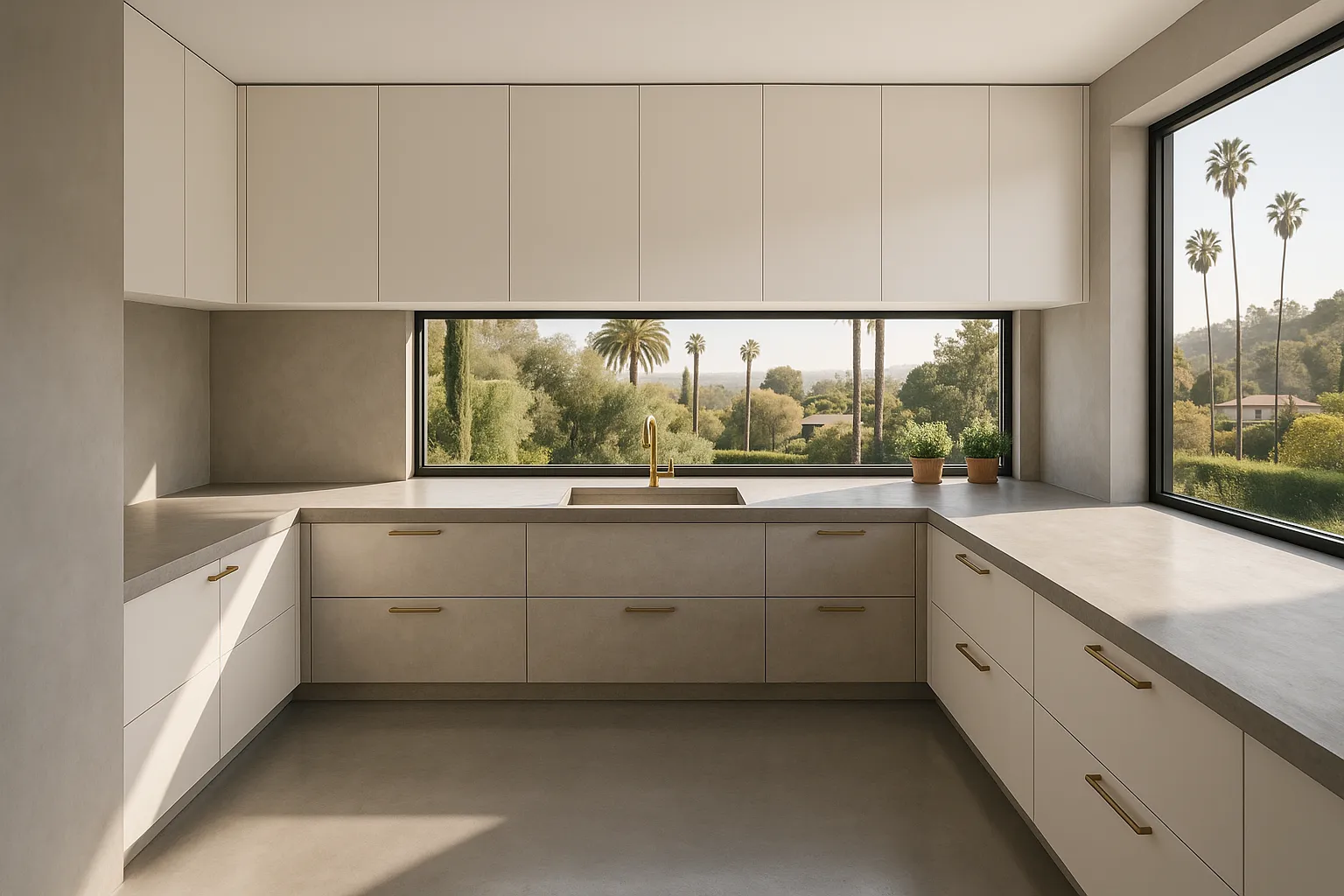
The [microcement kitchens & countertops](/services/microcement-kitchens-countertops) cost CA homeowners are paying in 2026 has shifted meaningfully from even two years ago — and if you're planning a kitchen renovation in [Los Angeles](/areas/los-angeles), [Beverly Hills](/areas/beverly-hills), or [Santa Monica](/areas/santa-monica), understanding what drives the price is the difference between a project that lands on budget and one that blows past it by $12,000. Based on Cemora's project data across 80+ kitchen and countertop installations completed in Southern California through early 2026, the average investment for a full microcement kitchen finish runs **$18,000–$52,000**, depending on square footage, substrate condition, and finish complexity.
This isn't a material you can price off a big-box store shelf. Microcement is a contractor-applied mineral system — labor-intensive, skill-dependent, and worth every dollar when it's done right. Let's break down exactly what you're paying for.
---
## What Is Microcement? A Definition Worth Knowing
What is microcement? Microcement is a polymer-modified cementitious coating applied in thin layers — typically **2–5mm total thickness** — directly over existing surfaces including tile, concrete, plywood, and drywall. It's not a poured slab or a tile. It's a seamless, continuous finish that bonds to the substrate and cures to a hard, waterproof surface when properly sealed.
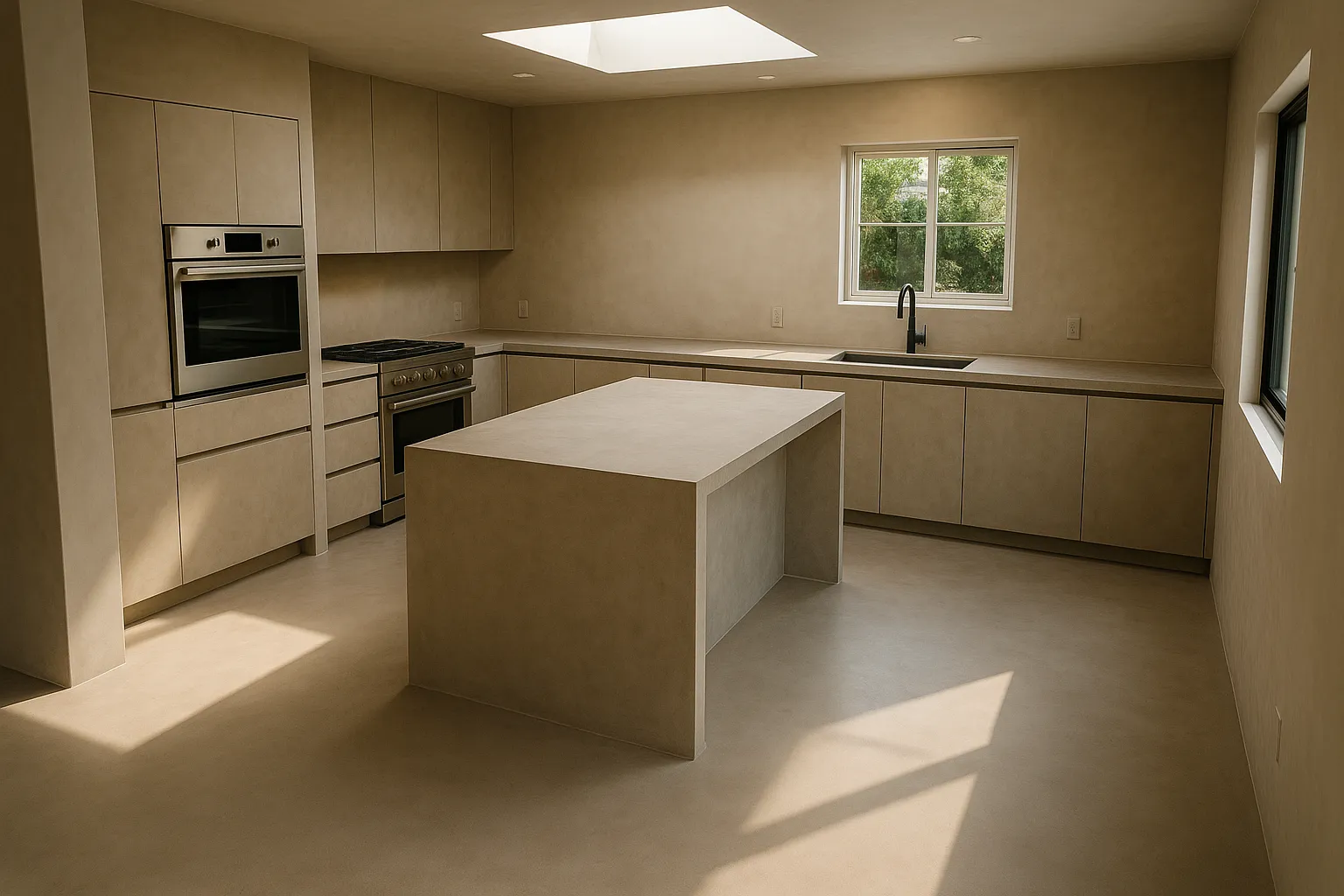
In a kitchen context, microcement is used on countertops, islands, backsplashes, floors, and full wall surfaces. The result is a monolithic, architectural look that reads like polished concrete but weighs a fraction of it and can be applied over existing cabinetry and surfaces without demolition.
What makes it different from concrete countertops? Unlike poured concrete, microcement doesn't require formwork, curing slabs, or significant structural reinforcement. It's applied cold, cures fast, and can achieve finishes ranging from ultra-matte to a polished sheen — all in the same material system.

---
## Microcement Kitchens & Countertops Cost CA: The Real Numbers in 2026
Based on Cemora's 2026 project data and cross-referenced against NAHB regional labor benchmarks for Southern California, here's what the microcement kitchens & countertops cost CA market looks like right now:
### Countertops Only
| Scope | Square Footage | 2026 Cost Range |
|---|---|---|
| Small countertop (single run) | 20–35 sq ft | $2,800–$5,500 |
| Mid-size kitchen countertops | 35–60 sq ft | $5,500–$10,000 |
| Large island + perimeter | 60–90 sq ft | $10,000–$16,500 |
| Countertops + backsplash | 60–110 sq ft | $12,000–$22,000 |
### Full Kitchen Surface Treatment
| Scope | Typical Size | 2026 Cost Range |
|---|---|---|
| Countertops + floor | 150–250 sq ft total | $18,000–$32,000 |
| Countertops + walls + floor | 200–350 sq ft total | $28,000–$45,000 |
| Full kitchen + adjacent dining | 300–500 sq ft total | $38,000–$58,000 |
These figures include **material, labor, primer, sealer, and two finish coats**. They do not include demolition of existing tile (add **$800–$2,500** depending on scope), cabinetry work, or plumbing disconnection.
---
## What Drives the Price? The 5 Biggest Cost Variables
Understanding the microcement kitchens & countertops cost CA breakdown means looking at what actually moves the needle on your quote.
### 1. Substrate Condition
Microcement is only as good as what's underneath it. A countertop substrate with soft spots, movement, or moisture intrusion requires remediation before any coating goes down. **Substrate prep can add $500–$3,000** to a project if the existing surface needs patching, priming for porosity, or moisture barrier treatment.
In older [Pasadena](/areas/pasadena) and [Glendale](/areas/glendale) homes, we frequently encounter tile-on-tile countertops or laminate substrates that need specific primer systems to ensure adhesion. Skipping this step is the single most common cause of microcement failure — and it's not a warranty repair, it's a full redo.
### 2. Finish Complexity and Layer Count
A standard two-coat system with a single color and matte sealer is the baseline. Add decorative aggregates, multi-tone blending, or a polished finish requiring machine buffing, and the labor hours jump significantly. **Polished or burnished finishes add 15–25% to labor costs** versus a standard matte application.
### 3. Edge Profiles on Countertops
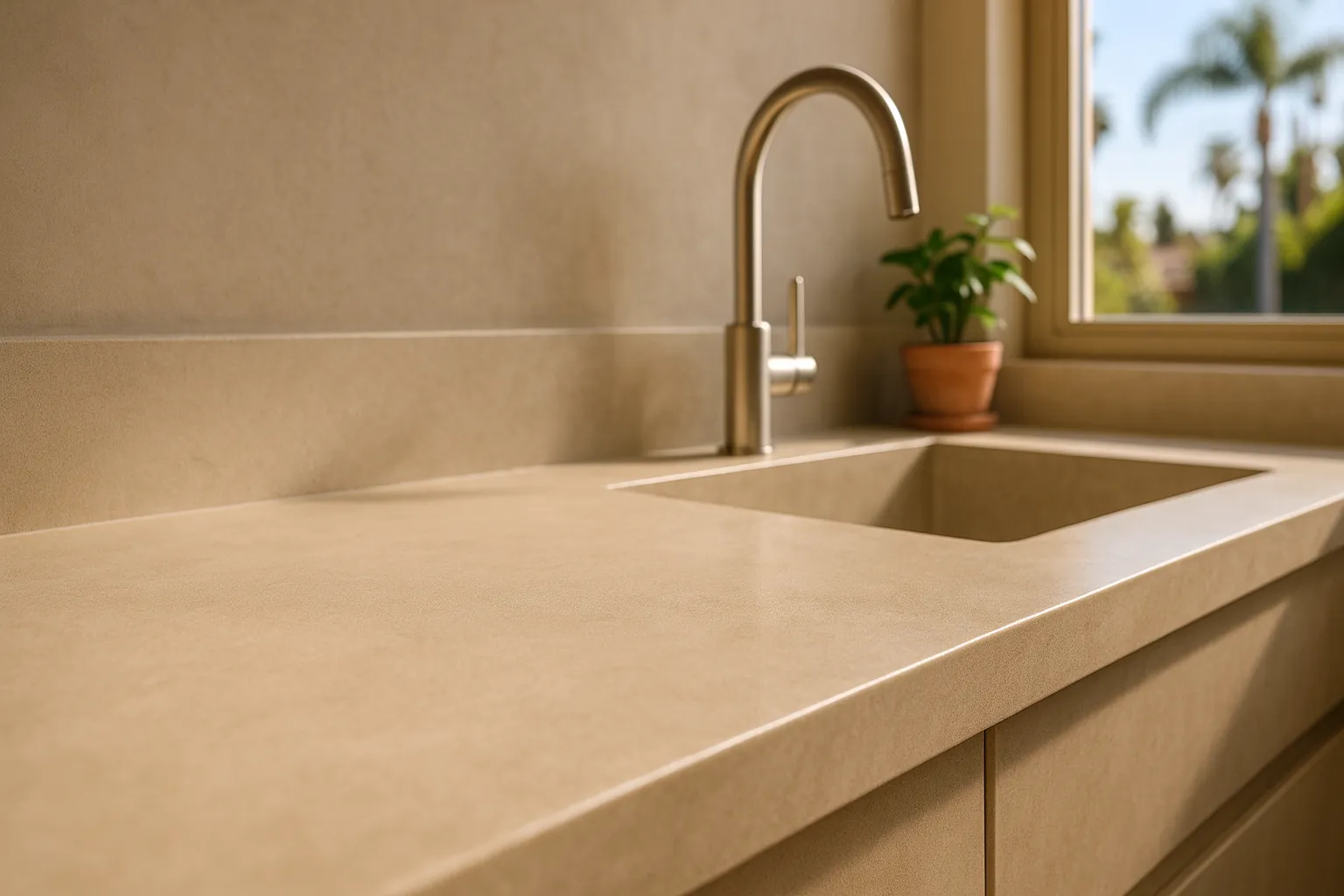
Microcement countertop edges require careful hand-tooling. A simple eased edge is included in standard pricing. Waterfall edges, thick mitered profiles, or integrated drip grooves are custom work — expect **$45–$85 per linear foot** in additional labor for complex edge detailing.
### 4. Sealer Selection
Not all sealers are equal. For kitchen countertops specifically, food-safe, chemical-resistant polyurethane or epoxy-modified sealers are the professional standard. These cost **$180–$320 per gallon** at trade pricing and require 2–3 coats on horizontal surfaces. A budget sealer on a kitchen countertop will fail within 12–18 months under daily cooking use.
### 5. Project Location and Access
In Beverly Hills and Santa Monica, parking, building access, and HOA material delivery restrictions can add **$300–$800** in logistics costs to a project. High-rise condos in downtown LA require freight elevator coordination and often restrict work hours — both factors that affect labor billing.
---
## How Does Microcement Compare to Other Countertop Materials?
When evaluating the microcement kitchens & countertops cost CA picture, it helps to see it against the alternatives. Here's a direct comparison based on 2026 installed costs in the Los Angeles market:
| Material | Installed Cost (per sq ft) | Seams | Heat Resistance | Resale Appeal |
|---|---|---|---|---|
| Microcement | $85–$185 | None | Moderate (w/ trivets) | High (design-forward) |
| Quartz | $75–$145 | Visible | Good | High |
| Marble | $90–$200 | Visible | Good | High |
| Granite | $60–$130 | Visible | Excellent | Moderate–High |
| Butcher Block | $40–$100 | Visible | Poor | Moderate |
| Laminate | $20–$55 | Visible | Poor | Low |
| Poured Concrete | $95–$200 | None | Good | Moderate |
Microcement sits in the premium tier — but unlike marble or quartz, it delivers **a completely seamless surface** with no grout lines, no visible joints, and the ability to wrap continuously from countertop to backsplash to wall. That continuity is what designers in the LA market are specifying in 2026.

---
## Three Real Projects: What LA Homeowners Actually Spent
Numbers in a table are useful. Real project breakdowns are better.
**Project 1 — Santa Monica Bungalow Kitchen Refresh**
A homeowner in Santa Monica wanted to update their dated tile countertops and matching backsplash without a full kitchen gut. Total countertop area was **42 square feet**, backsplash **28 square feet**. Substrate was sound ceramic tile in good condition. They chose a warm greige tone with matte sealer. **Total project cost: $8,400**. Timeline: 4 days on-site including cure time before sealer.
**Project 2 — Pasadena Open-Plan Kitchen and Dining Floor**
A 1940s Craftsman in Pasadena had original hardwood floors in the dining room and a cracked tile floor in the kitchen. The homeowners wanted visual continuity between the two spaces using microcement on the kitchen floor only — **210 square feet** — with a warm sand tone to complement the wood. Substrate required crack isolation membrane over two areas. **Total project cost: $19,200**, including substrate prep and two-component moisture-resistant sealer. Timeline: 6 days.
**Project 3 — Beverly Hills New Construction Kitchen Package**
A developer building a spec home in Beverly Hills specified microcement across the full kitchen: countertops (**78 sq ft**), island (**32 sq ft**), backsplash (**55 sq ft**), and kitchen floor (**290 sq ft**). Total surface area: **455 square feet**. Dark charcoal tone, polished finish on countertops, matte on floors. **Total project cost: $47,800**. Timeline: 9 working days across two mobilizations.
All three projects are from Cemora's 2026 project data. These aren't estimates — they're invoiced figures.
---
## What Is the Installation Process for Microcement Kitchens?
What is the microcement installation process? Understanding the sequence helps you plan your kitchen downtime realistically.
### Step-by-Step: How Cemora Installs Microcement in a Kitchen
1. **Substrate assessment and prep (Day 1):** We inspect for moisture, movement, and adhesion issues. Any cracks are filled and stabilized. Surfaces are cleaned, degreased, and primed with a bonding primer specific to the substrate type.
2. **First base coat application (Day 1–2):** The first layer of microcement is troweled on, building the base color and establishing thickness. This coat is feathered and leveled by hand.
3. **Sanding and second base coat (Day 2–3):** After the first coat dries (typically 4–6 hours), the surface is lightly sanded and a second base coat is applied. This is where color depth and texture are refined.
4. **Finish coat application (Day 3–4):** The finish coat — thinner, more refined — establishes the final texture and sheen level. This is the most skill-dependent step and where the look is made or broken.
5. **Curing period (Day 4–5):** Microcement requires **24–48 hours of dry cure time** before sealer application. No foot traffic or countertop use during this window.
6. **Sealer application — two to three coats (Day 5–6):** Food-safe polyurethane sealer is applied in multiple thin coats with light sanding between coats. Each coat requires **4–6 hours of dry time**.
7. **Final inspection and touch-up (Day 6–7):** We walk the surface in raking light to catch any pinholes, texture inconsistencies, or edge issues before sign-off.
Total kitchen downtime is typically **5–8 working days** for a mid-size project. You'll want to plan for no cooking or sink use during the installation window.
---
## How Does Microcement Affect Kitchen Resale Value in California?
This is the question every homeowner asks — and it deserves a straight answer.
A 2025 Houzz State of the Industry report found that **kitchen renovations in the Western US returned an average of 68–72% of project cost** at resale. For premium finish upgrades in the $150,000–$500,000+ kitchen renovation tier in markets like Beverly Hills and Santa Monica, that return can exceed 80% when the finish aligns with buyer expectations in that price range.
Microcement specifically appeals to the design-forward buyer segment that dominates the LA luxury market. Real estate agents in West LA consistently report that seamless, architectural surfaces — microcement floors, countertops, and walls — are a differentiating feature that shortens time on market. One Beverly Hills listing agent told us: *"When buyers walk into a kitchen with a full microcement treatment, they stop asking about the countertop material. They just want to know the price."*
That's not a guarantee of ROI — real estate never is. But in the Southern California market, premium mineral finishes are a recognized value signal in 2026.
---
## Why Is Microcement Popular Right Now in Los Angeles Kitchens?
The design conversation in LA kitchens in 2026 is moving away from the maximalist material stacking of the mid-2010s — marble everywhere, contrasting island stones, decorative tile backsplashes — toward restraint. Fewer materials. Cleaner transitions. Surfaces that recede and let the architecture breathe.
Microcement fits that moment precisely. It offers **a monolithic surface language** that quartz and tile can't replicate. It photographs well — which matters in a city where every renovation ends up on Instagram. And it's genuinely low-maintenance in daily use when properly sealed.
Based on Cemora's project intake data, **kitchen inquiries have grown 34% year-over-year from 2025 to 2026**, with countertop + floor combinations being the most requested scope. The shift is partly aesthetic and partly practical: homeowners who've seen microcement bathrooms want the same continuity in their kitchens.
For a look at how microcement performs in wet environments specifically, our [Microcement Bathrooms & Wet Rooms](/services/microcement-bathrooms?utm_source=blog&utm_medium=organic&utm_campaign=microcement-kitchens-countertops-cost-ca) page covers waterproofing standards and maintenance in detail.
---
## What Is the Maintenance Reality for Microcement Countertops?
What is the maintenance requirement for microcement countertops? Properly sealed microcement countertops require **resealing every 2–4 years** depending on use intensity. Daily cleaning is straightforward: pH-neutral cleaner, soft cloth, done.
Here's what microcement countertops don't handle well without proper care:
- **Standing water** left for extended periods on inadequately sealed surfaces
- **Strong acids** — lemon juice, vinegar, harsh cleaners — which can etch the sealer over time
- **Cutting directly on the surface** without a board (scratches the sealer, not the cement)
- **Hot pots placed directly** on the surface — use trivets; thermal shock can crack the sealer
None of these are dealbreakers. They're the same considerations you'd apply to marble or any other natural surface. The difference is that microcement is **far more forgiving than marble** and **easier to reseal than tile grout** when maintenance time comes.
Our [Microcement Floors & Walls](/services/microcement-floors-walls?utm_source=blog&utm_medium=organic&utm_campaign=microcement-kitchens-countertops-cost-ca) page has additional detail on sealer types and long-term maintenance schedules for high-traffic surfaces.

---
## How to Get an Accurate Microcement Kitchens & Countertops Cost CA Quote
The microcement kitchens & countertops cost CA quotes you'll receive from different contractors can vary by **40–60%** for the same scope — and that gap isn't always about quality. It's often about what's included.
When you're comparing quotes, make sure each one specifies:
- **Number of base coats and finish coats** (two base + one finish is standard minimum)
- **Sealer type and number of coats** (two coats minimum on countertops)
- **Substrate prep scope** — what's included vs. what's an add-on
- **Edge treatment** — is complex edge profiling included or billed separately?
- **Warranty terms** — what's covered and for how long?
- **Mobilization costs** — is there a minimum charge for small scopes?
A quote that doesn't specify these items is a quote that will grow during the project. Ask the questions upfront.
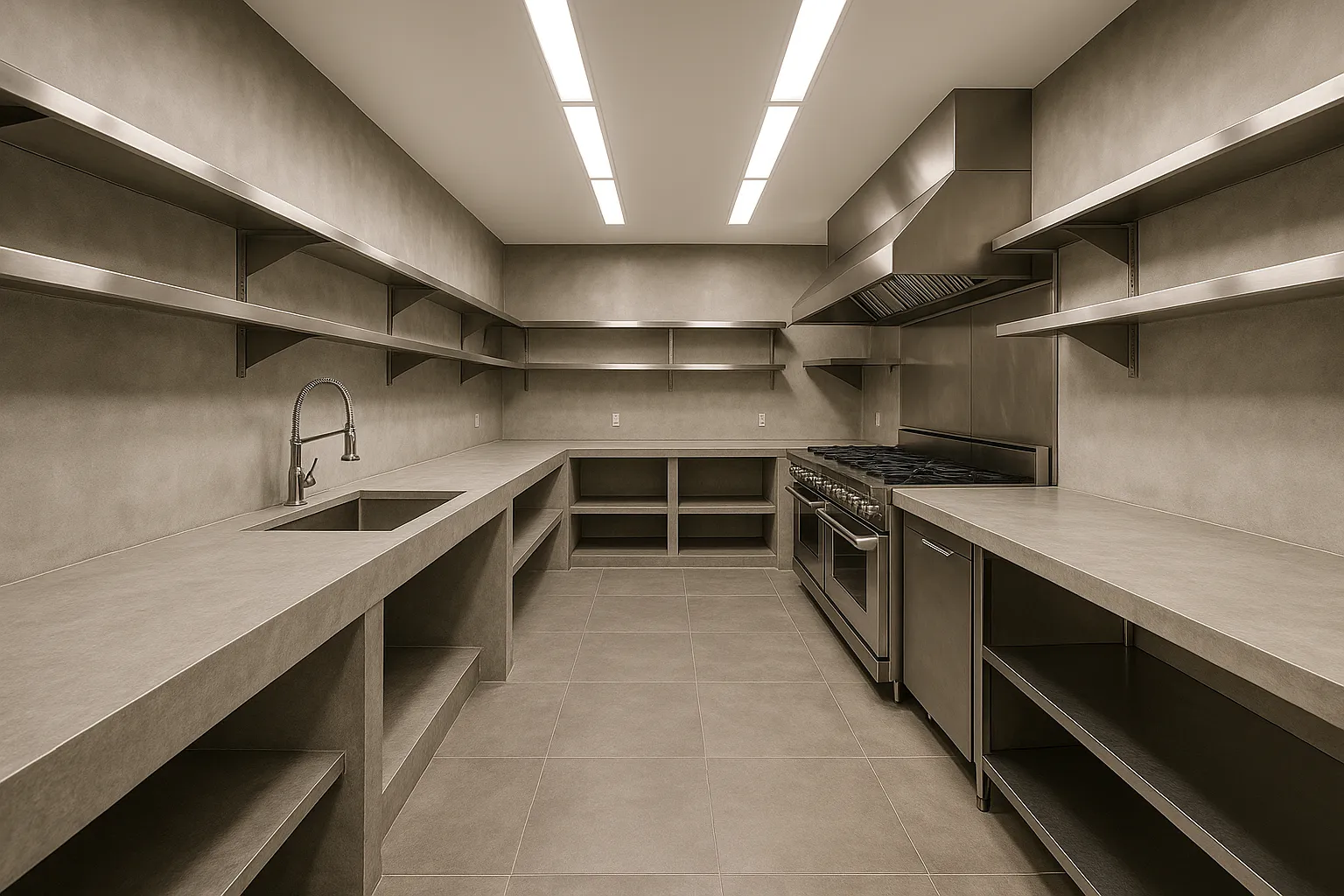
For [commercial](/services/microcement-commercial-hospitality) kitchen projects — restaurants, hotel kitchens, hospitality spaces — the scope and compliance requirements differ meaningfully from residential work. Our [Commercial & Hospitality Microcement](/services/microcement-commercial-hospitality?utm_source=blog&utm_medium=organic&utm_campaign=microcement-kitchens-countertops-cost-ca) page covers those distinctions.
If you're ready to get a scoped number for your kitchen project, the fastest path is our [free estimate tool](/estimate?utm_source=blog&utm_medium=organic&utm_campaign=microcement-kitchens-countertops-cost-ca) — fill out the project details and we'll come back with a real range within 48 hours, not a placeholder number.
---
## Frequently Asked Questions
### [How much does](/estimate) microcement kitchen countertop installation cost in California in 2026?
Based on Cemora's 2026 project data, microcement countertop installation in California runs **$85–$185 per square foot installed**, including materials, labor, primer, and sealer. A typical mid-size kitchen countertop of 40–60 square feet will run **$5,500–$10,000** for countertops only, with full kitchen packages (countertops, backsplash, floor) ranging from **$18,000–$52,000** depending on scope and finish complexity.
### How long does microcement kitchen installation take?
A standard mid-size kitchen microcement installation takes **5–8 working days** from first coat to final sealer cure. This includes substrate prep, two base coats, a finish coat, cure time, and two to three coats of sealer with dry time between each. You should plan for the kitchen to be out of use for the full duration — no cooking, no sink use, no foot traffic on floors during cure windows.
### Is microcement safe for kitchen countertops that come into contact with food?
Yes — when sealed with a food-safe, NSF-compliant polyurethane or water-based epoxy sealer, microcement countertops are safe for food preparation surfaces. The sealer is the critical component here, not the cement itself. Cemora uses food-safe sealers as the standard specification on all kitchen countertop projects, and we can provide product data sheets on request.
### How does microcement countertop cost compare to quartz in Los Angeles?
In the Los Angeles market in 2026, quartz countertops run **$75–$145 per square foot installed**, putting them in a similar range to microcement at **$85–$185 per square foot**. The key difference is that microcement delivers a completely seamless surface with no visible joints or grout lines, and it can continue across backsplashes and walls in one continuous finish — something quartz cannot do. For design-forward projects where visual continuity matters, microcement often delivers more value at a comparable price point.
### Does microcement increase home resale value in California?
A 2025 Houzz State of the Industry report found kitchen renovations in the Western US return **68–72% of project cost** at resale on average, with premium finish upgrades in high-value markets potentially exceeding 80%. Microcement specifically appeals to the design-forward buyer segment that dominates the LA and Beverly Hills luxury market, and real estate agents in West LA report it as a differentiating feature that can shorten time on market.
### Can microcement be applied over existing tile countertops?
Yes — microcement can be applied directly over existing ceramic or porcelain tile countertops in most cases, which eliminates demolition costs and reduces project disruption. The tile surface must be structurally sound with no loose or hollow sections, properly cleaned and degreased, and primed with a bonding primer appropriate for glazed tile. Any grout lines deeper than 2mm may require a skim coat to prevent read-through in the finished surface.
### What is the lifespan of a microcement kitchen countertop?
A properly installed and maintained microcement countertop has a functional lifespan of **15–25 years or more**. The surface itself is highly durable — the maintenance variable is the sealer, which should be refreshed every **2–4 years** depending on use intensity. A resealing service costs approximately **$400–$900** for a typical kitchen countertop scope and can be performed without disrupting the kitchen for more than a day.
### How much does a microcement kitchen floor cost in Los Angeles?
Microcement kitchen floor installation in Los Angeles runs **$18–$35 per square foot installed** for most residential projects, based on 2026 Cemora project data. A 200-square-foot kitchen floor would typically run **$7,500–$14,000** depending on substrate condition, finish specification, and sealer type. Projects requiring crack isolation membrane or moisture barrier treatment add **$2–$5 per square foot** to that baseline.
### What is the difference between microcement and polished concrete for kitchens?
What is the difference between microcement and polished concrete? Polished concrete is a process applied to an existing poured concrete slab — it requires a slab of sufficient thickness and quality to grind and polish. Microcement is an applied coating that goes over virtually any stable substrate. Microcement is typically **40–60% less expensive** than a poured and polished concrete countertop installation, installs faster, and can be applied in spaces where poured concrete is structurally impractical, such as upper-floor kitchens or countertops over existing cabinetry.
### How do I get a microcement kitchen quote from Cemora?
The fastest way is through our [free estimate tool](/estimate?utm_source=blog&utm_medium=organic&utm_campaign=microcement-kitchens-countertops-cost-ca), where you can describe your project scope and we'll respond with a real cost range within 48 hours. For larger or more complex projects — commercial kitchens, full home packages, or developer specifications — [booking a consultation](/book?utm_source=blog&utm_medium=organic&utm_campaign=microcement-kitchens-countertops-cost-ca) is the better path, so we can walk the space and give you a scoped proposal rather than a range.
---
## The Bottom Line on Microcement Kitchen Costs in California
The microcement kitchens & countertops cost CA picture in 2026 is clear: this is a premium finish that sits in the same investment tier as natural stone, but delivers something stone can't — seamless continuity across every surface in the room.
For a countertop-only project, budget **$5,500–$16,500** depending on size and complexity. For a full kitchen treatment including floors, walls, and countertops, the realistic range is **$28,000–$52,000** for most Los Angeles homes. Those numbers reflect real projects, real labor costs, and real material specifications — not ballpark estimates pulled from national averages.
If you're comparing materials and want to see how microcement performs across other surfaces in your home, our [Microcement Kitchens & Countertops](/services/microcement-kitchens-countertops?utm_source=blog&utm_medium=organic&utm_campaign=microcement-kitchens-countertops-cost-ca) service page has project photography and specification details. And if you're curious how the same material system works in bathrooms and wet rooms — which have even more demanding waterproofing requirements — [Microcement Bathrooms & Wet Rooms](/services/microcement-bathrooms?utm_source=blog&utm_medium=organic&utm_campaign=microcement-kitchens-countertops-cost-ca) covers that in full.
When you're ready to put real numbers to your project, [reach out to the Cemora team](/contact?utm_source=blog&utm_medium=organic&utm_campaign=microcement-kitchens-countertops-cost-ca) — we work across Los Angeles, Beverly Hills, Santa Monica, Pasadena, and Glendale, and we're happy to talk through scope before you commit to anything.

---
**Ready to start your your project in Los Angeles?** [Book a free consultation](/book?utm_source=blog&utm_medium=organic&utm_campaign=microcement-kitchens-countertops-cost-ca-what-to-expect-in-2026) — we'll come walk through your space and give you straight numbers, no pressure. Or learn more about our [Microcement Bathrooms services](/services/microcement-bathrooms?utm_source=blog&utm_medium=organic&utm_campaign=microcement-kitchens-countertops-cost-ca-what-to-expect-in-2026).