Microcement Kitchens & Countertops Cost CA: What to Expect in 2026
By Gilad Segev · July 20, 2026 · Last updated July 20, 2026 · Cost Guide
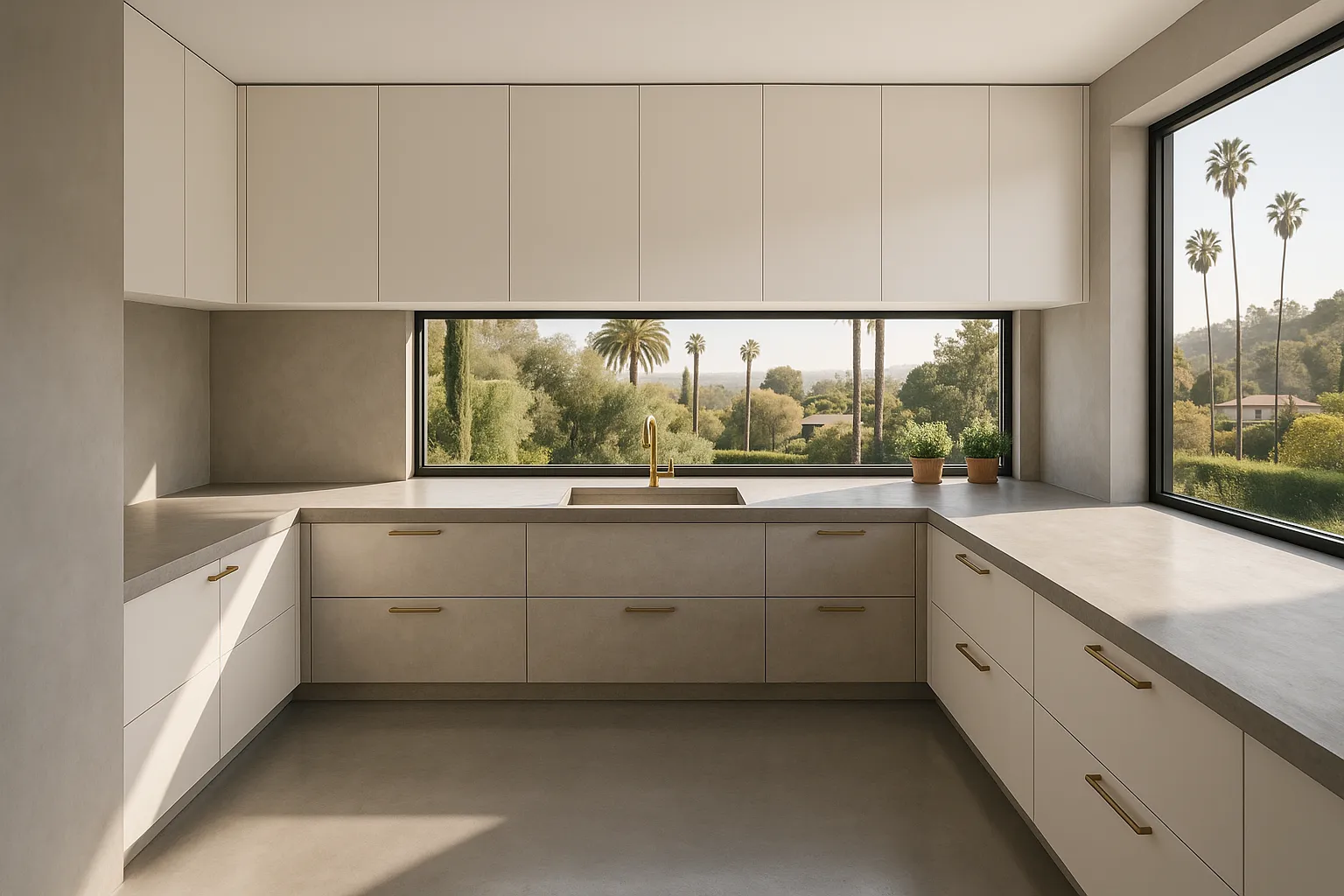
# [Microcement](/services/microcement-bathrooms) Kitchens & Countertops Cost CA: What to Expect in 2026
The [microcement kitchens & countertops](/services/microcement-kitchens-countertops) cost CA homeowners are budgeting for in 2026 sits between **$45 and $120 per square foot installed** — a range wide enough to confuse anyone doing their first round of research. That spread exists because microcement isn't a single product; it's a system, and the variables that shape the final number include surface prep, layer count, sealer type, and the skill level of whoever's applying it. Get those wrong, and you're not just overpaying — you're looking at delamination, moisture intrusion, or a finish that chalks within 18 months.
After completing projects across [Los Angeles](/areas/los-angeles), [Beverly Hills](/areas/beverly-hills), [Santa Monica](/areas/santa-monica), [Pasadena](/areas/pasadena), and [Glendale](/areas/glendale), Cemora has tracked real job costs across dozens of kitchen and countertop installations. This guide breaks down where the money actually goes, what separates a $55/sqft job from a $110/sqft job, and how to think about this investment before you call anyone.
---
## What Is Microcement? A Definition Worth Having
What is microcement? Microcement is a polymer-modified cementitious coating applied in multiple thin layers — typically 2–5mm total — directly over existing surfaces including tile, concrete, wood substrate, and drywall. Unlike traditional cement, it doesn't require demolition of the existing surface in most cases, which is a significant cost and timeline advantage.
The material itself is a blend of Portland cement, fine aggregates, water-based resins, and pigments. What makes it exceptional for kitchens is its seamless finish: no grout lines, no joints, no places for bacteria or grease to hide. Sealed correctly, it becomes waterproof, heat-resistant to moderate temperatures, and food-safe.
What is a microcement countertop system? A microcement countertop system refers to the full installation stack: substrate preparation, bonding primer, two or more base coats, a color coat, and a minimum of two sealer coats — often three for surfaces that see daily contact with water, oils, and cutting activity. Skipping any layer in this sequence is where cheap jobs fall apart.

---
## [How Much Does](/estimate) Microcement Kitchen & Countertop Installation Cost in California?
Based on Cemora's project data across 60+ kitchen and countertop installations in Los Angeles County between 2024 and 2026, here are the realistic cost benchmarks:
### Countertop-Only Projects
- **Small countertop area (under 40 sqft):** $3,200 – $5,500 total
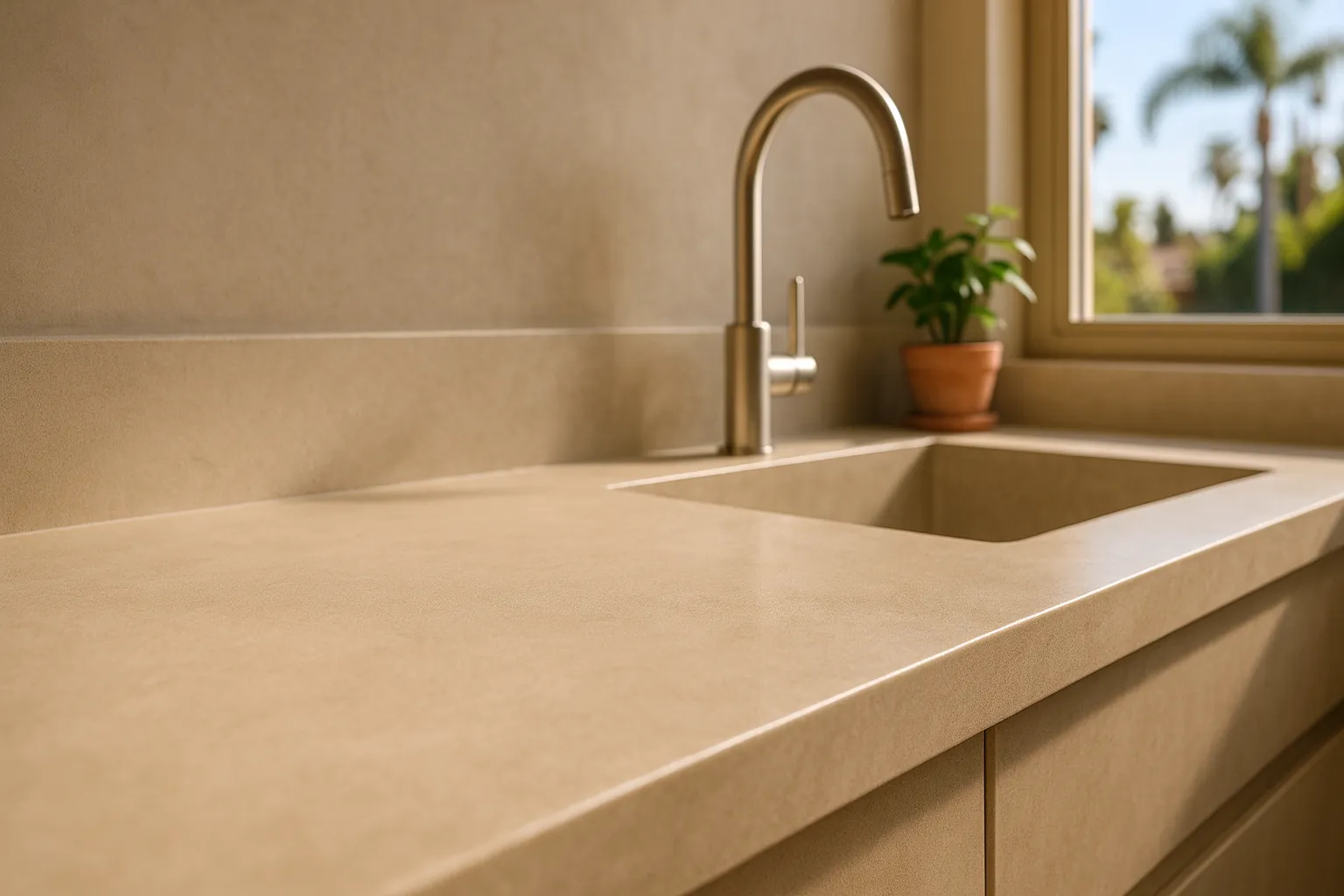
- **Mid-size kitchen countertops (40–80 sqft):** $5,500 – $9,600 total
- **Large kitchen with island (80–140 sqft):** $9,600 – $16,800 total
Those numbers assume standard substrate prep, two base coats, one color coat, and a three-coat polyurethane or epoxy-modified sealer. If you're adding a backsplash, figure an additional **$18–$35 per linear foot** depending on height and complexity.
### Full Kitchen Surface Projects (Floors + Walls + Countertops)
When clients go full-kitchen — floors, walls, and countertops in a continuous microcement finish — the per-square-foot cost drops slightly due to mobilization efficiency, but total project spend rises:
- **200–300 sqft total kitchen surface:** $18,000 – $32,000
- **300–500 sqft total kitchen surface:** $28,000 – $52,000
- **[Commercial](/services/microcement-commercial-hospitality) kitchen prep areas:** $55,000 – $120,000+ depending on code compliance requirements
Industry benchmarks from the 2025 Houzz State of the Industry report showed that high-end surface finishes in California kitchens averaged **$680 per linear foot of countertop** across premium materials — microcement falls competitively within that range while offering advantages no stone or tile product can match.
---
## What Drives the Price Up (or Down)?
The single biggest variable in microcement kitchens & countertops cost CA projects is **surface preparation**. A kitchen with existing tile that's poorly bonded, a countertop with flex in the substrate, or a floor with moisture transmission issues — these all require remediation work before a single gram of microcement goes down.
### Factors That Increase Cost
- **Existing tile removal:** Add $3–$6 per sqft if demolition is needed
- **Substrate leveling:** Uneven surfaces require skim work, adding $2–$4 per sqft
- **Moisture barrier installation:** In older LA homes, especially pre-1980 construction, this adds $1.50–$3 per sqft
- **Custom color development:** Bespoke pigment matching adds $400–$900 to the project
- **Three-coat sealer systems:** Required for countertops and wet areas, adds $8–$15 per sqft over a standard two-coat finish
- **Sink cutouts and edge detailing:** Each cutout adds $150–$350 in labor
### Factors That Reduce Cost
- **Sound existing substrate:** Solid, level, well-bonded surfaces cut prep time significantly
- **Larger project scope:** Mobilization costs spread across more square footage
- **Combining rooms in one visit:** Doing kitchen + bathroom in the same project saves **15–20% on total cost** versus scheduling separately
- **Standard color selection:** Choosing from an existing palette eliminates custom pigment work
---
## Microcement vs. Other Kitchen Countertop Materials: A Cost Comparison
It helps to see microcement in context. Here's how it stacks up against the most common countertop materials installed in Los Angeles kitchens in 2026:
| Material | Installed Cost (per sqft) | Lifespan | Grout Lines | Seamless | Resealable |
|---|---|---|---|---|---|
| Microcement | $45 – $120 | 15–25 yrs (with maintenance) | None | Yes | Yes |
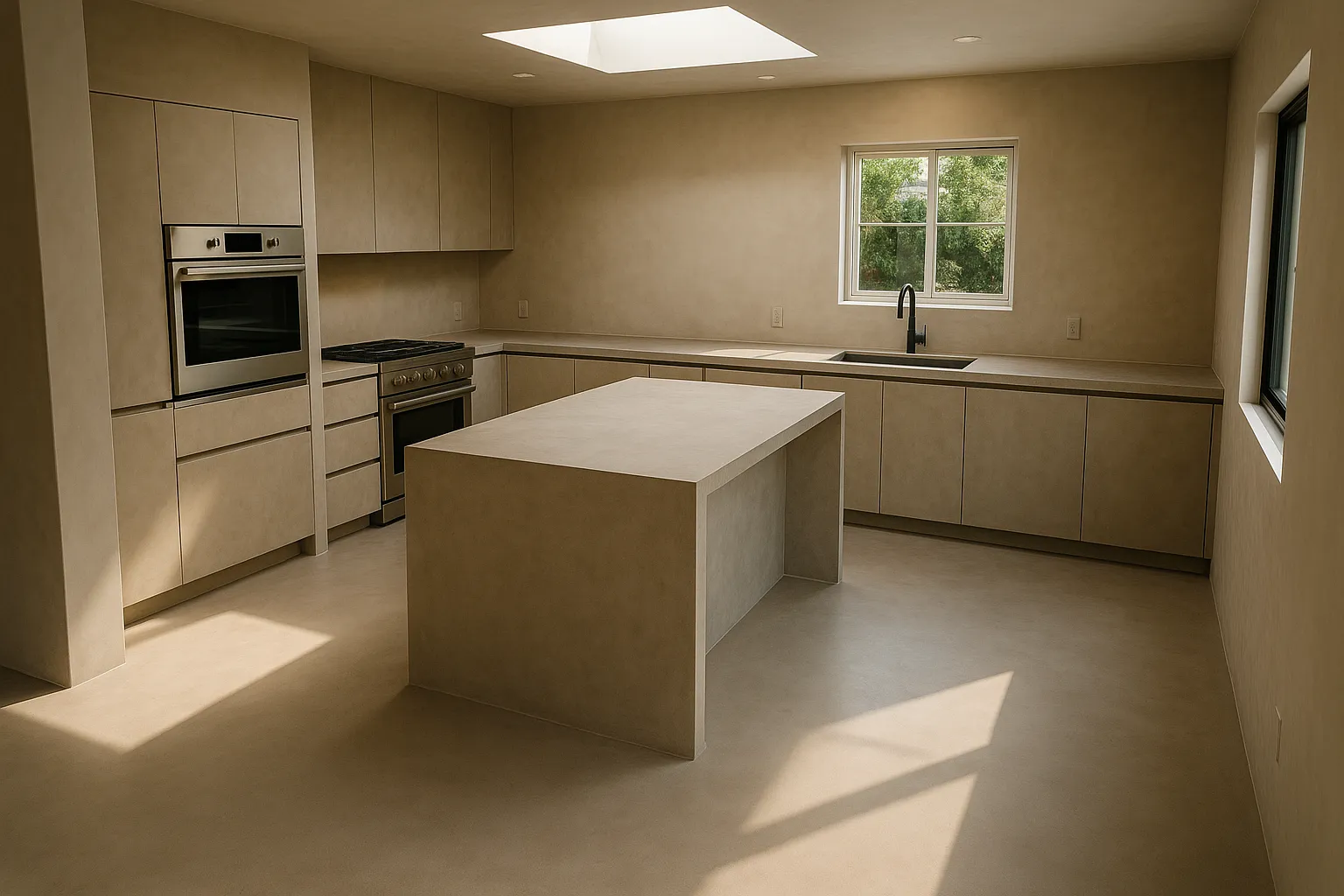
| Quartz | $80 – $140 | 25–30 yrs | None | No (seams) | No |
| Granite | $65 – $120 | 25+ yrs | None | No (seams) | Yes |
| Porcelain Tile | $25 – $65 | 20+ yrs | Yes | No | No |
| Concrete (poured) | $75 – $150 | 15–20 yrs | None | Yes | Yes |
| Laminate | $15 – $40 | 10–15 yrs | No | No | No |
| Marble | $100 – $200 | 20+ yrs | None | No (seams) | Yes |
Microcement's competitive advantage isn't just price — it's the ability to apply over existing surfaces without demolition, achieve truly seamless results across complex geometries, and be refinished in place rather than replaced. A countertop that gets scratched or stained in year 10 can be lightly abraded and resealed for **$400–$900**, versus a full slab replacement at $5,000+.

---
## How Long Does a Microcement Kitchen Project Take?
Timeline is one of the most underestimated parts of a microcement kitchen project. This isn't a weekend install.
### Typical Project Timeline
**Countertop-only project (40–80 sqft):**
- Day 1: Surface prep and primer
- Days 2–3: Base coat application and cure
- Day 4: Color coat application
- Days 5–6: Sealer coats (minimum two, with cure time between)
- Day 7: Final inspection and client walkthrough
- **Total: 7–10 days on-site, with a 28-day full cure period before heavy use**
**Full kitchen surface project (floors + walls + countertops):**
- Week 1: Substrate assessment, prep, and priming
- Week 2: Base coats across all surfaces
- Week 3: Color coats and detail work
- Week 4: Sealing, curing, and final touches
- **Total: 3–5 weeks on-site, kitchen unusable during application**
The 28-day cure period is non-negotiable for countertops. Microcement continues to harden as the polymer matrix fully crosslinks with the cement phase. Placing heavy pots, cutting directly on the surface, or exposing it to standing water before full cure is the most common cause of early failure we see when clients hire underqualified applicators.
---
## Three Real Projects: What Clients Actually Spent
### Scenario 1: Silver Lake Kitchen Countertop Refresh
A homeowner in Silver Lake (Los Angeles) had a 52-sqft kitchen with dated ceramic tile countertops. Rather than demolish and replace with quartz, they chose microcement applied directly over the existing tile. Total project: **$6,200**, which included surface cleaning, a bonding primer, two base coats, a warm greige color coat, and a three-coat water-based polyurethane sealer. Project duration was 8 days. The client later reported the countertops were still performing flawlessly 18 months in with zero resealing needed.
### Scenario 2: Beverly Hills Kitchen Full Surface Package
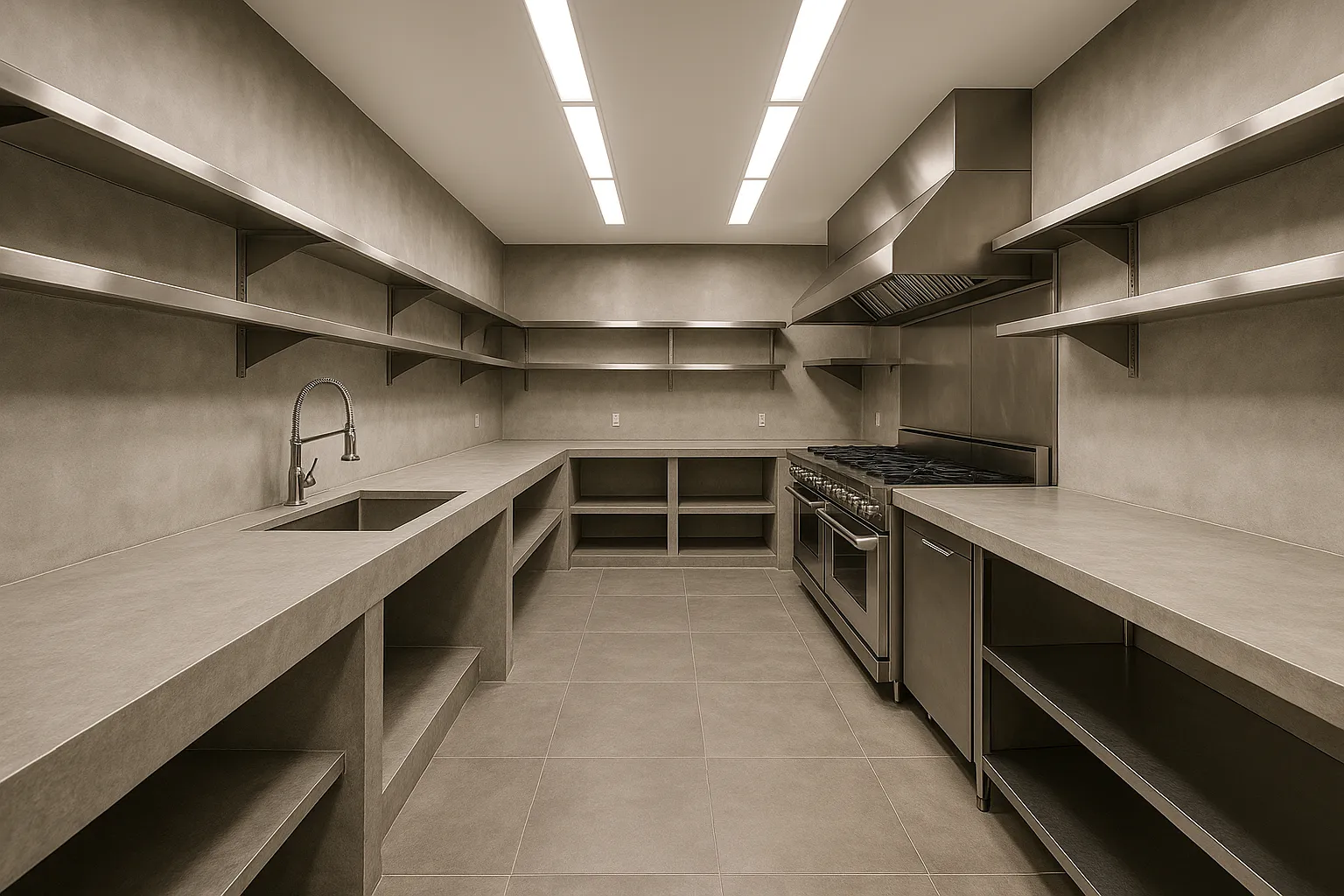
A design-build client in Beverly Hills commissioned a complete kitchen surface transformation — 380 sqft of floors, walls, and countertops in a continuous anthracite microcement finish. The project included custom color development, a full moisture barrier system on the concrete slab, and a commercial-grade epoxy sealer on the countertops. **Total investment: $44,800.** Timeline: 4.5 weeks. The client's interior designer noted the finish photographed so well it was featured in an architectural publication.
### Scenario 3: Pasadena Restaurant Kitchen Prep Station
A hospitality client in Pasadena needed 160 sqft of commercial-grade microcement across prep countertops and a service wall in a fast-casual restaurant. Requirements included NSF-compliant sealer certification, a surface hardness rating suitable for commercial use, and installation phased across three weekends to avoid shutting down the kitchen. **Total project cost: $21,400**, including the phased scheduling premium and NSF sealer system. Based on Cemora's [commercial and hospitality microcement](/services/microcement-commercial-hospitality?utm_source=blog&utm_medium=organic&utm_campaign=microcement-kitchens-countertops-cost-ca) experience, commercial projects typically run **20–35% higher** per square foot than residential due to sealer requirements and scheduling constraints.
---
## What Is the ROI on Microcement Countertops in California?
What is the return on investment for microcement kitchen surfaces? Based on 2025 Remodeling Magazine Cost vs. Value data for the Pacific region, minor kitchen remodels returned an average of **81.6% of cost at resale**, while major kitchen remodels returned **62.7%**. Microcement falls into the minor-to-mid remodel category when applied over existing surfaces — meaning you're likely capturing **70–80% of your investment** at resale while enjoying the surface daily.
For investment properties and short-term rentals in Los Angeles and Santa Monica, the calculus is different. A microcement kitchen finish photographs exceptionally well, commands higher nightly rates, and is far more durable than painted surfaces under high-turnover conditions. Several Cemora clients operating Airbnb properties in West LA have reported **12–18% increases in average nightly rate** after a microcement kitchen and bathroom refresh.
The durability math also matters. A properly sealed microcement countertop in a residential kitchen should last **15–25 years** before requiring anything beyond routine maintenance. Compare that to laminate at 10–15 years or tile grout that starts looking dated within 5–8 years in a high-use kitchen.
---
## How Do I Choose the Right Microcement Applicator in California?
California's CSLB (Contractors State License Board) requires that anyone applying microcement as part of a construction project hold a valid C-35 (Lathing and Plastering) or C-54 (Ceramic and Mosaic Tile) license depending on the substrate and scope. Always verify license status at the CSLB website before signing a contract.
### What to Ask Before Hiring
1. Can you show me completed projects similar in scope to mine?
2. What specific microcement system do you use, and who manufactures it?
3. What sealer do you specify for kitchen countertops, and is it food-safe after cure?
4. Do you perform moisture testing before application?
5. What is your warranty on the application, and what does it cover?
6. Will you provide a written substrate assessment before starting?
"In 15 years of applying mineral surfaces across Los Angeles, the most expensive calls we get are from homeowners whose previous applicator skipped the moisture test," says Cemora's lead applicator. "You can have the best microcement product in the world and it will fail in 18 months if there's vapor transmission through the slab that nobody measured."
Red flags to watch for: applicators who quote by phone without a site visit, no written substrate assessment, vague answers about sealer specifications, and pricing that's more than **30% below** the market range listed above. Microcement is a skilled trade. Discount pricing almost always means compromised materials or inexperienced labor.

---
## Maintenance: What Microcement Countertops Actually Require
What is the maintenance requirement for microcement countertops? Microcement countertop maintenance is minimal but not zero. The sealer is the surface's protective layer, and it does wear over time — particularly around the sink, near the stovetop, and in high-traffic prep zones.
### Routine Care
- **Daily:** Wipe with a damp cloth or mild pH-neutral cleaner. Avoid acidic cleaners (vinegar, lemon-based products) that can etch the sealer.
- **Weekly:** Light cleaning with a microcement-compatible surface cleaner.
- **Annually:** Inspect sealer integrity. If water no longer beads on the surface, it's time to reseal.
- **Every 3–5 years (residential):** Light abrasion and resealing of the countertop surface. Cost: **$400–$900** depending on area.
Avoid: cutting directly on the surface (use a cutting board), placing extremely hot pans without a trivet, and allowing standing water to pool near edges or at the sink interface.
For clients interested in the full scope of seamless surface options — including floors and walls — our [microcement floors & walls](/services/microcement-floors-walls?utm_source=blog&utm_medium=organic&utm_campaign=microcement-kitchens-countertops-cost-ca) service page covers the specifics of those applications. And if you're planning a bathroom renovation alongside the kitchen, our [microcement bathrooms & wet rooms](/services/microcement-bathrooms?utm_source=blog&utm_medium=organic&utm_campaign=microcement-kitchens-countertops-cost-ca) page is worth a read — combining both projects in a single mobilization typically saves **$1,500–$3,500** in setup costs.
---
## Design Trends Shaping Microcement Kitchen Choices in 2026
The design direction for microcement kitchens in 2026 has moved decisively toward **textural contrast and tonal layering**. Rather than the flat, uniform grays that dominated the mid-2020s, clients are now requesting:
- **Warm mineral tones:** Terracotta-adjacent ochres, dusty rose-beiges, and warm whites that complement natural wood cabinetry
- **Matte-to-satin finishes:** High-gloss is largely out of favor in residential kitchens; the current preference is a satin or low-sheen finish that reads as luxurious without being reflective
- **Integrated backsplash continuity:** Running the same microcement from countertop up the backsplash and onto the ceiling in a single continuous pour — a look that's impossible with tile
- **Two-tone applications:** Darker countertops paired with lighter walls in the same material family, creating depth without visual noise
- **Biophilic texture:** Intentional variation in the finish that mimics natural stone veining or aged plaster, applied by hand during the color coat stage
For clients in Beverly Hills and Bel Air, the demand for bespoke color development has grown significantly — **approximately 40% of Cemora's 2025–2026 kitchen projects** involved custom pigment formulation rather than standard palette selection.
If you're designing a commercial kitchen or hospitality space, the considerations shift toward durability ratings and compliance. Our [commercial and hospitality microcement](/services/microcement-commercial-hospitality?utm_source=blog&utm_medium=organic&utm_campaign=microcement-kitchens-countertops-cost-ca) page covers the sealer specifications and surface hardness requirements relevant to those environments.
---
## The Application Process: Step by Step
Understanding how microcement goes on helps you evaluate proposals and understand why timelines are what they are.
1. **Substrate assessment:** Moisture testing, surface hardness evaluation, and adhesion testing on existing finish. This step determines whether direct application is possible or if prep work is needed.
2. **Surface preparation:** Grinding, patching, leveling, or tile removal as required. Any movement in the substrate (flex, cracks, delamination) is addressed here.
3. **Moisture barrier (if required):** A waterproofing membrane is applied to slabs with measurable vapor transmission, particularly important in older Los Angeles construction.
4. **Bonding primer:** A penetrating primer is applied to create mechanical adhesion between the substrate and the first microcement layer.
5. **First base coat:** The structural layer of microcement, approximately 1–2mm thick, is applied and allowed to cure for 24 hours.
6. **Second base coat:** A second structural layer refines the surface and fills any remaining texture variation.
7. **Color coat:** The pigmented finish coat is applied by hand, with technique choices at this stage determining the final aesthetic — smooth, textured, veined, or layered.
8. **First sealer coat:** A penetrating sealer is applied and allowed to cure.
9. **Light abrasion:** The surface is lightly sanded to open the pores for maximum sealer adhesion.
10. **Second and third sealer coats:** Applied with cure time between each coat. Countertops always receive a minimum of three sealer coats.
11. **Final inspection and client walkthrough:** Surface is reviewed under raking light to confirm uniformity, and care instructions are provided in writing.
---
## Getting Your Project Scoped and Priced
The only way to get an accurate microcement kitchens & countertops cost CA estimate is a site visit. Phone quotes based on square footage alone miss the substrate variables that can shift a project by **$2,000–$8,000** in either direction. Any applicator quoting you without seeing the space is guessing.
At Cemora, we offer a no-obligation consultation where we assess your substrate, discuss your design goals, and provide a written scope and price before any commitment. If you're comparing multiple quotes, make sure each one specifies the same scope: number of coats, sealer system, and substrate prep assumptions.
For full kitchen surface projects — the kind that transform a space completely — explore our [microcement kitchens & countertops](/services/microcement-kitchens-countertops?utm_source=blog&utm_medium=organic&utm_campaign=microcement-kitchens-countertops-cost-ca) service page for examples and scope details. When you're ready to talk numbers specific to your space, [book a consultation](/book?utm_source=blog&utm_medium=organic&utm_campaign=microcement-kitchens-countertops-cost-ca) or [request a free estimate](/estimate?utm_source=blog&utm_medium=organic&utm_campaign=microcement-kitchens-countertops-cost-ca) — we cover Los Angeles, Beverly Hills, Santa Monica, Pasadena, and Glendale.
The right microcement kitchen ages beautifully. The wrong one becomes a cautionary tale. The difference is almost always in the preparation and the person doing it.
---
## Frequently Asked Questions
### How much does microcement countertop installation cost in California in 2026?
Based on Cemora's project data, microcement countertop installation in California runs **$45–$120 per square foot installed**, with most residential kitchen countertop projects falling between **$5,500 and $16,800 total** depending on square footage, substrate condition, sealer system, and color complexity. Commercial applications run higher due to NSF sealer requirements and scheduling constraints, typically landing **20–35% above residential pricing**.
### How long does microcement last on kitchen countertops?
A properly installed and sealed microcement countertop in a residential kitchen should last **15–25 years** before requiring anything beyond routine maintenance and periodic resealing. The sealer coat is the wear layer and can be refreshed every 3–5 years for **$400–$900** — far less than replacing a countertop surface. Longevity depends heavily on correct installation and appropriate sealer selection for the use environment.
### Can microcement be applied directly over existing tile countertops?
Yes, in most cases microcement can be applied directly over existing ceramic or porcelain tile countertops, which eliminates demolition costs and reduces project timelines significantly. The tile must be fully bonded (no hollow spots), structurally sound, and properly cleaned and primed before application. A professional applicator will perform an adhesion test before committing to direct application.
### How long does a microcement kitchen project take from start to finish?
A countertop-only project typically takes **7–10 days on-site**, followed by a **28-day full cure period** before the surface is ready for heavy daily use. A full kitchen surface project covering floors, walls, and countertops typically runs **3–5 weeks on-site**. The kitchen is generally unusable during active application, so planning for temporary kitchen access is important.
### Is microcement food-safe for kitchen countertops?
Microcement itself is inert once cured, but the sealer applied over it determines food safety. Cemora specifies water-based polyurethane or epoxy-modified sealers that are food-safe after full cure (typically 72 hours for initial food contact, 28 days for full performance). For commercial kitchen applications, NSF-certified sealer systems are available and required in California food service environments. Always ask your applicator to specify the sealer product and confirm its food-safety rating.
### What maintenance does a microcement countertop require?
Routine maintenance is minimal: daily wiping with a pH-neutral cleaner, avoiding acidic products like vinegar or citrus-based cleaners, and using cutting boards and trivets. The sealer should be inspected annually — if water stops beading on the surface, it's time for a reseal. A full reseal costs **$400–$900** for a typical kitchen countertop area and extends the surface life by another 3–5 years.
### How does microcement countertop cost compare to quartz in California?
Installed quartz countertops in Los Angeles run **$80–$140 per square foot** in 2026, which overlaps with the mid-to-upper range of microcement pricing. However, microcement offers advantages quartz cannot: application over existing surfaces without demolition (saving $3–$6/sqft in removal costs), truly seamless results across complex geometries and integrated sinks, and the ability to refinish in place rather than replace. For projects where the existing substrate is sound, microcement often delivers a lower total cost with a more distinctive result.
### Do I need permits for a microcement kitchen countertop installation in Los Angeles?
In most cases, microcement countertop installation applied over existing surfaces in Los Angeles does not require a building permit, as it is a surface finish rather than a structural change. However, if the project involves plumbing modifications (moving a sink), electrical work (adding outlets), or structural substrate changes, those components will require permits. Your applicator should clarify scope upfront, and Cemora always advises clients on permit requirements before starting work. Always verify with the LA Department of Building and Safety for your specific project.
### What is the difference between microcement and polished concrete for countertops?
What is polished concrete? Polished concrete is a process of mechanically grinding and polishing an existing concrete slab to a high-gloss finish — it requires the substrate itself to be concrete and cannot be applied over other materials. Microcement, by contrast, is a thin coating system applied over virtually any stable substrate, making it far more versatile for kitchen countertop applications where the substrate may be tile, wood, or existing concrete. Polished concrete is typically **$5–$15 per sqft** for the polishing process alone but requires a concrete substrate; microcement at **$45–$120 per sqft installed** includes the material and can go anywhere.
### Can microcement be used in commercial restaurant kitchens in California?
Yes, microcement is used in commercial restaurant kitchens in California, but the sealer system must meet NSF/ANSI 51 certification standards for food equipment materials. Cemora's commercial projects — including the Pasadena restaurant prep station referenced above — use NSF-compliant sealer systems and surface hardness specifications appropriate for commercial use. Commercial kitchen applications typically cost **20–35% more per square foot** than residential due to sealer requirements, scheduling constraints around operating hours, and higher durability specifications. Our [commercial and hospitality microcement](/services/microcement-commercial-hospitality?utm_source=blog&utm_medium=organic&utm_campaign=microcement-kitchens-countertops-cost-ca) service covers these projects in detail.
---
**Ready to start your your project in Los Angeles?** [Book a free consultation](/book?utm_source=blog&utm_medium=organic&utm_campaign=microcement-kitchens-countertops-cost-ca-what-to-expect-in-2026) — we'll come walk through your space and give you straight numbers, no pressure. Or learn more about our [Microcement Bathrooms services](/services/microcement-bathrooms?utm_source=blog&utm_medium=organic&utm_campaign=microcement-kitchens-countertops-cost-ca-what-to-expect-in-2026).