Microcement Kitchens & Countertops Cost CA: What to Expect in 2026
By Gilad Segev · July 27, 2026 · Last updated July 27, 2026 · Cost Guide
# [Microcement](/services/microcement-bathrooms) Kitchens & Countertops Cost CA: What to Expect in 2026
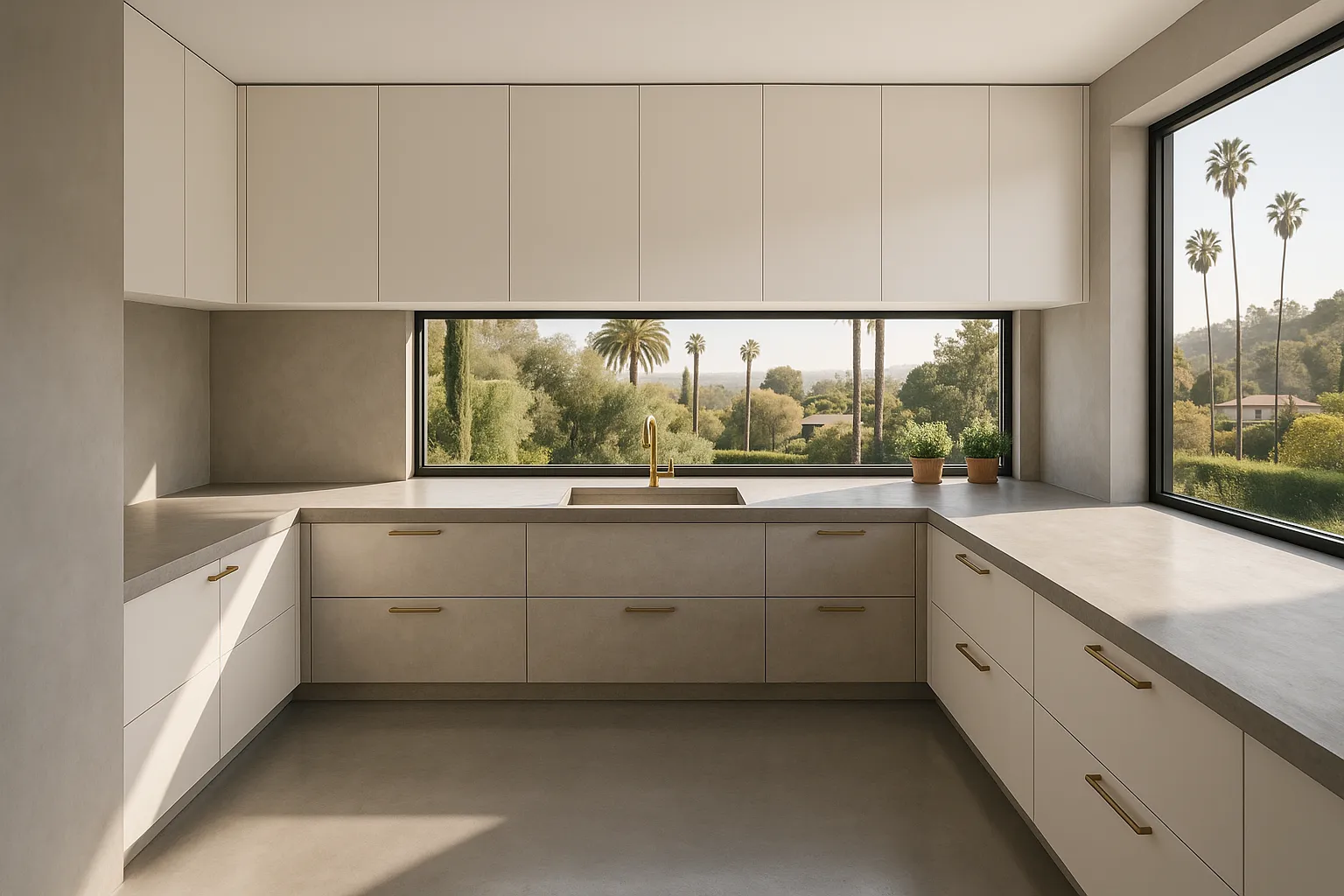
The [microcement kitchens & countertops](/services/microcement-kitchens-countertops) cost CA homeowners are budgeting for in 2026 sits between **$4,500 and $18,000** for most residential projects — but that range hides a lot of detail. Based on Cemora's project data across [Los Angeles](/areas/los-angeles), [Beverly Hills](/areas/beverly-hills), and [Santa Monica](/areas/santa-monica), the average kitchen countertop application runs **$85–$145 per square foot installed**, while full kitchen floor-and-wall systems push into the **$12,000–$22,000** range for mid-size spaces. If you're comparing that against quartz or tile, the numbers look similar on the surface — but the finish, durability, and long-term maintenance story are completely different.
This guide breaks down exactly what drives those costs, what the installation process looks like, and what three real LA-area kitchens actually cost in 2026.
---
## What Is Microcement, Exactly?
What is microcement? Microcement is a polymer-modified cementitious coating, typically **2–3mm thick**, applied directly over existing surfaces — tile, concrete, drywall, or plywood — without demolition. It's not concrete in the traditional sense. It cures into a seamless, waterproof surface that can be sealed to food-safe standards, making it genuinely viable for kitchen countertops, backsplashes, and floors.
The material itself is a blend of Portland cement, fine aggregates, acrylic or epoxy resins, and pigments. That resin content is what separates it from standard skim coat or plaster — it gives microcement its flexibility, adhesion, and water resistance.
What is a mineral surface? In the trade, "mineral surface" refers to any coating where inorganic mineral particles form the structural matrix. Microcement falls into this category alongside Venetian plaster and polished concrete overlays. The distinction matters because mineral surfaces breathe differently than synthetic laminates, which affects how they perform in steam-heavy kitchen environments.

---
## [How Much Does](/estimate) Microcement Kitchens & Countertops Cost in California in 2026?
Let's get specific. The microcement kitchens & countertops cost CA projects typically break into three tiers:
### Entry-Level: Countertops Only
A countertop-only application — 25–40 sq ft of surface — runs **$2,800–$5,500** in the Los Angeles metro in 2026. This covers material, two to three base coats, color coat, and a food-safe polyurethane or epoxy topcoat. Labor accounts for roughly **60–65%** of that total, based on Cemora's internal project data.
### Mid-Range: Countertops + Backsplash
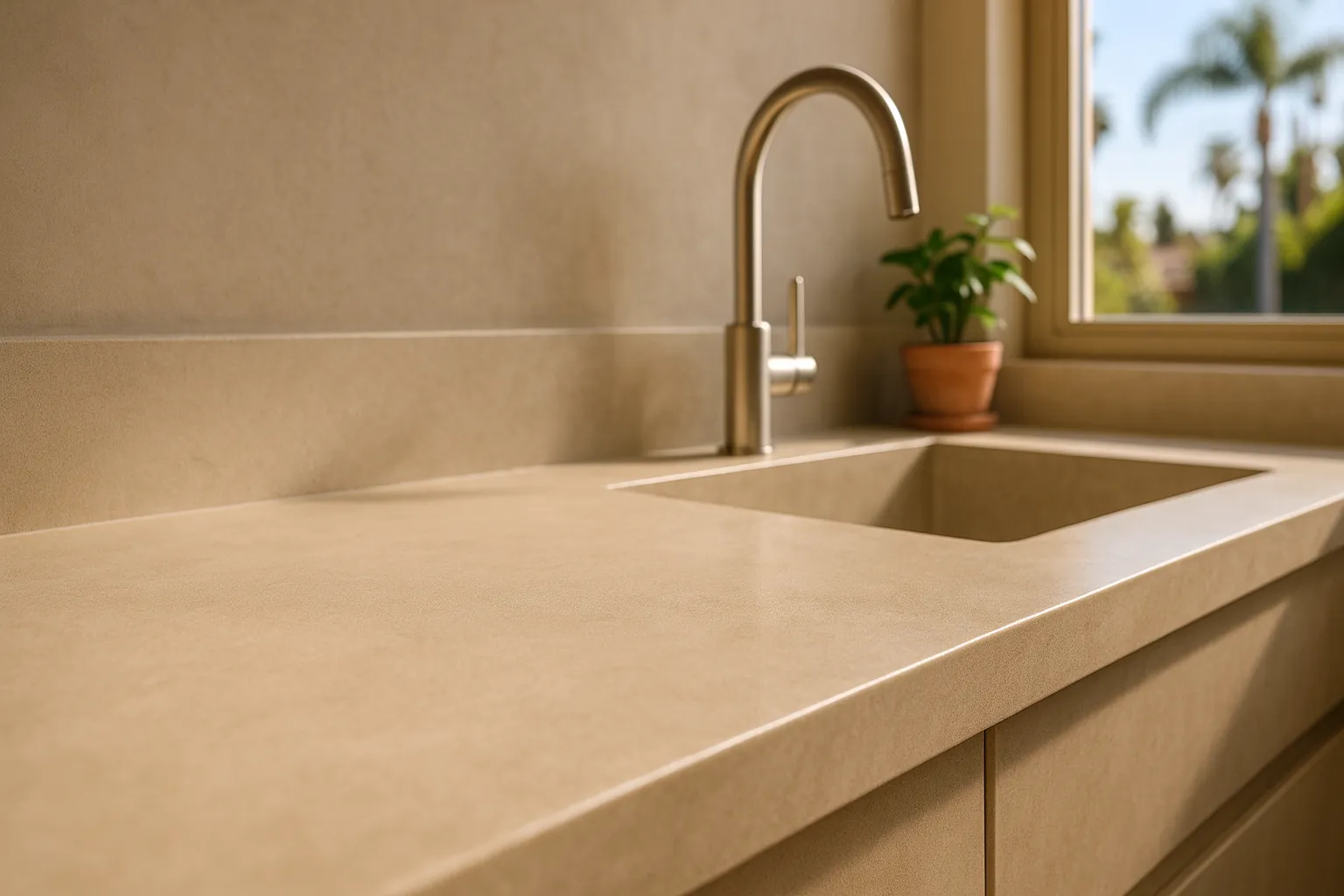
Add a full backsplash — typically 15–25 sq ft — and the project lands at **$4,500–$8,500**. The seam between countertop and backsplash is where most failures happen with inferior applicators. A properly executed cove detail at that junction eliminates grout lines entirely and is one of the defining advantages of microcement over tile.
### Full Kitchen System: Floors, Walls, and Countertops
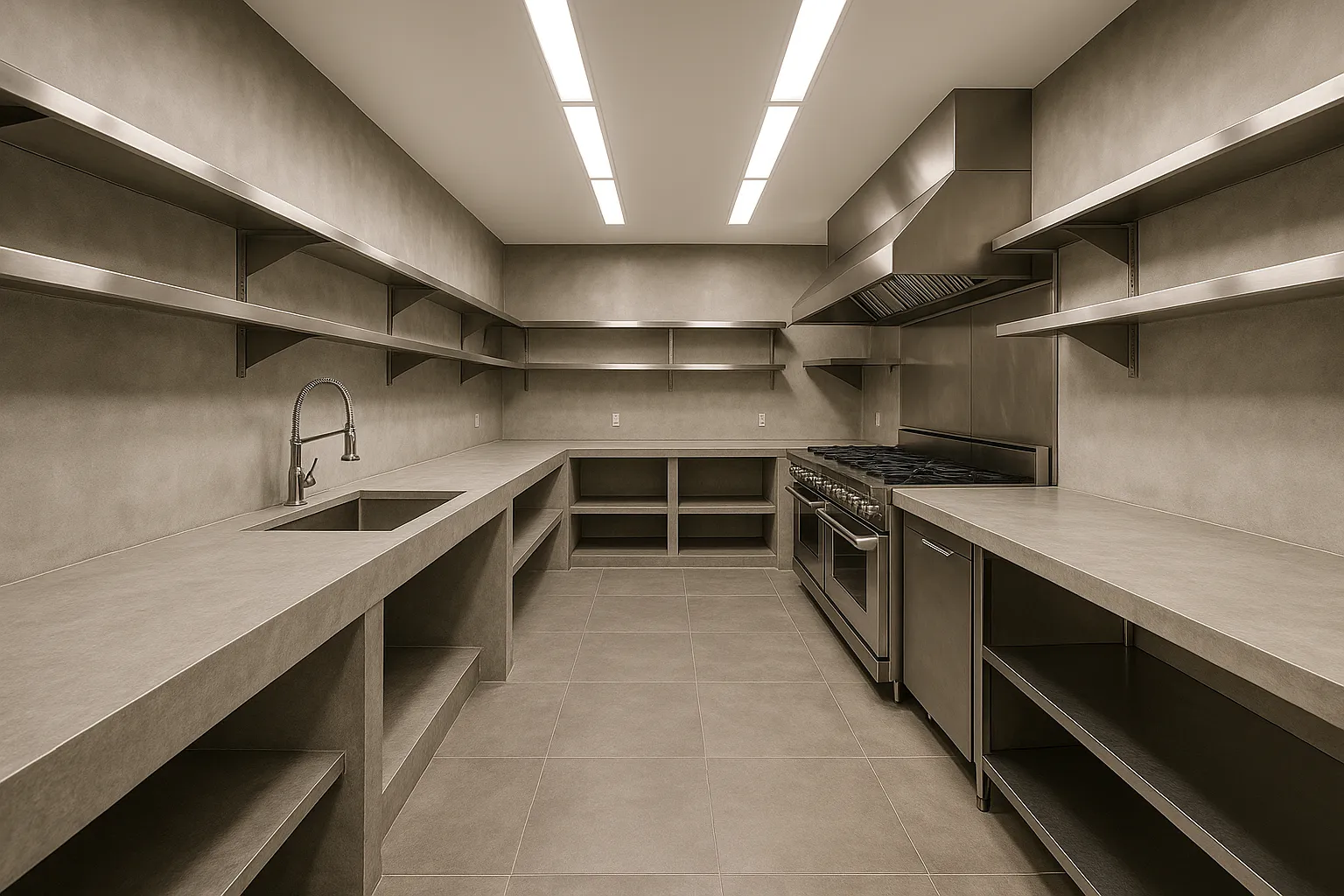
A full kitchen transformation — floors, lower walls, countertops, and island — in a 200–300 sq ft kitchen runs **$12,000–$22,000** in Southern California. [Commercial](/services/microcement-commercial-hospitality) kitchen applications in Beverly Hills and West Hollywood hospitality projects (bars, restaurant pass-throughs, prep counters) typically run **$18,000–$35,000** due to stricter surface prep requirements and heavier-duty sealer systems.
| Application Type | Typical Size | 2026 Cost Range (CA) | Cost Per Sq Ft |
|---|---|---|---|
| Countertop Only | 25–40 sq ft | $2,800–$5,500 | $85–$145 |
| Countertop + Backsplash | 40–65 sq ft | $4,500–$8,500 | $90–$130 |
| Full Kitchen (Floor + Walls + Countertops) | 200–300 sq ft | $12,000–$22,000 | $55–$85 |
| Commercial Kitchen / Hospitality | 300–600 sq ft | $18,000–$35,000 | $55–$95 |
| Island Countertop Only | 15–25 sq ft | $1,800–$3,500 | $95–$145 |
---
## What Drives the Price Up (or Down)?
Not all microcement jobs cost the same, and the variation isn't random. Here are the five factors that move the number most:
### 1. Substrate Condition
Microcement bonds to what's underneath it. If your existing countertops are solid, level, and structurally sound, prep is minimal. If there's flex in the substrate — common with older laminate countertops over particleboard — the applicator needs to add a rigid backer layer. That adds **$300–$900** to the job depending on scope.
### 2. Color Complexity and Layering
Solid, single-tone finishes (warm grays, off-whites, charcoal) are straightforward. Veined or marbled effects that mimic natural stone require additional coats and significantly more hand skill. Expect to add **15–25%** to the base price for decorative layered finishes.
### 3. Sealer Type
What is a topcoat sealer in microcement? It's the final protective layer applied over the color coat — and it determines how the surface performs long-term. Options include:
- **Water-based polyurethane**: most common for residential countertops, **$8–$15/sq ft** added cost
- **Epoxy topcoat**: harder, more chemical-resistant, preferred for commercial kitchens, adds **$12–$22/sq ft**
- **Penetrating sealer**: for floors only, not suitable for food-prep surfaces
For California kitchens, Cemora typically specifies a two-coat water-based polyurethane for residential countertops and a high-build epoxy for any commercial food-service application.
### 4. Number of Coats
A properly applied microcement system is **4–6 layers**: primer, two base coats, color coat, and one to two sealer coats. Some budget applicators skip coats. You won't notice immediately — you'll notice in 18 months when hairline cracks appear at stress points. Industry benchmarks show that **properly layered systems last 10–15 years** before refinishing; under-coated systems often fail within 3–5 years.
### 5. Access and Logistics
A ground-floor kitchen in a Santa Monica bungalow is easy. A high-rise condo in downtown LA with elevator restrictions, parking permits, and HOA material-delivery windows adds **$400–$1,200** in project overhead. This is a real cost that many quotes leave out until you're committed.

---
## Three Real-World Microcement Kitchen Projects in LA (2026)
These are representative projects based on Cemora's 2025–2026 work across Los Angeles County.
### Project 1: Beverly Hills Condo Kitchen Countertop Refresh
A homeowner in Beverly Hills wanted to update a 32 sq ft countertop surface — L-shaped layout, no island — without replacing the existing solid surface substrate underneath. The existing surface was in good condition, so prep was minimal. The scope included two base coats, a warm charcoal color coat, and two coats of water-based polyurethane sealer.
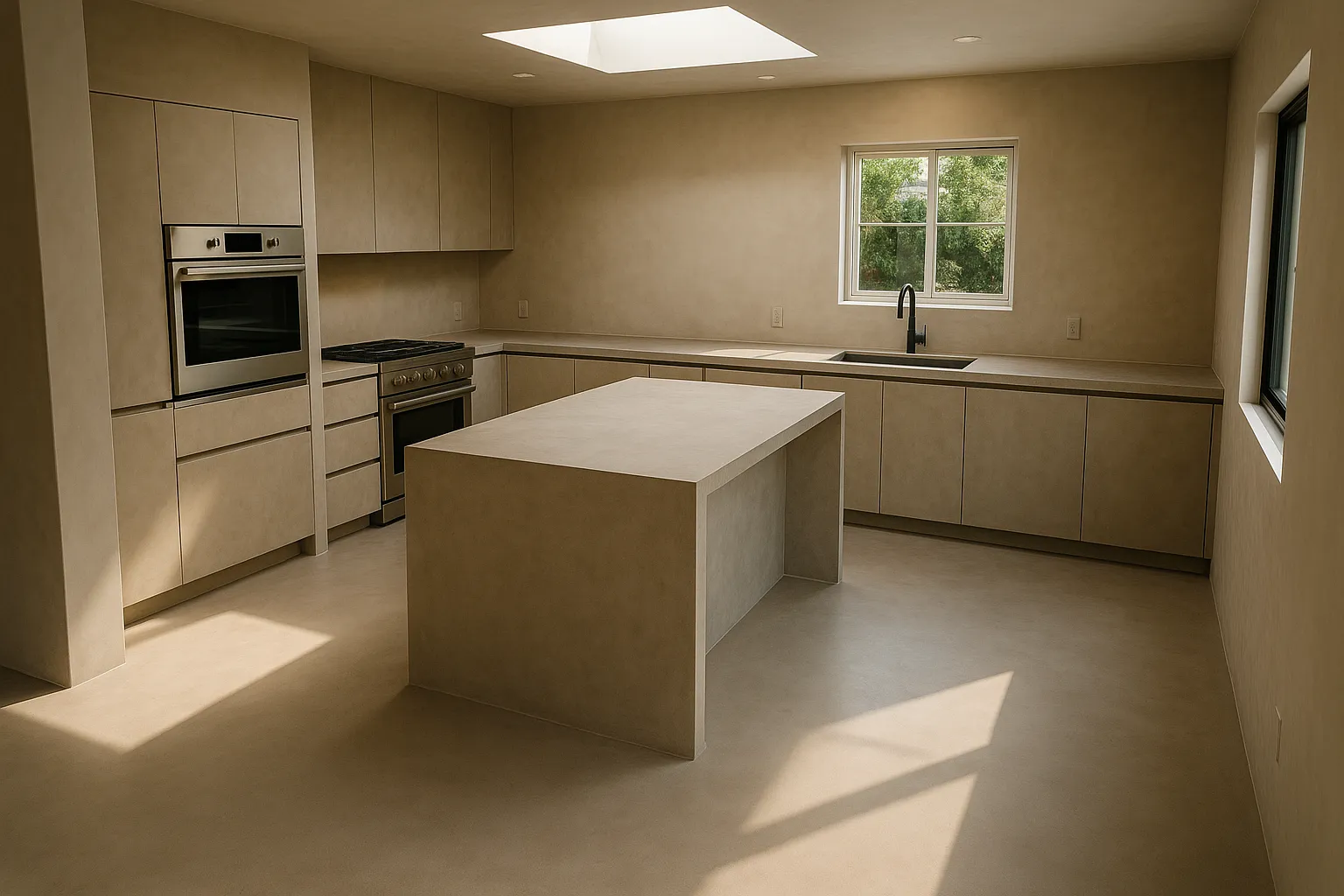
**Total cost: $4,100.** Timeline: **3 days** (day 1 prep and base coats, day 2 color coat, day 3 sealer and cure inspection). The homeowner compared quotes for quartz replacement at **$5,800–$7,200** installed and chose microcement for both cost and the seamless aesthetic.
### Project 2: Santa Monica Kitchen Full Transformation
A full kitchen renovation in Santa Monica covered **210 sq ft** of floor, a 28 sq ft countertop, and a 20 sq ft backsplash — total 258 sq ft. The floor substrate was existing 12x12 ceramic tile in good condition; no removal required. The countertop substrate needed a skim-coat leveling layer before application.
**Total cost: $16,400.** Timeline: **7 working days** across two weeks (allowing for cure time between coats). The client selected a warm sand floor tone with a slightly darker countertop to create visual contrast — a two-tone approach that added approximately **$1,200** over a single-color job.
### Project 3: [Pasadena](/areas/pasadena) Restaurant Pass-Through Counter (Commercial)
A restaurant in Pasadena needed a 45 sq ft pass-through counter refinished to match a new interior design direction. Commercial food-service requirements meant an epoxy topcoat rated for cleaning chemical exposure. Surface prep involved grinding the existing concrete substrate to open the pores for adhesion.
**Total cost: $6,800.** Timeline: **4 days**, with a mandatory **72-hour cure** before the surface could accept food contact. The epoxy topcoat added roughly **$900** over what a residential polyurethane system would have cost on the same square footage. The restaurant's general contractor confirmed the surface passed LA County Health Department inspection on first review.
---
## How Does Microcement Compare to Other Kitchen Surface Options?
Homeowners researching microcement kitchens & countertops cost CA are almost always also looking at quartz, concrete, and tile. Here's how they stack up in 2026:
| Material | Installed Cost (CA, 2026) | Lifespan | Maintenance | Seams |
|---|---|---|---|---|
| Microcement | $85–$145/sq ft | 10–15 yrs (refinishable) | Low (annual seal check) | None |
| Quartz (engineered) | $75–$130/sq ft | 20–25 yrs | Very low | Visible at joints |
| Poured Concrete | $95–$150/sq ft | 15–20 yrs | Medium (sealing) | None |
| Ceramic/Porcelain Tile | $35–$75/sq ft | 20+ yrs | Medium (grout) | Grout lines |
| Natural Stone (marble/granite) | $80–$200/sq ft | 25+ yrs | High (sealing) | Visible at joints |
| Laminate | $20–$45/sq ft | 10–15 yrs | Low | Visible edges |
The honest answer: microcement isn't the cheapest option and it's not the most permanent. What it offers that nothing else does is **seamlessness at a mid-range price point** with the ability to be refinished in place rather than torn out. For a kitchen that's being renovated without a full gut, that matters a lot.
"Microcement sits in a unique position in the market," says the NAHB's 2025 Remodeling Market Index report. "It delivers the aesthetic of poured concrete without the structural requirements, and the refinishability factor is increasingly important to homeowners who don't want to commit to a permanent material choice."
---
## What Is the Installation Process for Microcement Countertops?
What is the microcement installation process? Here's the step-by-step sequence Cemora follows on every kitchen countertop project:
1. **Surface Assessment** — Check substrate for flex, moisture, and adhesion compatibility. Any movement in the substrate must be addressed before application begins.
2. **Surface Preparation** — Clean, degrease, and mechanically abrade the existing surface. For tile, grout lines are filled with a leveling compound.
3. **Primer Application** — One to two coats of adhesion primer, allowed to cure **4–6 hours**.
4. **First Base Coat** — Applied with a steel trowel at approximately 1mm thickness. Allowed to cure **12–24 hours**.
5. **Second Base Coat** — Builds thickness and begins to establish the final texture. Cure: **12–24 hours**.
6. **Color Coat** — The finish layer that determines the final tone and texture. Applied in thin, overlapping passes. Cure: **24 hours**.
7. **First Sealer Coat** — Applied by roller or sprayer. Allowed to cure **4–8 hours** before light use.
8. **Second Sealer Coat** — Final protection layer. Full cure: **48–72 hours** before normal kitchen use, **7 days** before heavy use or cleaning with chemicals.
Total timeline for countertops only: **3–4 days** on-site. Full kitchen systems: **6–10 working days**, depending on square footage and coat cure scheduling.

---
## How Long Does Microcement Last in a Kitchen Environment?
Kitchens are hard on surfaces. Heat, moisture, acidic foods, cleaning chemicals — it's one of the most demanding environments in a home. Here's what to realistically expect:
**With proper sealing and maintenance**, a microcement countertop in a residential kitchen should last **10–15 years** before any refinishing is needed. The sealer is the critical variable — it's the sealer that faces daily abuse, not the microcement itself.
Annual maintenance is simple: a light sanding with **220-grit paper** and a fresh coat of sealer, which costs roughly **$300–$600** as a professional service or can be DIY'd with the right product. That annual attention extends the life of the finish dramatically.
For floors, the story is similar. A properly sealed microcement floor in a residential kitchen — with **felt pads on furniture** and regular pH-neutral cleaning — holds up well for **10–15 years**. High-traffic commercial floors may need a sealer refresh every **2–3 years**.
A 2025 Houzz State of the Home report found that **38% of homeowners** who chose microcement for kitchen surfaces cited "low long-term maintenance" as a primary factor, second only to aesthetics.
---
## Why Is Microcement Gaining Traction in California Kitchens Right Now?
The microcement kitchens & countertops cost CA conversation is happening more often in 2026 for a few specific reasons.
First, **California's renovation culture** leans heavily toward seamless, minimalist aesthetics — the kind that photograph well and align with the indoor-outdoor lifestyle that defines LA living. Grout lines and visible seams work against that.
Second, **the renovation-over-replacement trend** is accelerating. With construction costs up roughly **4% year-over-year** from 2025 to 2026 (based on BLS construction wage data and materials index tracking), homeowners are looking for ways to transform spaces without full gut renovations. Microcement applied over existing tile or laminate is exactly that.
Third, **the commercial hospitality sector** in Los Angeles — hotels, restaurants, boutique retail — has been an early adopter. When hospitality designers in Beverly Hills and West Hollywood specify microcement for bar tops and kitchen pass-throughs, residential clients in those same neighborhoods notice. Cemora's [commercial and hospitality microcement](/services/microcement-commercial-hospitality?utm_source=blog&utm_medium=organic&utm_campaign=microcement-kitchens-countertops-cost-ca) work has directly influenced residential inquiries in the same zip codes.
Fourth, California's **strict VOC regulations** (among the tightest in the US) have pushed the market toward water-based microcement systems that are genuinely low-emission. This matters to health-conscious homeowners in Santa Monica and Pasadena who are already buying low-VOC paints and formaldehyde-free cabinetry.
---
## Is Microcement Right for Your Kitchen? Honest Considerations
Microcement isn't perfect for every kitchen. Here's the honest breakdown:
**Microcement works best when:**
- You want a seamless, grout-free surface
- The existing substrate is structurally sound
- You're comfortable with annual maintenance (one sealer check per year)
- You want a custom color that standard materials can't deliver
- You're renovating a rental or commercial space where speed and minimal disruption matter
**Consider alternatives if:**
- Your substrate has significant flex or moisture issues (fix those first)
- You want a completely maintenance-free surface for the next 20 years (quartz is more forgiving)
- Your budget is under $2,500 for countertops (the quality won't be there at that price point)
- You cook with heavy cast iron and regularly drag pots across the counter (microcement can scratch; so can most surfaces, but this matters)
For [microcement bathrooms and wet rooms](/services/microcement-bathrooms?utm_source=blog&utm_medium=organic&utm_campaign=microcement-kitchens-countertops-cost-ca), the calculus is slightly different — bathrooms are actually an easier environment for microcement because they see less mechanical abrasion than kitchens. If you're considering both spaces, the bathroom is often the better starting point.
For [microcement floors and walls](/services/microcement-floors-walls?utm_source=blog&utm_medium=organic&utm_campaign=microcement-kitchens-countertops-cost-ca) beyond the kitchen, the same principles apply — substrate condition and sealer choice drive both performance and longevity.

---
## How to Get an Accurate Quote for Your Kitchen Project
Most microcement quotes that come in wildly low are missing one of three things: substrate prep costs, sealer system costs, or the number of coats. Here's how to make sure you're comparing apples to apples:
**Ask every applicator:**
1. How many coats of base coat are included?
2. What sealer system do you use, and is it food-safe?
3. Is substrate preparation included in the price?
4. What's your warranty on the finish?
5. Can I see a completed project in a similar kitchen environment?
A reputable studio — like Cemora — will answer all five without hesitation and will offer a physical sample board so you can see the actual finish in your lighting conditions before committing.
If you're ready to get specific numbers for your kitchen, [request a free estimate](/estimate?utm_source=blog&utm_medium=organic&utm_campaign=microcement-kitchens-countertops-cost-ca) and we'll assess your substrate, scope, and finish preferences before giving you a number. You can also [book a consultation](/book?utm_source=blog&utm_medium=organic&utm_campaign=microcement-kitchens-countertops-cost-ca) to see material samples and discuss design options in person.
For [microcement kitchens and countertops](/services/microcement-kitchens-countertops?utm_source=blog&utm_medium=organic&utm_campaign=microcement-kitchens-countertops-cost-ca) specifically, we work across Los Angeles, Beverly Hills, Santa Monica, Pasadena, and [Glendale](/areas/glendale) — and we're happy to walk through a project scope over the phone before any site visit.
---
## Frequently Asked Questions
### How much does microcement kitchen countertop installation cost in California in 2026?
Based on Cemora's 2026 project data across Los Angeles County, microcement countertop installation runs **$85–$145 per square foot installed**, or roughly **$2,800–$5,500** for a typical 25–40 sq ft countertop. Full kitchen systems including floors, walls, and countertops range from **$12,000–$22,000** for 200–300 sq ft spaces. Commercial applications with epoxy topcoats run higher — typically **$55–$95 per square foot** at scale.
### How long does microcement last on kitchen countertops?
A properly installed and sealed microcement countertop in a residential kitchen lasts **10–15 years** before refinishing is needed. The sealer is the critical variable — the microcement itself is durable, but the topcoat takes the daily abuse. Annual maintenance (a sealer check and touch-up if needed) extends the life significantly and costs **$300–$600** as a professional service.
### Is microcement safe for food-contact surfaces?
Yes, when sealed with a food-safe polyurethane or epoxy topcoat. The microcement material itself is inert once cured, but the sealer must be rated for food contact. Cemora specifies water-based polyurethane sealers for residential kitchen countertops and high-build epoxy for commercial food-service applications. Always confirm the sealer specification with your applicator — not all sealers are food-safe.
### How does microcement countertop cost compare to quartz in California?
In California in 2026, quartz countertops run **$75–$130 per square foot installed**, while microcement runs **$85–$145 per square foot**. They're comparable in price, but the value proposition differs: quartz requires no annual maintenance and has a longer lifespan, while microcement offers seamless integration, custom color matching, and refinishability without replacement. For kitchens where aesthetics and grout-free surfaces are priorities, microcement often wins despite the slightly higher entry cost.
### How long does microcement kitchen installation take?
A countertop-only project takes **3–4 days** on-site, including cure time between coats. A full kitchen system — floors, walls, and countertops — takes **6–10 working days**, typically spread across two weeks to allow proper cure time between layers. The surface needs **48–72 hours** after the final sealer coat before normal kitchen use, and **7 full days** before exposure to cleaning chemicals or heavy mechanical use.
### Can microcement be applied over existing tile in a kitchen?
Yes — this is one of microcement's most significant advantages. Cemora regularly applies microcement over existing ceramic and porcelain tile without removal. The tile must be structurally sound, well-adhered, and level. Grout lines are filled with a leveling compound before application. Skipping demolition saves **$800–$2,500** in tile removal and disposal costs on a typical kitchen project.
### Does microcement scratch or stain in kitchen environments?
Microcement can scratch with sharp objects and can stain if acidic liquids (lemon juice, vinegar, red wine) are left in contact for extended periods without the sealer being in good condition. The sealed surface is water-resistant and reasonably stain-resistant under normal use. Cutting boards are recommended — the same advice applies to quartz and natural stone. With a well-maintained sealer, everyday kitchen use does not meaningfully degrade the surface.
### What is the difference between microcement and polished concrete for kitchens?
What is polished concrete? Polished concrete is a process applied to an existing concrete slab — grinding and polishing the concrete itself to a smooth finish. It requires a concrete substrate. Microcement is a coating that can be applied over virtually any stable substrate — tile, plywood, existing countertop materials — at **2–3mm thickness**. For kitchens without a concrete substrate, microcement is the practical choice. Polished concrete runs **$3–$12 per square foot** for floors but cannot be applied to countertops without a poured concrete base.
### Are there California-specific regulations affecting microcement kitchen installations?
California's VOC (volatile organic compound) regulations under CARB (California Air Resources Board) are among the strictest in the US. Cemora uses water-based, CARB-compliant microcement systems throughout LA County. For commercial food-service installations, LA County Department of Public Health requires food-contact surfaces to meet NSF/ANSI 51 standards — the epoxy topcoat systems Cemora specifies for commercial kitchens are rated to this standard. Residential installations do not require permits in most LA jurisdictions.
### How do I maintain a microcement kitchen countertop?
Daily maintenance is simple: clean with a pH-neutral cleaner and a soft cloth. Avoid abrasive scrubbers and acidic cleaners (vinegar-based products). Once a year, inspect the sealer by placing a few drops of water on the surface — if the water beads, the sealer is intact; if it absorbs, it's time for a sealer refresh. A professional sealer refresh costs **$300–$600** for a typical countertop, or can be DIY'd with the correct product. This annual check is the single most important maintenance step for long-term performance.
---
The microcement kitchens & countertops cost CA question doesn't have a single answer — it has a range, and where your project lands in that range depends on substrate condition, scope, finish complexity, and sealer specification. What the numbers consistently show is that microcement competes directly with quartz and concrete on price while offering something neither delivers: a completely seamless, grout-free surface that can be refinished in place rather than replaced.
If you're weighing the options for a kitchen renovation in Los Angeles, Beverly Hills, Santa Monica, or anywhere across LA County, the most useful next step is a site assessment — not another quote from a contractor who hasn't seen your substrate. [Contact Cemora](/contact?utm_source=blog&utm_medium=organic&utm_campaign=microcement-kitchens-countertops-cost-ca) to start that conversation, or [book a consultation](/book?utm_source=blog&utm_medium=organic&utm_campaign=microcement-kitchens-countertops-cost-ca) to see material samples and get a realistic scope for your specific kitchen.
---
**Ready to start your your project in Los Angeles?** [Book a free consultation](/book?utm_source=blog&utm_medium=organic&utm_campaign=microcement-kitchens-countertops-cost-ca-what-to-expect-in-2026) — we'll come walk through your space and give you straight numbers, no pressure. Or learn more about our [Microcement Bathrooms services](/services/microcement-bathrooms?utm_source=blog&utm_medium=organic&utm_campaign=microcement-kitchens-countertops-cost-ca-what-to-expect-in-2026).