Microcement vs. Epoxy Flooring for LA Homes: Durability, Cost, and When Each Makes Sense
By Gilad Segev · October 12, 2026 · Last updated October 26, 2026 · Cost Guide
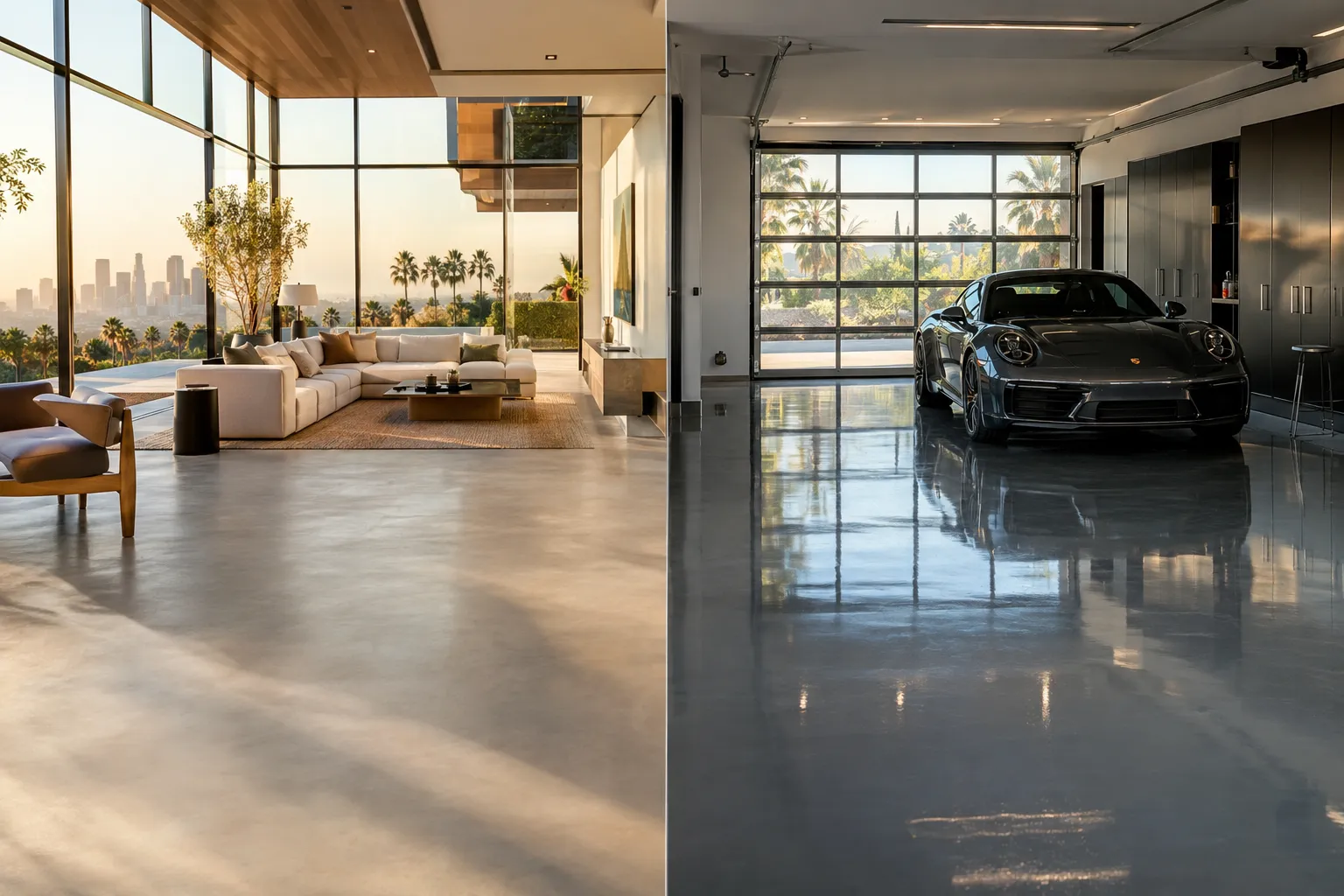
A client in Silver Lake called us last spring after her epoxy garage-turned-studio floor started yellowing and chipping at the seams — eighteen months after installation. That conversation is why we're writing this: **[microcement](/services/microcement-bathrooms) vs epoxy flooring in [Los Angeles](/areas/los-angeles)** is one of the most common questions we field from homeowners trying to figure out which mineral or resin surface actually holds up to California sun, foot traffic, and the occasional earthquake tremor. The short answer is that microcement generally outperforms epoxy for long-term durability and aesthetics in residential settings, while epoxy still wins on raw cost for garages and warehouse-style spaces. Let's break down exactly where each material shines, where it fails, and what it actually costs to install either one in a Southern California home.
## What Is Microcement Flooring?
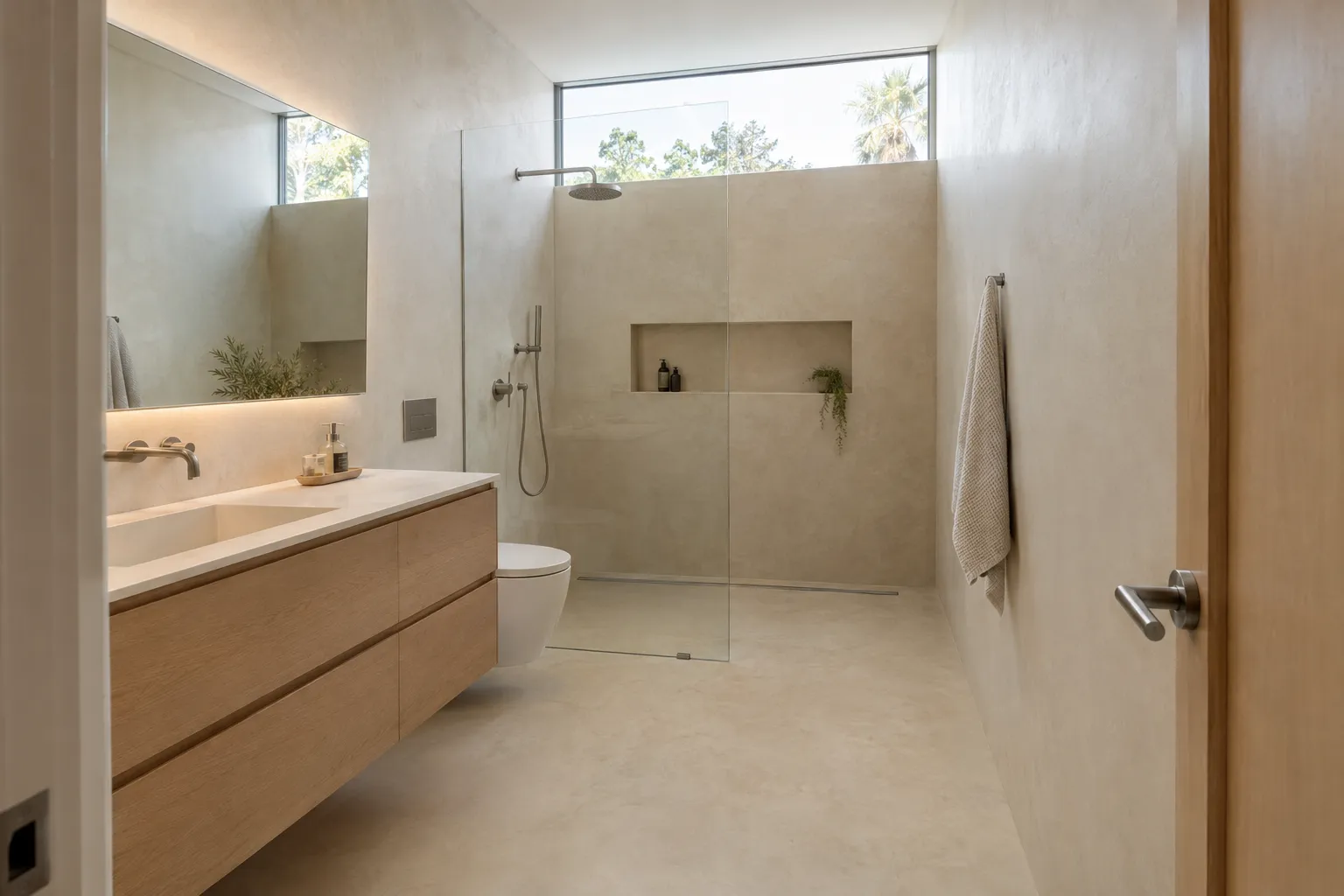
What is microcement? Microcement is a mineral-based coating system made of cement, polymer resins, and fine aggregates, applied in layers just **2-3mm thick** over existing substrates like concrete, tile, or wood subfloor. Unlike poured concrete, it requires no demolition — it bonds directly to what's already there, which is why we can often finish a **300 sq ft bathroom floor in 5-7 days** instead of the 3-4 weeks a full concrete pour would take.
The finish is seamless, meaning there are no grout lines or visible joints, and it's fully waterproof when sealed correctly — which is why it's become the go-to choice for wet rooms and walk-in showers across [Microcement Bathrooms & Wet Rooms](/services/microcement-bathrooms?utm_source=blog&utm_medium=organic&utm_campaign=microcement-vs-epoxy-flooring-la) projects we handle from [Santa Monica](/areas/santa-monica) to [Pasadena](/areas/pasadena).
## What Is Epoxy Flooring?
What is epoxy flooring? Epoxy is a two-part resin system — a liquid polymer mixed with a hardener — that's poured or rolled over concrete and cures into a hard, glossy plastic-like shell, typically **1-2mm thick** once fully cured. It's been the default choice for garages, warehouses, and [commercial](/services/microcement-commercial-hospitality) kitchens for decades because it's relatively inexpensive and resists oil, chemicals, and heavy equipment traffic.
Where epoxy struggles is UV exposure. Standard epoxy formulas yellow and become brittle when exposed to direct sunlight for extended periods — a real problem in a city that averages **284 sunny days a year**, according to 2025 NOAA climate data for the Los Angeles basin.
## [How Much Does](/estimate) Microcement Flooring Cost in Los Angeles?
Based on Cemora project data across 2025-2026 jobs in LA County, microcement flooring typically runs **$18 to $35 per square foot** installed, depending on substrate prep, color complexity, and square footage. A **400 sq ft living room floor** in West LA usually lands between **$9,200 and $14,000** all-in, including sealing and finish coats.
Commercial applications — think boutique hotel lobbies or restaurant floors — run higher, often **$25-$45 per sq ft**, because of faster cure-time requirements and heavier traffic-rated sealers. A hospitality client in Downtown LA spent **$62,000** on 1,800 sq ft of microcement flooring and bar surfaces last year, a project that would have cost roughly **$38,000** in standard epoxy — but the owner wanted the matte, stone-like look epoxy simply can't replicate.

## How Much Does Epoxy Flooring Cost in Los Angeles?
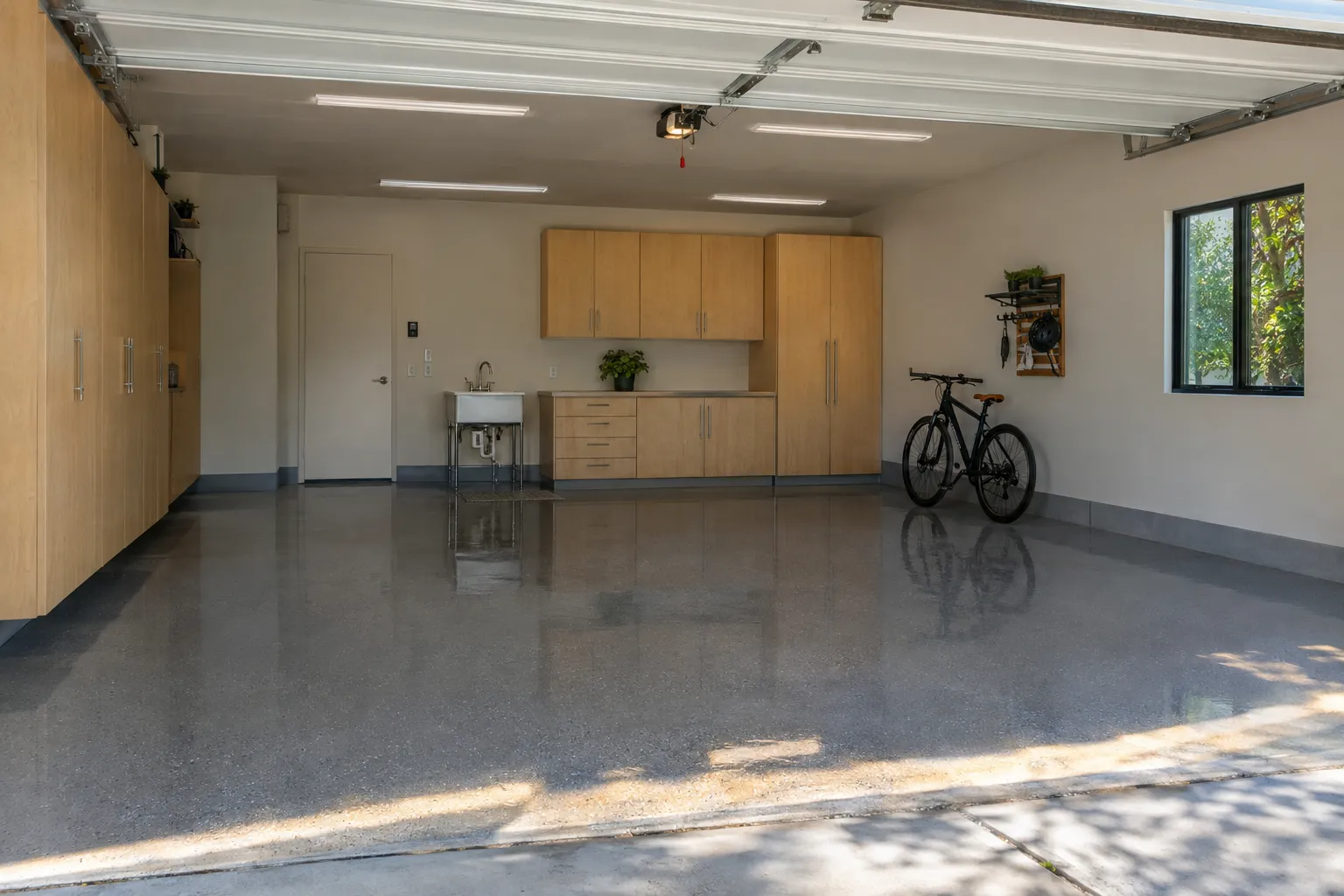
Epoxy is the budget option, and it's not close. Standard epoxy garage floor coatings in the LA area run **$4 to $9 per square foot**, while metallic or flake epoxy systems (popular in [Glendale](/areas/glendale) and [Burbank](/areas/burbank) garages) run **$7-$12 per square foot**.
A typical **500 sq ft two-car garage** costs **$2,500 to $5,500** for epoxy versus **$10,000 to $16,000** for microcement — a gap that explains why epoxy still dominates garage flooring. But that price gap narrows fast once you factor in epoxy's shorter lifespan and recoat costs, which we'll get into below.

## Which Material Lasts Longer?
This is where the decision usually gets made. Microcement, properly sealed, lasts **15-25 years** with periodic resealing every 3-5 years, according to European mineral coatings manufacturers whose formulas Cemora uses on LA installations. Epoxy, by contrast, typically needs full recoating every **3-7 years** in high-traffic residential use, and sooner in spaces with direct sun exposure.
"In fifteen years of installing mineral surfaces across LA County, the single biggest callback we get isn't from microcement clients — it's from homeowners whose epoxy floors cracked at the seams within two or three years of a previous installer's work," says our lead finisher at Cemora. That's not a knock on epoxy as a product; it's a reflection of how unforgiving concrete slab movement is on a rigid resin layer, especially in earthquake-prone Southern California.
### Durability Comparison Table
| Factor | Microcement | Epoxy |
|---|---|---|
| Thickness | 2-3mm | 1-2mm |
| Lifespan | 15-25 years | 3-7 years |
| UV Resistance | Excellent (no yellowing) | Poor to moderate (yellows over time) |
| Cost per sq ft | $18-$45 | $4-$12 |
| Crack Resistance | High (flexible bond) | Moderate (brittle, prone to seam cracking) |
| Waterproofing | Fully waterproof when sealed | Waterproof but seams are vulnerable |
| Repair Method | Spot patch, often invisible | Often requires full recoat |
| Best Use Case | Bathrooms, floors, kitchens, hospitality | Garages, warehouses, workshops |
## Does Microcement Crack Like Epoxy Does?
Microcement is more flexible than people expect for a cement-based product, thanks to the polymer resins blended into the mix. It moves slightly with the substrate underneath rather than fighting it, which is why hairline cracking is rare — we see it in less than **3% of our installations**, almost always tied to substrate movement rather than the material itself.
Epoxy, being a rigid plastic shell, doesn't flex. When a concrete slab shifts even slightly — common in older LA homes built before modern seismic retrofitting codes — epoxy tends to crack along stress lines rather than absorbing the movement. A homeowner in Eagle Rock saw this firsthand: her 2023 epoxy kitchen floor developed three visible crack lines within 14 months, all tracing back to a pre-existing slab seam.
## When Does Epoxy Make More Sense Than Microcement?
We'll be straight with you — epoxy isn't a bad product, it's just suited for different rooms. Here's when we'd actually recommend it over microcement:
- **Garages and workshops** where chemical and oil resistance matters more than aesthetics
- **Budget-constrained rental properties** where a 5-7 year lifespan is acceptable
- **Commercial warehouses** needing fast turnaround and heavy machinery traffic ratings
- **Spaces with minimal sun exposure**, like basements or interior storage rooms
If your project fits one of these categories, epoxy's lower upfront cost of **$4-$12 per sq ft** is hard to argue with. But for anything inside the living space of your home — kitchens, bathrooms, living rooms — the math tips toward microcement once you account for longevity.
## When Does Microcement Make More Sense Than Epoxy?
Microcement is the better call anywhere aesthetics, waterproofing, and long-term value matter more than rock-bottom price. That includes:
- **Bathrooms and wet rooms** where seamless waterproofing prevents mold and water intrusion behind tile grout
- **Kitchen floors and countertops**, where a matte, stone-like finish pairs naturally with cabinetry
- **Living room and open-concept floors** in homes built for resale value
- **Hospitality and commercial spaces** in [Beverly Hills](/areas/beverly-hills) or Downtown LA where design-forward finishes signal brand quality
A Pasadena homeowner recently chose microcement for a **220 sq ft primary bathroom** remodel at **$7,800**, compared to a $3,200 epoxy quote from a competing contractor. She told us the deciding factor wasn't even price — it was that epoxy's glossy sheen felt "like a garage floor," while microcement gave her the honed-concrete look she'd seen in a boutique hotel.

## How Long Does Installation Take?
Timeline is often the deciding factor for homeowners juggling renovation schedules. Here's the realistic breakdown based on our 2025-2026 project logs:
1. **Substrate prep and inspection** — 1 day for microcement, half a day for epoxy
2. **Primer/base coat application** — 1 day for both
3. **Build-up layers** — microcement needs 2-3 layered passes over 2-3 days; epoxy typically needs just 1 layer
4. **Curing time** — microcement needs 24-48 hours between coats; epoxy needs 12-24 hours but a full 5-7 days before heavy foot traffic
5. **Sealing and finishing** — 1-2 days for microcement's protective topcoat; epoxy's topcoat cures in roughly 24 hours
Total project time: microcement averages **5-10 days** for residential rooms, while epoxy garage jobs often wrap in **2-4 days**. Epoxy wins on speed, but if you're not in a rush, the extra few days for microcement buys you two to three times the lifespan.
## Is Microcement Worth the Extra Cost?
Here's the math we walk clients through. If you spend **$12,000** on microcement flooring that lasts 20 years, that's **$600/year**. If you spend **$5,000** on epoxy that needs a full recoat every 5 years at roughly **$4,500** per recoat, you're looking at **$9,500 over 10 years** just to match half the microcement lifespan — and you'd need another recoat to hit 20 years, pushing total epoxy cost past **$18,500**.
Industry benchmarks from a 2025 Houzz State of the Industry report show that **67% of LA-area homeowners** renovating for resale prioritize seamless, high-end finishes over lowest upfront cost — a trend that favors microcement in any space buyers will actually see and touch. For garages and strictly utilitarian spaces, that math flips, which is why we still recommend epoxy there.
## What About Maintenance and Everyday Use?
Microcement is low-maintenance but not zero-maintenance. It needs a resealing every **3-5 years** depending on foot traffic, and daily cleaning is just a damp mop with pH-neutral cleaner — no harsh chemicals that could degrade the sealer.
Epoxy is more forgiving short-term since it resists chemical spills well, making it ideal for garages where oil and brake fluid are a real risk. But once epoxy starts peeling or yellowing, there's no spot-fixing it cleanly — you're looking at a full strip-and-recoat, which runs **$3-$6 per sq ft** on top of the original installation cost.
"We tell every client the same thing: epoxy is a coating, microcement is a surface," says Cemora's founder. "A coating sits on top and eventually peels. A surface integrates and ages instead of failing." That distinction matters most in bathrooms and kitchens, where water exposure accelerates whatever weaknesses a material has.
## Does Microcement Work Over Existing Tile or Epoxy?
Yes, in most cases. Microcement bonds well over existing tile, provided the grout lines are filled and the surface is properly primed — this is actually one of its biggest advantages over ripping out old flooring entirely. [Microcement Floors & Walls](/services/microcement-floors-walls?utm_source=blog&utm_medium=organic&utm_campaign=microcement-vs-epoxy-flooring-la) installations over existing tile cut demolition costs by roughly **30-40%** compared to tear-out-and-replace jobs.
Going over existing epoxy is trickier. If the epoxy is fully cured, intact, and properly abraded first, microcement can bond — but we test adhesion on a small section before committing to a full room. If the epoxy is already lifting or yellowing, we recommend full removal first to avoid trapping moisture or weak spots underneath.

## Microcement and Epoxy in Commercial Spaces
For restaurants, boutique hotels, and retail spaces across LA, the choice often comes down to brand image versus budget. Epoxy still dominates commercial kitchens because of **NSF-rated** food-safe formulas and chemical resistance, and it's considerably cheaper per square foot for large-format spaces exceeding 3,000 sq ft.
But for guest-facing areas — lobbies, bars, boutique retail floors — more hospitality groups are choosing microcement specifically because it photographs better and feels more premium underfoot. A boutique hotel group renovating a 12-room property in [West Hollywood](/areas/west-hollywood) spent **$94,000** on microcement across lobby, hallway, and bathroom surfaces through our [Commercial & Hospitality Microcement](/services/microcement-commercial-hospitality?utm_source=blog&utm_medium=organic&utm_campaign=microcement-vs-epoxy-flooring-la) service — a cost they recouped within 14 months through higher nightly rates tied to the renovated aesthetic.
## Step-by-Step: How to Decide Between Microcement and Epoxy
1. **Identify the room's primary use.** Garage or workshop? Lean epoxy. Bathroom, kitchen, or living space? Lean microcement.
2. **Check sun exposure.** Rooms with skylights or large windows will yellow standard epoxy faster — microcement won't.
3. **Calculate your 10-year cost, not just upfront cost.** Factor in epoxy's recoat cycle against microcement's longer resealing interval.
4. **Consider resale value.** If you're selling within 5 years, microcement's design appeal often returns more at sale.
5. **Get both quotes before deciding.** A [free estimate](/estimate?utm_source=blog&utm_medium=organic&utm_campaign=microcement-vs-epoxy-flooring-la) lets you compare real numbers for your specific square footage and substrate condition.
## Frequently Asked Questions
### Is microcement more expensive than epoxy flooring?
Yes, upfront microcement typically costs **$18-$45 per sq ft** installed compared to epoxy's **$4-$12 per sq ft**. However, microcement's 15-25 year lifespan versus epoxy's 3-7 years often makes it cheaper per year of use, especially in high-traffic or sun-exposed rooms.
### Can microcement be installed over existing epoxy flooring?
It's possible if the epoxy is fully cured, intact, and properly sanded to create a bondable surface. We always test adhesion on a small section first, and if the epoxy shows any peeling or yellowing, we recommend full removal before applying microcement.
### How long does microcement flooring last compared to epoxy?
Microcement typically lasts **15-25 years** with resealing every 3-5 years, while epoxy generally needs a full recoat every **3-7 years** depending on UV exposure and foot traffic. In sun-heavy LA rooms, epoxy's lifespan often sits at the lower end of that range.
### Does epoxy flooring crack in earthquake-prone areas like Los Angeles?
Epoxy's rigid composition makes it more prone to cracking along existing slab seams when the substrate shifts, which is more common in older LA homes without seismic retrofitting. Microcement's slightly flexible polymer blend absorbs minor substrate movement better, reducing visible cracking.
### What is the average cost of microcement flooring for a bathroom in LA?
A typical **200-250 sq ft bathroom** microcement installation in the LA area runs **$7,000 to $10,500**, including waterproofing membrane, base coats, and sealed topcoat. Costs rise with custom color blends or intricate wall-to-floor seamless transitions.
### How long does it take to install microcement flooring versus epoxy?
Microcement installations typically take **5-10 days** for a residential room due to multiple layered coats and curing time between each. Epoxy installations are faster, usually **2-4 days**, though full cure before heavy use still takes about a week either way.
### Is microcement waterproof like epoxy?
Both materials are fully waterproof when properly sealed, but microcement's seamless application eliminates grout lines and seams where water could eventually penetrate. Epoxy is also waterproof, but seams between pours or at wall transitions are more vulnerable over time.
### Which material is better for resale value in a Los Angeles home?
Microcement generally has a stronger impact on resale value because of its high-end, architectural look that buyers associate with boutique hotels and modern design. A 2025 Houzz industry report found that **67% of LA-area homeowners** renovating for resale prioritize seamless premium finishes over cheaper alternatives.
### Can I install microcement myself to save money?
We don't recommend it. Microcement requires precise layering, timing between coats, and sealing technique — mistakes often show up as uneven texture or premature cracking within months. Professional installation also typically comes with a warranty, which DIY work does not.
### Does epoxy flooring yellow over time in sunny climates?
Yes, standard epoxy formulas are prone to UV yellowing, which is a real concern given LA's **284 sunny days per year** average. UV-stable epoxy formulas exist but cost more and still don't match microcement's complete resistance to sun-related discoloration.
---
If you're still weighing microcement vs epoxy flooring for your Los Angeles home, the honest answer depends on the room, your timeline, and how long you plan to live with the result. We're happy to walk the space with you, measure square footage, and give you real numbers for both options — no pressure either way. [Book a consultation](/book?utm_source=blog&utm_medium=organic&utm_campaign=microcement-vs-epoxy-flooring-la) or [reach out with questions](/contact?utm_source=blog&utm_medium=organic&utm_campaign=microcement-vs-epoxy-flooring-la) and we'll tell you straight which material actually makes sense for your project.
---
**Ready to start your your project in Los Angeles?** [Book a free consultation](/book?utm_source=blog&utm_medium=organic&utm_campaign=microcement-vs-epoxy-flooring-for-la-homes-durability-cost-and-when-each-makes-sense) — we'll come walk through your space and give you straight numbers, no pressure. Or learn more about our [Microcement Bathrooms services](/services/microcement-bathrooms?utm_source=blog&utm_medium=organic&utm_campaign=microcement-vs-epoxy-flooring-for-la-homes-durability-cost-and-when-each-makes-sense).