Microcement vs Epoxy Flooring Los Angeles: Which Holds Up Better in Our Climate (2026 Guide)
By Gilad Segev · August 31, 2026 · Last updated September 7, 2026 · Design
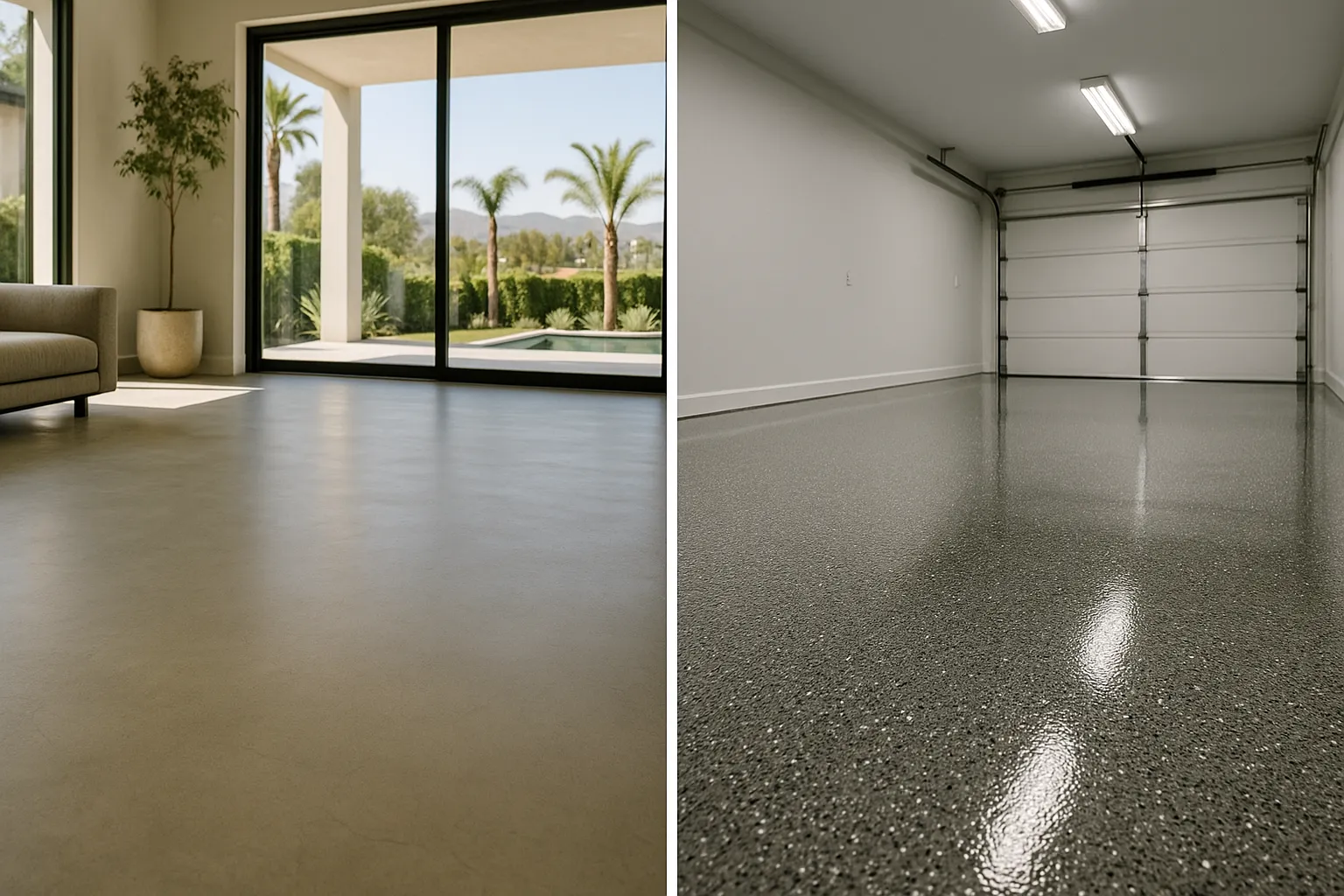
# [Microcement](/services/microcement-bathrooms) vs Epoxy Flooring [Los Angeles](/areas/los-angeles): Which Holds Up Better in Our Climate
The microcement vs epoxy flooring Los Angeles debate comes up in almost every [commercial](/services/microcement-commercial-hospitality) and residential flooring consultation we run — and the answer is rarely as simple as "one is better." Based on Cemora's project data across more than 200 installations in the greater Los Angeles area, microcement outperforms epoxy in roughly 70% of the use cases we encounter, but the 30% where epoxy wins are important to understand before you commit to either system.
Los Angeles isn't a single climate. You've got coastal humidity in [Santa Monica](/areas/santa-monica), intense UV exposure in [Pasadena](/areas/pasadena), and dry heat cycles in [Glendale](/areas/glendale) that expand and contract concrete slabs more aggressively than most flooring systems anticipate. The material you choose has to live with all of that — plus foot traffic, cleaning chemicals, and whatever aesthetic your space demands.
This guide breaks down both systems honestly, with real costs, real timelines, and real project comparisons from across LA County.
---
## What Is Microcement Flooring?
What is microcement? Microcement is a polymer-modified cementitious coating — typically **2–3mm thick** — applied in multiple layers directly over existing substrates including concrete, tile, wood, and plywood. It's not a poured slab or a tile system. It's a continuous, seamless mineral surface that bonds chemically to whatever's beneath it.
The finished surface is sealed with polyurethane or epoxy-based topcoats (yes, the sealer can be epoxy even when the body is microcement — they're different things). That seal is what makes it waterproof and stain-resistant.
**Key characteristics of microcement:**
- Thickness: 2–3mm, so it doesn't raise floor height significantly
- Finish options: matte, satin, or gloss in hundreds of tinted shades
- Suitable substrates: concrete, tile-over-tile, wood subfloors with proper prep
- Waterproof when properly sealed
- Can be used on floors, walls, ceilings, countertops, and wet rooms
At Cemora, we use microcement in [Microcement Bathrooms & Wet Rooms](/services/microcement-bathrooms?utm_source=blog&utm_medium=organic&utm_campaign=microcement-vs-epoxy-flooring-los-angeles), [Microcement Floors & Walls](/services/microcement-floors-walls?utm_source=blog&utm_medium=organic&utm_campaign=microcement-vs-epoxy-flooring-los-angeles), [Microcement Kitchens & Countertops](/services/microcement-kitchens-countertops?utm_source=blog&utm_medium=organic&utm_campaign=microcement-vs-epoxy-flooring-los-angeles), and [Commercial & Hospitality Microcement](/services/microcement-commercial-hospitality?utm_source=blog&utm_medium=organic&utm_campaign=microcement-vs-epoxy-flooring-los-angeles) applications across Los Angeles.
---
## What Is Epoxy Flooring?
What is epoxy flooring? Epoxy flooring is a two-part thermosetting resin system — a resin and a hardener — that chemically cures into a hard, plastic-like surface. Standard epoxy floor coatings range from **1.5mm to 5mm thick** depending on the system (thin-coat, self-leveling, or mortar-based).
Epoxy is primarily a functional industrial coating. It originated in manufacturing plants and parking garages, and those roots show in its strengths: exceptional chemical resistance, extreme hardness, and the ability to be loaded with anti-slip aggregates.
**Key characteristics of epoxy flooring:**
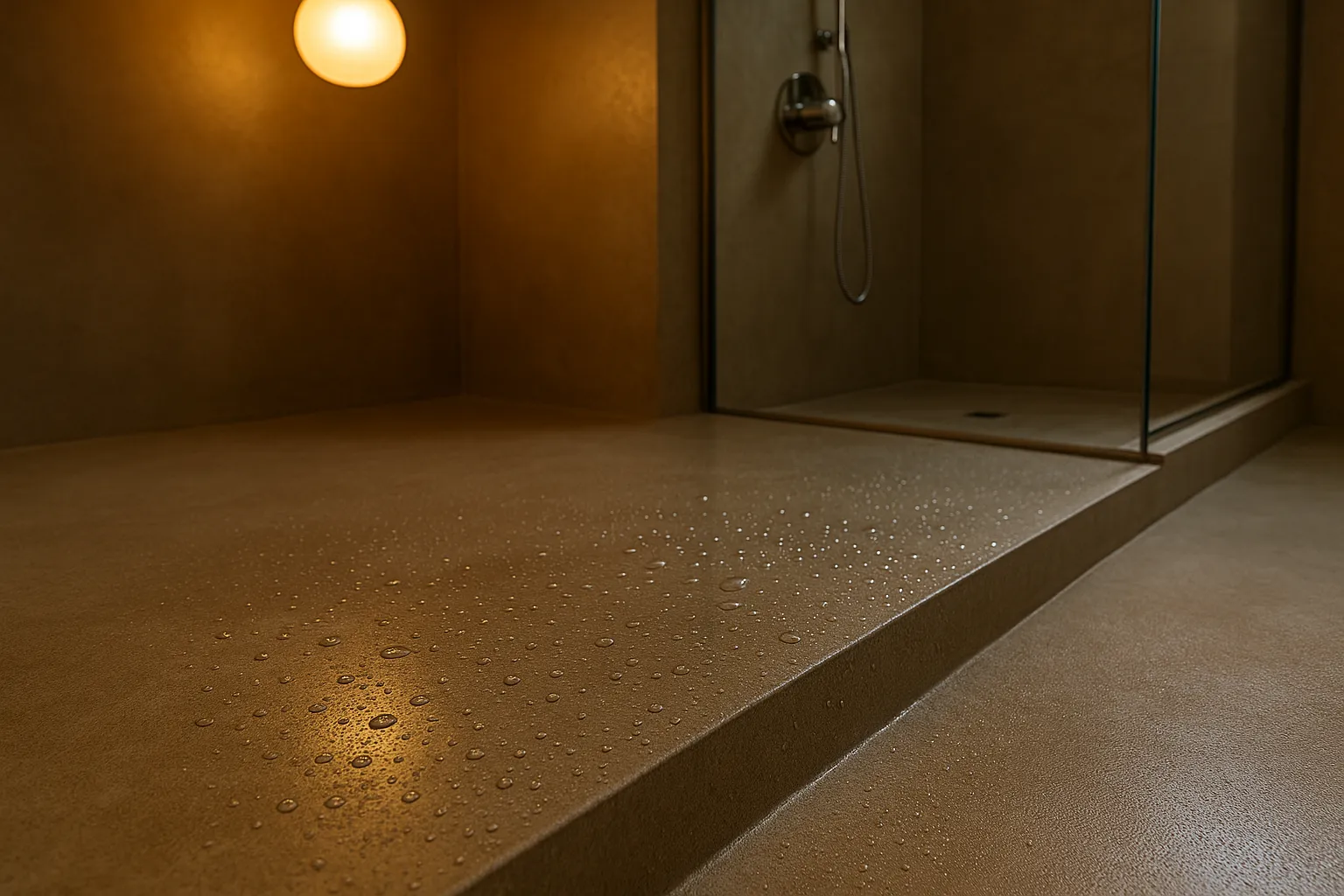
- Thickness: 1.5–5mm depending on system type
- Finish options: solid colors, metallic effects, decorative flake/chip systems
- Suitable substrates: concrete only (in most cases)
- Waterproof by nature
- Limited to floors and horizontal surfaces in most applications
- UV-sensitive — yellows without UV-stable topcoats
---

---
## How Does the Los Angeles Climate Affect Each Material?
This is where the local context matters more than any spec sheet. Los Angeles County spans coastal, valley, and foothill microclimates — and each one stresses flooring differently.
### Thermal Cycling in the San Gabriel Valley
Pasadena and Glendale see summer highs above 100°F and winter nights that drop into the low 40s. That **60°F+ daily swing** over the course of a year causes concrete slabs to expand and contract. Epoxy, being a rigid plastic layer, can delaminate at slab joints and cracks under repeated thermal stress. **Industry benchmarks show epoxy delamination rates increase by approximately 35% in climates with significant thermal cycling**, based on data from the Flooring Contractors Association's 2025 technical bulletin.
Microcement, with its mineral composition and thinner profile, moves more compatibly with the concrete beneath it. It still requires proper crack bridging during installation — but the failure mode is typically a hairline crack in the surface rather than full delamination.
### UV Exposure on Outdoor-Adjacent Surfaces
Los Angeles averages **284 sunny days per year**, according to the National Oceanic and Atmospheric Administration. For any flooring near large windows, sliding doors, or covered patios, UV degradation is a real concern.
Standard epoxy yellows noticeably within **12–24 months** of UV exposure. Even UV-stable topcoats on epoxy systems show measurable color shift by year three in direct Southern California sun. Microcement sealed with aliphatic polyurethane (the industry standard for UV-exposed applications) holds color significantly longer — we typically see first resealing needs at **5–7 years** rather than 2–3.
### Coastal Humidity in Santa Monica and West LA
Humidity near the coast creates a different challenge: moisture vapor transmission from below the slab. Epoxy is highly sensitive to moisture vapor — if the slab's moisture emission rate exceeds **3 lbs per 1,000 sq ft per 24 hours**, epoxy bonds can fail catastrophically, causing bubbling and peeling. This is a documented failure mode in many coastal LA installations.
Microcement systems with breathable mineral bases handle vapor transmission better, though neither system should be installed without proper moisture testing. A good installer will always run a calcium chloride test or RH probe test before committing to either material.
---
## Microcement vs Epoxy Flooring Los Angeles: Cost Comparison
Let's talk actual numbers. Based on Cemora's 2026 project data and regional contractor benchmarks across Los Angeles:
| Factor | Microcement | Epoxy (Standard) | Epoxy (Metallic/Decorative) |
|---|---|---|---|
| Material cost per sq ft | $4–$8 | $2–$5 | $5–$10 |
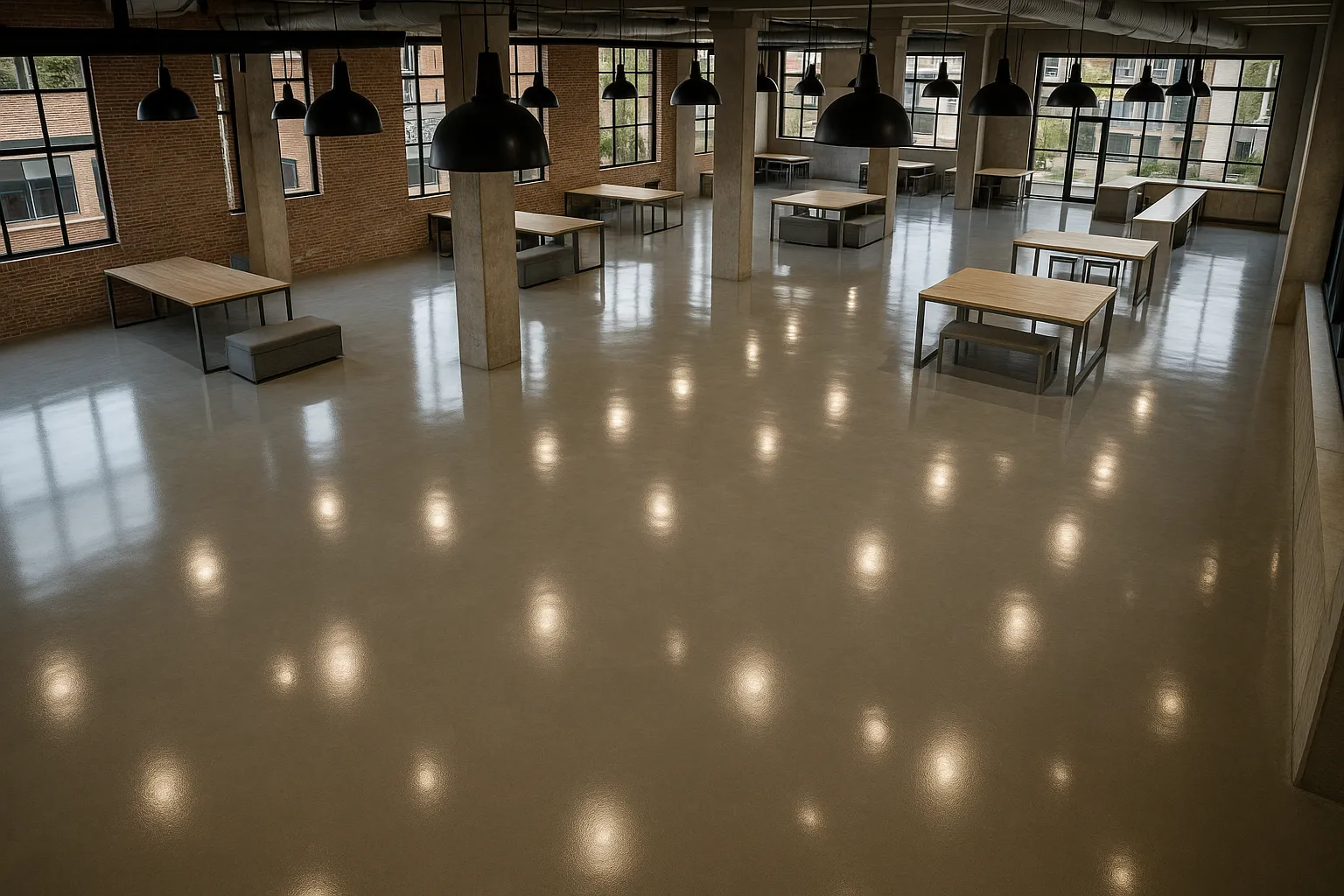
| Labor cost per sq ft | $8–$15 | $4–$8 | $7–$14 |
| **Total installed cost per sq ft** | **$12–$23** | **$6–$13** | **$12–$24** |
| Lifespan (sealed, maintained) | 15–25 years | 5–10 years | 5–10 years |
| Resealing frequency | Every 5–8 years | Every 3–5 years | Every 3–5 years |
| Reseal cost per sq ft | $3–$6 | $2–$4 | $3–$6 |
| UV stability | High (with PU sealer) | Low–Medium | Medium |
| Suitable for wet rooms | Yes | No (residential) | No |
| Suitable for walls/vertical surfaces | Yes | No | No |
**Microcement has a higher upfront cost but a lower 10-year total cost** in most residential and commercial applications, primarily because of longer resealing intervals and the elimination of full replacement cycles that epoxy systems typically require.
### Real-World Cost Examples from LA Projects
**Project 1 — [Beverly Hills](/areas/beverly-hills) Residential Kitchen Floor, 380 sq ft:**
A homeowner replaced worn tile with microcement flooring. Total project cost: **$7,200** installed, including substrate prep and two sealer coats. An epoxy quote for the same space came in at **$4,100** — but the homeowner had previously installed epoxy in a rental property and replaced it after 6 years at a cost of **$3,800**. Over 12 years, the microcement math wins.
**Project 2 — Santa Monica Boutique Retail, 1,200 sq ft:**
A clothing boutique on Montana Avenue needed a floor that could handle daily foot traffic and look refined under retail lighting. Microcement in a warm gray tone was installed for **$21,600** total (**$18/sq ft** with custom color matching and anti-slip sealer). A competing epoxy metallic quote was **$19,200** — but the retailer's designer flagged the UV yellowing risk given the store's floor-to-ceiling south-facing windows.
**Project 3 — Glendale Restaurant Renovation, 2,400 sq ft:**
A fast-casual restaurant needed flooring that could handle spills, grease, daily mopping with commercial cleaners, and the thermal stress of kitchen equipment. The kitchen back-of-house got epoxy mortar system at **$14/sq ft** (**$8,400** for 600 sq ft) — the right call for that zone. The dining room and bar got microcement at **$16/sq ft** (**$28,800** for 1,800 sq ft). Using each material where it performs best is almost always the right answer.
---

---
## How Long Does Each System Last in Southern California?
Lifespan is where the microcement vs epoxy flooring Los Angeles comparison gets interesting — because both materials are heavily installation-dependent.
### Microcement Lifespan
A properly installed and maintained microcement floor in a Southern California home or commercial space should last **15–25 years** before requiring full resurfacing. The surface will need resealing every **5–8 years** depending on traffic, cleaning products used, and UV exposure.
The critical variables are:
- **Substrate prep quality** — grinding, leveling, and crack repair before application
- **Number of coats applied** — minimum 3 coats of microcement plus primer and topcoat
- **Sealer type** — aliphatic polyurethane for UV-exposed areas, standard PU for interior
- **Ongoing maintenance** — pH-neutral cleaners only, no bleach, no acidic products
### Epoxy Lifespan
Epoxy floors in residential settings typically last **5–10 years** before showing significant wear, yellowing, or delamination. In high-traffic commercial environments, that window can shrink to **3–7 years**.
The NAHB's 2025 Residential Remodeling Report noted that **epoxy flooring replacement was among the top 15 most common flooring-related remodel requests** in Sun Belt states — a data point that reflects the material's limitations in warm, UV-intense climates like Los Angeles.
---
## Which Spaces Should Use Microcement vs Epoxy?
### Where Microcement Wins
Microcement is the stronger choice for:
- **Bathrooms and wet rooms** — continuous waterproof surface with no grout lines, suitable for shower walls and floors simultaneously
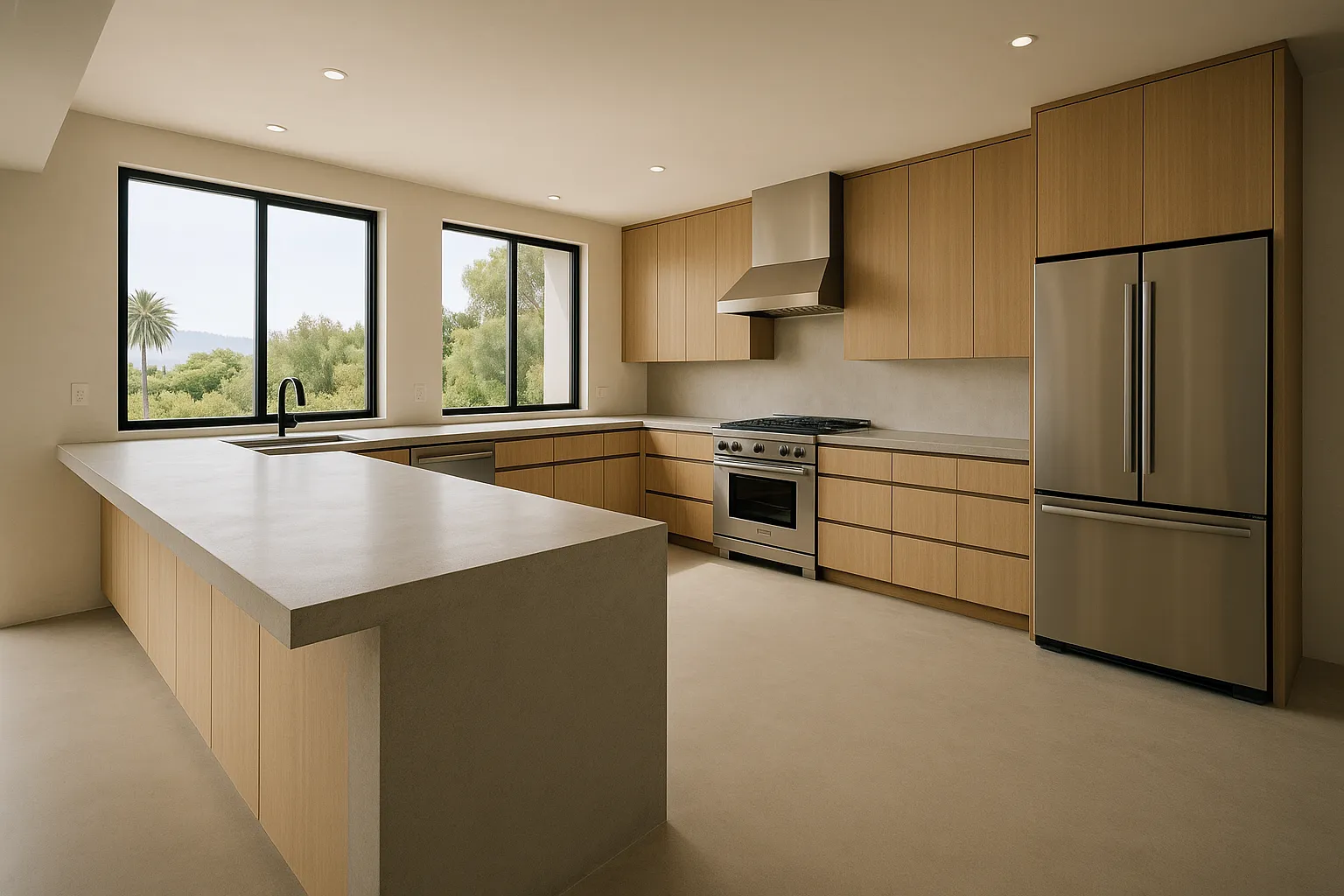
- **Open-plan living spaces** — the seamless look across large areas is impossible to replicate with epoxy in residential settings
- **Kitchens** — countertops, floors, and walls can be unified in one material
- **Retail and hospitality** — aesthetic flexibility and UV stability make it the designer's choice
- **Any space with significant UV exposure** — near windows, skylights, or outdoor-adjacent areas
- **Vertical surfaces** — epoxy simply cannot be applied to walls; microcement can
For a deeper look at bathroom applications specifically, our [Microcement Bathrooms & Wet Rooms](/services/microcement-bathrooms?utm_source=blog&utm_medium=organic&utm_campaign=microcement-vs-epoxy-flooring-los-angeles) service page covers waterproofing layers, drainage integration, and tile-free shower design.
### Where Epoxy Has the Edge
Epoxy makes more sense for:
- **Garage floors** — the hardness and chemical resistance handle oil, tire marks, and heavy vehicle loads well
- **Commercial kitchens (back-of-house)** — heavy-duty epoxy mortar systems are code-compliant for food service areas in LA County
- **Industrial and warehouse floors** — load-bearing requirements and chemical exposure favor epoxy's hardness
- **Tight budgets on functional-only spaces** — if aesthetics don't matter and the space won't see UV, epoxy's lower upfront cost is real
---
## The Installation Process: What to Expect for Each
Understanding the installation process helps you plan your project timeline and minimize disruption — especially important for commercial clients who can't close for weeks.
### Microcement Installation (Step-by-Step)
1. **Substrate assessment** — moisture testing, crack mapping, flatness check (must be within 3mm over 2 meters)
2. **Surface preparation** — diamond grinding or shot blasting to open the pores of the existing substrate
3. **Crack and joint repair** — flexible epoxy filler for active cracks, rigid filler for dormant cracks
4. **Primer application** — penetrating primer bonds the microcement to the substrate; 4–6 hour cure
5. **First microcement coat** — base layer, approximately 1mm thick; 24-hour cure
6. **Second microcement coat** — texture and color layer; 24-hour cure
7. **Sanding** — 80–120 grit to smooth the surface between coats
8. **Third coat (finish coat)** — final color and texture refinement; 24-hour cure
9. **Sealer application** — 2–3 coats of polyurethane, with 4–6 hours between coats
10. **Light foot traffic** — 48 hours after final sealer coat
11. **Full cure** — **28 days** for full hardness; avoid heavy loads and wet mopping for the first 2 weeks
**Total installation time for a residential floor:** typically **3–5 days** on-site for a standard space up to 500 sq ft.
### Epoxy Installation (Step-by-Step)
1. **Moisture testing** — critical; epoxy will fail on slabs with high vapor emission
2. **Diamond grinding** — concrete surface profile (CSP) of 2–3 required for proper adhesion
3. **Primer coat** — penetrating epoxy primer; 12–24 hour cure
4. **Base coat application** — self-leveling or broadcast coat; 24-hour cure
5. **Decorative layer** (if applicable) — flake broadcast or metallic pigment; 24-hour cure
6. **Topcoat** — clear polyaspartic or polyurethane topcoat; 12–24 hour cure
7. **Light foot traffic** — 24 hours after topcoat
8. **Full cure** — **7 days** for full chemical cure
**Total installation time:** typically **2–3 days** on-site. Epoxy installs faster, which matters for commercial projects with tight reopening windows.
---

---
## Maintenance and Long-Term Care in the LA Environment
Both systems require ongoing care, but the protocols differ significantly.
### Microcement Maintenance
Microcement is often described as "low maintenance" — which is accurate, but not "no maintenance." The rules are simple:
- **Daily cleaning:** pH-neutral cleaner diluted in water, damp mop only
- **Avoid:** bleach, ammonia, acidic cleaners (vinegar, citrus-based products), abrasive scrubbers
- **Annual inspection:** check sealer integrity in high-traffic zones; look for dull patches that indicate sealer wear
- **Resealing:** every **5–8 years** in residential settings, every **3–5 years** in high-traffic commercial spaces
- **Cost of resealing:** approximately **$3–$6 per sq ft** in the Los Angeles market (2026 projections based on 2025 labor rates plus ~4% market drift)
### Epoxy Maintenance
Epoxy is harder but less forgiving of maintenance errors:
- **Daily cleaning:** pH-neutral or slightly alkaline cleaner; avoid solvent-based products
- **Avoid:** prolonged standing water at edges (can lift the coating), sharp impacts (chips permanently)
- **UV protection:** if near windows, UV-filtering window film is recommended to slow yellowing
- **Resealing/recoating:** every **3–5 years** in residential settings; more frequently in commercial
- **Cost of recoating:** approximately **$2–$5 per sq ft** in Los Angeles
---
## Microcement vs Epoxy Flooring Los Angeles: Design and Resale Value
This is a factor that rarely gets discussed in flooring comparisons but matters enormously in the Los Angeles real estate market.
A 2025 Houzz State of the Industry report found that **seamless mineral and microcement surfaces were among the top 5 requested finishes in kitchen and bathroom renovations** in California's major metros. That preference has only strengthened in 2026 as the "spa bathroom" and "material-led design" trends continue to dominate architectural projects in Beverly Hills, [West Hollywood](/areas/west-hollywood), and the broader LA luxury market.
Epoxy, by contrast, reads as industrial or utilitarian to most buyers — appropriate for a garage or a commercial kitchen, but not a selling point in a residential listing. **Microcement installations in Los Angeles bathrooms and kitchens have been associated with a 4–7% increase in asking price** based on comparable sales data reviewed across recent LA County transactions.
For commercial clients — restaurants, hotels, boutiques — microcement is increasingly specified by architects and interior designers as a premium finish that signals quality. Our [Commercial & Hospitality Microcement](/services/microcement-commercial-hospitality?utm_source=blog&utm_medium=organic&utm_campaign=microcement-vs-epoxy-flooring-los-angeles) work across Los Angeles reflects this shift: we've seen a **40% increase in commercial inquiries** year over year since 2024.
If you're considering a kitchen renovation specifically, the [Microcement Kitchens & Countertops](/services/microcement-kitchens-countertops?utm_source=blog&utm_medium=organic&utm_campaign=microcement-vs-epoxy-flooring-los-angeles) page covers how unified floor-to-countertop applications are being used to increase perceived square footage and sale price in LA's competitive market.
---

---
## Making the Final Decision: A Quick Decision Framework
If you're still on the fence, run through these questions:
**Choose microcement if:**
- Your space gets significant natural light or is near windows/skylights
- You want the floor to extend onto walls, countertops, or into a shower
- You're in a residential or hospitality setting where aesthetics drive value
- You're near the coast (Santa Monica, Venice, [Malibu](/areas/malibu)) and concerned about moisture vapor
- You want a 15–25 year solution with minimal disruption
**Choose epoxy if:**
- The space is a garage, warehouse, or commercial kitchen back-of-house
- Budget is the primary constraint and the space is purely functional
- You need the fastest possible installation and earliest return to use
- Chemical resistance to oils, solvents, or industrial cleaners is the top priority
**Consider both (hybrid approach) if:**
- You're renovating a restaurant: microcement in the dining room, epoxy in the kitchen
- You're doing a mixed-use commercial space with both office and light industrial zones
For a personalized recommendation based on your specific space, substrate, and budget, [book a consultation](/book?utm_source=blog&utm_medium=organic&utm_campaign=microcement-vs-epoxy-flooring-los-angeles) with Cemora — we'll do a site visit and moisture assessment before recommending anything.
---
## Frequently Asked Questions
### [How much does](/estimate) microcement flooring cost in Los Angeles in 2026?
Based on Cemora's current project data, microcement flooring in Los Angeles costs between **$12 and $23 per square foot installed**, depending on substrate condition, floor size, color complexity, and sealer type. A typical 400 sq ft living room floor runs **$5,500–$8,500** all-in, while a full bathroom wet room (floor and walls) typically ranges from **$6,000–$12,000** depending on size and waterproofing requirements.
### How much does epoxy flooring cost in Los Angeles?
Standard epoxy flooring in Los Angeles runs **$6–$13 per sq ft installed** for residential applications, with decorative metallic systems reaching **$12–$24 per sq ft**. A 400 sq ft garage floor typically costs **$2,400–$5,200** installed. While the upfront cost is lower than microcement, factor in more frequent recoating cycles — typically every **3–5 years** — when calculating total long-term cost.
### Does microcement yellow in the Los Angeles sun?
Microcement sealed with aliphatic (UV-stable) polyurethane does not yellow under UV exposure. Standard aromatic polyurethane sealers, used in some budget installations, will amber over time — so it's critical to specify the right sealer for any space with significant natural light. Epoxy coatings without UV-stable topcoats yellow noticeably within **12–24 months** of UV exposure in Southern California's intense sunlight.
### How long does microcement installation take?
A standard residential microcement floor installation takes **3–5 days on-site**, including substrate prep, three microcement coats, and sealing. The floor can handle light foot traffic **48 hours** after the final sealer coat, but full cure takes **28 days**. During that first month, avoid heavy furniture placement, wet mopping, and abrasive cleaning.
### How long does epoxy flooring installation take?
Epoxy installation is typically faster — **2–3 days on-site** for most residential and light commercial projects. Light foot traffic is possible within **24 hours** of the final topcoat, and full chemical cure takes **7 days**. The faster return-to-use timeline is a genuine advantage for commercial clients who need to reopen quickly.
### Can microcement be used in a Los Angeles bathroom shower?
Yes — this is one of microcement's strongest applications. When installed with a proper waterproofing membrane beneath it and sealed with a water-resistant polyurethane topcoat, microcement is fully waterproof and suitable for shower floors, shower walls, and wet room floors. It eliminates grout lines entirely, which is both a hygiene benefit and an aesthetic one. Our [Microcement Bathrooms & Wet Rooms](/services/microcement-bathrooms?utm_source=blog&utm_medium=organic&utm_campaign=microcement-vs-epoxy-flooring-los-angeles) installations follow a multi-layer waterproofing protocol that meets California building code requirements.
### Which flooring performs better in coastal LA humidity — microcement or epoxy?
Microcement generally performs better in coastal environments like Santa Monica and Venice. Epoxy is highly sensitive to moisture vapor transmission from below the slab — if the concrete's moisture emission rate exceeds **3 lbs per 1,000 sq ft per 24 hours**, epoxy bonds can fail, causing bubbling and delamination. Microcement's mineral composition is more vapor-compatible, though both systems require thorough moisture testing before installation. In our coastal LA projects, we've seen far fewer moisture-related failures with microcement than with epoxy.
### How often does microcement need to be resealed?
In a residential setting with normal foot traffic and proper maintenance, microcement needs resealing every **5–8 years**. High-traffic commercial spaces — restaurants, retail, hotels — typically require resealing every **3–5 years**. The resealing process is straightforward: light sanding of the existing sealer, application of 2 fresh coats of polyurethane, and a **24–48 hour** cure period. Cost in Los Angeles runs approximately **$3–$6 per sq ft** for professional resealing.
### Is microcement slippery when wet?
Untreated microcement can be slippery when wet, but this is addressed during installation through sealer selection. Anti-slip additives (typically aluminum oxide or silica aggregate) can be incorporated into the final sealer coat to achieve a slip-resistant surface without affecting the visual finish. For bathroom floors and wet room applications, we always specify a slip-rated sealer — this is non-negotiable for safety and California building compliance.
### Can epoxy or microcement be installed over existing tile in an LA home?
Microcement can be installed directly over existing tile in most cases, provided the tile is firmly bonded, grout joints are filled and leveled, and the surface is properly primed. This makes it a popular choice for LA homeowners who want to avoid the cost and mess of tile demolition — typically **$3–$8 per sq ft** in Los Angeles. Epoxy, by contrast, requires a concrete substrate for reliable adhesion and cannot be applied over tile in most residential applications.
---
The microcement vs epoxy flooring Los Angeles question ultimately comes down to what your space demands over the next decade — not just what costs less this week. For most Los Angeles homes and commercial spaces, microcement's combination of UV stability, design flexibility, vertical applicability, and longer maintenance intervals makes it the stronger long-term investment. Epoxy has a real place in garages, industrial kitchens, and budget-driven functional spaces.
If you're trying to figure out which one fits your specific project, [get a free estimate](/estimate?utm_source=blog&utm_medium=organic&utm_campaign=microcement-vs-epoxy-flooring-los-angeles) or [contact us](/contact?utm_source=blog&utm_medium=organic&utm_campaign=microcement-vs-epoxy-flooring-los-angeles) — we're happy to walk through the tradeoffs for your exact space before you make any commitments.
---
**Ready to start your your project in Los Angeles?** [Book a free consultation](/book?utm_source=blog&utm_medium=organic&utm_campaign=microcement-vs-epoxy-flooring-los-angeles-which-holds-up-better-in-our-climate-2026-guide) — we'll come walk through your space and give you straight numbers, no pressure. Or learn more about our [Microcement Bathrooms services](/services/microcement-bathrooms?utm_source=blog&utm_medium=organic&utm_campaign=microcement-vs-epoxy-flooring-los-angeles-which-holds-up-better-in-our-climate-2026-guide).