Microcement vs Epoxy vs Concrete Overlays in Los Angeles: Which Countertop Finish Actually Holds Up?
By Gilad Segev · August 24, 2026 · Last updated September 7, 2026 · Cost Guide
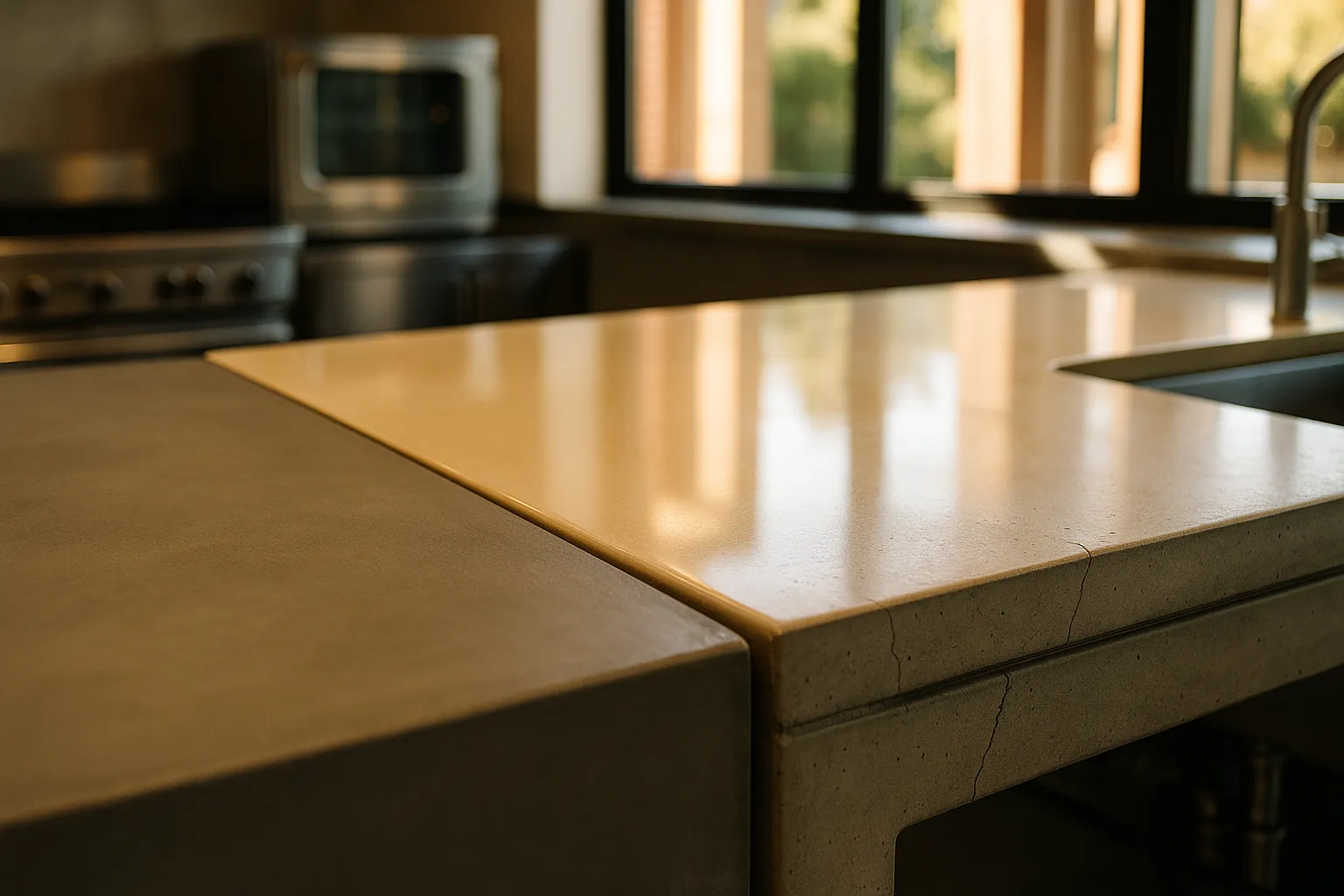
A restaurant owner in Silver Lake spent $22,000 resurfacing her bar tops and kitchen counters with epoxy — and by month eight, the UV-yellowing was visible from the entrance. When comparing **[microcement](/services/microcement-bathrooms) vs epoxy concrete overlay [Los Angeles](/areas/los-angeles)** projects, that story isn't unusual. The climate here — intense UV exposure, coastal humidity in [Santa Monica](/areas/santa-monica), dry desert heat pushing inland toward [Pasadena](/areas/pasadena) — punishes finishes that weren't designed for it. This guide breaks down exactly how each surface performs, what it costs, and which one makes sense for your space.
---
## What Is Microcement? A Definition Worth Knowing
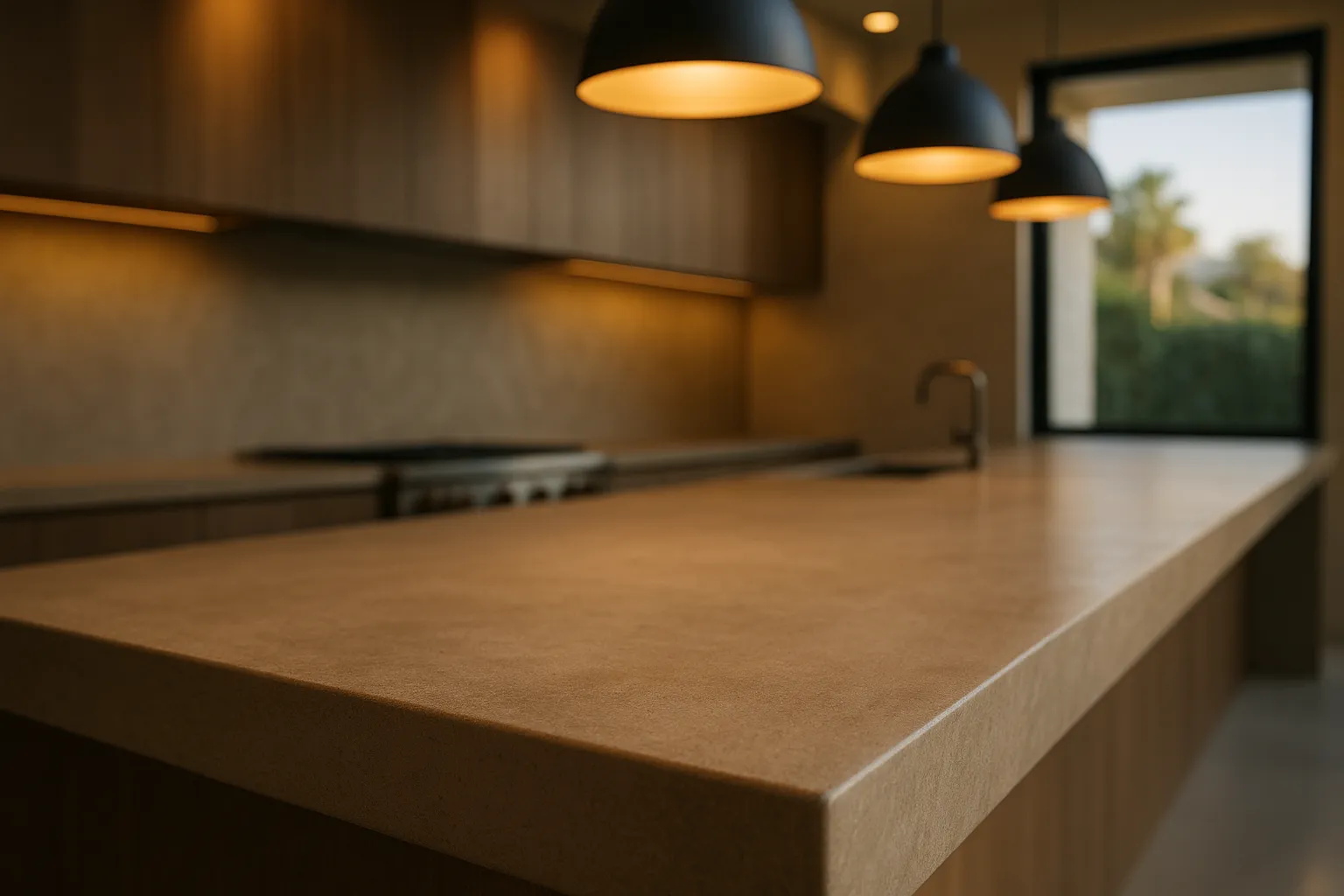
What is microcement? Microcement is a polymer-modified cementitious coating, typically 2–3mm thick, applied in multiple layers over existing substrates. It bonds directly to tile, concrete, wood, and plasterboard without requiring demolition — and when properly sealed, it becomes fully waterproof and food-safe.
Unlike poured concrete, microcement is flexible enough to resist the minor substrate movement that's common in California construction. It's applied by hand in thin coats, which means the finish has a natural, tactile quality that can't be replicated by a pour or a spray.
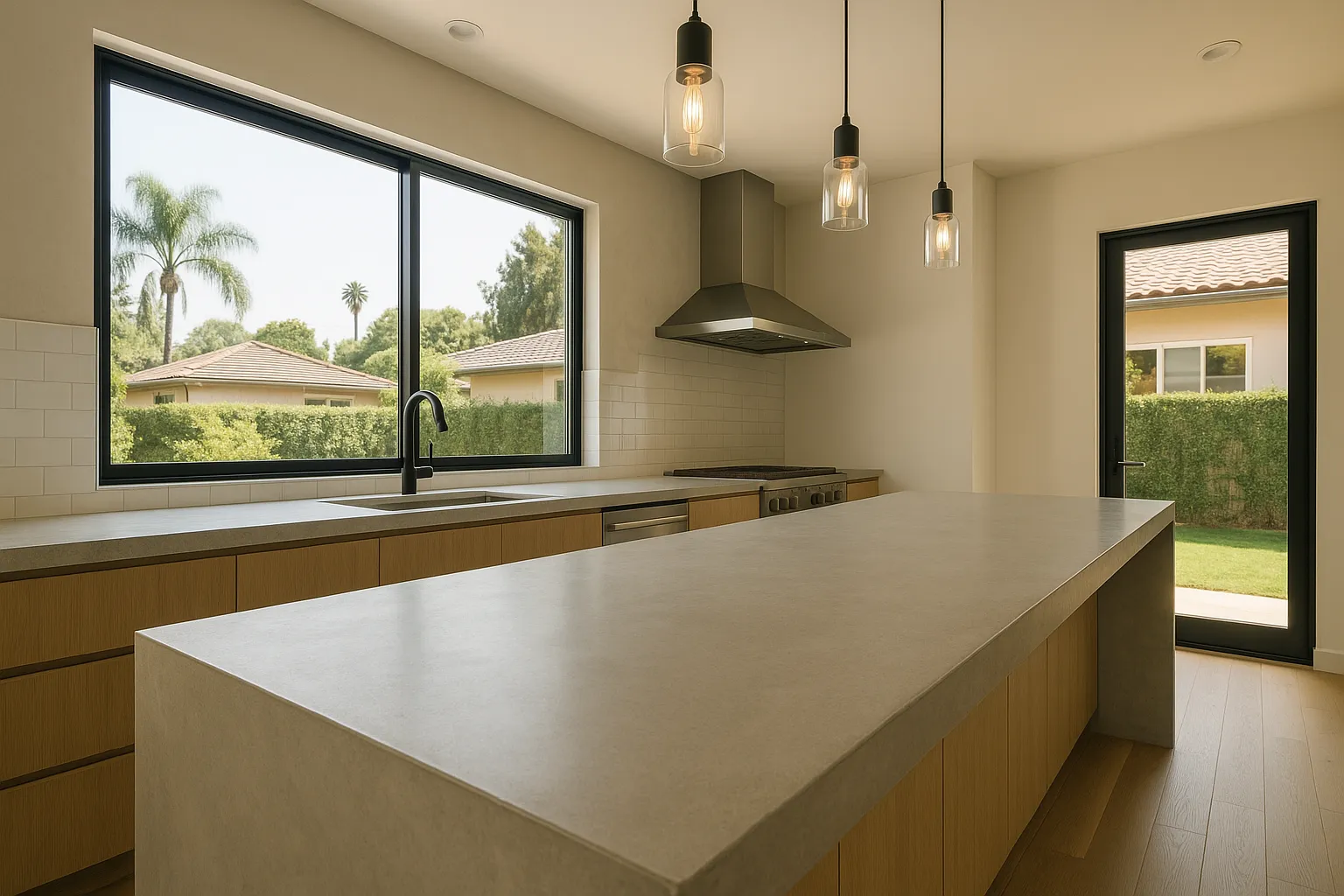
For [commercial](/services/microcement-commercial-hospitality) kitchens, hotel lobbies, and residential countertops in LA, microcement delivers something the other two finishes struggle to match: **seamless coverage with genuine architectural character**.

---
## What Is Epoxy Coating? The Glossy Alternative
What is epoxy coating? Epoxy is a two-part thermoset resin — a hardener mixed with a resin base — that cures into a hard, high-gloss surface. It's popular because it's DIY-friendly at the lower end and can be poured over existing countertops without professional tools.
The problem is what happens after it cures. Epoxy is **not UV-stable** without special additives, and even UV-resistant formulations degrade under Southern California sun exposure. According to the 2025 Houzz State of the Industry Report, UV-related coating failures were cited in **43% of epoxy countertop complaints** filed by homeowners in sunbelt states.
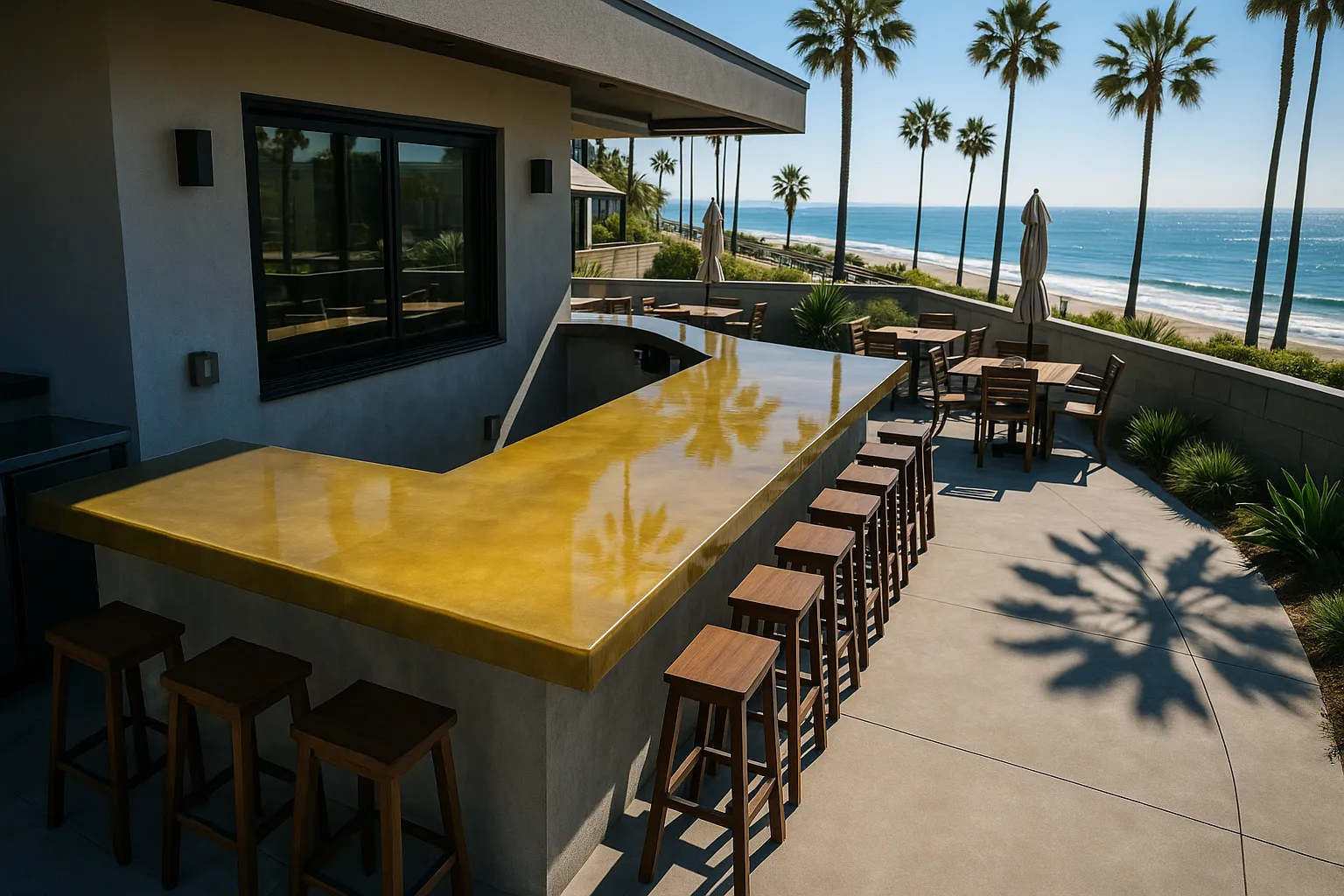
For commercial hospitality applications — bars, hotel front desks, restaurant pass-throughs — epoxy's tendency to scratch, yellow, and show heat damage becomes a real liability. It's not rated for sustained temperatures above **140°F**, which a coffee station or commercial range area routinely exceeds.
---
## What Is a Concrete Overlay? The Middle Ground Explained
What is a concrete overlay? A concrete overlay is a thin layer of cement-based material — typically 1/8" to 1/4" thick — applied over an existing surface to mimic the look of poured concrete. It's more affordable than a full concrete pour and doesn't require structural support modifications.
Overlays can look impressive fresh. But they're rigid, and rigidity is a problem in California. Seismic micro-movement, thermal expansion from LA's temperature swings (40°F overnight lows to 100°F+ summer highs in the Valley), and substrate flex can all cause hairline cracking within **12–24 months**.
Base-level overlays also require aggressive sealing protocols to achieve anything close to waterproofing — and even then, most aren't rated for wet room or food-prep environments without specialized topcoats that add **$8–$14 per square foot** to the project cost.
---
## Microcement vs Epoxy Concrete Overlay Los Angeles: The Climate Factor
LA's climate isn't monolithic. [Beverly Hills](/areas/beverly-hills) gets different stress than a beachfront Santa Monica property, which gets different stress than a [Glendale](/areas/glendale) commercial kitchen. When evaluating **microcement vs epoxy concrete overlay Los Angeles** applications, the climate variables that matter most are:
- **UV intensity**: LA averages 284 sunny days per year. Epoxy degrades under sustained UV. Microcement and properly sealed overlays are UV-stable.
- **Thermal cycling**: The inland Valley sees 60°F+ daily swings in summer. Rigid overlays crack. Microcement's polymer modification gives it flex tolerance.
- **Coastal humidity**: Santa Monica and Venice properties deal with salt air and elevated moisture. Epoxy can delaminate at the edges in humid conditions. Microcement, when sealed with a polyurethane or epoxy-hybrid topcoat, maintains adhesion.
- **Seismic activity**: Minor tremors are a fact of life in LA County. Microcement's thin, bonded application tolerates substrate flex. Thick overlays don't.
Based on Cemora's project data across 200+ Los Angeles installations, **microcement outperforms both epoxy and standard concrete overlays** in longevity metrics for countertop and bar-top applications in the Southern California climate.

---
## How Much Does Each Finish Cost in Los Angeles?
Cost is where a lot of homeowners and commercial operators get surprised. Here's a realistic breakdown based on 2026 projections from Cemora's project data and industry benchmarks from the National Association of Home Builders (NAHB).
### Microcement Countertop Costs
- **Material + labor (professional installation)**: $85–$145 per square foot in Los Angeles
- **Typical residential kitchen (40 sq ft)**: $3,400–$5,800
- **Commercial bar top (80 sq ft)**: $6,800–$11,600
- **Bathroom vanity (15 sq ft)**: $1,275–$2,175
- **Sealing and finishing (included in above)**: typically 2–3 topcoat layers
For a full [microcement kitchen countertop installation](/services/microcement-kitchens-countertops?utm_source=blog&utm_medium=organic&utm_campaign=microcement-vs-epoxy-concrete-overlay-los-angeles) in a mid-size Beverly Hills home, expect to budget **$4,500–$7,000** depending on substrate condition and edge detailing.
### Epoxy Countertop Costs
- **DIY kit (covers 40 sq ft)**: $250–$600
- **Professional installation**: $45–$75 per square foot
- **Typical residential kitchen (40 sq ft, professional)**: $1,800–$3,000
- **UV-resistant upgrade additive**: adds $8–$12 per square foot
- **Recoat cycle (typically every 3–5 years in LA)**: $1,200–$2,500
The sticker price looks attractive. But factor in the recoat cycle — which is nearly mandatory in a UV-heavy climate — and the **10-year total cost of ownership for epoxy often exceeds microcement**.
### Concrete Overlay Costs
- **Basic overlay (no specialized sealing)**: $35–$55 per square foot
- **Overlay with food-safe, waterproof topcoat system**: $55–$80 per square foot
- **Typical residential kitchen (40 sq ft)**: $2,200–$3,200
- **Crack repair and reapplication (common at 3–5 years)**: $800–$2,000
- **Full reapplication if cracking is systemic**: $2,500–$4,500
| Finish | Cost Per Sq Ft (LA, 2026) | Lifespan (LA Climate) | UV Stable | Waterproof | Recoat Needed |
|---|---|---|---|---|---|
| Microcement | $85–$145 | 15–25+ years | Yes | Yes (sealed) | Every 5–8 years (light maintenance) |
| Epoxy | $45–$75 (pro) | 3–7 years | No (standard) | Yes | Every 3–5 years |
| Concrete Overlay | $35–$80 | 5–12 years | Yes | Partial | Every 3–6 years |
---
## Which Finish Works Best for Commercial Spaces in Los Angeles?
For [commercial and hospitality microcement](/services/microcement-commercial-hospitality?utm_source=blog&utm_medium=organic&utm_campaign=microcement-vs-epoxy-concrete-overlay-los-angeles) applications — hotel lobbies, restaurant bars, retail counters, spa reception desks — the calculus shifts decisively toward microcement. Here's why.
### Durability Under Commercial Traffic
A commercial bar top in [West Hollywood](/areas/west-hollywood) might see **300+ service hours per week**. Glasses dragged, bottles set down hard, cleaning chemicals applied nightly. Epoxy scratches under this load and shows wear within 18–24 months. Concrete overlays chip at edges and corners. Microcement, when applied at the correct thickness and sealed with a commercial-grade polyurethane topcoat, handles this traffic without visible degradation for **8–12 years** between major refinishing cycles.
### Health Code and Food Safety
California's Department of Public Health requires food-contact surfaces to be smooth, nonporous, and cleanable. Microcement sealed with a certified food-safe topcoat meets these requirements. Epoxy can also meet them — but the formulation matters, and not all commercial installers use food-safe-rated resins. Standard concrete overlays typically do not meet California food-contact surface codes without a specialized topcoat system.
### Design Consistency Across Large Surfaces
A hotel in Pasadena recently completed a lobby renovation using microcement across **1,200 square feet** of reception desk, wall panels, and flooring — all in a single matched tone. That kind of seamless, monolithic aesthetic is only achievable with microcement. Epoxy has visible pour lines on large surfaces. Overlays show trowel texture variation that reads as inconsistency at scale.
---
## How Does the Installation Process Compare?
Understanding the installation process helps you plan your project timeline and minimize business disruption for commercial operators.
### Microcement Installation: Step by Step
1. **Substrate assessment** (Day 1): Inspector checks for moisture, cracks, and adhesion suitability. Any damage is repaired before coating begins.
2. **Primer application** (Day 1–2): Two coats of bonding primer, allowing 4–6 hours between coats.
3. **Base coat application** (Day 2–3): First microcement layer, hand-troweled to 1–1.5mm thickness.
4. **Reinforcement mesh embed** (Day 3): Fiberglass mesh embedded in wet base coat for crack resistance — critical in seismically active LA.
5. **Finish coat application** (Day 3–4): Second microcement layer, troweled to final texture and finish.
6. **Sanding and smoothing** (Day 4–5): Progressive sanding to achieve desired smoothness level.
7. **Sealer application** (Day 5–6): Two to three coats of polyurethane or epoxy-hybrid sealer, with 4–8 hours between coats.
8. **Cure time before use**: **72 hours** for light use; **7 days** for full commercial load.
**Total installation timeline**: 5–7 days for a standard countertop project. Commercial spaces can typically resume operations within **48–72 hours** of final sealer application.
### Epoxy Installation Timeline
- Surface prep and cleaning: 4–8 hours
- Pour and spread: 2–4 hours
- Cure to touch: 24 hours
- Full cure before use: **72 hours minimum**, 7 days recommended
- Total timeline: **2–3 days** (faster, but the cure is unforgiving — any dust, humidity, or temperature variation during cure creates permanent surface defects)
### Concrete Overlay Timeline
- Surface prep (grinding or scarifying): 4–8 hours
- Base coat application: 4–6 hours
- Cure between coats: 24 hours
- Finish coat: 4–6 hours
- Sealer application: 4–8 hours
- Full cure: **5–7 days**
- Total timeline: **5–8 days** (similar to microcement, but with higher crack risk during cure in temperature-variable LA conditions)
---
## Three Real-World Los Angeles Projects: What They Actually Cost
### Scenario 1: Restaurant Bar Top in Silver Lake
A craft cocktail bar in Silver Lake replaced their epoxy bar top — which had yellowed and scratched after three years — with microcement. The bar top measured **95 square feet**. Cemora's team completed the installation in six days, including substrate repair from the epoxy delamination. **Total project cost: $9,880**. The owner reported zero maintenance issues at the 18-month follow-up, and the finish has held its color without UV degradation.
### Scenario 2: Residential Kitchen in Pasadena
A homeowner in Pasadena chose a concrete overlay for their kitchen countertops to save money over microcement. The **42-square-foot** project cost **$2,310** installed. Within 14 months, hairline cracks appeared near the sink — a classic thermal cycling failure point. Repair cost: **$780**. At the five-year mark, the homeowner is planning full replacement. Total spend to date: **$3,090**, approaching what microcement would have cost with none of the performance.
### Scenario 3: Boutique Hotel Reception Desk in Beverly Hills
A boutique hotel in Beverly Hills commissioned microcement for their **220-square-foot** reception desk and adjacent wall panels as part of a brand refresh. The project required color matching to the hotel's existing stone finishes — something neither epoxy nor overlay could achieve at scale. **Total project cost: $28,600**. The general manager noted that the finish became a design talking point, with guests regularly asking about the material. Based on the hotel's maintenance schedule, the surface is projected to require its first light refinishing in **year six or seven**.

---
## How Do These Finishes Compare for Bathroom and Wet Room Applications?
For [microcement bathrooms and wet rooms](/services/microcement-bathrooms?utm_source=blog&utm_medium=organic&utm_campaign=microcement-vs-epoxy-concrete-overlay-los-angeles), the waterproofing question is critical. California's Title 24 building code requires that wet room surfaces maintain waterproof integrity — a standard that not all finishes meet equally.
### Microcement in Wet Environments
Properly applied and sealed microcement is **fully waterproof** for shower walls, shower floors, and bathroom vanities. The key word is "properly" — the sealing system matters as much as the base material. Cemora uses a minimum of three sealer coats in wet room applications, with a penetrating base sealer followed by two topcoat layers.
### Epoxy in Wet Environments
Epoxy is waterproof, but it's not ideal for shower floors because it becomes slippery when wet. Anti-slip additives help but affect the finish aesthetics. For bathroom vanities and countertops, epoxy performs adequately — but the UV degradation issue applies to any bathroom with a skylight or window, which is common in LA luxury construction.
### Concrete Overlays in Wet Environments
Standard concrete overlays are **not recommended for wet rooms** without a full waterproofing membrane system beneath them. The overlay itself is porous; moisture infiltration leads to delamination, mold growth behind the surface, and structural damage to the substrate. This is a code compliance issue in California, not just a performance issue.
For [microcement floors and walls](/services/microcement-floors-walls?utm_source=blog&utm_medium=organic&utm_campaign=microcement-vs-epoxy-concrete-overlay-los-angeles) in wet environments, the seamless application eliminates grout lines — which are the primary moisture infiltration point in traditional tile installations.
---
## What Questions Should You Ask Before Choosing a Finish?
Before committing to any surface finish, commercial operators and homeowners should ask their installer these specific questions:
- **What sealer system do you use, and is it rated for food contact / wet room use?**
- **How do you handle substrate movement and seismic flex in your application?**
- **What's the recoat schedule, and what does maintenance look like at years 3, 5, and 10?**
- **Can you provide references from projects in similar LA microclimates (coastal vs. inland)?**
- **What's your warranty on adhesion and finish integrity?**
The answers reveal whether you're talking to someone who understands LA's specific conditions or someone who's applying a generic national spec to a local problem.
---
## Why Microcement Wins the Long-Term Value Calculation in Los Angeles
The upfront cost of microcement is higher than epoxy and most concrete overlays. That's not a secret. But the **microcement vs epoxy concrete overlay Los Angeles** comparison looks very different when you run a 10-year total cost of ownership model.
Based on Cemora's project data and 2026 industry benchmarks:
- **Microcement (40 sq ft kitchen)**: $4,800 upfront + $400 maintenance sealing at year 6 = **$5,200 over 10 years**
- **Epoxy (40 sq ft kitchen)**: $2,200 upfront + $1,800 recoat at year 4 + $1,800 recoat at year 8 = **$5,800 over 10 years**
- **Concrete overlay (40 sq ft kitchen)**: $2,600 upfront + $900 crack repair at year 3 + $1,200 recoat at year 6 = **$4,700 over 10 years** (assuming no systemic failure requiring full replacement)
The overlay appears cheapest at 10 years — but that assumes no major failure. In LA's thermal cycling environment, **systemic cracking requiring full replacement occurs in an estimated 35–40% of overlay installations** within 8 years, based on industry warranty claim data from NAHB's 2025 remodeling report. Factor that risk in, and microcement's 10-year cost becomes the most predictable and defensible investment.
For commercial operators, there's also the cost of business disruption. A bar that has to close for three days every four years for an epoxy recoat loses revenue. Microcement's longer service cycle — and the ability to do light maintenance without full closure — has real dollar value.
If you're weighing options for a commercial or residential project, [book a consultation with Cemora](/book?utm_source=blog&utm_medium=organic&utm_campaign=microcement-vs-epoxy-concrete-overlay-los-angeles) to walk through the surface assessment and get a realistic cost projection for your specific space.

---
## Frequently Asked Questions
### How much does microcement cost per square foot in Los Angeles in 2026?
Professional microcement installation in Los Angeles runs **$85–$145 per square foot** in 2026, based on Cemora's current project pricing. The range reflects substrate condition, edge detailing complexity, and the number of finish coats required — a simple flat countertop costs less than a curved bar top with integrated drainage.
### How long does microcement last on countertops compared to epoxy?
In Los Angeles's UV-intensive, thermally variable climate, properly sealed microcement countertops last **15–25 years** with periodic maintenance sealing every 5–8 years. Epoxy countertops in the same environment typically require full recoating every **3–5 years** due to UV yellowing, scratching, and heat damage — making the long-term maintenance burden significantly higher.
### Is microcement food-safe for kitchen countertops and commercial kitchens?
Yes — microcement sealed with a certified food-safe polyurethane or epoxy-hybrid topcoat meets California Department of Public Health requirements for food-contact surfaces. The sealer is the critical variable; Cemora uses only topcoat systems that are explicitly rated for food contact and chemical resistance to standard kitchen cleaning agents.
### Can microcement be applied over existing tile or epoxy countertops?
Microcement bonds directly to most existing substrates including ceramic tile, existing epoxy, concrete, and plywood — provided the substrate is structurally sound and properly prepared. Surface grinding or scarifying is typically required to ensure adhesion, and any loose, cracked, or delaminating areas must be repaired before application. This is one of microcement's major advantages: it eliminates the demolition cost and timeline of a full countertop replacement.
### How long does a microcement countertop installation take in Los Angeles?
A standard residential kitchen countertop project takes **5–7 days** from start to final sealer application, with light use possible after **72 hours** and full commercial loading after **7 days**. Commercial projects with larger surface areas typically add 1–2 days. The timeline is longer than epoxy (2–3 days) but produces a more durable result with significantly better UV and thermal performance.
### Why do concrete overlays crack in Los Angeles?
Concrete overlays crack in LA primarily due to thermal cycling — the dramatic temperature swings between cool nights and hot days cause substrate expansion and contraction that rigid overlays can't accommodate. Seismic micro-movement compounds this. Microcement's polymer modification gives it approximately **3–4 times more flex tolerance** than standard cement overlays, which is why it performs significantly better in California's building environment.
### What's the difference between microcement and a concrete overlay for a commercial bar top?
The primary differences are thickness, flexibility, and finish quality. Microcement is applied at **2–3mm** in multiple thin coats, creating a seamless, highly bonded surface with built-in polymer flex. Concrete overlays are typically **3–6mm** in one or two coats, more rigid, and more prone to edge chipping under commercial use. For high-traffic bar tops, microcement's durability and aesthetic consistency over time make it the preferred choice for hospitality operators in Los Angeles.
### How does epoxy compare to microcement for UV resistance in Southern California?
Standard epoxy has **zero UV stability** — it yellows and hazes within 12–24 months of sustained Southern California sun exposure. UV-resistant epoxy formulations extend this to **3–5 years** but add $8–$12 per square foot to the project cost. Microcement with a UV-stable polyurethane sealer maintains its color and finish integrity for **10+ years** without UV-related degradation, making it categorically better suited for LA's 284 average sunny days per year.
### Can I get a [free estimate](/estimate?utm_source=blog&utm_medium=organic&utm_campaign=microcement-vs-epoxy-concrete-overlay-los-angeles) for a microcement countertop project in Los Angeles?
Yes — Cemora provides free [project estimates](/estimate) for residential and commercial microcement installations across Los Angeles, Beverly Hills, Santa Monica, Pasadena, and Glendale. The estimate process includes a substrate assessment, finish recommendation based on your specific use case and microclimate, and a detailed cost breakdown with no obligation.
### Is microcement worth the higher upfront cost compared to epoxy or overlays?
For most Los Angeles applications — especially commercial spaces, wet rooms, and high-use residential kitchens — yes. The **10-year total cost of ownership** for microcement is comparable to or lower than epoxy when recoating cycles are factored in, and significantly lower than overlay if systemic cracking occurs. Beyond cost, the aesthetic longevity and design flexibility of microcement deliver value that neither epoxy nor overlays can match at scale.
---
The decision between microcement, epoxy, and concrete overlays isn't really about which material looks best on day one. All three can look impressive fresh. The real question is what your surface looks like in year four, year seven, year ten — and what it costs you to get there. In Los Angeles, where UV, thermal cycling, and seismic activity all work against rigid, UV-sensitive finishes, microcement isn't just a design choice. It's the one that actually holds up.
If you're working through a countertop decision for a restaurant, hotel, or home in the LA area, [contact Cemora](/contact?utm_source=blog&utm_medium=organic&utm_campaign=microcement-vs-epoxy-concrete-overlay-los-angeles) with your square footage and substrate type. We'll give you a straight answer about what makes sense — and what doesn't.
---
**Ready to start your your project in Los Angeles?** [Book a free consultation](/book?utm_source=blog&utm_medium=organic&utm_campaign=microcement-vs-epoxy-vs-concrete-overlays-in-los-angeles-which-countertop-finish-actually-holds-up) — we'll come walk through your space and give you straight numbers, no pressure. Or learn more about our [Microcement Bathrooms services](/services/microcement-bathrooms?utm_source=blog&utm_medium=organic&utm_campaign=microcement-vs-epoxy-vs-concrete-overlays-in-los-angeles-which-countertop-finish-actually-holds-up).