Microcement vs Polished Concrete Los Angeles: Which Is Right for Your Home?
By Gilad Segev · October 19, 2026 · Last updated October 26, 2026 · Cost Guide
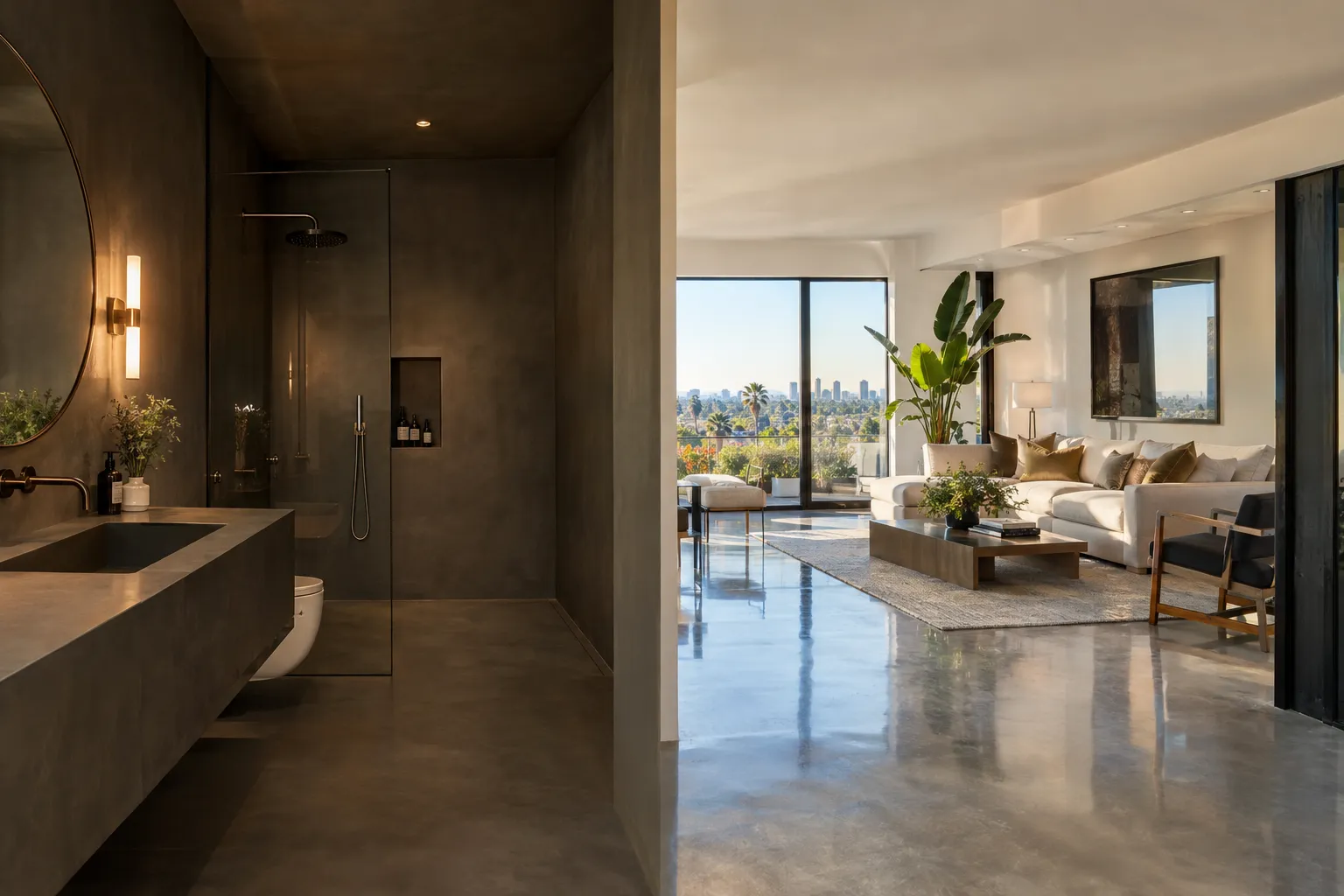
A contractor pulled a 1,100-square-foot sample slab out of a Mar Vista garage last spring, cracked right down the middle from a foundation shift, and the homeowner asked a question we hear every week: should she go with **[microcement](/services/microcement-bathrooms) vs polished concrete** when she redid the floors? The honest answer depends on her slab, her budget, and how much she wants to touch up that crack versus grind the whole thing flat. In [Los Angeles](/areas/los-angeles), where older slabs, hillside foundations, and a lot of mid-century concrete work meet modern renovation budgets, this decision trips up more homeowners than almost any other finish choice.
Both materials give you that seamless, industrial-meets-warm look that's dominated LA interiors since around 2019, but they get there through completely different processes, price points, and long-term maintenance realities. This guide breaks down the real tradeoffs — not the marketing version — so you can pick the right one for your bathroom, kitchen, living space, or [commercial](/services/microcement-commercial-hospitality) build-out.
## What Is Microcement, and How Is It Different From Polished Concrete?
What is microcement? Microcement is a thin mineral-based coating, typically **2-3mm thick**, made of cement, polymer resins, and fine aggregates, applied in multiple layers over nearly any existing surface — tile, concrete, wood subfloor, even drywall with the right prep.
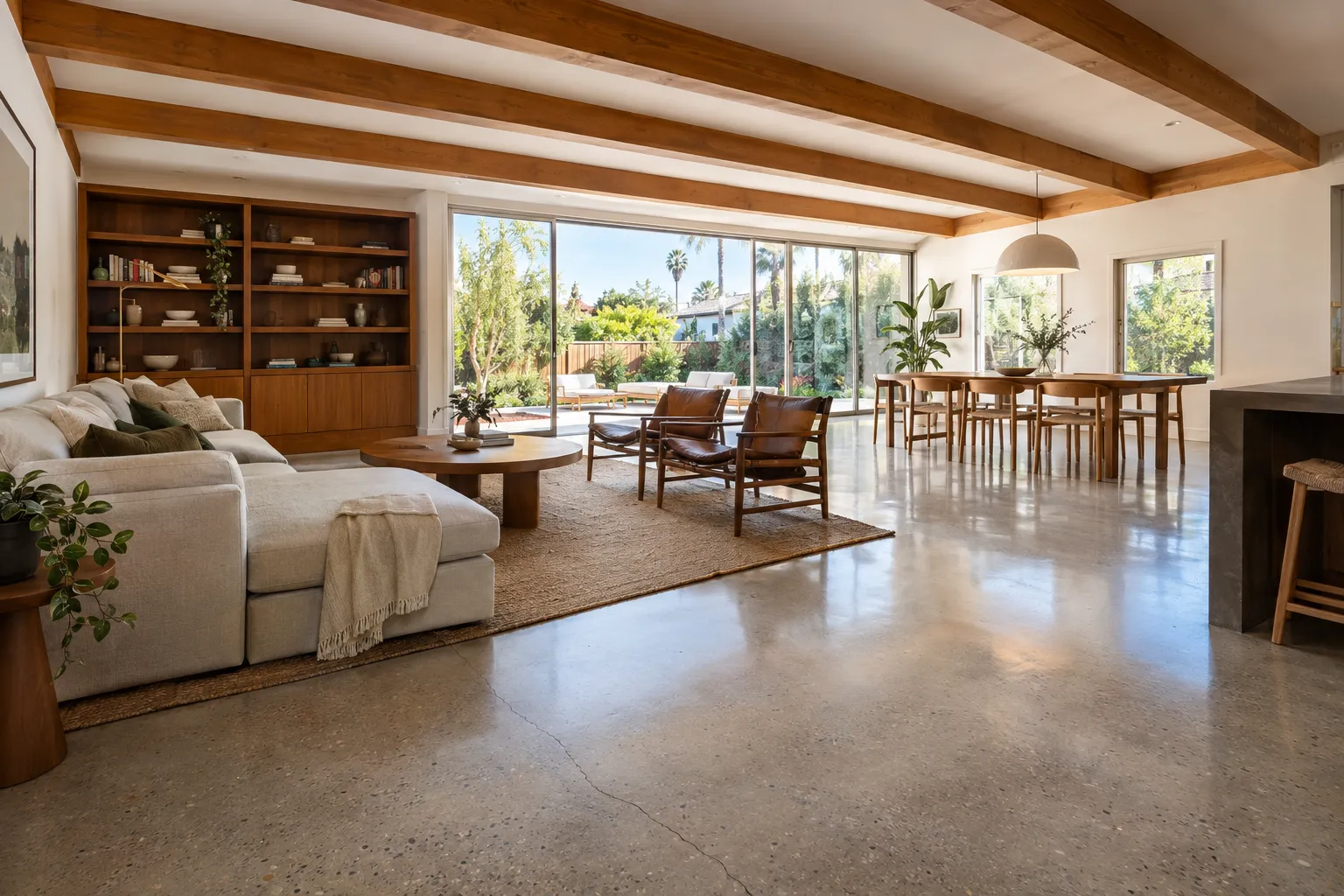
Polished concrete, by contrast, isn't an applied coating at all. It's the existing concrete slab itself, mechanically ground down with diamond abrasives and sealed to a glossy or satin sheen.
That distinction matters more than most homeowners realize going in. Microcement is a renovation material — it layers onto what's already there. Polished concrete is a slab-dependent process — it reveals and refines what's already underneath, flaws included.
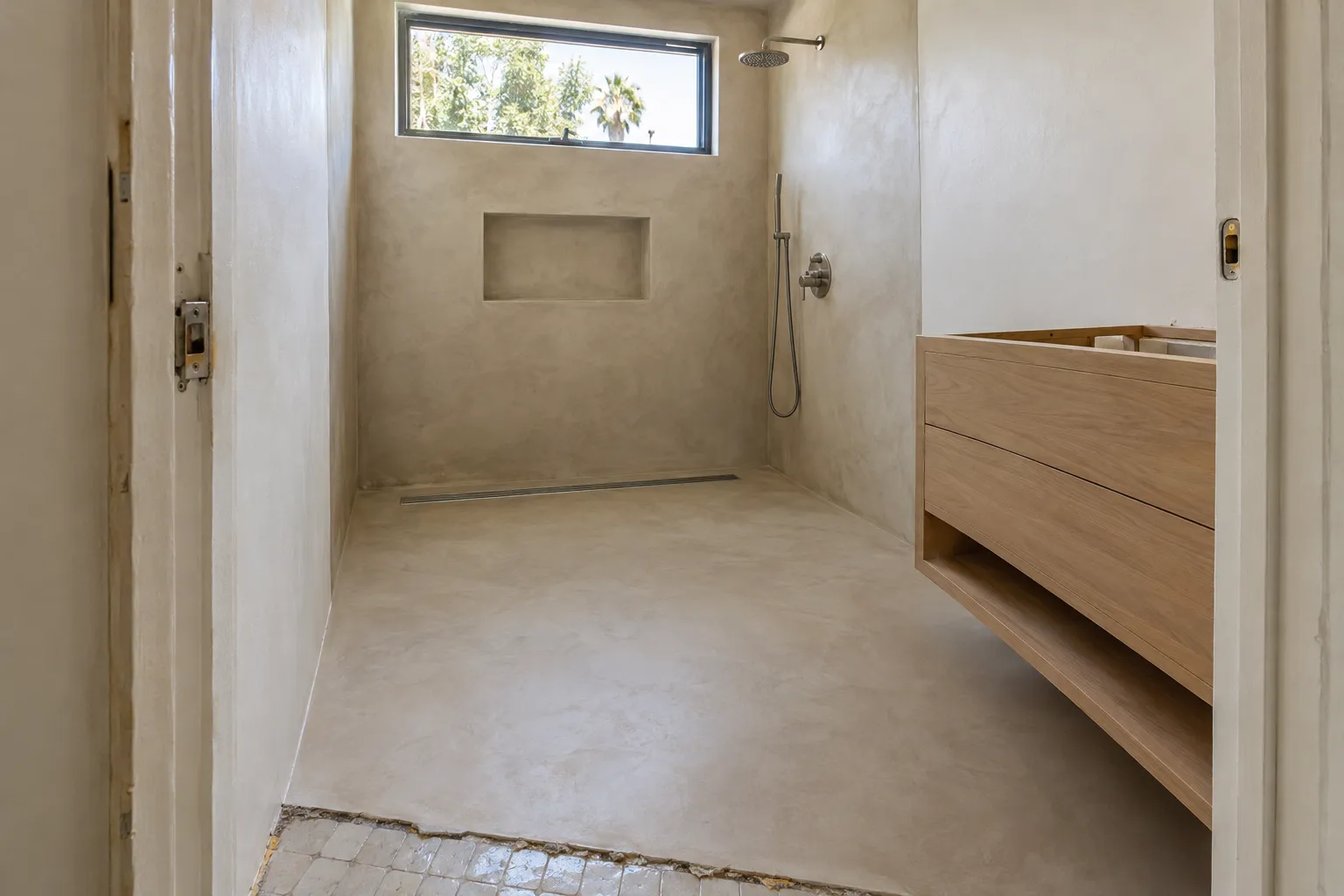
We've had clients in [Pasadena](/areas/pasadena) bungalows assume their 1920s concrete basement floor would polish up beautifully, only to discover after a test grind that the aggregate was inconsistent and pockmarked with old patch repairs. That's a scenario microcement solves cleanly; polished concrete can't fix it.
## [How Much Does](/estimate) Microcement Cost vs Polished Concrete in LA?
Cost is usually the first question, and it's where the two materials diverge the most. Based on Cemora project data across more than 80 Southern California installations since 2023, here's what homeowners are actually paying in 2026.
| Factor | Microcement | Polished Concrete |
|---|---|---|
| Material + labor (per sq ft) | **$18-$35** | **$8-$20** |
| Best suited for | Bathrooms, kitchens, walls, countertops | Garages, large open floors, warehouses |
| Works over existing tile | Yes | No — requires exposed slab |
| Typical 1,000 sq ft project | **$22,000-$32,000** | **$9,500-$18,000** |
| Waterproofing included | Yes, standard | No, requires separate sealant system |
| Repair cost (localized) | $400-$900 per patch | $600-$1,500 (grinding required) |
A homeowner in [Santa Monica](/areas/santa-monica) recently spent **$27,400** microcementing a 900-square-foot primary bathroom, hallway, and adjoining walk-in closet — a job that included full waterproofing membrane work in the wet room. A commercial client in Culver City, by comparison, spent **$14,200** polishing 1,800 square feet of existing warehouse-turned-office slab, because the concrete underneath was already structurally sound and aesthetically workable.
The gap isn't arbitrary. Microcement's labor-intensive, multi-coat application (often 5-7 layered passes including primer, base coats, and sealant) drives cost per square foot higher than a single mechanical grinding and polishing pass. **Industry benchmarks from HomeAdvisor's 2026 TrueCost data show polished concrete averaging 35-45% less per square foot than decorative microcement systems nationally** — a gap that holds roughly true across LA County too.

## Which Material Holds Up Better in LA's Climate and Soil Conditions?
Southern California throws two specific challenges at flooring: seismic shift and extended dry heat that cracks rigid materials over time.
Polished concrete is only as durable as the slab beneath it. If your foundation has hairline settling cracks — common in homes built before 1980 across [Glendale](/areas/glendale) and [Burbank](/areas/burbank) — those cracks will telegraph through the polish, and no amount of sealing prevents that long-term.
Microcement, because it's a flexible, bonded coating rather than the structural slab itself, handles minor substrate movement differently. It won't crack from the same stress the way raw concrete does, though it isn't immune to failure if applied over an unstable or improperly primed substrate.
"We've reworked more than a few DIY microcement jobs where the contractor skipped the fiberglass mesh reinforcement layer," says our lead installer at Cemora. "In LA, skipping that step is asking for hairline cracking within 18 months, especially over subfloors with any flex."
Both materials perform fine in wet environments when properly sealed, but **microcement's waterproofing membrane system** is specifically engineered for wet rooms and showers — something polished concrete alone cannot achieve without an added waterproofing layer underneath, which defeats some of its cost advantage.
## What About Maintenance and Long-Term Wear?
Here's where the two materials are closer than people expect, but not identical.
Microcement needs a fresh sealant reapplication roughly **every 3-5 years** depending on foot traffic, with high-use kitchen floors sometimes needing touch-ups closer to the 3-year mark. The sealant is what gives it stain and water resistance; without it, the mineral surface is porous.
Polished concrete needs resealing on a similar cycle — typically **every 2-4 years** for residential use, more frequently in commercial spaces with heavy foot traffic, like the restaurant and retail builds we see across West LA.
- **Microcement:** resists chipping well, patches blend almost invisibly, slightly softer underfoot
- **Polished concrete:** extremely hard-wearing surface, patches are more visible due to color/grind matching difficulty, colder underfoot without radiant heating
- **Both:** require pH-neutral cleaners only — acidic or abrasive cleaners degrade the sealant on either surface
A 2025 Houzz State of the Industry report found that **62% of homeowners who installed polished concrete in high-traffic kitchens** reported visible wear patterns near entry points within 5 years, compared to a smaller share for well-sealed microcement in similar use cases — underscoring that sealant maintenance discipline matters more than the base material itself.
## Design Flexibility: Where Microcement Pulls Ahead
If you're after a true custom look, this is the category where microcement wins outright.
Microcement comes in **hundreds of custom color formulations** and can be tinted to match anything from warm Venetian plaster tones to cool charcoal industrial finishes. It can also run continuously from floor to wall to countertop — a seamless, grout-free look that's become one of the defining 2026 bathroom trends in LA renovations, especially in [Beverly Hills](/areas/beverly-hills) primary suites where clients want a spa-like, monolithic wet room.
Polished concrete, by contrast, is limited to the natural tone of your existing slab, with some ability to add dye or stain for color variation. You can't run it up a wall or onto a countertop — it's floor-only by nature.
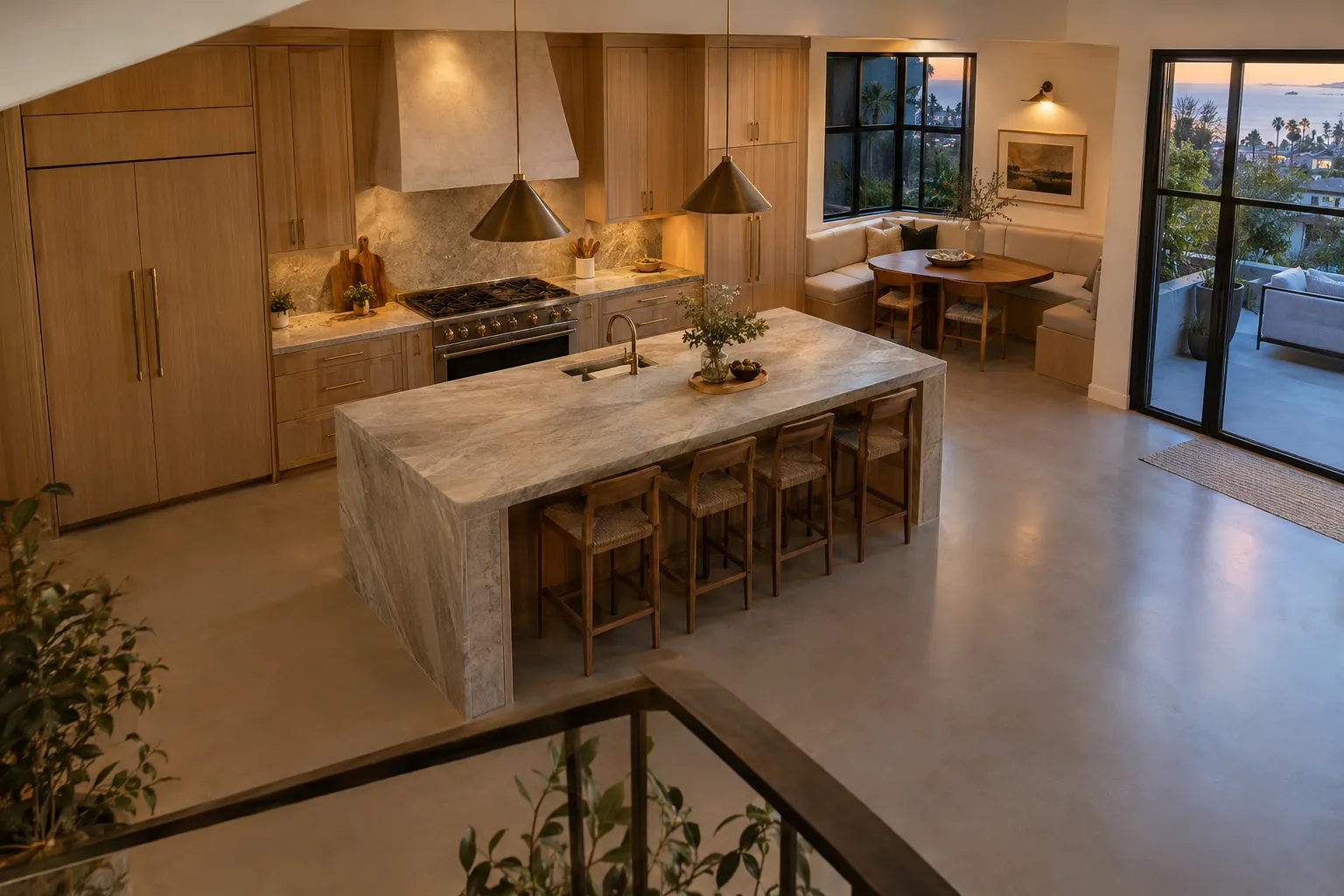
For kitchens specifically, microcement countertops have become a popular alternative to quartz among clients wanting a hand-finished, matte mineral look without seams. Polished concrete simply isn't an option here; it has no vertical or countertop application.

## When Does Polished Concrete Make More Sense Than Microcement?
Polished concrete isn't the lesser option — it's the better one in specific scenarios.
1. **Large commercial or warehouse spaces** where budget per square foot matters more than custom finish — a 5,000 sq ft retail build in Glendale, for example, saved roughly **$65,000** choosing polished concrete over a full microcement system.
2. **Garages and industrial-use areas** where moisture, oil exposure, and heavy equipment traffic call for raw slab durability rather than a coated finish.
3. **New construction with a clean, crack-free slab poured specifically for polishing** — this eliminates the substrate-quality risk entirely.
4. **Projects without plumbing, wall, or countertop integration needs** — if it's floor-only and the slab is in good shape, there's no reason to pay microcement premiums.
A property manager in Pasadena overseeing a 12-unit commercial retrofit chose polished concrete for all common areas (**$11 per sq ft, $38,500 total for 3,500 sq ft**) but used microcement selectively in two ground-floor retail bathrooms (**$24 per sq ft**) where waterproofing and wall continuity mattered. That kind of mixed approach is common in larger [commercial and hospitality microcement](/services/microcement-commercial-hospitality?utm_source=blog&utm_medium=organic&utm_campaign=microcement-vs-polished-concrete-los-angeles) projects we handle across LA County.
## Step-by-Step: How to Decide Between the Two
1. **Assess your existing substrate.** Have a contractor core-sample or inspect your slab for cracking, aggregate consistency, and old patch repairs.
2. **Define the surfaces involved.** If walls, countertops, or shower pans are part of the project, microcement is your only real option.
3. **Set your per-square-foot budget ceiling.** Under $20/sq ft generally points to polished concrete; $20-$35/sq ft opens up microcement.
4. **Consider your timeline.** Polished concrete grinding typically takes **3-7 days** for an average residential space; microcement application runs **7-14 days** due to multi-coat curing time.
5. **Factor in waterproofing needs.** Wet rooms, showers, and kitchens with sink areas lean microcement for integrated waterproofing.
6. **Get both quotes before committing.** A reputable installer will tell you honestly if your slab isn't a good polishing candidate rather than force the sale.
## How Long Does Each Installation Take?
Timeline is often the deciding factor for homeowners juggling renovation schedules.
Polished concrete moves faster because it's a mechanical process on an existing surface — typically **3-7 days** for a residential room, including grinding passes, densifier application, and final polish.
Microcement takes longer due to curing requirements between coats. A standard bathroom runs **7-10 days**; a full kitchen or multi-room floor project can stretch to **10-14 days**, particularly when waterproofing membranes need full cure time before the next layer.
"Rushing the cure time between microcement coats is the single most common cause of callbacks we see in this trade," notes a 2025 Journal of Light Construction piece on decorative concrete finishes — a point that applies directly to why we don't compress our own install schedules even when clients are eager to move back in.
---
## Does Either Material Add Resale Value in LA Homes?
Both finishes read as premium, design-forward upgrades to buyers and appraisers, but they signal slightly different things.
Microcement, especially in bathrooms and kitchens, tends to be associated with recent full renovations — buyers see it and assume updated plumbing and waterproofing behind it, which is often true. Real estate agents across Santa Monica and West LA report that **fully renovated microcement bathrooms can support a 5-8% sale price premium** on comparable listings, consistent with broader 2026 NAHB remodeling impact data on bathroom renovations.
Polished concrete reads more as an architectural or industrial design choice — it performs well in modern/loft-style homes but can feel cold or commercial in a traditional Spanish Revival home common throughout Pasadena and Glendale, where it may actually undersell compared to warmer finishes.
Neither is a guaranteed value-add in isolation; it depends on matching the finish to the home's existing architectural language.
## Frequently Asked Questions
### Is microcement more expensive than polished concrete in Los Angeles?
Yes, generally. Microcement runs **$18-$35 per square foot** installed in the LA market, while polished concrete runs **$8-$20 per square foot**, mainly because microcement involves multiple layered coats and waterproofing membranes rather than grinding an existing slab.
### Can microcement be installed over my existing tile floor?
Yes, that's one of its biggest advantages — microcement bonds directly over existing tile, stone, or old concrete with proper primer prep, which eliminates demolition costs that polished concrete can't avoid since it requires an exposed slab.
### How long does a microcement bathroom installation take?
A standard bathroom typically takes **7-10 days** from prep to final sealant cure, including waterproofing membrane installation for wet rooms and shower areas. Larger or multi-room microcement projects can run **10-14 days** depending on the number of coats and curing conditions.
### Will polished concrete crack in an older LA home?
It can, if the underlying slab already has settling cracks or inconsistent aggregate — polishing reveals those flaws rather than hiding them. This is especially common in homes built before 1980 in areas like Glendale and Pasadena, where original slabs weren't poured with modern reinforcement standards.
### Which option is better for a wet room or walk-in shower?
Microcement is the stronger choice because it includes a dedicated waterproofing membrane system designed for continuous wet exposure across floors and walls. Polished concrete requires a separate sealant system for wet areas and isn't typically used on shower walls at all.
### How often does microcement need resealing?
Most microcement surfaces need resealing every **3-5 years**, though high-traffic kitchen floors sometimes need touch-ups closer to the 3-year mark. Reapplication costs are relatively modest, typically a few hundred dollars for an average bathroom, far less than a full reinstall.
### Does polished concrete cost less over a 10-year period?
Not always — while the upfront install is cheaper, polished concrete in high-traffic residential kitchens shows visible wear patterns sooner, according to 2025 Houzz industry data, which can mean earlier refinishing costs than homeowners expect. Over a decade, total cost of ownership often evens out closer than the initial price gap suggests.
### Can I use microcement on kitchen countertops?
Yes, and it's become increasingly popular in 2026 LA kitchen renovations as a seamless alternative to quartz or stone. It's applied directly over existing countertop substrates and finished with a food-safe sealant, giving a matte, hand-troweled look that polished concrete simply can't replicate on vertical or countertop surfaces.
### Is polished concrete a good fit for a Spanish Revival or older character home?
It depends on the design goal — polished concrete tends to read as modern and industrial, which can feel out of place in traditional Pasadena or Glendale character homes. Microcement, with its warmer tone range and plaster-like finish, often integrates more naturally into older architectural styles while still delivering a contemporary update.
### How much does a typical 1,000 square foot project cost for each material?
Based on Cemora's 2026 project data, a 1,000 square foot microcement installation typically runs **$22,000-$32,000** including waterproofing and multiple finish coats. The same square footage in polished concrete typically runs **$9,500-$18,000**, assuming the existing slab doesn't require significant repair before grinding.
---
If you're staring at a slab or an outdated tile floor trying to decide which direction makes sense, the honest move is to get both materials assessed against your actual substrate and design goals — not just compared on a spreadsheet. We walk LA homeowners through that exact comparison regularly, whether it's a [microcement bathroom and wet room](/services/microcement-bathrooms?utm_source=blog&utm_medium=organic&utm_campaign=microcement-vs-polished-concrete-los-angeles) in Beverly Hills or a full [microcement floors and walls](/services/microcement-floors-walls?utm_source=blog&utm_medium=organic&utm_campaign=microcement-vs-polished-concrete-los-angeles) project spanning a whole first floor in Pasadena.
If you've got a kitchen in the mix too, it's worth looking at [microcement kitchens and countertops](/services/microcement-kitchens-countertops?utm_source=blog&utm_medium=organic&utm_campaign=microcement-vs-polished-concrete-los-angeles) as part of the same renovation to keep finishes consistent room to room.
Want a straight answer on which material fits your space, budget, and timeline? [Get a free estimate](/estimate?utm_source=blog&utm_medium=organic&utm_campaign=microcement-vs-polished-concrete-los-angeles) or [book a consultation](/book?utm_source=blog&utm_medium=organic&utm_campaign=microcement-vs-polished-concrete-los-angeles) and we'll take a look at your actual slab before recommending anything. You can also [reach out with questions](/contact?utm_source=blog&utm_medium=organic&utm_campaign=microcement-vs-polished-concrete-los-angeles) if you're still comparing options for a commercial space.
---
**Ready to start your your project in Los Angeles?** [Book a free consultation](/book?utm_source=blog&utm_medium=organic&utm_campaign=microcement-vs-polished-concrete-los-angeles-which-is-right-for-your-home) — we'll come walk through your space and give you straight numbers, no pressure. Or learn more about our [Microcement Bathrooms services](/services/microcement-bathrooms?utm_source=blog&utm_medium=organic&utm_campaign=microcement-vs-polished-concrete-los-angeles-which-is-right-for-your-home).